
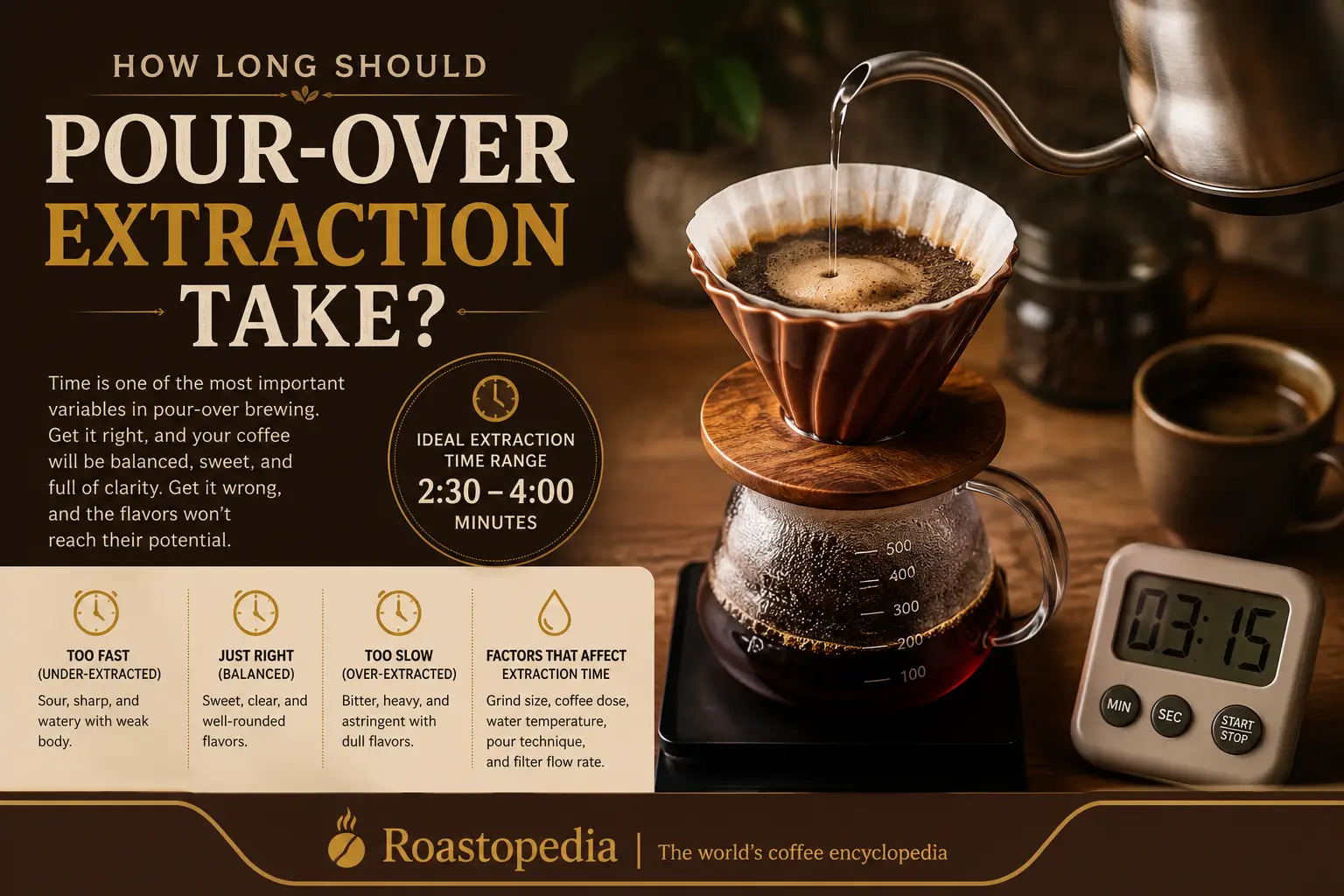
Pour-over extraction typically takes between 2 minutes 30 seconds and 4 minutes, measured from the first pour of water onto the grounds to the moment the last drop drains through the filter. The exact figure a brewer should aim for depends on the device, the grind size, the dose-to-water ratio, and the flavor profile being pursued, but the 2:30–4:00 window is the range most specialty roasters and baristas treat as the working standard for pour-over brewing. This entry explains what extraction time means, why it is treated as a diagnostic rather than a fixed rule, and which variables push it longer or shorter.
Definition
Extraction is the process by which hot water dissolves soluble compounds — acids, sugars, melanoidins, and lipids — out of ground coffee. “Extraction time” refers to the total duration the water is in contact with the grounds, including the initial pre-infusion stage known as the bloom, through to full drawdown. It is one of the core levers, alongside grind size, water temperature, and dose, that determines a brew’s final extraction yield and total dissolved solids (TDS).
Pour-over’s reliance on gravity rather than pressure is what separates it from pulling an espresso shot, which forces water through a compacted puck in roughly 25–35 seconds. Because pour-over water moves through a much looser, gravity-fed bed, contact time is naturally far longer, and small timing differences have an outsized effect on the cup.
The Standard Time Range
Most widely used pour-over devices fall into fairly predictable timing bands:
- V60 (conical, fast-draining): 2:00–3:00 total
- Kalita Wave (flat-bottomed, more even flow): 2:30–3:30 total
- Chemex (thick paper, slower flow): 3:30–4:30 total
- Origami and other hybrid drippers: 2:30–3:30, depending on the paper used
These ranges assume a standard ratio near 1:15–1:17 (coffee to water by weight) and a medium-fine grind. A brew that finishes well under two minutes for a V60, or drags past five minutes for a Chemex, is usually signaling a problem with grind size, agitation, or channeling in the bed rather than a deliberate stylistic choice.
Why Extraction Time Matters
Time is not the goal in itself — it is a proxy for extraction yield, which is the percentage of the ground coffee’s mass that ends up dissolved in the cup. The Specialty Coffee Association’s brewing control chart generally targets 18–22% extraction yield and 1.15–1.35% TDS for a balanced cup, and time is the most practical variable a home brewer can watch and adjust to steer toward that target.
- Under-extraction (brew finishes too fast relative to grind and dose) produces a sour, thin, sometimes salty cup, because the fastest-dissolving compounds (acids) come out first, and the slower-releasing sugars and rounder flavors never fully develop. This is closely tied to why some coffees taste more acidic than others even when the same beans are used with different techniques.
- Over-extraction (brew runs too long) pulls out excessive bitter, astringent, and papery-tasting compounds from deeper in the coffee’s cell structure, muting sweetness and clarity.
Key Variables That Influence Extraction Time
Not everything that happens in coffee brewing affects how extraction time is calculated. The following are the key variables:
Grind Size
Finer grinds increase surface area and slow the flow rate, extending contact time; coarser grinds do the opposite. Grind size is the single biggest lever for adjusting time without changing the recipe, and it directly affects extraction efficiency — a relationship also explored in discussions of how grind size affects caffeine extraction in light roast coffee.
Water Temperature
Hotter water (typically 195–205°F / 90–96°C) extracts more quickly, so brewers sometimes slightly shorten their pour schedule at the top of that range to avoid over-extraction.
Bloom and Degassing
The 30–45-second bloom, where a small amount of water pre-wets the grounds and releases trapped CO₂, is part of total extraction time and exists specifically because coffee requires degassing before brewing — without it, CO₂ escaping mid-pour disrupts even saturation and skews the rest of the timeline.
Pour Technique and Agitation
Slow, controlled pours in stages keep the bed level and extract predictably. Aggressive, fast pouring or excessive stirring speeds up extraction and can shorten the ideal total time by 20–30 seconds.
Roast Level
Darker roasts are more porous and soluble, so they extract faster and often need a coarser grind or shorter time than lighter roasts to hit the same yield — a dynamic covered in more depth under the role of roast level in coffee flavor development and in comparisons of whether light roast coffee has more caffeine than medium roast.
Coffee Freshness
Coffee that has gone stale extracts differently than fresh coffee because it has lost the CO₂ and volatile compounds that normally slow and structure the pour; this is one reason brewers pay attention to whether green coffee goes stale before roasting and how green coffee loses quality during storage, since both affect how predictably a batch will brew once roasted.
Bean Density, Species, and Processing
Denser beans and certain processing methods resist water penetration differently than porous ones, and the species itself matters: Arabica beans generally have a different density and sugar profile than Robusta, which changes how quickly compounds dissolve. Bean surface oils, discussed under why some coffee beans are oily, can also slow water penetration slightly and affect drawdown speed.
Extraction Time vs. Extraction Yield and TDS
Extraction time correlates with — but does not guarantee — a given extraction yield. Two brews with identical total time can land at different yields if grind size, agitation, or bed depth differ. Brewers who take extraction seriously typically use a refractometer to measure TDS, then use time as the day-to-day dial to keep yield in the target band once the recipe is dialed in.
This is part of why the origin and market context of the coffee matters too — a lot on the single-origin coffee market or a lot from a specific coffee belt region can carry a bean density and moisture profile that shifts the ideal timing from bag to bag, which is one reason rare lots such as those explaining why Geisha coffee costs so much more than other coffee often come with roaster-specific brew guides rather than generic timing advice.
Troubleshooting Common Timing Problems
| Symptom | Likely Cause | Fix |
| Drains in under 2:00 (V60) | Grind too coarse, uneven bed, or channeling | Grind finer, pour more gently, ensure even bloom |
| Drags past 4:30 | Grind too fine, over-agitation, or clogged filter | Grind coarser, reduce stirring, rinse filter thoroughly |
| Fast finish but bitter cup | Localized over-extraction from channeling despite short total time | Improve pour technique and bed leveling rather than just cutting time |
| Slow finish but sour/thin cup | Poor saturation early in the brew | Improve bloom, check that all grounds are wetted |
Practical Guidelines
- Start with the standard range for your device (see table above).
- Change only one variable at a time — grind size first, pour technique second.
- Treat time as feedback, not a target: if the cup tastes sour, extend contact time (finer grind); if bitter, shorten it (coarser grind).
- Keep a brew log noting dose, ratio, grind setting, total time, and tasting notes so adjustments are based on data rather than guesswork.
See Also
- How to Pull an Espresso Shot
- The Role of Roast Level in Coffee Flavor Development
- Why Does Fine Grinding Increase Espresso Channeling?
- Why Does Coffee Require Degassing Before Brewing?
- Why Are Some Coffees More Acidic Than Others?
- Does Grind Size Change Caffeine Extraction in Light Roast Coffee?
- Does Light Roast Coffee Have More Caffeine Than Medium Roast?
- Does Green Coffee Go Stale Before Roasting?
References
- Specialty Coffee Association. SCA Coffee Brewing Standards & Best Practices. Specialty Coffee Association, Santa Ana, CA.
- Lingle, T. R. The Coffee Brewing Handbook: A Systematic Guide to Coffee Preparation. Specialty Coffee Association of America, Long Beach, CA.
- Rao, S. Everything but Espresso: Professional Coffee Brewing Techniques. Rao Publications.
- Batali, M. E., Ristenpart, W. D., & Guinard, J.-X. “Brew Temperature, at Fixed Extraction Yield, Has Little Impact on Coffee Flavor.” Scientific Reports, 10, 16450.
- Cotter, J. A., Hendon, C. H., et al. “Predicting Strength and Extraction Yield in Pour-Over Coffee.” Journal of Colloid and Interface Science, 599, 190–199.
- Hendon, C. H., & Colonna-Dashwood, M. Water for Coffee: Science of Water Quality and Composition in Coffee Brewing. Colonna and Small Ltd.
- Hoffmann, J. The World Atlas of Coffee: From Beans to Brewing. Mitchell Beazley.
- UC Davis Coffee Center. “Coffee Extraction and Sensory Science” (research summaries and brewing studies). University of California, Davis.