
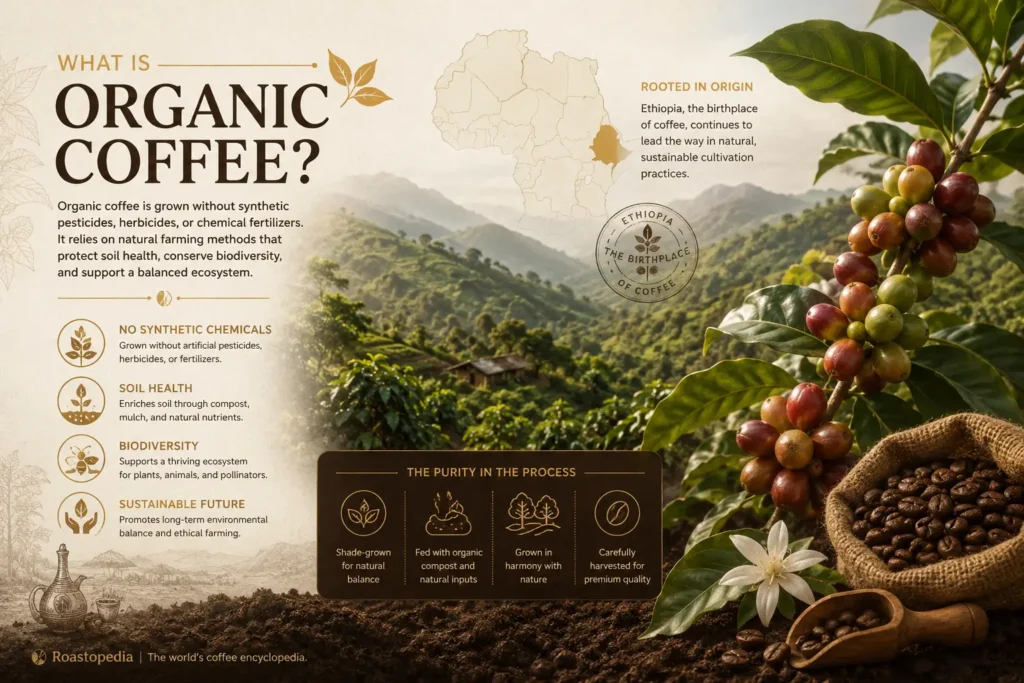
Organic coffee refers to coffee (Coffea arabica, Coffea canephora, and related species) cultivated, processed, and traded under rigorous standards that prohibit the use of synthetic chemical inputs — including synthetic pesticides, herbicides, fungicides, and artificial fertilizers — throughout the entire production chain. Under certified organic systems, growers rely on natural alternatives such as compost, crop rotation, shade management, biological pest controls, and traditional intercropping techniques to maintain soil fertility and manage agricultural threats.
Organic coffee occupies a distinct and growing category within the global coffee industry, commanding premium retail prices and attracting a consumer base increasingly motivated by health, environmental, and ethical considerations. The product is distinguished from conventionally grown coffee not only by its farming inputs but also by a mandatory chain-of-custody certification that extends from the farm through milling, export, import, roasting, and retail packaging — each link in the supply chain must carry its own organic accreditation for the final product to bear an official organic label.
As of 2024, the global organic coffee market was valued at approximately USD 9.9 billion and is projected to reach USD 20.0 billion by 2033, expanding at a compound annual growth rate (CAGR) of approximately 7.7%–8.0%, according to analyses by IMARC Group and Straits Research. North America represented the largest single regional market in 2024, accounting for approximately 51.8% of global sales, while the Asia-Pacific region registered the fastest growth trajectory.
Definition
The term “organic coffee” carries a legally defined meaning in most major consuming markets. In the United States, the authoritative definition is established by the National Organic Program (NOP), a federal regulatory framework administered by the USDA Agricultural Marketing Service. Under NOP rules, a product may be labeled “Certified Organic” only when at least 95% of its agricultural ingredients are certified organic; a product labeled “100% Certified Organic” must contain exclusively certified organic ingredients.
At the international level, the FAO/WHO Codex Alimentarius Commission provides guidelines for the production, processing, labeling, and marketing of organically produced foods, offering a global reference standard that many national regulatory bodies adapt. The European Union maintains its own organic regulation (EU 2018/848), while Japan operates under the Japanese Agricultural Standard (JAS) for Organic Agricultural Products.
Each of the following three U.S. labeling categories carries different legal obligations:
- 100% Certified Organic: All agricultural ingredients are certified organic. Eligible for the USDA Organic seal.
- Certified Organic (or “USDA Organic”): A minimum of 95% of agricultural ingredients are certified organic. Eligible for the USDA Organic seal.
- Made with Organic: Contains at least 70% certified organic ingredients. Not eligible to display the USDA Organic seal; may state “Made with Organic [ingredient]” on front label.
Use of the unqualified word “organic” on packaging without an official seal and without a named USDA-accredited certifying agent is not strictly regulated by federal law, leaving room for ambiguity in the marketplace that consumer advocates and researchers have frequently flagged.
Origin & History
Pre-Certification Era
Coffee cultivation predates any formal concept of organic agriculture by several centuries. The earliest documented cultivation of Coffea arabica occurred in the mountainous regions of Yemen during the 15th century, with the plant’s original habitat traced to the highlands of Ethiopia. For the majority of the crop’s cultivated history — from its spread across the Arabian Peninsula and into the Ottoman Empire and Europe, through its transplantation to the Americas and Asia during colonial expansion — coffee was grown by default under what would today be recognized as organic practices: no synthetic chemicals yet existed, and traditional polyculture systems, shade canopy, and natural soil management predominated.
The Industrial Revolution and the subsequent development of synthetic nitrogen fertilizers (most notably through the Haber-Bosch process, commercialized circa 1913) and organochlorine pesticides (introduced widely after World War II) fundamentally altered global agriculture. Coffee farming progressively adopted these chemical inputs throughout the 20th century, particularly as the International Coffee Agreement and commodity price pressures incentivized monoculture sun-grown systems optimized for volume over ecological complexity.
The Modern Organic Movement and Coffee
The formal organic agriculture movement emerged in Europe in the early 20th century, with foundational contributions from Sir Albert Howard (whose 1940 text “An Agricultural Testament” codified composting and soil biology principles) and Rudolf Steiner (whose 1924 lecture series gave rise to biodynamic agriculture). These movements laid the philosophical and agronomic groundwork for what would later become certified organic production.
The first U.S. company documented as selling certified organic coffee was Cafe Altura, based in California, which began marketing organic coffee in 1980, marking an early commercial milestone in the category. During the 1980s, the domestic organic food movement gained significant momentum, though regulatory definitions remained fragmented and inconsistent across states.
Regulatory Formalization: 1990–2002
The pivotal legislative moment for organic coffee in the United States was the passage of the Organic Foods Production Act (OFPA) by the U.S. Congress in 1990. The OFPA mandated the creation of the National Organic Program and charged the USDA with developing uniform federal standards for organic production.
However, the formal NOP standards were not fully enacted and implemented until 2002, a gap of twelve years during which the industry operated under transitional and state-level frameworks.
Concurrently, international standard-setting bodies — including IFOAM (the International Federation of Organic Agriculture Movements, founded in 1972) — worked to harmonize global definitions. The Codex Alimentarius Commission adopted its first Guidelines for the Production, Processing, Labelling and Marketing of Organically Produced Foods in 1999 (CAC/GL 32-1999), providing an internationally recognized reference point for trade.
Third Wave and Market Mainstreaming: 2000s–Present
The emergence of the Third Wave coffee movement from the early 2000s onward created a receptive consumer culture for transparency, traceability, and ethical sourcing. Organic certification increasingly converged with complementary certifications such as Fair Trade, Rainforest Alliance, and the Smithsonian Bird Friendly seal. The U.S. organic coffee market in 2024 was projected to reach USD 2.8 billion by 2030, with an anticipated CAGR of 9%, according to the Organic Trade Association and Grand View Research.
Certification Standards and Bodies
USDA National Organic Program (NOP)
The USDA NOP constitutes the primary certification framework for organic coffee sold in the United States. To achieve NOP certification, farmland must demonstrate the absence of all prohibited substances for a minimum of three years immediately preceding the first certified harvest.
Prohibited inputs include most (though not all) synthetic pesticides, synthetic herbicides, and synthetic nitrogen, phosphate, and potash fertilizers. Exemptions may be granted for certain listed substances, which critics have noted introduces complexity and occasional inconsistency into what consumers may perceive as an absolute prohibition.
Certification is administered not directly by the USDA but through USDA-accredited third-party certifying agents — private organizations contracted to inspect and audit producers, processors, and handlers. For a roasted coffee bearing the USDA Organic seal, every entity in the supply chain — the farm, the cooperative or wet mill, the export processor, the green coffee importer, and the roaster — must independently hold organic certification issued by an accredited agent.
Roasters must segregate organic coffee from non-organic coffee throughout roasting, grinding, and packaging to prevent commingling; failure to do so legally disqualifies the product from organic labeling even if the green beans were fully certified.
The annual cost of certification ranges from several hundred to several thousands of dollars in fees alone, excluding the operational costs of transitioning to organic-compliant methods. For smallholder farmers cultivating plots of one hectare or less, this financial burden is frequently prohibitive. Cooperatives may hold umbrella certification on behalf of member smallholders, allowing cost-sharing, but the cooperative’s entire certification is jeopardized if any individual member fails compliance.
EU Organic Regulation (EU 2018/848)
The European Union’s organic regulation, which took effect in January 2022, governs the production, labeling, and control of organic products within the EU and for products imported into the EU market. Coffee imported into the EU for sale as organic must comply with EU standards and carry the EU Organic Logo. Third-country producers may gain EU recognition either through equivalence agreements or through direct certification to EU standards.
Other Major Certification Schemes
- Rainforest Alliance Certified: Formed by the 2018 merger of the Rainforest Alliance and UTZ Certification, this is the world’s largest sustainable coffee and cocoa certification program. It incorporates environmental, social, and economic sustainability criteria; organic certification is not a prerequisite.
- Smithsonian Bird Friendly: Administered by the Smithsonian Migratory Bird Center, this certification requires farms to be certified organic as a baseline and additionally meet specific shade canopy standards for height, diversity, and density — making it one of the most stringent environmental certifications in the coffee sector.
- Fair Trade Certified: Focuses on equitable pricing and social standards for smallholder cooperatives; organic certification is not required but is commonly held simultaneously, often described as “organic Fair Trade” coffee.
- California Certified Organic Farmers (CCOF): A U.S.-based nonprofit USDA-accredited certifier operating in California and internationally, maintaining inspection and compliance records for member organic operations.
Cultivation and Processing
Growing Conditions
Organic coffee is predominantly grown in tropical and subtropical highland regions lying between the Tropics of Cancer and Capricorn — commonly referred to in the industry as the “Coffee Belt or the Bean Belt” Major producing countries include Ethiopia, Colombia, Peru, Mexico, Honduras, Guatemala, Nicaragua, India, and Indonesia.
Within this zone, elevations of 1,000–2,000 meters above sea level are associated with slower bean maturation, greater sugar development, and more complex flavor profiles — attributes that dovetail with the typically slower-growing organic cultivation paradigm.
Organic coffee farms commonly employ shade-grown or agroforestry systems, in which coffee plants grow beneath a diverse canopy of native or managed tree species. This practice reduces soil temperature, retains soil moisture, reduces erosion, provides natural leaf-litter fertilization, and creates habitat corridors for migratory bird species and beneficial insects — factors that contribute to natural pest regulation.
The USDA NOP and FAO Codex standards do not mandate shade-grown cultivation for organic certification, but the overlap between organic farms and shade-grown systems is well documented in the agronomic literature.
Soil Management
Organic fertility management relies on biologically available nutrient sources rather than synthetic inputs. Approved organic fertilizers include compost derived from plant and animal matter, coffee pulp (the outer layer of the coffee cherry, which is returned to the soil as a nitrogen-rich amendment), cattle manure, chicken manure, biochar-amended organic soil treatments, and bocashi (a fermented organic fertilizer).
The three primary macronutrients required by Coffea species — nitrogen, phosphorus, and potassium — must be supplied entirely through such organic sources. Organic fertilizers have been documented to reduce bulk soil density and improve long-term soil fertility relative to synthetic inputs, which can degrade soil structure over repeated application cycles.
Pest and Disease Management
The primary biotic threats to coffee in organic production systems include the coffee berry borer (Hypothenemus hampei), coffee leaf rust (Hemileia vastatrix), and various root nematode species. Organic pest management strategies include biological controls (introduction of predatory fungi such as Beauveria bassiana for the coffee berry borer), shade canopy management to reduce rust-favorable humidity, varietal selection of rust-resistant cultivars, crop diversity and intercropping to reduce monoculture vulnerability, and carefully timed harvesting to reduce residual berry populations.
A significant point of controversy in the organic coffee sector is that outbreaks of coffee leaf rust — which devastated Central American crops in 2012–2013 — can threaten the viability of organic production for smallholders who lack access to approved fungicides effective enough to prevent crop losses that may span three to four growing seasons.
Processing Methods
Organic coffee beans may be processed through any of the established coffee processing methods — washed (wet process), natural (dry process), honey process, or anaerobic fermentation — provided that all processing equipment, water, and any added agents comply with organic standards. Processing facilities must be separately certified if they handle both organic and conventional coffees and must implement documented cleaning protocols between lots to prevent commingling.
Decaffeinated organic coffee must employ decaffeination methods approved under relevant organic standards; carbon dioxide (CO₂) and water-process decaffeination are the methods most compatible with organic certification requirements, as solvent-based methods using methylene chloride are prohibited.
Benefits
Environmental Benefits
Organic coffee farming is widely associated with a range of environmental advantages relative to conventional production:
- Soil Health: The prohibition of synthetic fertilizers and the mandate to use composted organic matter have been documented to improve soil microbial diversity, increase organic carbon content, and reduce bulk density over time.
- Biodiversity: Shade-grown organic farms frequently support higher avian species richness and diversity than sun-grown conventional plantations, a finding supported by studies published by the Smithsonian Migratory Bird Center.
- Water Quality: The absence of synthetic herbicide and pesticide runoff in organic systems reduces the contamination of surface water and groundwater in coffee-growing watersheds.
- Carbon Sequestration: Agroforestry systems common in organic coffee production sequester atmospheric carbon in biomass and soil organic matter at rates typically exceeding those of sun-grown monoculture systems.
- Reduced Chemical Exposure: Farm workers on organic coffee operations are not exposed to the synthetic agrochemicals documented at conventional farms — including organophosphate pesticides linked to neurological and developmental health impacts in occupational exposure studies.
Health Benefits
Research into the health properties of organic coffee relative to conventional coffee continues to develop, and absolute claims of superiority remain contested in the scientific literature. Nonetheless, the following findings and observations are documented:
- Antioxidant Content: Organic coffee contains antioxidants including chlorogenic acid, quinides, and melanoidins. A study conducted at Warsaw University found that organic coffee samples exhibited statistically significantly higher antioxidant measures than conventional samples under controlled conditions, though the authors cautioned against generalizing this finding across all organic coffees, as results vary by origin and processing conditions.
- Reduced Pesticide Residue: Studies have documented that organic food products, including coffee, tend to contain measurably lower levels of synthetic pesticide residues than conventional counterparts. Conventional coffee is among the most heavily treated agricultural crops globally, with estimates of up to 250 pounds of agrochemicals applied per acre in high-input conventional systems.
- Polyphenol Profile: Some research suggests organic production conditions may be associated with higher concentrations of certain phenolic compounds, possibly because plants relying on endogenous defense pathways (in the absence of synthetic protection) may upregulate secondary metabolite production.
- General Coffee Health Associations: Broad observational and clinical research has associated regular coffee consumption with a reduced risk of type 2 diabetes, Parkinson’s disease, Alzheimer’s disease, liver disease, and certain cardiovascular outcomes. These associations apply to coffee broadly and are not yet established specifically and exclusively for organically produced coffee.
Economic and Social Benefits
Organic certification provides access to specialty and premium market channels that typically offer price premiums above the commodity floor. For smallholder cooperatives in producing countries such as Peru, Honduras, and Ethiopia, organic certification — particularly when combined with Fair Trade status — can improve farmer income stability and enable reinvestment in farm infrastructure and community development. The premium also creates incentives for long-term land stewardship, as the three-year transition period and ongoing certification requirements encourage sustained commitment to soil health.
Speculations and Controversies
The organic coffee category is subject to ongoing scholarly, regulatory, and industry debate across several dimensions:
The Organic Premium and Smallholder Equity
While organic certification is marketed partly as a mechanism for improving farmer livelihoods, critics have documented that the certification system itself creates substantial burdens for the smallholder farmers most in need of economic support.
Annual certification fees, the cost of transitioning to organic methods, the three-year waiting period before the first certified harvest can be sold at organic prices, and the risk of losing entire crops to unchecked disease during this period have led observers to question whether the benefits of organic premiums accrue equitably to producers.
The former vice-chair of the U.S. National Organic Standards Board has stated on the record that “Organic labels are not statements regarding the healthiness, nutritional value, or overall safety of consuming such products,” underscoring the gap between consumer perception and regulatory intent.
Flavor and Quality Equivalence
Whether organic coffee is inherently superior in cup quality to conventionally grown coffee remains a matter of active debate. Because regulatory requirements preclude growing organic and conventional coffee side by side on the same farm, direct controlled comparisons are methodologically difficult to conduct.
Some specialty roasters and Q Graders have noted that the slower growth associated with organic shade-grown systems can concentrate sugars and develop more complex flavor profiles; others contend that soil health, altitude, varietal selection, and post-harvest processing are more determinative of cup quality than whether the crop was organically certified.
Certification Integrity and “Organic Washing”
Consumer advocates and investigative journalists have periodically flagged concerns about the integrity of the organic supply chain, particularly for coffee imported from countries with limited regulatory infrastructure. Because third-party certifying agents vary in their rigor and because the USDA does not directly inspect overseas farms, systemic gaps in verification have been identified.
Fraudulent organic labeling — marketing conventionally grown coffee as certified organic — has been documented in high-profile U.S. Department of Justice and USDA enforcement actions.
Yield Gaps and Food Security Implications
Organic farming systems typically produce lower per-hectare yields than optimized conventional systems — a yield gap estimated at 19–25% across agricultural crops in meta-analyses. In the context of a global coffee industry already under stress from climate change, crop disease, and demographic shifts in producing regions, the yield implications of wide-scale organic conversion have prompted debate about trade-offs between environmental sustainability and supply adequacy.
Variations and Product Forms
Organic coffee is available across a wide range of product formats and specialty subcategories:
By Bean Species
- Organic Arabica (Coffea arabica): Commands approximately 65.98% of organic coffee market share as of 2024. Prized for its complex aroma, lower caffeine content, and sweet-to-acidic flavor spectrum. Predominantly grown at higher elevations in Latin America, East Africa, and parts of Asia.
- Organic Robusta (Coffea canephora): Projected to be the fastest-growing organic segment by CAGR (10.87%) through 2030. Higher caffeine, earthier and more bitter profile; increasingly used in certified organic espresso blends.
By Processing Method
- Organic Washed (Wet Process): Fruit removed before drying; clean, bright cup profile favored in specialty markets.
- Organic Natural (Dry Process): Cherry dried whole; fruit-forward, winey, or fermented notes; common in Ethiopian organics.
- Organic Honey Process: Intermediate method with partial mucilage retained during drying; balance of sweetness and clarity.
- Organic Anaerobic Fermentation: Emerging processing innovation; beans fermented in sealed, oxygen-deprived tanks before drying; produces distinctive flavor compounds.
By Roast Level
- Light Roast Organic: Preserves origin characteristics; higher chlorogenic acid content (antioxidants decrease with roast progression); prominent in Third Wave specialty offerings.
- Medium Roast Organic: Dominant commercial segment, holding approximately 51.20% of the organic coffee market share by roast level.
- Dark Roast Organic: Reduced antioxidant content compared to lighter roasts; preferred in espresso blends; common in mass-market organic offerings.
By Product Format
- Organic Whole Bean: Primary format for specialty and artisan retail; consumer grinds immediately before brewing.
- Organic Ground Coffee: Led the organic coffee market by product type in 2024 with a 34.87% revenue share.
- Organic Pods/Capsules: Fastest-growing format segment with a projected CAGR of 11.24% through 2030; innovations include home-compostable pod systems (introduced commercially in 2024 by operators such as Artizan Coffee Roasters and Muskoka Roastery).
- Organic Ready-to-Drink (RTD): Growing convenience segment; includes organic cold brew in canned formats (e.g., Chameleon Organic Coffee’s 8 oz. RTD cold-brew line launched in 2024 in nitro black, double espresso, sweetened black, and flat white variants).
- Organic Decaffeinated Coffee: Subject to organic-compliant decaffeination methods (CO₂ or Swiss Water Process); a stable niche segment with peak search interest recorded in June 2025.
- Organic Mushroom Coffee: Emerging functional beverage category combining certified organic coffee with adaptogenic mushroom extracts (lion’s mane, chaga, reishi); USDA Organic Mushroom Coffee Capsules introduced commercially by Artizan Coffee Roasters in June 2024.
Adaptations and Innovations
Regenerative Organic Certification (ROC)
Building upon the baseline of USDA Organic, Regenerative Organic Certification (ROC) — developed by the Regenerative Organic Alliance and launched in 2018 — sets higher-tier standards encompassing soil health, animal welfare, and social fairness. In the coffee sector, it has been adopted by producers and roasters seeking to differentiate beyond conventional organic claims.
In February 2025, Artigiano (Canada) completed its acquisition of Salt Spring Coffee, establishing itself as the only organic coffee roaster in Canada sourcing ROC-certified beans.
Biodynamic Coffee
Biodynamic agriculture, rooted in Rudolf Steiner’s 1924 Agricultural Course, incorporates organic principles within a holistic systems framework that uses lunar and astrological planting calendars, biodynamic preparations (fermented herbal and mineral compounds), and a closed-loop farm ecosystem approach.
Biodynamic certification in the coffee sector is administered by Demeter International. Biodynamic coffee qualifies as organic under USDA NOP standards and is generally positioned as a premium tier above standard organic.
Organic Cold Brew and RTD Innovation
The proliferation of ready-to-drink coffee formats has created a rapidly expanding channel for organic coffee products. In 2024, cold brew RTD products made with certified organic beans became widely available in mainstream retail alongside specialty channels. The integration of organic certification with nitrogen-infused dispensing technology (nitro cold brew) has enabled premium positioning in the convenience segment.
Agroforestry and Climate Adaptation
Advances in sustainable farming, particularly agroforestry and climate-adaptive intercropping, are being integrated into organic coffee systems as a response to climate change. The Asian Development Bank’s 2024 provision of a USD 100 million loan to ECOM Agroindustrial Corporation to develop climate-resilient coffee value chains across India, Indonesia, Papua New Guinea, and Vietnam — supporting over 62,000 smallholder farmers — illustrates the scale of institutional investment in adapting organic and sustainable coffee production to shifting growing conditions.
Comparative Analysis: Organic Coffee vs. Conventional Coffee
| Feature / Attribute | Organic Coffee | Conventional Coffee |
| Farming Method | No synthetic pesticides, herbicides, or fertilizers; natural inputs only | Synthetic chemicals, herbicides, pesticides, and fertilizers routinely used |
| Certification Required | Yes — USDA NOP, EU Organic, or equivalent body (third-party audited) | No certification required; standard agricultural regulations apply |
| Soil Management | Crop rotation, compost, cover crops; soil health is a primary concern | Conventional tillage and synthetic soil amendments; soil health secondary |
| Pesticide Residue on Bean | Minimal to none; no synthetic pesticide application permitted | Potential residue from the estimated 200–250 lbs of agrochemicals per acre |
| Shade-Grown Practice | Common; organically managed farms frequently use shade canopy | Less common; sun-grown monoculture prevalent for higher yield |
| Biodiversity Impact | Positive; promotes habitat for birds, insects, and native plants | Negative; monoculture and chemicals reduce surrounding biodiversity |
| Carbon Footprint | Lower; no synthetic fertilizer production; organic matter sequesters carbon | Higher; synthetic fertilizer production is energy-intensive |
| Antioxidant Profile | Research suggests higher phenolic/antioxidant content under certain conditions | Variable; may be lower due to high-input growing conditions |
| Flavor Profile | Often described as cleaner, more complex; slower growth may deepen flavors | Consistent; high-yield varieties prioritized; flavor can be less nuanced |
| Price to Consumer | Premium priced; typically 20–50% higher than conventional counterparts | Lower; economies of scale and higher yields reduce per-unit cost |
| Farmer Income | Potential premium and certification access to specialty markets | Standard commodity pricing; subject to volatile global coffee prices |
| Certification Cost | Hundreds to thousands of dollars annually; burdensome for smallholders | No certification cost; accessibility higher for small-scale farmers |
| GMO Use | Prohibited under all organic certification standards | Permitted in some jurisdictions; few GM coffee varieties are commercially grown |
| Water Pollution Risk | Low; organic inputs do not generate the runoff contamination of synthetics | Higher; synthetic runoff can contaminate waterways and groundwater |
| Market Availability | Growing; major retailers, specialty cafés, and online channels carry it | Ubiquitous; dominant in mass-market retail and foodservice globally |
The Future of Organic Coffee
The organic coffee sector is positioned for sustained expansion through the remainder of the 2020s and into the 2030s, driven by several converging forces:
Market Growth and Consumer Demographics
Millennials and Generation Z consumers — who represent the primary growth demographic in specialty and premium coffee markets — have demonstrated statistically higher rates of willingness to pay price premiums for organic, sustainably sourced, and ethically certified products. Market research conducted by the Center for the Promotion of Imports found that 19% of German consumers in 2024 expressed willingness to pay premium prices specifically for organic-certified coffee, with similar trends reported across Western European and North American markets.
Climate Resilience and Agroforestry
Climate change projections for the primary coffee-growing regions — including significant reductions in suitable cultivable land area in Central America, East Africa, and parts of Southeast Asia by 2050 — have elevated the urgency of climate-adaptive farming practices.
Agroforestry systems, which are frequently associated with organic production, have been identified in climate adaptation research as providing greater microclimate buffering, soil moisture retention, and ecological resilience than sun-grown monocultures.
Advances in regenerative agriculture techniques, biochar soil amendments, and precision agroforestry are expected to improve both the sustainability and productivity of organic coffee systems.
Certification Evolution and Technology
Blockchain-based supply chain traceability systems are increasingly being piloted by specialty coffee companies to provide verifiable, tamper-resistant records of organic certification status from farm to cup. These systems address long-standing consumer and regulatory concerns about the integrity of organic labeling across complex, multi-country supply chains. Satellite monitoring of farm canopy, land use, and agrochemical application is also emerging as a supplementary tool for remote verification between in-person audits.
Product Innovation
The organic coffee market is expected to witness continued product diversification through the incorporation of functional ingredients (adaptogens, superfoods, plant-based milk alternatives in RTD formats), expansion of single-origin and micro-lot offerings, and the development of eco-friendly compostable or infinitely recyclable packaging formats that align with the values of organic coffee consumers.
Regulatory Developments
In the European Union, the EU Deforestation Regulation (EUDR), which entered enforcement in 2025, requires that coffee (among other regulated commodities) sold in the EU market be demonstrated not to have been produced on land deforested after December 31, 2020. This regulation effectively raises the due diligence bar for all coffee importers and is expected to increase the documentation and traceability infrastructure that will secondarily benefit organic certification frameworks.
See Also
- Single-Origin Coffee
- Estate Coffee
- Green Coffee
- Selective Picking
- Strip Picking
- Coffea arabica (Arabica)
- Coffea canephora (Robusta)
- Coffee Processing Methods
- Roastery
References
- United States Department of Agriculture – Agricultural Marketing Service. (2002, 2024). National Organic Program (NOP): Regulations and Guidance. Washington, D.C.: USDA AMS. https://www.ams.usda.gov/about-ams/programs-offices/national-organic-program
- U.S. Congress. (1990). Organic Foods Production Act of 1990 (OFPA), Title XXI of the Farm Bill (P.L. 101-624). Washington, D.C.: Government Publishing Office.
- FAO/WHO Codex Alimentarius Commission. (1999, revised 2013). Guidelines for the Production, Processing, Labelling and Marketing of Organically Produced Foods (CAC/GL 32-1999). Rome: FAO/WHO.
- Howard, Sir Albert. (1940). An Agricultural Testament. Oxford: Oxford University Press. [Foundational text in organic agronomy; cited in organic certification history literature.]
- Café Imports. (2020, November 11). A Series about Certifications, Part 1 – Organics. Minneapolis: Café Imports. https://www.cafeimports.com/europe/blog/2020/11/11/a-series-about-certifications-part-1-organics/
- IMARC Group. (2024). Organic Coffee Market: Global Industry Trends, Share, Size, Growth, Opportunity and Forecast 2025–2033. IMARC Group Research Reports. https://www.imarcgroup.com/organic-coffee-market
- Straits Research. (2025). Organic Coffee Market: Size, Competitors, Trends & Forecast 2025–2033. Straits Research Industry Reports. https://straitsresearch.com/report/organic-coffee-market
- Worldhealth.net / Warsaw University Research Reference. (2026, March 12). The Science Behind Antioxidants and Organic Coffee. https://worldhealth.net/news/science-behind-antioxidants-organic-coffee/
- National Center for Biotechnology Information – PMC. (2024). Coffee as a Source of Antioxidants and an Elixir of Youth. National Library of Medicine. https://www.ncbi.nlm.nih.gov/pmc/articles/PMC11939571/
- Wikipedia – Organic Coffee. (Revised February 2026). Organic coffee. Wikimedia Foundation. https://en.wikipedia.org/wiki/Organic_coffee
- Genuine Origin Blog. (2025, October 17). The Roasters’ Guide to Coffee Certifications. Genuine Origin. https://blog.genuineorigin.com/2025/07/the-roasters-guide-to-coffee-certifications/
- Café Altura. (2021, March 3). Certification History of Organic Coffee. Ventura, CA: Café Altura. https://cafealtura.com/certification-history-organic-coffee/
- Asian Development Bank. (2024). ADB Provides USD 100 Million Loan to Boost Climate-Resilient Coffee Value Chains. Manila: ADB. https://www.adb.org [as cited in Mordor Intelligence, 2025]
- Smithsonian Migratory Bird Center. (n.d.). Bird Friendly Coffee Certification Standards. Washington, D.C.: Smithsonian Institution. https://nationalzoo.si.edu/migratory-birds/bird-friendly-coffee
- Organic Trade Association. (2024). U.S. Organic Sales Data. Washington, D.C.: OTA. [Referenced in Grand View Research and Genuine Origin Blog, 2025]