
The drying phase is the initial thermodynamic stage of the coffee roasting process, characterized by the endothermic absorption of heat and the evaporation of internal moisture from the green coffee seed.
This period begins the moment raw beans are introduced into the heated roasting chamber and typically concludes when the internal moisture content has stabilized and the beans transition from a green to a pale yellow or “hay-like” color.
In the context of industrial food science, this phase is recognized as a critical period of physical preparation where the cellular matrix of the bean is softened and hydrated to facilitate the complex chemical reactions that follow.
While the most visible transformations occur later, the efficiency and uniformity of the drying phase determine the structural integrity and flavor potential of the final product.
Thermodynamic Fundamentals
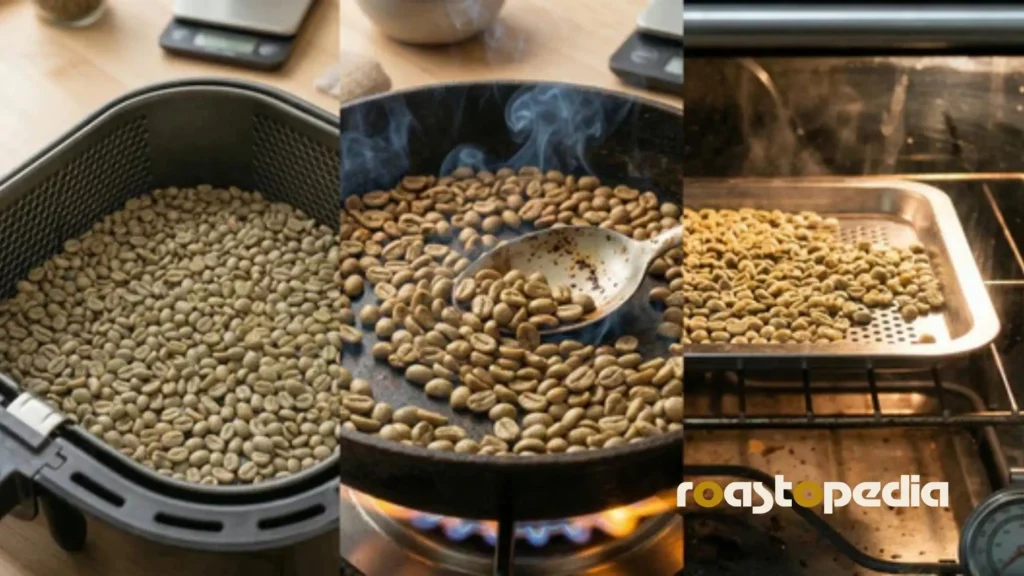
The drying phase is defined by its endothermic nature, meaning the coffee beans actively absorb thermal energy from the roasting environment to facilitate the phase change of water from liquid to vapor. When green coffee—which typically possesses an initial moisture content of 8% to 12%—is charged into a drum, the temperature of the roasting environment drops sharply as energy is transferred to the cooler seeds.
This heat transfer is a combination of conduction from the heated metal surfaces and convection from the circulating hot air. The primary thermodynamic objective during this period is to raise the internal temperature of the bean mass uniformly while preventing surface scorching.
During this stage, the water within the bean acts as a thermal buffer, absorbing significant amounts of energy through the latent heat of vaporization. This internal moisture is essential for conducting heat into the core of the bean, as water is a more efficient thermal conductor than the dry cellulose material.
If the drying occurs too rapidly, the exterior of the bean may reach the onset of the Maillard reaction while the core remains cool and hydrated, leading to an uneven roast profile. Conversely, if the phase is prolonged excessively, the bean may lose its “inner-bean momentum,” resulting in a flat or “baked” flavor profile due to the exhaustion of reactive moisture precursors.
The efficiency of heat absorption is also influenced by the density and surface area of the Arabica Coffee or Robusta Coffee being processed. High-density beans, often grown at higher altitudes, possess a more compact cellular structure that requires more energy to penetrate.
Low-density beans are more porous and can lose moisture more easily, necessitating a more cautious heat application to avoid “tipping” or uneven drying. The thermodynamic balance of this phase sets the stage for the Rate of Rise (RoR), which must be carefully managed to ensure a smooth transition into the chemical development phases.
Historical Context and Technical Nomenclature
The systematic categorization of the “drying phase” as a distinct part of the roasting cycle emerged during the industrialization of coffee production in the nineteenth century. Before the development of mechanical roasting drums, the initial phase of roasting was often observed simply as the period where the “smell of fresh grass” disappeared.
As roasting technology evolved to include temperature probes and data logging systems, professionals began to identify specific temperature markers that defined the end of the drying period. The terminology has shifted from artisanal descriptions of color to technical definitions based on water activity and thermal momentum.
In contemporary roasting vocabulary, the end of the drying phase is frequently identified by the “yellowing” of the beans, which occurs at a bean surface temperature of approximately 150°C (302°F). However, technical literature often prefers the term “initial heating phase” or “moisture removal phase” to emphasize the physics involved.
The historical shift toward data-driven roasting has made it possible to calculate the percentage of total roast time dedicated to drying, which is now a standard metric for professional quality control. This evolution reflects the industry’s move away from subjective observation toward a rigorous, documented understanding of thermodynamic transitions.
The nomenclature also distinguishes between the drying that occurs during post-harvest processing and the drying that happens within the roaster. While the former reduces moisture from 60% down to the 11% export standard, the latter is a high-speed thermal event that prepares the bean for structural rupture.
Understanding this distinction is vital for researchers and roasters who must account for the specific “water activity” of their green coffee stock. By using precise technical language, the coffee industry ensures that the documentation of roasting procedures remains a reliable record for scientific analysis and technical replication.
Physical Transitions and Structural Changes
The physical changes during the drying phase are subtle but foundational to the bean’s eventual expansion. As the moisture begins to evaporate, the internal pressure within the bean’s cellular vacuoles starts to rise, causing a slight increase in volume.
However, the most notable visual change is the degradation of chlorophyll, the green pigment responsible for the appearance of raw coffee seeds. As the temperature rises, these pigments break down, and the beans transition through various shades of pale green, yellow-green, and finally a golden yellow. This color change is a technical indicator that the moisture content has been reduced to a level where browning reactions can initiate.
The structural integrity of the bean walls also undergoes a transition during this phase. The application of heat and the presence of steam soften the rigid cellulose matrix, making the bean more pliable and porous.
This “thermal softening” is necessary for the bean to expand effectively during First Crack. If the beans are dried too slowly, they can become “baked,” a state where the cellulose becomes overly brittle and loses its elasticity, resulting in a cup that lacks vibrant acidity and body. Properly managed drying ensures that the bean remains structurally sound enough to trap the gases generated in the later stages of the roast.
Another physical transition is the shedding of the chaff, or silverskin, which becomes brittle and detaches from the bean as it expands. The removal of this material is essential for technical hygiene and prevents the accumulation of combustible dust within the roasting system.
As the drying phase concludes, the beans exhibit a more uniform surface texture and a characteristic “toasted grain” aroma, signaling the onset of complex aroma development. These physical markers provide the roaster with a sensory validation of the thermodynamic data being recorded by the system’s probes.
The Mechanism of Moisture Migration
Moisture removal in coffee roasting is governed by the principle of vapor pressure differentials between the interior of the bean and the surrounding atmosphere of the drum. As the internal temperature of the bean rises, the water molecules gain kinetic energy and transition into steam.
This steam must then migrate through the microscopic channels of the cellulose matrix to reach the surface, where it can be carried away by the roaster’s airflow. The speed of this migration is dictated by the bean’s porosity and the temperature gradient between the core and the surface.
A technical risk during this process is “case hardening,” which occurs when the exterior of the bean is heated too aggressively. This causes the surface to dry out and harden prematurely, creating a barrier that prevents internal moisture from escaping. The result is a buildup of extreme internal pressure that can lead to uneven development or the “tipping” of the bean ends.
Managing the moisture migration requires a balanced heat application that allows the core and surface to dry at a synchronized rate. This is why many roasters utilize a “soak” period at the beginning of the roast to allow heat to penetrate the bean core gently.
The moisture content of the beans throughout the drying phase is also a factor in the heat capacity of the batch. As water is removed, the “Specific Heat” of the beans decreases, meaning they require less energy to increase in temperature. This creates a natural acceleration in the Rate of Rise (RoR) as the drying phase concludes. A roaster must be technically prepared to manage this sudden shift in thermal momentum to prevent the roast from “crashing” or “flicking” during the subsequent chemical stages. The physics of water migration thus dictates the operational logic of the entire roasting procedure.
Pre-Chemical Maturity and Precursors
While the drying phase is often considered “pre-chemical” in terms of flavor development, it is actually the period where the precursors for the Maillard reaction and Strecker degradation are prepared. The presence of residual moisture is essential for the hydrolysis of sucrose into reducing sugars like glucose and fructose.
These sugars are the fundamental fuel for the browning reactions that define coffee flavor. If the beans are dried too aggressively, the lack of moisture may inhibit this hydrolysis, leading to a flavor profile that is underdeveloped and lacking in sweetness.
The degradation of organic acids also begins in a limited capacity during the latter half of the drying phase. Chlorogenic acids, which contribute to the bitter and metallic notes in under-extracted coffee, start to break down into quinic and caffeic acids. The timing of this transition is influenced by the hydration state of the bean; moisture acts as a medium for these chemical transformations.
A well-managed drying phase ensures that these precursors are at the optimal concentration when the internal bean temperature reaches the 150°C threshold where complex browning reactions accelerate.
Furthermore, the drying phase is the stage where the bean’s internal pH begins to shift. As moisture is lost and early-stage thermal degradation occurs, the acidity profile of the bean is established. This chemical maturity is the prerequisite for the formation of melanoidins, which provide the body and color of the final product.
By viewing the drying phase as a period of chemical preparation rather than just moisture loss, a roaster can better understand the technical origins of the flavors identified on the Coffee Flavor Wheel.
Operational Management and Energy Control
The primary tool for managing the drying phase is the “Charge Temperature,” which is the internal temperature of the roaster when the green beans are first introduced. A high charge temperature provides the initial energy required to drive moisture from the dense bean structure, while a lower charge temperature allows for a more gradual and gentle drying process.
The selection of this temperature depends on the batch size, bean density, and the intended roast profile. Once the beans are charged, the temperature probe will record a “Turning Point,” which is the lowest temperature reached before the beans begin to heat up in earnest.
Airflow management is another critical component of operational control during the drying phase. High airflow helps to remove the humid air from the drum, facilitating more efficient evaporation. However, excessive airflow can also remove too much thermal energy from the roasting environment, causing the drying phase to stall.
Roasters must calibrate their fan speeds to maintain a consistent environment that promotes even moisture removal without sacrificing heat momentum. This operational balance is the key to preventing “baked” roasts and ensuring that the batch enters the development phase with the correct energy profile.
Roasters also monitor the “Time to Yellow” (TTY) as a key performance indicator of their drying efficiency. If a batch reaches the yellowing stage too quickly, it may indicate that the internal core is still too moist, which can lead to uneven Extraction results in the final beverage.
If it takes too long, the coffee may lose its structural vitality. Maintaining a consistent TTY across multiple production cycles is a core technical responsibility that ensures the reliability of the brand’s flavor standards. By documenting these operational variables, the roasting facility maintains a high level of professional accountability and technical precision.
Technical Milestones and Recorded Metrics
Specific technical milestones define the progress of the drying phase within a documented roast profile. The “Turning Point” (TP) typically occurs between 45 and 90 seconds into the roast, marking the moment when the thermal energy of the drum and the bean mass have reached equilibrium.
Following the TP, the roaster tracks the Rate of Rise (RoR), aiming for a steady acceleration as moisture loss begins. The “Yellowing Point” (YP) is reached when the beans hit approximately 150°C (302°F), at which point the drying phase is technically considered complete, and the Maillard phase begins.
The “Drying Ratio” is another metric used to evaluate the balance of the roast. This is the percentage of the total roast time dedicated to the drying phase, which for most specialty roasts ranges between 35% and 50%. A roast with a high drying ratio may produce more body but lower acidity, while a lower ratio often highlights brighter, more floral notes.
These recorded metrics allow roasters to compare different batches and adjust their techniques to suit specific origins. For example, a natural process coffee may require a different drying ratio than a washed coffee due to differences in sugar content and moisture distribution.
Moisture loss statistics provide a final technical validation of the drying phase’s success. While the total weight loss of a roast is measured at the end, the majority of the moisture removal occurs during this initial stage.
Industrial facilities often use “moisture meters” to verify the hydration levels of their green stock before and during production. This data ensures that the roasting parameters are based on the actual physical state of the coffee, rather than just a predetermined recipe.
By treating these milestones as empirical data points, the industry maintains a strictly scientific and professional standard for coffee production.
Systemic Interlinking and Process Integration
The success of the drying phase is the technical foundation upon which all subsequent stages of the roast are built. It dictates the structural integrity required for a vigorous First Crack and the moisture precursors needed for effective strecker degradation.
Failure to manage drying properly often manifests as a flavor defect that cannot be corrected later in the roast, such as a “green” or “vegetal” taste in under-dried beans or a “bitter-baked” character in over-dried beans. This integration ensures that the roast is a continuous, linked process where every phase depends on the one that preceded it.
Structural changes initiated during drying also directly impact extraction efficiency in the café. A coffee with uniform moisture removal will grind more consistently, leading to a more stable brew.
The porosity established during this phase allows water to penetrate the grounds evenly, ensuring that the melanoidins and aromatic compounds are pulled into the liquid beverage at the intended rate. This technical interlinking between the roast profile and the final liquid beverage is the foundational principle that defines the professional standards of the specialty coffee world.