
A coffee plant is a perennial evergreen shrub or small tree belonging to the genus Coffea. It is cultivated primarily in the tropical and subtropical regions collectively known as the Coffee Belt, where climatic conditions support its growth and fruit production. The plant produces fleshy fruits called coffee cherries, each of which typically contains two seeds that are processed, roasted, and brewed to produce coffee.
The genus Coffea originated in tropical Africa, with its greatest natural diversity occurring in the forests of the continent and on several islands in the western Indian Ocean. Although wild populations remain an important component of these ecosystems, coffee cultivation has spread to numerous producing countries, making the plant one of the world’s most valuable agricultural commodities and the foundation of a global coffee industry.
From a botanical perspective, the coffee plant exhibits specialized adaptations that influence its growth, flowering, fruit development, and seed production. Its life cycle, morphology, and environmental requirements determine where it can be cultivated successfully and have shaped the distribution of coffee production across tropical regions worldwide.
Definition
The word “coffee” entered English in the early 17th century, derived from the Italian caffè, which in turn came from the Ottoman Turkish kahve, itself borrowed from the Arabic qahwah. The genus name Coffea is the Latinized form of this Arabic root, formally adopted by Carl Linnaeus when he classified the genus in the 18th century. Some etymological traditions also connect qahwah to the region of Kaffa in present-day Ethiopia, a historically cited origin point of wild coffee.
Taxonomy
The coffee plant belongs to the family Rubiaceae, the same family that includes gardenias and quinine-producing cinchona trees. Its full taxonomic classification is as follows: Kingdom Plantae, Clade Angiosperms, Clade Eudicots, Clade Asterids, Order Gentianales, Family Rubiaceae, Genus Coffea. The genus contains over 130 recognized species, though only a small number are cultivated commercially, the most important being Coffea arabica and Coffea canephora (robusta).
History
Coffee’s cultivation history traces back to the highlands of Ethiopia, where local legend credits a goat herder named Kaldi with discovering the energizing effects of coffee cherries. From Ethiopia, coffee cultivation and trade spread to the Arabian Peninsula by the 15th century, particularly around Yemen, where it was cultivated and traded through the port of Mocha.
Sufi monasteries used coffee to aid concentration during nocturnal devotions, and coffeehouses began appearing across the Middle East by the 16th century. European traders introduced coffee to the continent in the 17th century, and colonial powers subsequently established plantations across Southeast Asia, the Caribbean, and Latin America, regions that today dominate global coffee production.
Geographic Distribution
Coffee plants are cultivated within the so-called Coffee Belt, a band of tropical and subtropical territory generally located between the Tropic of Cancer and the Tropic of Capricorn. Major producing regions include Brazil, Vietnam, Colombia, Indonesia, Ethiopia, and Honduras, among others. Within this belt, cultivation is concentrated in highland and equatorial zones offering the temperature, rainfall, and altitude conditions suited to the plant’s physiology.
Botanical Description
Growth Habit
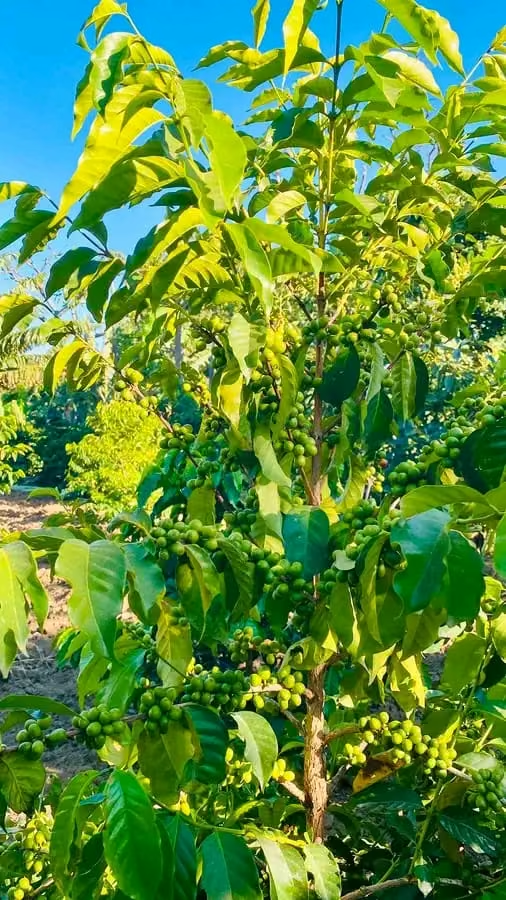
In its wild state, the coffee plant grows as an understory shrub or small tree in tropical forests, typically thriving in the dappled shade beneath a forest canopy. Under cultivation, plants are usually pruned to maintain a manageable shrub form that facilitates harvesting.
Size
Left unpruned, Coffea arabica can reach heights of up to 9 to 12 meters, while Coffea canephora can grow even taller. Cultivated plants are typically maintained between 2 and 4 meters through regular pruning.
Lifespan
A coffee plant can live and produce fruit for several decades, with productive economic life generally spanning 20 to 30 years, although individual plants may survive considerably longer under favorable conditions.
Root System
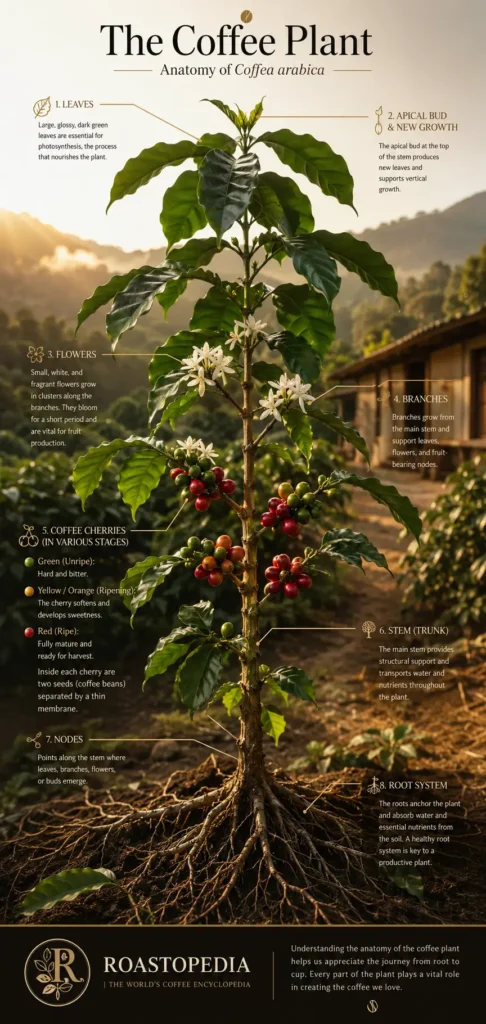
Coffee plants develop a taproot system with a dominant central root that can extend deep into the soil, complemented by a dense network of lateral feeder roots concentrated in the upper soil layers where most nutrient and water absorption occurs.
Stem and Trunk
The main stem, or trunk, is woody and upright, serving as the structural axis from which branches emanate in a characteristic whorled pattern.
Branching Pattern
Coffee plants exhibit a distinctive dimorphic branching structure: orthotropic (vertical) growth from the main stem, and plagiotropic (horizontal) growth from lateral branches, which are the primary fruit-bearing structures.
Plant Anatomy
Roots
The root system anchors the plant and absorbs water and nutrients, with the majority of active absorption occurring in fine roots located within the top 30 centimeters of soil.
Stem
The woody stem provides structural support and houses the vascular tissue responsible for transporting water, nutrients, and photosynthetic products throughout the plant.
Branches
Primary lateral branches grow horizontally from the main stem and bear secondary branches, flowers, and fruit along their length.
Leaves
Coffee leaves are simple, opposite, glossy, and dark green, typically elliptical to lanceolate in shape, with a waxy cuticle that helps reduce water loss.
Flowers
Coffee flowers are small, white, and fragrant, often compared to jasmine in scent, growing in clusters at the leaf axils along the plagiotropic branches.
Fruits (Coffee Cherries)
The fruit, known as a coffee cherry, is a small drupe that ripens from green to yellow and finally to a deep red or purple color, depending on the variety.
Seeds (Coffee Beans)
Each cherry typically contains two seeds, the coffee beans, situated face to face with their flat sides touching; occasionally a single rounded seed, known as a peaberry, develops instead.
Major Coffee Species
Arabica (Coffea arabica)
Coffea arabica accounts for the majority of global coffee production and is prized for its comparatively mild, aromatic, and nuanced flavor profile. It is native to the highlands of Ethiopia and is generally cultivated at higher altitudes.
Robusta (Coffea canephora)
Coffea canephora, commonly called robusta, is hardier, higher-yielding, and more resistant to pests and disease than arabica, but produces a beverage generally regarded as more bitter and less aromatically complex.
Liberica (Coffea liberica)
Native to West Africa, liberica is grown in smaller quantities, primarily in parts of Southeast Asia, and is noted for its large fruit and distinctive, often woody or fruity flavor.
Excelsa
Once classified as a separate species and now generally considered a variety of liberica, excelsa is cultivated on a limited scale, mainly in Southeast Asia, and is valued for its unique tart and fruity character.
Growth Cycle
Germination
Coffee seeds germinate within four to eight weeks under suitable warmth and moisture, sending down a primary root before pushing a hooked shoot above the soil surface.
Seedling Stage
After germination, the seedling develops its first true leaves and is typically grown in a nursery for several months to a year before transplanting.
Vegetative Growth
During this stage, the young plant focuses on developing its root system, trunk, and branch structure, generally taking two to four years before it is mature enough to flower.
Flowering
Mature plants produce clusters of white flowers, typically triggered by a period of dry weather followed by rainfall.
Fruiting
Following pollination, the flowers develop into green cherries that gradually mature over a period of approximately six to nine months, depending on species and climate.
Maturation
As cherries ripen, they change color and develop the sugars and compounds that influence the final flavor of the processed bean.
Senescence
As coffee plants age, yields gradually decline, and many growers eventually replace or rejuvenate aging plants through pruning techniques such as stumping.
Environmental Requirements
Altitude
Arabica generally thrives at elevations of higher altitudes between 900 and 2,000 meters, while robusta is typically grown at lower elevations, from sea level up to about 800 meters.
Temperature
Arabica favors moderate temperatures between approximately 15 and 24 degrees Celsius, whereas robusta tolerates warmer conditions, generally between 24 and 30 degrees Celsius.
Rainfall
Coffee plants generally require annual rainfall between 1,500 and 2,500 millimeters, well distributed throughout the growing season with a defined drier period to stimulate flowering.
Humidity
Moderate to high humidity supports healthy growth, though excessive humidity can increase susceptibility to fungal diseases.
Sunlight
Coffee plants evolved as understory species and often benefit from partial shade, although many modern cultivars have been bred for higher sun tolerance to increase yields.
Soil
Well-draining, deep, and fertile volcanic or loamy soils rich in organic matter are ideal for coffee cultivation.
Soil pH
Coffee plants generally prefer slightly acidic soils, with an optimal pH range of approximately 6.0 to 6.5.
Cultivation
Propagation
Coffee is propagated either from seed or through vegetative methods such as cuttings and grafting, with seed propagation being the most common commercial method.
Planting
Seedlings are typically transplanted from nurseries into the field once they reach a sufficient size, spaced to allow for mature canopy growth and ease of harvesting.
Pruning
Regular pruning controls plant height, removes unproductive wood, and stimulates new growth, directly influencing yield and the plant’s productive lifespan.
Fertilization
Coffee plants require balanced applications of nitrogen, phosphorus, and potassium, along with micronutrients, to support healthy vegetative growth and fruit development.
Shade Management
Many growers use shade trees to moderate temperature, reduce soil erosion, and support biodiversity, a practice central to traditional and “shade-grown” coffee systems.
Irrigation
In regions with insufficient or poorly distributed rainfall, supplemental irrigation is used to maintain consistent soil moisture, particularly during flowering and fruit development.
Reproduction
Flowering
Coffee flowering is often synchronized across a plantation, triggered by rainfall after a dry spell, producing a dramatic, short-lived bloom.
Pollination
Coffea arabica is largely self-pollinating, while Coffea canephora generally requires cross-pollination, often facilitated by wind and insects, particularly bees.
Fruit Set
Following successful pollination, fertilized flowers develop into green cherries, while unfertilized flowers typically abort and drop from the plant.
Seed Development
Within the developing cherry, the seeds mature through stages of soft, watery tissue hardening progressively into the dense, dry coffee bean.
Pests and Diseases
Coffee Berry Borer
The coffee berry borer is a small beetle considered one of the most damaging coffee pests worldwide, boring into cherries to lay eggs and damaging the beans within.
Coffee Leaf Rust
Caused by the fungus Hemileia vastatrix, coffee leaf rust is a devastating disease that causes leaf loss and significant yield reduction, historically responsible for major crop failures.
Coffee Berry Disease
This fungal disease, caused by Colletotrichum kahawae, primarily affects arabica coffee, causing premature fruit drop and significant losses in affected regions, particularly in parts of Africa.
Coffee Wilt Disease
Caused by a strain of the fungus Fusarium xylarioides, coffee wilt disease attacks the vascular system of the plant, often leading to plant death.
Nematodes
Various species of root-knot and lesion nematodes attack coffee root systems, impairing water and nutrient uptake and weakening overall plant health.
Other Pests and Diseases
Additional threats include the coffee leaf miner, mealybugs, scale insects, and various fungal and bacterial pathogens that affect leaves, branches, and roots depending on region and climate.
Physiology
Photosynthesis
Coffee plants perform C3 photosynthesis, a process generally less efficient under high light and heat stress, which partly explains the species’ preference for moderate light conditions.
Water Uptake
Water is absorbed primarily through fine roots and transported via the xylem to support cellular processes, photosynthesis, and fruit development.
Nutrient Uptake
Essential nutrients are absorbed from the soil through root systems and are critical for vegetative growth, flowering, and the biochemical development of the bean, including caffeine and sugar content.
Seasonal Growth
Coffee growth is closely tied to seasonal rainfall patterns, with distinct phases of vegetative growth, flowering, and fruit maturation occurring in response to wet and dry periods.
Economic Importance
Coffee is one of the most widely traded agricultural commodities in the world, providing livelihoods for an estimated 25 million farmers globally, the majority of whom are smallholders in developing countries. The crop generates substantial export revenue for many producing nations and supports an extensive global value chain encompassing processing, roasting, distribution, and retail.
Ecological Importance
Shade-grown coffee systems, in particular, can support significant biodiversity, providing habitat for birds, insects, and other wildlife, while also contributing to soil conservation and carbon sequestration relative to more intensive monoculture systems.
Uses
The primary use of the coffee plant is the production of roasted coffee beans for brewing as a beverage, valued both for its flavor and its stimulant properties due to caffeine content. Beyond beverages, coffee derivatives are used in food flavoring, cosmetics, and traditional medicine, while by-products such as cherry pulp and husks are increasingly explored for use in composting, biofuel, and novel food products.
Varieties and Cultivars
Within the major species, particularly arabica, numerous cultivars have been developed or selected over time, including Typica, Bourbon, Caturra, Catuai, Geisha (Gesha), and SL28, among many others, each offering distinct characteristics in terms of yield, disease resistance, and cup quality.
Related Articles
- Coffee Cherry
- Coffee Bean
- Green Coffee
- Coffee Belt
- Coffee Harvesting
- Coffee Processing
- Coffee Varieties
- Arabica Coffee
- Robusta Coffee
See Also
References
- Davis, A.P., Govaerts, R., Bridson, D.M., & Stoffelen, P. (2006). “An annotated taxonomic conspectus of the genus Coffea (Rubiaceae).” Botanical Journal of the Linnean Society.
- Wintgens, J.N. (Ed.). (2004). Coffee: Growing, Processing, Sustainable Production. Wiley-VCH.
- International Coffee Organization. “Botany of the Coffee Plant.” icocoffee.org
- Food and Agriculture Organization of the United Nations (FAO). “Coffee Crop Information.” fao.org
- Royal Botanic Gardens, Kew. “Coffea arabica.” Plants of the World Online, powo.science.kew.org
- World Coffee Research. “Arabica Coffee Varieties.” varieties.worldcoffeeresearch.org
- Davis, A.P., Chadburn, H., Moat, J., O’Sullivan, R., Hargreaves, S., & Lughadha, E.N. (2019). “High extinction risk for wild coffee species and implications for coffee sector sustainability.” Science Advances.
- United States Department of Agriculture (USDA). “Coffee: World Markets and Trade.” usda.gov
- Smithsonian National Museum of Natural History. “The Story of Coffee.” si.edu
- Charrier, A., & Berthaud, J. (1985). “Botanical classification of coffee.” In Coffee: Botany, Biochemistry and Production of Beans and Beverage. Springer.
- International Plant Genetic Resources Institute (Bioversity International). “Coffee Genetic Resources.” bioversityinternational.org
- Vega, F.E. (2008). “The rise of coffee.” American Scientist.
- Centre for Agriculture and Bioscience International (CABI). “Hemileia vastatrix (coffee leaf rust).” Invasive Species Compendium, cabi.org
- Encyclopaedia Britannica. “Coffee.” britannica.com