
A coffee leaf is the primary photosynthetic organ of the coffee plant, responsible for capturing sunlight and converting it into energy through photosynthesis. It is typically dark green, glossy, elliptical in shape, and arranged in opposite pairs along the branches. Coffee leaves also regulate gas exchange, water loss, and nutrient transport, making them essential for the plant’s growth, flowering, development of the coffee cherry, its enclosed coffee beans, and the plant’s overall health. The coffee leaf plays a central role in plant vigor, disease resistance, and, indirectly, the quality of the finished cup.
The Coffee Leaf Anatomy
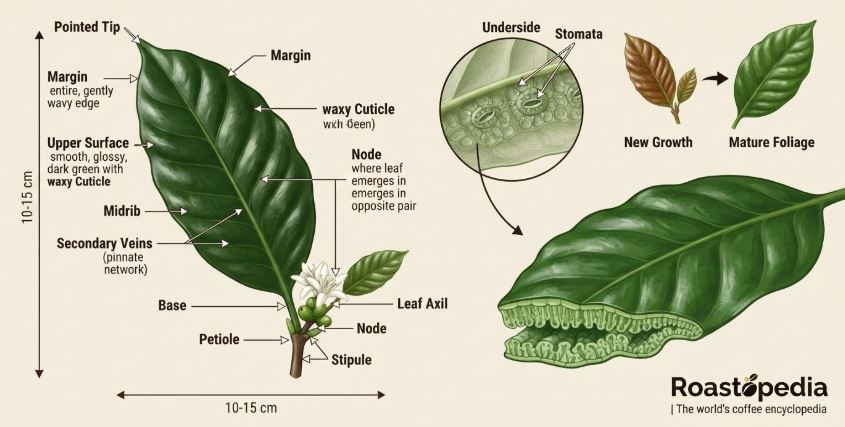
A mature coffee leaf is elliptical to lance-shaped, tapering to a pointed tip, and typically measures between 10 and 15 centimeters in length, with size varying by species and growing environment. The upper surface is smooth, glossy, and dark green, a sheen produced by a thin waxy cuticle that limits water loss and reflects excess sunlight.
The underside is paler and matte, covered in microscopic pores called stomata, through which the plant exchanges gases and releases water vapor. A prominent central midrib runs the length of the leaf, from which a network of secondary veins branches outward in a pinnate pattern before curving toward the margin, which is entire and gently wavy rather than serrated or toothed.
Leaves emerge in opposite pairs at each node, and it is at these leaf axils that the plant’s small white flowers, and later its fruit, develop. New growth is often bronze or reddish in color before maturing to the deep green associated with established foliage, a shift driven by fading anthocyanin pigments as chlorophyll accumulates.
Leaf size, thickness, and color intensity differ measurably across species and cultivars. Foliage of Arabica coffee tends to be smaller and thinner than that of Robusta, whose broader, more leathery leaves reflect its greater tolerance for heat and lower-elevation growing conditions. Specialty cultivars such as Geisha are often noted for narrower, more elongated leaves, one of several field traits growers use informally to distinguish varieties before flowering or fruiting begins.
Leaves grown at higher altitude tend to be smaller and thicker, an adaptation to cooler temperatures and stronger ultraviolet exposure, while foliage at lower elevations is typically larger and thinner. This variability is one expression of terroir, and experienced growers can often estimate a plot’s growing conditions simply by examining its leaves.
Beyond photosynthesis, the coffee leaf functions as an early warning system for plant health. Coffee leaf rust, caused by the fungus Hemileia vastatrix, first appears as orange-yellow lesions on the leaf underside and remains one of the most economically destructive coffee diseases worldwide, capable of causing severe defoliation and yield collapse.
Growers practicing organic coffee cultivation, who forgo synthetic fungicides, rely heavily on shade management, resistant cultivars, and routine leaf inspection to contain outbreaks. On working farms and estate coffee operations, checking foliage condition is a standard part of crop management, since leaf health correlates closely with nutrient deficiencies, water stress, and pest pressure long before such problems become visible in the fruit.
Because healthy leaves drive the sugar and acid accumulation that shapes flavor development, leaf condition indirectly influences qualities prized in the finished cup, including coffee acidity and coffee aroma. A stressed or diseased plant produces fewer, less developed leaves, limiting the photosynthetic output available to ripening cherries and, by extension, the character of the beans they eventually yield.
See Also
- Coffee Plant
- Coffee Cherry
- Coffee Bean
- Arabica
- Robusta
- Terroir
- Altitude
- Estate Coffee
- Organic Coffee
References
- Davis, A.P., Govaerts, R., Bridson, D.M., & Stoffelen, P. “An Annotated Taxonomic Conspectus of the Genus Coffea (Rubiaceae).” Botanical Journal of the Linnean Society, 2006.
- Wintgens, Jean Nicolas, ed. Coffee: Growing, Processing, Sustainable Production. 2nd ed. Wiley-VCH, 2012.
- Clarke, R.J., and Macrae, R., eds. Coffee: Volume 1 – Chemistry. Elsevier Applied Science, 1985.
- Avelino, Jacques, et al. “The Coffee Rust Crises in Colombia and Central America (2008–2013): Impacts, Plausible Causes and Proposed Solutions.” Food Security, 2015.
- World Coffee Research. “Arabica Coffee Varieties.” worldcoffeeresearch.org.
- Food and Agriculture Organization of the United Nations. “Coffee Production and Protection.” fao.org.
- Royal Botanic Gardens, Kew. “Coffea arabica.” Plants of the World Online, powo.science.kew.org.
- Purdue University Center for New Crops and Plant Products. “Coffea arabica L.” hort.purdue.edu.
- Hoffmann, James. The World Atlas of Coffee. 2nd ed. Octopus Publishing, 2018.
- Illy, Andrea, and Viani, Rinantonio, eds. Espresso Coffee: The Science of Quality. Academic Press, 2005.
- National Coffee Association USA. “The Coffee Plant.” ncausa.org.
- Encyclopaedia Britannica, The Editors of. “Coffee Plant.” britannica.com.
- Perfect Daily Grind. “What Is a Coffee Bean? The Anatomy of the Coffee Cherry.” perfectdailygrind.com.