
Agitation is the deliberate or incidental movement of water and coffee grounds during the brewing process. It is one of the most influential variables in coffee extraction because it affects how efficiently water comes into contact with coffee particles and how evenly soluble compounds are dissolved and carried away from the grounds.
Agitation occurs in virtually every brewing method, from pour-over and immersion brewing to espresso preparation, although its intensity and effects vary significantly depending on the technique used.
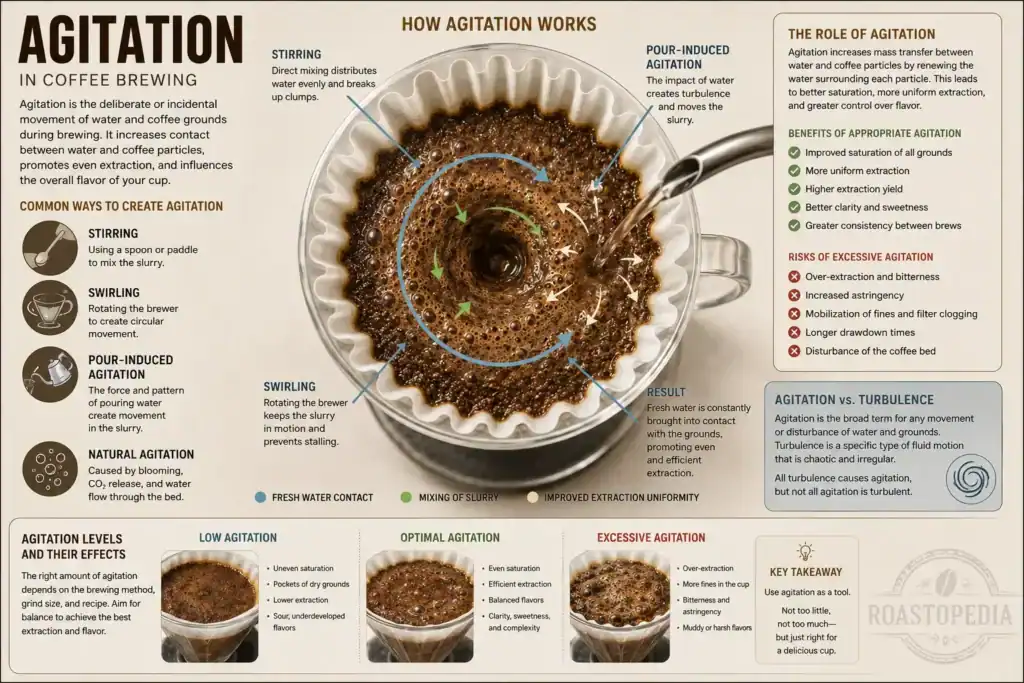
In coffee science, agitation is generally understood as any action that disturbs the coffee bed, slurry, or brewing liquid. This disturbance may be created intentionally through stirring, swirling, or shaking, or it may occur naturally through the force of pouring water, the release of carbon dioxide during blooming, or pressure-driven water movement within the coffee bed.
When properly controlled, agitation promotes more uniform extraction and can improve cup quality. Excessive agitation, however, may contribute to uneven extraction, filter clogging, bitterness, or other undesirable brewing outcomes.
Definition and Brewing Principles
During brewing, water extracts soluble compounds from roasted coffee particles. As extraction progresses, the concentration of dissolved substances surrounding each coffee particle increases, gradually slowing the extraction process.
Agitation helps renew the water surrounding the grounds by mixing the brewing liquid and redistributing dissolved compounds.
From a physical perspective, agitation increases mass transfer between water and coffee particles. By constantly moving fresh water into contact with the grounds, agitation can accelerate extraction and improve extraction uniformity. This is particularly important in methods where water may otherwise follow preferred pathways or leave portions of the coffee bed insufficiently saturated.
The concept is closely related to fluid dynamics and extraction theory. Coffee professionals often adjust agitation levels as a means of controlling extraction without changing other brewing variables such as grind size, water temperature, brew ratio, or contact time.
Sources of Agitation
Agitation can originate from several sources during brewing:
- Stirring the slurry with a spoon or paddle
- Swirling the brewer or vessel
- Circular pouring patterns
- High-flow pouring from a kettle
- Blooming and carbon dioxide release
- Pressure-driven water movement in espresso
- Shaking methods such as those used in certain cold brew or AeroPress recipes
The degree of agitation produced by these actions varies considerably. A gentle swirl may produce subtle movement within the slurry, whereas vigorous stirring can significantly alter extraction dynamics.
Agitation in Different Brewing Methods
Pour-Over Brewing
Agitation plays a particularly important role in pour-over methods such as the V60, Kalita Wave, Chemex, and Origami Dripper. Because water flows through the coffee bed under gravity, uneven saturation can easily occur if portions of the bed receive more water than others.
Brewers often use agitation during the bloom phase to ensure all grounds become evenly wetted. Additional agitation may occur through circular pouring patterns, pulse pours, stirring, or post-pour swirling techniques. Controlled agitation can help reduce dry pockets and improve extraction consistency.
However, excessive agitation may mobilize fine particles, causing them to migrate toward the filter and slow drawdown. This can result in over-extraction or increased bitterness.
Immersion Brewing
In immersion methods such as the French Press, Clever Dripper, and cupping, coffee grounds remain submerged throughout most of the brewing process.
Agitation is frequently used at the beginning of brewing to ensure complete saturation of the grounds. Stirring breaks apart clumps and encourages even extraction throughout the slurry.
Because the grounds remain immersed in water, immersion brewers are generally more forgiving of agitation than percolation methods.
Nevertheless, vigorous or repeated stirring can increase extraction rates and alter flavor balance, particularly when fine grind sizes are used.
Espresso Brewing
In espresso preparation, agitation is less visible but remains highly significant. Water moving through a compacted coffee puck creates microscopic fluid movement that influences extraction.
Proper distribution of grounds before tamping helps create uniform conditions for water flow. Excessive disturbance of the puck structure can encourage channeling, while controlled agitation during puck preparation can contribute to extraction uniformity.
Cold Brew
Cold brew extraction proceeds slowly due to lower water temperatures. Agitation is sometimes employed during the initial mixing stage to ensure all grounds are saturated. Additional agitation during steeping can increase extraction efficiency, although many recipes minimize movement to preserve clarity and reduce sediment.
Agitation and Extraction
The relationship between agitation and extraction is generally direct: increased agitation tends to increase extraction efficiency.
Benefits of appropriate agitation include:
- Improved saturation of coffee grounds
- More uniform extraction
- Reduced likelihood of dry pockets
- Enhanced extraction yield
- Greater consistency between brews
However, excessive agitation may introduce problems such as:
- Over-extraction
- Increased bitterness
- Greater astringency
- Filter clogging due to fines migration
- Longer drawdown times
- Disturbance of the coffee bed structure
Because agitation interacts with grind size, brew ratio, temperature, and brewing method, its optimal level varies from one recipe to another.
Agitation vs. Turbulence
Although the terms are sometimes used interchangeably, agitation and turbulence are not precisely the same concept.
Agitation refers broadly to any movement or disturbance of coffee grounds and brewing water. It describes the overall process of mixing and motion within the brew.
Turbulence, by contrast, refers specifically to a fluid-flow condition characterized by chaotic and irregular water movement. Turbulence is therefore one possible mechanism through which agitation occurs.
For example:
- Stirring a French Press creates agitation.
- Swirling a dripper creates agitation.
- A forceful pour from a gooseneck kettle generates turbulence within the slurry.
- That turbulence, in turn, contributes to agitation.
In practical brewing terms, agitation is the broader category, while turbulence is a particular type of fluid motion that produces agitation. Understanding the distinction helps brewers better analyze how pouring techniques influence extraction behavior.
Historical Development
Although agitation has always existed as part of coffee preparation, its role became more widely discussed during the specialty coffee movement of the late twentieth and early twenty-first centuries.
As coffee professionals began focusing on extraction theory, brew reproducibility, and sensory analysis, agitation emerged as a key variable affecting cup quality.
Modern brewing research and experimentation have demonstrated that seemingly minor changes in stirring, swirling, or pouring technique can significantly alter extraction outcomes. Consequently, agitation is now routinely considered when developing brewing recipes and evaluating brewing consistency.
Significance in Modern Coffee Brewing
Today, agitation is recognized as one of the primary tools available to brewers seeking greater control over extraction. Unlike variables such as roast level or coffee origin, agitation can be adjusted instantly during the brewing process.
Professional baristas often manipulate agitation to fine-tune extraction without altering grind size or brew ratio. Home brewers likewise use stirring, swirling, and controlled pouring techniques to improve consistency and repeatability.
As coffee science continues to evolve, agitation remains a central concept linking brewing physics, extraction chemistry, and sensory quality.
See Also
- Blooming
- Brew Ratio
- Channeling
- Coffee Bed
- Contact Time
- Diffusion
- Drawdown
- Extraction
- Extraction Yield
- Flow Rate
- Immersion Brewing
- Mass Transfer
- Percolation Brewing
- Saturation
- Slurry
- Total Dissolved Solids (TDS)
- Turbulence
- Uniform Extraction
- Water Distribution
References
- Rao, Scott. The Coffee Roaster’s Companion. Scott Rao Publishing, 2014.
- Rao, Scott. Coffee Brewing Best Practices. Scott Rao Publishing, 2019.
- Hoffmann, James. The World Atlas of Coffee. 2nd Edition. Octopus Publishing, 2018.
- Illy, Andrea & Viani, Rinantonio (Eds.). Espresso Coffee: The Science of Quality. Academic Press, 2005.
- Navarini, Luciano et al. Coffee: Recent Developments. Wiley-Blackwell, 2021.
- Clarke, R. J. & Macrae, R. Coffee: Volume 2 – Technology. Elsevier Applied Science, 1987.
- Clarke, R. J. & Vitzthum, O. G. Coffee: Recent Developments. Blackwell Science, 2001.
- Hendon, Christopher. Water for Coffee. BH Books, 2015.
- Gagné, Jonathan. The Physics of Filter Coffee. BH Books, 2021.
- Lee, W. T., Smith, A., & Arshad, A. “Uneven Extraction in Coffee Brewing.” arXiv, 2022.
- Frankfurt Coffee Festival Coffee Lexicon. “Agitation.”
- Canterbury Coffee. “Agitation.”
- Bean Ground. “How Does Agitation Affect Coffee Brewing and Extraction?”
- Coffee Basics Pro. “Agitation, Turbulence, and Channeling.”
- Podium Coffee Club. “Agitation in Coffee Brewing: Stirring, Swirling, Tapping.”
- Hendon, Christopher H., et al. “Systematically Improving Espresso: Insights from Mathematical Modeling and Experiment.” Matter, 2020.
- Méndez Harper, J. & Hendon, C. H. “Chemical Strategies to Mitigate Electrostatic Charging During Coffee Grinding.” arXiv, 2023.