
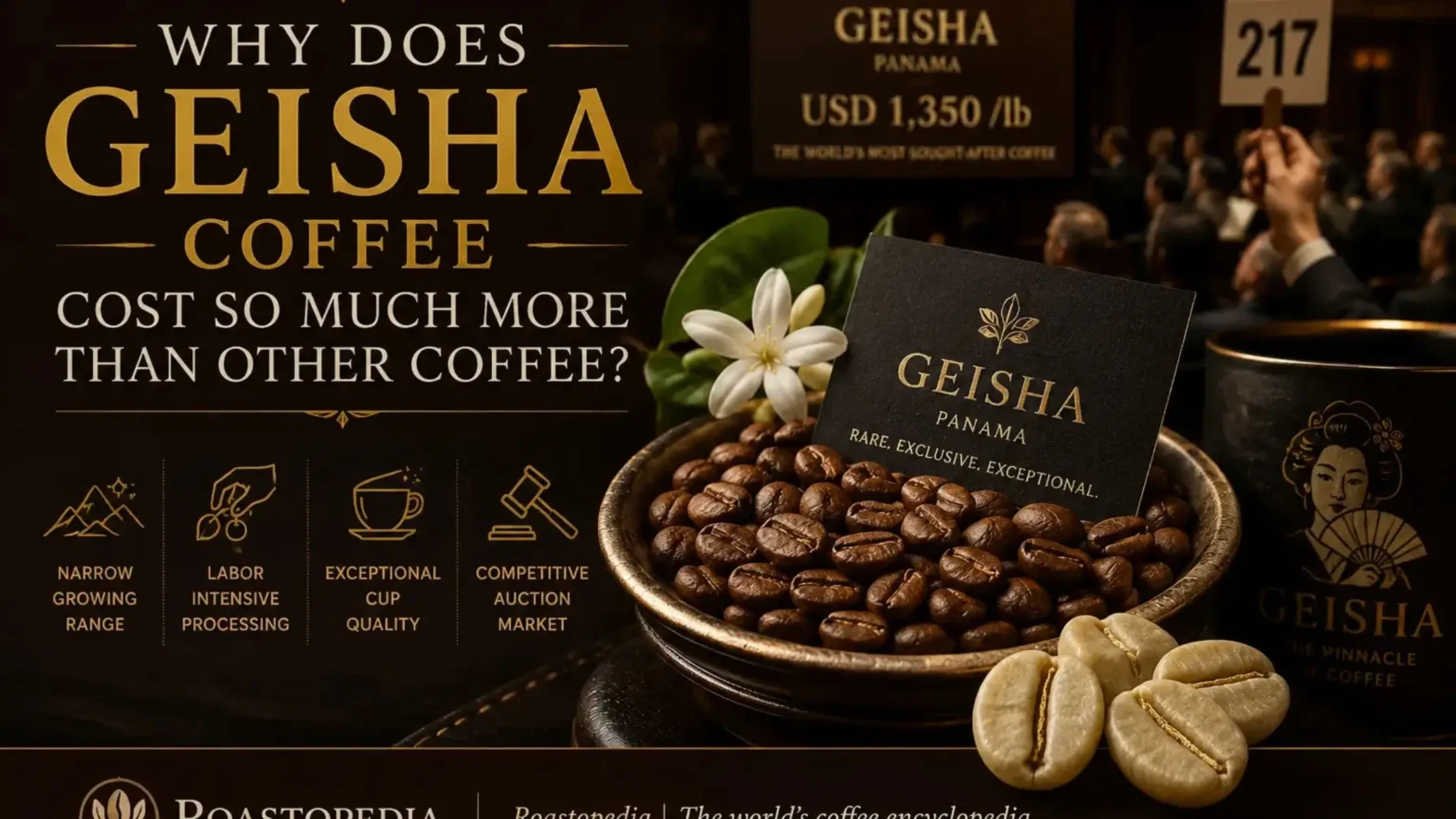
Geisha coffee costs more than any other coffee due to its low yields, a narrow growing range, labor-intensive processing, distinctive flavor characteristics, and a competitive auction market.
A single 20-kilogram lot of washed Geisha from Hacienda La Esmeralda in Boquete, Panama, sold for US $604,080 at the 2025 Best of Panama auction — a record US$30,204 per kilogram (US$13,705 per pound), more than three times the previous year’s benchmark. Ordinary green coffee, by comparison, typically trades for a few dollars per kilogram on the commodity market. The gap between those two numbers is the story of Geisha.
A Rare Variety with a Difficult Biology
Geisha is a variety of Coffea arabica, the species that dominates the Coffee Belt, the tropical band roughly between 25° North and 30° South of the Equator where coffee cultivation is viable.
It was first documented in the 1930s in the Gori Gesha forest of southwestern Ethiopia and was later distributed through Tanzania and Costa Rica’s CATIE research station before reaching Panama in the 1960s, where growers originally valued it only for resistance to coffee leaf rust.
The coffee plant itself explains part of the cost. Geisha trees have thin leaves and a comparatively weak root system, which reduces photosynthetic efficiency and cuts yields well below those of common cultivars such as Caturra or Catuai — in some estimates by roughly half.
The variety also demands elevations above 1,400–1,800 meters and cool, stable temperatures to develop its floral and fruit-forward character, which restricts where it can be grown at all. Lower and hotter terrain produces a far less distinctive cup, so viable Geisha land is scarce even within already-limited high-altitude zones.
From Obscurity to the Best of Panama

Geisha remained agriculturally marginal for decades. That changed in 2004, when the Peterson family’s Hacienda La Esmeralda entered an isolated lot into the Best of Panama competition, organized by the Specialty Coffee Association of Panama (SCAP).
Judges encountered a cup dominated by jasmine, bergamot, and tropical fruit rather than the chocolate and nut notes typical of the standard Arabica. The lot sold for roughly US $21 per pound — nearly ten times the going rate for high-quality coffee at the time — and the variety’s reputation and price have climbed nearly every year since.
By 2017, a natural-processed lot from the same farm had reached US $601 per pound. In 2019, an Elida Estate lot from the Lamastus family sold for US $1,029 per pound. The trend accelerated further in August 2025, when Hacienda La Esmeralda’s washed Geisha, scored 98 out of 100 by international judges, sold to a Dubai buyer for the current world-record US $30,204 per kilogram; a natural-processed lot from the same estate sold separately to a Chinese buyer for US $23,608 per kilogram.
Across the full 2025 auction, 50 lots generated more than US $2.8 million, at an average price of US $2,861.20 per kilogram — over double the 2024 average. This auction structure, run as a public, internationally bid event, is itself a price driver: roasters and retailers from Japan, South Korea, China, the United Arab Emirates, and elsewhere compete directly for a fixed, tiny supply, and the winning bid becomes public record and marketing material.
Cultivation and Processing Costs
Unlike commodity Robusta or mass-market Arabica, Geisha is almost always single-origin coffee, and often true estate coffee, traceable to one farm, one harvest, and frequently one lot within that farm. Producers hand-pick only the ripest coffee cherry, since underripe fruit produces a bitter, less aromatic result, and Geisha’s fragile branches make mechanical harvesting impractical.
Once picked, the cherries are processed either through the washed process, which depulps and ferments the fruit away from the coffee bean to emphasize clarity, coffee acidity, and floral coffee aroma, or the natural process, which dries the whole cherry to build a jammier, fruit-forward sweetness.
Either method, done carefully at the standard required to command auction prices, requires far more labor and quality control than mass processing.
Some Geisha, particularly from smaller cooperatives in Latin America, is also grown and certified as organic coffee, which adds certification and input costs without increasing yield. None of these choices is unique to Geisha, but Geisha producers apply them at a more exacting level, because the coffee is judged, scored, and sold at a level of scrutiny ordinary coffee never faces.
Roasting Adds a Final Layer of Cost
Because Geisha’s value lies in delicate aromatics rather than roasted, caramelized flavor, most roasters treat it differently from bulk stock. Roasting is typically kept light, ending shortly after the first crack, to preserve the jasmine and citrus compounds that a darker roast would drive off or mask. This requires closer attention per batch, smaller roast sizes, and often a dedicated profile — all of which raise the effective cost per roasted kilogram compared with a standard commercial blend roasted in bulk.
The Bottom Line
Geisha’s price is not manufactured hype attached to an ordinary bean. It reflects a naturally low-yielding plant, a narrow band of the Coffee Belt where it performs well, hand-selective harvesting, meticulous processing, and an auction system that turns scarcity into a public bidding war.
Each layer compounds the one before it, which is why a coffee that starts as the same botanical genus as a supermarket blend can end up selling for tens of thousands of dollars per kilogram.
See Also
- Why Are Some Coffees More Acidic Than Others?
- How Soil, Altitude, and Climate Determine Coffee Flavor at Origin
- The Role of Roast Level in Coffee Flavor Development
- Does Green Coffee Go Stale Before Roasting?
- Why Does Green Coffee Lose Quality During Storage?
- Why Are Some Coffee Beans Oily?
- Why Does Coffee Require Degassing Before Brewing?
References
- Newsroom Panama, “$30,000+ Per Kilo is the Price for Panamanian Geisha Coffee from Boquete Breaking a Record,” August 2025.
- Global Coffee Report, “Best of Panama auction sees world-record price,” August 8, 2025.
- UPI, “Panamanian Geisha coffee sets new price record,” August 8, 2025.
- Forbes, “Panama’s Geisha Coffee Sets A Record Price. Its Source Is Worth A Trip,” August 11, 2025.
- Coffee Magazine, “New Record-Breaking High Price paid at Best of Panama Auction 2025,” August 2025.
- CoffeeTalk, “Auction Sets New Price Record For Panamanian Geisha Coffee,” August 2025.
- Wikipedia, “Geisha (coffee),” accessed 2026.
- Boquete Coffee Traders, “Hacienda La Esmeralda: Panama’s Famous Geisha Coffee.”
- Opus Coffee, “The Geisha Coffee Variety: Coveted and world-renowned.”
- Perfect Daily Grind, “Washed, Natural, Honey: Coffee Processing 101,” July 2016.
- Specialty Coffee Association of Panama (SCAP), Best of Panama competition and auction records.