
A coffee bean refers to the seed of the Coffea plant, the raw material from which the beverage known as coffee is prepared. Despite the name, the coffee bean is not a true bean in the botanical sense (a legume) but is a seed, more precisely a structure derived from a drupe, found in pairs within the fruit of the coffee plant known as the coffee cherry.
Coffee beans are harvested, processed, dried, roasted, ground, and brewed to produce coffee, one of the most widely traded agricultural commodities and most consumed beverages in the world, ranking alongside water and tea in global consumption. Coffee beans are a major cash crop, accounting for over 50 percent of foreign exchange earnings in some developing nations. As of the mid-2020s, Brazil is recorded as the largest producer of coffee beans globally, followed by Vietnam, Colombia, and Ethiopia.
Definition
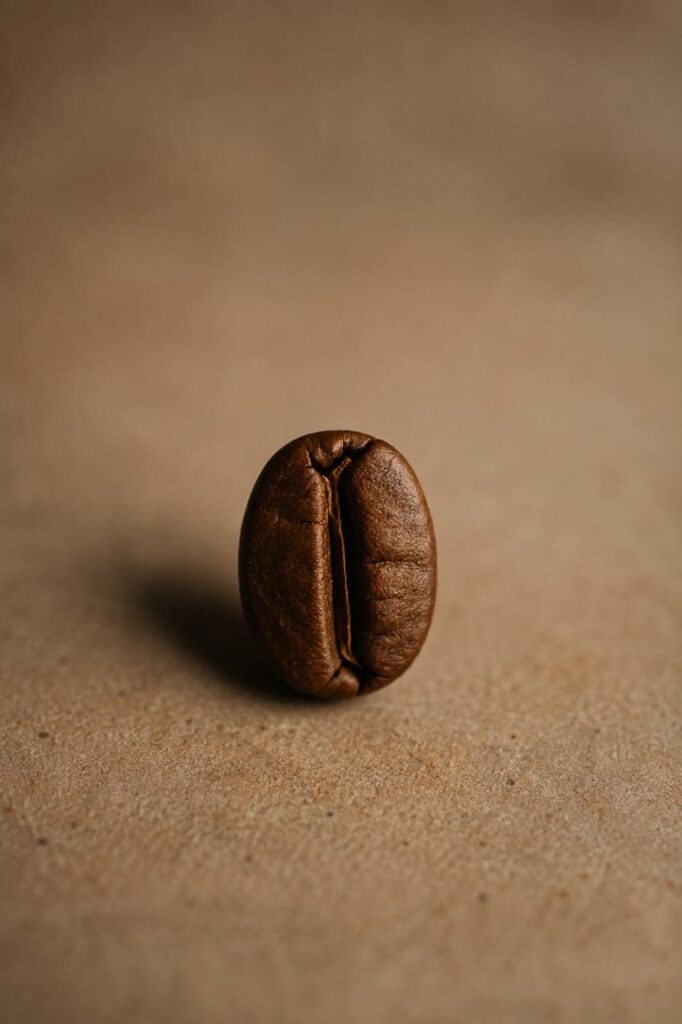
The Merriam-Webster Dictionary defines a coffee bean as the usually dried and roasted seed of a tropical plant of the genus Coffea (see Coffee Plant), particularly Coffea arabica and Coffea canephora (Robusta), from which coffee is prepared.
Botanically, each coffee cherry typically contains two seeds (see Fig. (6)➡ (Coffee Cherry Anatomy) positioned with their flat sides facing each other; these seeds are referred to as “beans” owing to their visual resemblance to true beans, in much the same way a peanut is colloquially called a nut despite being a legume.
Like Brazil nuts and white rice, coffee beans consist mostly of endosperm. In roughly 5 to 15 percent of cherries, only a single, rounder seed develops instead of two — a naturally occurring variant called a peaberry, from the Spanish caracol (“snail”).
Etymology
The word “coffee” is widely held to derive, through Ottoman Turkish kahve and Arabic qahwa, from the Kaffa region of southwestern Ethiopia, an area historically associated with the wild growth of Coffea arabica.
The Arabic term qahwa originally referred more broadly to wine or a stimulating beverage before becoming specifically associated with coffee. The term entered English in the late 16th and early 17th centuries via Dutch (koffie) and Italian (caffè) as European trade with the Ottoman Empire expanded.
Origin and History
The most widely circulated origin narrative is the legend of Kaldi, a goatherd said to have lived in Ethiopia or Arabia around 850 CE. According to the legend, Kaldi observed his goats becoming unusually energetic after eating the red berries of a certain bush, sampled the berries himself, and brought them to a nearby monastery.
The head monk reportedly deemed the berries the devil’s work and threw them into a fire, from which an intense aroma emerged; the roasted beans were then removed, crushed, and dissolved in hot water, producing what the legend holds to be the first cup of coffee.
Historians regard the Kaldi story as folklore, an embellishment of the more credible tradition that coffee’s earliest human use occurred in Ethiopia, but it remains the most frequently cited origin story in Western literature. A separate, lesser-known Yemeni legend attributes coffee’s discovery to a Sufi mystic named Sheikh Omar, who is said to have boiled coffee berries for sustenance while living in exile as a hermit.
Coffee is botanically indigenous to Ethiopia’s highland forests, particularly the Kaffa region, where wild Coffea arabica still grows today. The earliest credible documentary evidence of coffee cultivation and deliberate brewing dates to the 15th century in Yemen, where Sufi monks used coffee — known as qahwa — to sustain concentration and wakefulness during nighttime prayer and devotional ritual (dhikr). Coffee is believed to have reached Yemen from Ethiopia across the narrow Red Sea passage, likely carried by traders or through historical contact between the two regions.
Yemen became the first place where coffee was deliberately farmed as an agricultural crop rather than simply foraged, and cultivation centered on the Red Sea port of Mocha (al-Mukhā), which became the principal hub of the global coffee trade for over two centuries and lent its name to the “mocha” flavor and drink terminology still used today.
By the early 16th century, coffee had spread from Yemen to Mecca and Medina, and subsequently to Cairo, Damascus, Baghdad, and Constantinople, giving rise to a new social institution: the coffeehouse, or qahveh khaneh. These venues functioned as centers of conversation, music, storytelling, chess, and political debate throughout the Islamic world.
To protect its trade monopoly, Yemen required that all beans destined for export be boiled or parched, rendering them infertile and unable to be cultivated elsewhere. This monopoly persisted until the 17th century, when a pilgrim traditionally identified as Baba Budan is said to have smuggled seven fertile seeds out of Yemen to India, and Dutch traders separately succeeded in transporting live coffee plants to the Netherlands and, subsequently, to the island of Java in the Indonesian archipelago.
Coffee reached Europe in the 16th and 17th centuries, arriving in Venice, reportedly via Venetian merchants trading with the Ottoman Empire, with the first recorded shipment reaching Venice from Mocha in 1615.
Coffee was initially met with suspicion by some religious authorities, who referred to it as “the bitter invention of Satan,” but its popularity nonetheless spread rapidly across Britain, France, and the American colonies.
English coffeehouses became known as “penny universities,” so called because the price of a single cup of coffee bought access to hours of intellectual conversation and debate. Coffee cultivation expanded to the Americas in the 18th century, reaching Brazil in the 1720s, and to the Hawaiian Islands in 1825.
By the 20th century, the Western Hemisphere, led by Brazil, had become the world’s dominant coffee-producing region. Industrial roasting and grinding machinery, vacuum-sealed packaging, and decaffeination methods were all developed in the late 19th and early 20th centuries, and the production of instant coffee was perfected after 1950.
Botanical Classification
The genus Coffea belongs to the family Rubiaceae and includes more than 6,000 recognized plant species, although botanists estimate that only 25 to 100 of these are properly classified as coffee trees. The genus was first formally described in 1753 by the Swedish botanist Carolus Linnaeus in his taxonomic work Species Plantarum.
Coffee trees can range from small shrubs to trees exceeding 30 feet (9 meters) in height if left unpruned, with the coffee cherries growing along the branches beneath waxy, veined leaves. An average coffee tree produces roughly 10 pounds of coffee cherries per year, yielding approximately 2 pounds of dried, unroasted (green) beans.
Characteristics and Anatomy
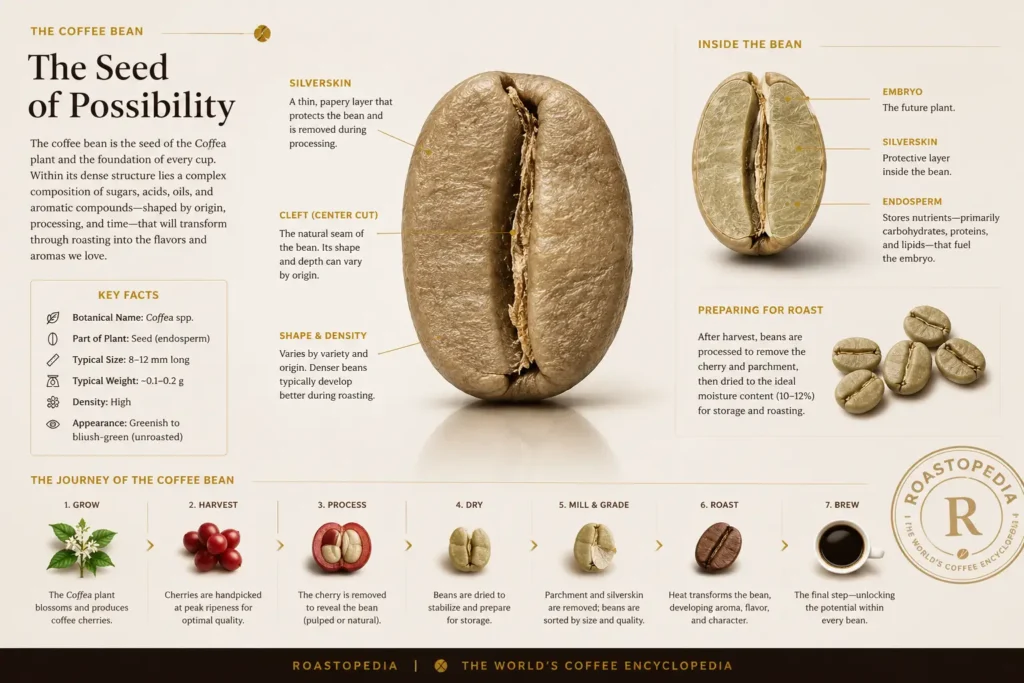
The coffee bean itself is the endosperm of the coffee seed, the dense, food-storing tissue that surrounds and nourishes the plant embryo within. Botanically, the bean is understood as a seed consisting of three principal parts: the silverskin, the endosperm, and the embryo.
The silverskin, which gets oily during roasting (also called the testa, epidermis, or perisperm), is a thin, papery membrane that clings directly to the bean’s surface, remaining after the parchment layer of the surrounding cherry has been removed. It is typically pale, silvery, or straw-colored and is largely shed during roasting, when it detaches from the bean and is expelled as a byproduct known as chaff.
The endosperm forms the bulk of the bean and is the part of the seed most people picture when they think of a coffee bean. It is divided into two halves, or cotyledons, separated by a visible central groove or fissure running lengthwise down the bean’s flat side, known as the “center cut.” This crease is one of the bean’s most distinctive visual features and is a residue of how the two seeds were pressed together, flat side to flat side, inside the cherry.
Embedded within the endosperm, near its base, is the embryo itself — a miniature plant structure roughly 3 to 4 millimeters long, composed of a hypocotyl (embryonic stem) and two cotyledons of its own, which would, under natural conditions, germinate into a new coffee tree through epigeous germination, in which the seed is pushed above the soil surface as it sprouts. The endosperm’s function is to serve as a food reserve for this embryo, not as a structure intended for human consumption in its raw state.
Physically, a green (unroasted) coffee bean averages approximately 10 millimeters in length and 6 millimeters in width, though size varies by species, variety, and growing conditions. Each bean has one flat side, bearing the center cut, and one convex, rounded side that faced outward against the cherry’s flesh.
Arabica beans are generally flatter, more elongated, and more oval in outline than Robusta beans, which tend to be smaller, more rounded, and shorter. In its unroasted state, the bean is hard, dense, and pale green to bluish-green or yellowish-green in color, with a grassy, herbaceous smell and virtually none of the aroma associated with brewed coffee.
Green coffee beans typically carry a moisture content of around 10 to 12 percent, and their density varies with growing altitude, with beans grown at higher elevations generally maturing more slowly and developing denser, harder endosperm.
Chemically, the endosperm contains both water-soluble compounds — including caffeine, trigonelline, nicotinic acid (niacin), at least 18 distinct chlorogenic acids, mono-, di-, and oligosaccharides, and some proteins and minerals — and water-insoluble compounds such as cellulose, polysaccharides, lignin, hemicellulose, and lipids.
It is this chemical composition that, through subsequent roasting, is transformed via the Maillard reaction into the aroma and flavor compounds associated with brewed coffee; the bean’s color also shifts during this process, from green through yellow and cinnamon tones to the familiar shades of brown as roasting progresses.
Caffeine content varies by species: Arabica beans typically contain 0.8 to 1.4 percent caffeine by weight, while Robusta beans contain 1.7 to 4.0 percent, roughly 50 to 60 percent more than Arabica; caffeine functions biologically as a natural defense compound that deters insects and fungal pathogens. Caffeine content does not change as the bean matures, though beans grown at higher altitudes tend to exhibit higher caffeine concentrations.
Growing Conditions and the Coffee Belt
Commercial coffee cultivation is confined almost entirely to a geographic band informally known as the “Coffee Belt” or “bean belt,” a tropical and subtropical zone generally defined as lying between the Tropic of Cancer and the Tropic of Capricorn — roughly 25°N to 30°S latitude — encompassing more than 70 countries across Central and South America, Africa, the Middle East, and Asia.
Within this belt, coffee trees require fairly narrow environmental conditions: stable temperatures generally between 60°F and 75°F (15°C to 24°C), consistent and abundant rainfall, well-draining soil, and protection from frost, which can kill the trees outright.
Arabica coffee favors cooler, higher-elevation environments, typically between 2,000 and 6,000 feet (600 to 2,000 meters) above sea level, where slower cherry maturation is associated with more complex sugar development and brighter acidity; because such terrain tends to be steep and difficult to mechanize, Arabica cultivation is comparatively labor-intensive and costly.
Robusta, by contrast, tolerates lower elevations, warmer temperatures, and less exacting conditions, and is markedly more resistant to disease and pests, making it cheaper to cultivate at scale. Together, environmental factors such as soil composition, climate, altitude, sunlight, and surrounding vegetation are collectively referred to in the industry as “terroir,” a concept borrowed from wine, which is considered especially influential in shaping the distinctive flavor profile of single-origin coffee.
Variations
The two principal commercial species of coffee are Coffea arabica (Arabica) and Coffea canephora (Robusta), accounting for approximately 60 percent and 40 percent of global production, respectively. Arabica is generally regarded as producing a smoother, more aromatically complex cup with higher acidity and lower caffeine content. Robusta, native to central and western sub-Saharan Africa, yields a bolder, more bitter cup with substantially higher caffeine content and is generally considered less refined in cup quality, though it is prized for its hardiness, higher yields, and role in espresso blends, where it contributes body and a persistent crema.
Two additional, commercially minor species are recognized: Coffea liberica (Liberica) and Coffea excelsa (Excelsa), both grown in limited quantities, primarily in parts of Southeast Asia and West Africa, and known for unusually large fruit and distinctive, often woody or fruity, cup characteristics. Within Arabica and Robusta, numerous varieties and cultivars exist, comparable to grape varietals in winemaking — including Typica, Bourbon, Caturra, Catuaí, Pacamara, and Geisha (also spelled Gesha) — each exhibiting distinct cup characteristics, disease resistance profiles, and yields.
A further natural variation is the peaberry, in which a coffee cherry develops only a single, oval seed instead of the usual two flat-sided seeds, occurring in roughly 5 to 15 percent of cherries depending on the source. Peaberries are sometimes manually sorted and sold separately, as some in the industry consider them to have a more concentrated flavor, though this claim remains a matter of trade opinion rather than settled scientific consensus.
Harvesting
Coffee cherries are harvested once they reach full ripeness, generally identifiable by a red, orange, or yellow coloration depending on the variety. Two primary harvesting methods are used. Selective picking involves manually harvesting only ripe cherries, often across multiple passes through the same trees over several weeks; this method is labor-intensive but yields higher-quality, more uniformly ripe fruit and is common on Arabica farms in mountainous terrain.
Strip picking involves removing all cherries from a branch in a single pass, regardless of ripeness, and is typically more efficient but produces a less uniform harvest, mixing under-ripe, ripe, and overripe cherries that must later be sorted. Machine harvesting, used on large, flat commercial plantations, mechanically shakes or strips cherries from trees and is common in regions such as Brazil, where terrain permits it.
Processing and Drying
Following harvesting, the fruit surrounding the coffee beans must be removed through one of several processing methods, each of which measurably influences the final flavor profile.
In the washed (wet) process, historically associated with Central America and parts of East Africa, the skin and pulp are mechanically removed from the cherry shortly after picking using a pulping machine, and the beans are then fermented in water for roughly one to two days to loosen the remaining mucilage, which is subsequently washed away before drying. Washed coffees tend to exhibit the brightest acidity and cleanest cup profile of the major processing methods.
In the natural (dry) process, historically associated with Brazil, Yemen, and much of Africa, whole cherries are spread in the sun on patios, concrete, bricks, or raised beds and dried for roughly two to three weeks, with regular turning to ensure even drying; the fruit is removed from the dried bean only afterward, during hulling. Natural processing tends to produce a fuller body and more pronounced fruit-forward sweetness, though it carries a higher risk of fermentation-related defects if not carefully managed.
A third method, honey (or pulped natural) processing, removes the skin but leaves some or all of the sticky mucilage on the bean during drying, producing a flavor profile positioned between washed and natural coffees; honey-processed coffees are further classified by color — yellow, red, or black — depending on how much mucilage remains and how much sun exposure the beans receive during drying. In parts of Asia, a more unconventional method exists in which certain animals, such as the Asian palm civet, consume and excrete coffee cherries, with the partially digested beans subsequently collected, cleaned, and processed; coffee produced this way is prized in some niche markets, though it remains a very small share of total global production. Skin and pulp discarded during processing are sometimes dried separately to produce cascara, a tea-like infusion made from the dried coffee cherry.
Once dried to a target moisture content, generally around 10 to 12 percent, beans undergo hulling to remove the parchment layer, followed by sorting, grading, and polishing before being bagged as green coffee for storage, export, and eventual roasting. Some green coffee is deliberately aged in warehouses for extended periods, sometimes for six months to three years, a practice that reduces acidity and increases body; this is referred to as aged or vintage coffee.
Grading and Classification
Green coffee is graded and classified prior to sale, primarily on the basis of bean size, defect count, and cup quality, although no single universal grading system exists; standards vary considerably by producing country. Bean size is measured using screens with holes calibrated in increments of 1/64 of an inch, typically ranging from screen size 8 (the smallest, roughly 3.2 mm) to screen size 20 (the largest, roughly 8 mm); larger screen sizes are often, though not conclusively, associated with beans grown at higher altitudes and correspondingly denser, more flavorful cups.
Defects are separately counted and classified, generally into primary (or category 1) defects — such as full black beans, full sour beans, and severe insect damage, which significantly compromise cup quality — and secondary (or category 2) defects, such as partial black beans, broken or chipped beans, and minor insect damage, which are considered less severe individually but are still weighted in a coffee’s overall defect count.
Under the widely referenced Green Arabica Coffee Classification System, one full primary defect might be considered equivalent to several secondary defects when tallying a sample. Coffees are then typically roasted and cupped (professionally tasted) to evaluate aroma, flavor, acidity, body, and overall quality, often on the Specialty Coffee Association’s 100-point cupping scale, where a score of 80 or above generally designates a coffee as “specialty grade.”
Grading terminology and altitude designations vary by origin: examples include Colombia’s Supremo grade, Kenya’s AA and AB classifications (based on bean size and density), Guatemala’s Strictly Hard Bean (SHB) designation for coffee grown above roughly 1,400 meters, and Ethiopia’s numeric grading scale. Because these systems are not standardized internationally, a grade considered high in one origin country may not directly correspond to the same numeric or letter grade in another.
Roasting
Roasting transforms green coffee beans into the aromatic brown beans recognizable to consumers, driving off residual moisture and triggering the Maillard reaction and caramelization, chemical processes in which sugars and amino acids within the endosperm break down and recombine to generate coffee’s characteristic flavor and aroma compounds.
During roasting, the silverskin detaches from the bean and is expelled as chaff. As internal bean temperature approaches roughly 485°F (approximately 250°C), an audible “first crack” occurs — a popping sound marking the onset of pyrolysis, after which the bean begins generating its own internal heat and the roast can progress rapidly. Some roast profiles carry the bean further to a “second crack,” associated with darker roast levels.
Roast levels, ranging from light to dark and further categorized under such names as City, Full City, Vienna, French, and Italian roast, are typically classified using standardized color-measurement scales, such as the Agtron scale used by industry evaluators to assign a numeric reading to both whole-bean and ground coffee color. Lighter roasts generally preserve more origin-specific acidity, floral or fruit-forward notes, and antioxidant content, while darker roasts develop heavier body, reduced acidity, and more pronounced notes of chocolate, char, or smoke as origin character is progressively overridden by the effects of the roast itself.
Roasting equipment ranges from small stovetop and sample roasters used for home roasting and quality testing, to large-scale commercial drum roasters and fluid-bed roasters used in industrial production.
Storage and Decaffeination
Roasted coffee is generally considered most flavorful within a few weeks of roasting, as exposure to air, moisture, heat, and light progressively degrades aromatic compounds; airtight storage away from direct light and heat is standard industry guidance for preserving freshness. Green coffee, by contrast, is comparatively stable and can be stored for extended periods prior to roasting.
Decaffeination, the process of removing most of the caffeine from coffee, is always performed at the green bean stage, before roasting, using one of several methods based on chemical solvents, activated carbon filtering, carbon dioxide extraction, or triglycerides. Regardless of the method used, decaffeinated coffee is never rendered entirely caffeine-free.
Difference Between Coffee Cherry and Coffee Bean
| Aspect | Coffee Cherry | Coffee Bean |
| Definition | The whole fruit produced by the coffee plant | The seed found inside the coffee cherry |
| Botanical classification | A drupe (stone fruit) | A seed (endosperm and embryo) enclosed within the drupe |
| Composition | Exocarp (skin), mesocarp (pulp/mucilage), and the seeds within | Endosperm, embryo, and a thin silverskin covering |
| Typical quantity per fruit | One fruit | Usually two seeds per cherry (one in the case of a peaberry) |
| Color when ripe | Red, orange, or yellow, depending on variety | Green (before roasting); brown (after roasting) |
| Average size | Roughly 10–15 mm in diameter | Roughly 10 mm long by 6 mm wide (green) |
| Primary use | Occasionally dried and used to make cascara (a tea-like infusion) | Roasted, ground, and brewed to produce coffee |
| Stage in production | The starting agricultural product harvested from the tree | The processed and dried product remaining after the fruit is removed |
| Edibility as harvested | Sweet, fruit-like pulp is technically edible | Not palatable raw; requires roasting to develop flavor |
| Caffeine content | Concentrated within the seeds, not the surrounding fruit | 0.8–1.4% (Arabica) to 1.7–4.0% (Robusta) by weight |
See Also
- Coffee Cherry
- Coffee Plant
- Green Coffee
- Organic Coffee
- Estate Coffee
- Geisha Coffee
- Specialty Coffee
- Selective Picking
References
- Britannica. “Coffee.” Encyclopaedia Britannica. https://www.britannica.com/topic/coffee
- Britannica. “History of Coffee.” Encyclopaedia Britannica. https://www.britannica.com/topic/history-of-coffee
- National Coffee Association (NCA). “What Is Coffee?” AboutCoffee.org. https://www.aboutcoffee.org/origins/what-is-coffee/
- National Coffee Association (NCA). “Beans.” AboutCoffee.org. https://www.aboutcoffee.org/beans/
- National Coffee Association (NCA). “Varieties.” AboutCoffee.org. https://www.aboutcoffee.org/beans/varieties/
- Wikipedia. “Coffee Bean.” https://en.wikipedia.org/wiki/Coffee_bean
- Wikipedia. “Kaldi.” https://en.wikipedia.org/wiki/Kaldi
- Merriam-Webster. “Coffee Bean.” Merriam-Webster.com Dictionary. https://www.merriam-webster.com/dictionary/coffee%20bean
- Perfect Daily Grind. “What Is a Coffee Bean? The Anatomy of the Coffee Cherry.” https://perfectdailygrind.com/2019/02/what-is-a-coffee-bean-the-anatomy-of-the-coffee-cherry/
- Kaʻū Coffee Mill. “The Anatomy of a Coffee Bean.” https://kaucoffeemill.com/blogs/news/the-anatomy-of-a-coffee-bean
- Stone Street Coffee. “Coffee Bean Anatomy: 101.” https://stonestreetcoffee.com/blogs/brooklyn-coffee-academy/coffee-bean-anatomy-101
- Food and Agriculture Organization of the United Nations (FAO). “Annex 7: Green Coffee Classification and Grading.” https://www.fao.org/4/x6939e/x6939e13.htm
- Specialty Coffee Association (SCA). “Grounding Green Grading in Sensory Science: Research to Understand Physical Coffee Defects.” https://sca.coffee/sca-news/25/issue-24-grounding-green-grading
- Trabocca. “Coffee Grades: Understanding the Basics.” https://www.trabocca.com/coffee-knowledge/quality/coffee-grades-understanding-the-basics/