
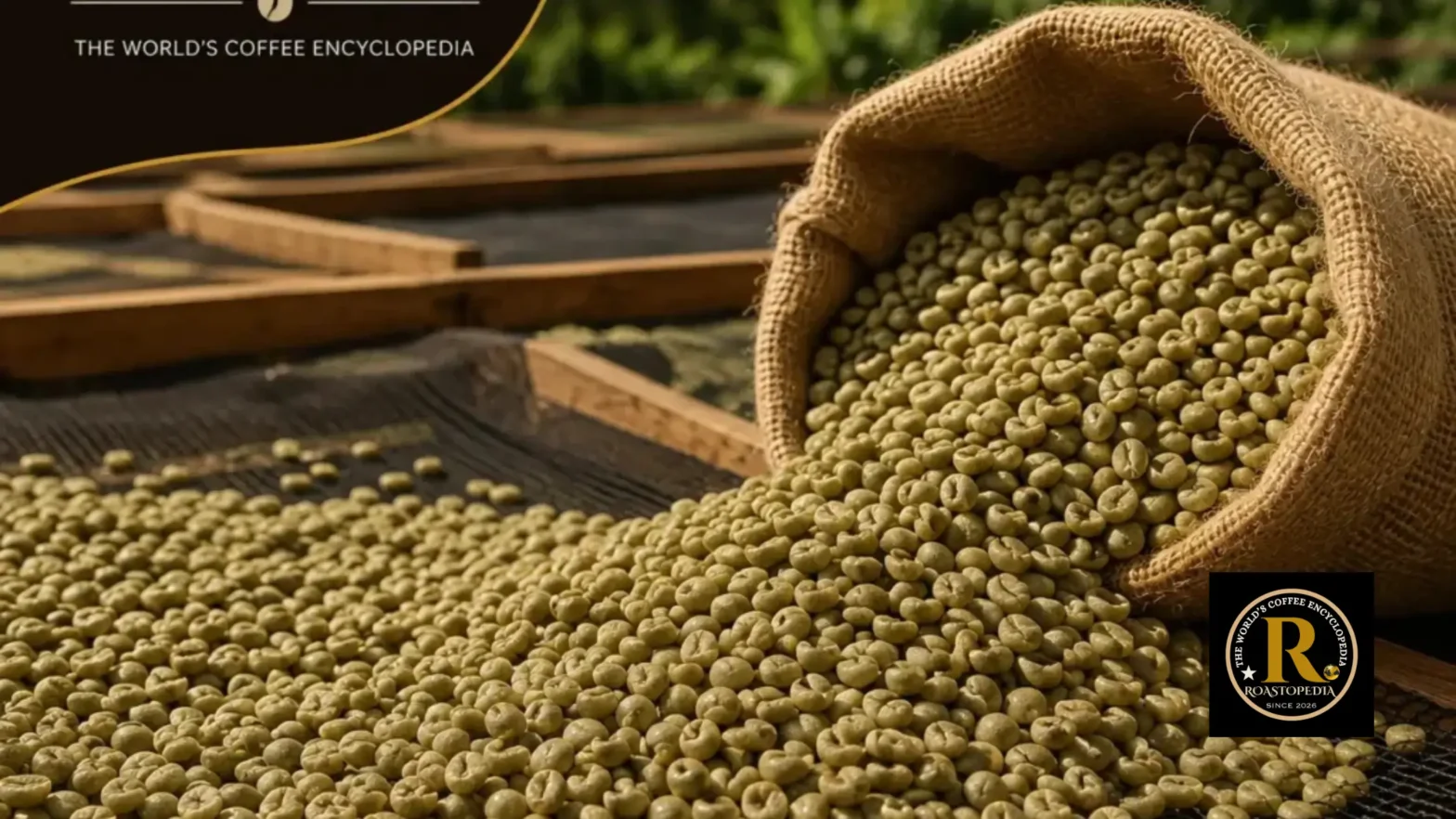
Green coffee loses quality during storage because it is a living, hygroscopic seed whose moisture content, water activity, and internal chemistry keep changing after harvest. Fluctuating humidity and temperature let beans absorb or shed water, which speeds up chemical breakdown, encourages mold, and drains away the acids, sugars, and lipids that build flavor. Even under ideal conditions, green coffee slowly ages, and poor storage only accelerates the decline. The result is a bean that roasts less evenly and cups flatter, staler, or more woody than fresh crop.
Moisture Content Is the First Line of Defense
Green coffee is typically dried and stored at a moisture content of roughly 10–12.5%, a range considered safe for both flavor stability and microbial safety. When beans sit above this window, internal reactions speed up and the risk of mold, insect infestation, and structural breakdown rises sharply. When moisture drops too low, coffee beans turn brittle and lose the compounds responsible for aroma and body. Either direction pulls the coffee away from its peak.
Water Activity Matters More Than Moisture Alone
Moisture content only tells you how much water is inside a bean, not how “available” that water is to fuel spoilage. Water activity (aw) measures the free water that microorganisms and enzymes can actually use, and it is considered a more reliable predictor of degradation than moisture percentage alone. The Specialty Coffee Association sets an upper water activity limit of 0.70 for specialty-grade coffee, with a safer working range closer to 0.55–0.65. Above roughly 0.77–0.85 aw, dangerous molds capable of producing mycotoxins can begin to grow.
Temperature Accelerates Every Chemical Reaction
Heat is a universal catalyst for the biochemical processes that age green coffee. Research on storage conditions shows that temperatures above about 30°C (86°F) significantly speed up lipid oxidation, Maillard-precursor breakdown, and enzymatic activity inside the bean. Studies comparing storage at different temperatures have found that beans held near 20°C age noticeably faster than beans kept cool, which is why many exporters and roasters favor stable, moderate warehouse temperatures below 25°C.
Lipid Oxidation Slowly Turns Beans Rancid
Green coffee contains a substantial share of unsaturated fatty acids, and these lipids are chemically unstable once exposed to oxygen, heat, or light. Accelerated storage studies on Robusta beans found that acid value, peroxide value, and free fatty acid content all rose steadily during storage, confirming ongoing lipid oxidation even in unroasted coffee. This oxidation is a major driver of the “woody” or “papery” taste associated with old crop coffee.
Chlorogenic Acids Break Down Over Time
Chlorogenic acids are among the most abundant and flavor-relevant compounds in green coffee, and they are not chemically stable across years of storage. Long-term studies tracking beans over several years found that hydrolysis and oxidation steadily degrade these acids, producing quinone derivatives with different sensory properties than the original compounds. Because chlorogenic acids influence acidity and body in the cup, their slow disappearance is part of why aged green coffee tastes duller.
Humidity Drives Mold, Swelling, and Off-Flavors
Relative humidity in the storage environment directly governs how much moisture a bean absorbs or releases. High ambient humidity encourages beans to swell, weakens their structure, and creates conditions favorable to mold, fungi, and bacteria that produce musty or earthy off-flavors. Low humidity does the opposite, drying beans out and stripping away delicate aromatics. Most storage guidance recommends keeping warehouse relative humidity between roughly 50% and 60% to avoid both extremes.
Oxygen, Light, and Packaging Choices
Beyond moisture and heat, ongoing exposure to oxygen and light adds another layer of slow deterioration. Hermetic, low-permeability packaging such as multilayer polyethylene bags — often protected inside an outer jute sack — limits oxygen exchange and helps beans hold their density and flavor for longer than beans left in permeable jute alone. Comparative storage trials have shown that packaging with lower oxygen permeability generally preserves quality markers better over extended periods. This is why many specialty coffee importers now favor sealed, oxygen-limiting bags over traditional burlap-only storage.
How Long Does Green Coffee Actually Stay Fresh?
Under well-controlled hermetic storage — moderate airflow, minimal light, and temperatures below roughly 25°C — green coffee can generally hold peak quality for up to about 12 months. After that window, it is often classified as “old crop” and gradually loses distinctive flavor notes and aroma even if it never spoils outright. This is why shipping timelines and warehouse conditions matter as much as the coffee’s origin or processing method.
The Bottom Line
Green coffee quality loss is not caused by a single factor but by the interaction of moisture, water activity, temperature, humidity, oxygen, and time. Each variable pushes internal chemistry — lipid oxidation, chlorogenic acid breakdown, and moisture-driven microbial risk — a little further from the bean’s fresh-crop baseline. Controlling storage conditions doesn’t stop aging entirely, but it slows it enough to protect cup quality for as long as possible.
See Also
- Does Light Roast Coffee Have More Caffeine Than Medium Roast?
- Does Grind Size Change Caffeine Extraction in Light Roast Coffee?
- The Role of Roast Level in Coffee Flavor Development
- How Soil, Altitude, and Climate Determine Coffee Flavor at Origin
- How Water Temperature Affects Coffee Extraction
- Why Does Channeling Cause Uneven Espresso Extraction Results?
- How to Pull an Espresso Shot
References
- Effect of green and roasted coffee storage conditions on selected characteristic quality parameters — PMC / Scientific Reports
- Stability and degradation of chlorogenic acids in green and roasted coffee beans during long-term storage — ScienceDirect
- Characterization of the Lipid Oxidation Process of Robusta Green Coffee Beans and Shelf Life Prediction during Accelerated Storage — PMC
- Specialty Coffee Association — Coffee Standards (Revised 2018), including the Water Activity Standard
- Specialty Coffee Association — Standards Development Program
- Specialty Coffee Association — Protocols and Best Practices
- Green Coffee Association — Recommended Coffee Warehouse Storage Practices
- Preservation and Moisture Estimation of Green Coffee — eScholarship, University of California
- Songer & Associates — Summary of Coffee Technical Literature Regarding Green Bean Moisture and Color
- MTPak Coffee — Why Does Green Coffee Storage Humidity Matter?
- MTPak Coffee — What Are the Best Practices for Green Coffee Storage?
- Cropster — Master Green Grading: A Coffee Roaster’s Guide
- LEBREW — Moisture Content vs Water Activity: Two Key Factors in Green Coffee Storage
- Espresso Academy — Green Coffee Defects: Complete Guide with Examples and SCA Table