
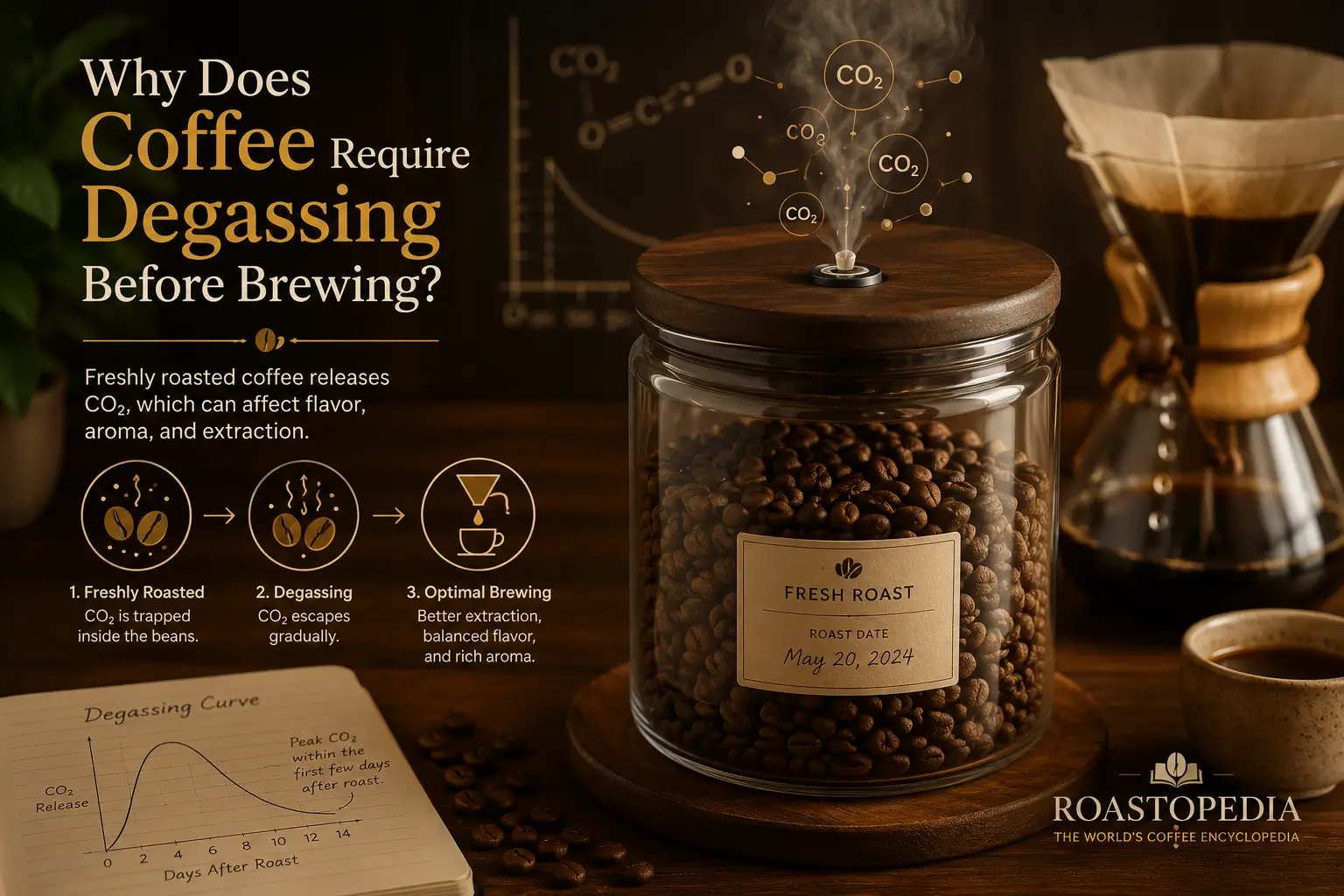
Coffee requires degassing before brewing because freshly roasted beans are still trapped with carbon dioxide, and that gas physically pushes water away from the grounds during extraction. Without a resting period, the escaping CO2 creates uneven saturation, blocks water from contacting the coffee evenly, and leads to a sour, thin, or unbalanced cup. Degassing simply gives the coffee bean time to release that excess gas so brewing water can do its job properly.
What Happens Inside the Bean During Roasting
Roasting triggers intense chemical change inside every coffee bean. Heat breaks down sugars and starches, produces aromatic compounds, and generates gas as a byproduct.
Roughly 90% of that gas is carbon dioxide, with small amounts of nitrogen and volatile organics filling out the rest. Much of it stays locked inside the bean’s porous internal structure until it can find a way out.
This trapped CO2 is also why beans “puff” audibly at first crack. Pressure builds until the cell walls give way, releasing some gas immediately while the bulk remains sealed inside.
Why Carbon Dioxide Interferes With Extraction
Carbon dioxide is hydrophobic, meaning it naturally repels water. When freshly roasted grounds meet hot water, the gas rushing out forms tiny bubbles that coat the coffee particles.
These bubbles act like a barrier, keeping water from making full contact with the grounds. The result is inconsistent extraction yield, where some particles give up too little flavor and others release too much too fast.
This is precisely why a bloom happens during pour-over brewing. That visible foam is escaping carbon dioxide, and it’s a strong visual cue that the coffee hasn’t fully degassed yet.
The Link Between Degassing and Channeling
Poorly degassed coffee doesn’t just extract unevenly on the surface; it can also disrupt flow beneath it. In espresso, trapped gas escaping through a compacted puck can carve out weak points in the coffee bed.
Water naturally follows the path of least resistance, rushing through these weak points instead of moving evenly through the puck. This uneven flow is known as channeling, and it’s a common cause of sour, unbalanced shots pulled from beans that are simply too fresh.
Proper degassing reduces this risk by lowering the volume of gas fighting against water during the shot.
How Roast Level Affects Degassing Time
Not all coffee degasses at the same rate. Roast level plays one of the biggest roles in how quickly CO2 escapes.
Darker roasts spend more time exposed to heat, which breaks down more of the bean’s cell structure. That added porosity lets gas escape faster, often within a few days.
Lighter roasts retain a tighter, denser structure. They hold onto carbon dioxide longer, sometimes requiring a week or more before they’re ready to brew at their best.
Degassing in Espresso vs. Filter Coffee
Brew method changes how much degassing time a coffee actually needs. Espresso is especially sensitive because it relies on short contact time and high pressure to force water through a compact bed of grounds.
Too much residual CO2 during an espresso shot causes excessive foaming, an unstable crema, and inconsistent extraction. Many baristas wait five to twelve days after roasting before pulling shots for this reason.
Slower, gentler methods like French press or drip coffee are more forgiving. Because contact time is longer and pressure is lower, these methods can tolerate slightly fresher beans without the same extraction penalties.
The Barista and Roaster’s Role in Managing Freshness
A skilled roaster accounts for degassing when planning bag release dates, often building in a rest period before coffee ever reaches a customer. Packaging with one-way valves lets CO2 escape without letting oxygen back in, protecting flavor during that window.
On the other end, the barista has to recognize the signs of under-degassed coffee at the machine. A shot that gushes, foams excessively, or tastes flat despite correct dosing often points back to roast date rather than grind size or tamping technique.
Understanding this relationship helps prevent both over-extraction and under-extraction that stem from timing rather than technique.
How to Tell If Your Coffee Has Finished Degassing
There’s a simple home test for this.
Seal a small batch of beans in a resealable bag, squeeze out the air, and leave it overnight.
If the bag puffs up by morning, gas is still escaping and the coffee needs more rest. If it stays flat, the beans have degassed enough to brew.
Tasting is the more reliable method in practice. Brew a cup daily after roasting and note when flavor stops improving; that’s usually the sweet spot between too fresh and starting to stale.
The Bottom Line
Degassing isn’t a delay standing between you and great coffee, it’s part of what makes great coffee possible. Letting carbon dioxide escape before brewing allows water to extract evenly, prevents channeling, and unlocks the full flavor a well-roasted bean has to offer. Skip it, and even the best beans from the best roaster can taste disappointing in the cup.
See Also
- Why Does Channeling Cause Uneven Espresso Extraction Results?
- How Water Temperature Affects Coffee Extraction
- How to Pull an Espresso Shot
- The Role of Roast Level in Coffee Flavor Development
- Does Grind Size Change Caffeine Extraction in Light Roast Coffee?
- How Long Should a V60 Drawdown Take?
References
- Perfect Daily Grind. “Coffee Degassing: What Does It Mean For Brewers & Roasters?”
- Bean Poet. “Why You Should Always Degas Your Freshly Roasted Coffee.”
- Burman Coffee Traders. “Degassing Coffee: Definition, Importance, & Factors.”
- Green Plantation. “Freshly Roasted Coffee: What Is Degassing and When to Drink Coffee After Roasting?”
- Bean & Bean Coffee Roasters. “What Is Coffee Degassing?”
- Fellow Products. “Understanding Degassing: Is Fresh Best?”
- Home Grounds. “Degassing Coffee and Why Fresher Is Not Always Better.”
- Berto Online. “The Science of Coffee Degassing: Understanding Its Impact on Flavor.”
- Hendon, Christopher H., et al. “Systematically Improving Espresso: Insights from Mathematical Modeling and Experiment.” Matter, 2020.
- Specialty Coffee Association (SCA). “Coffee Brewing Standards and Protocols.”
- Illy, Andrea, and Rinantonio Viani. Espresso Coffee: The Science of Quality. Academic Press.
- Rao, Scott. The Coffee Roaster’s Companion. Scott Rao Publishing.