
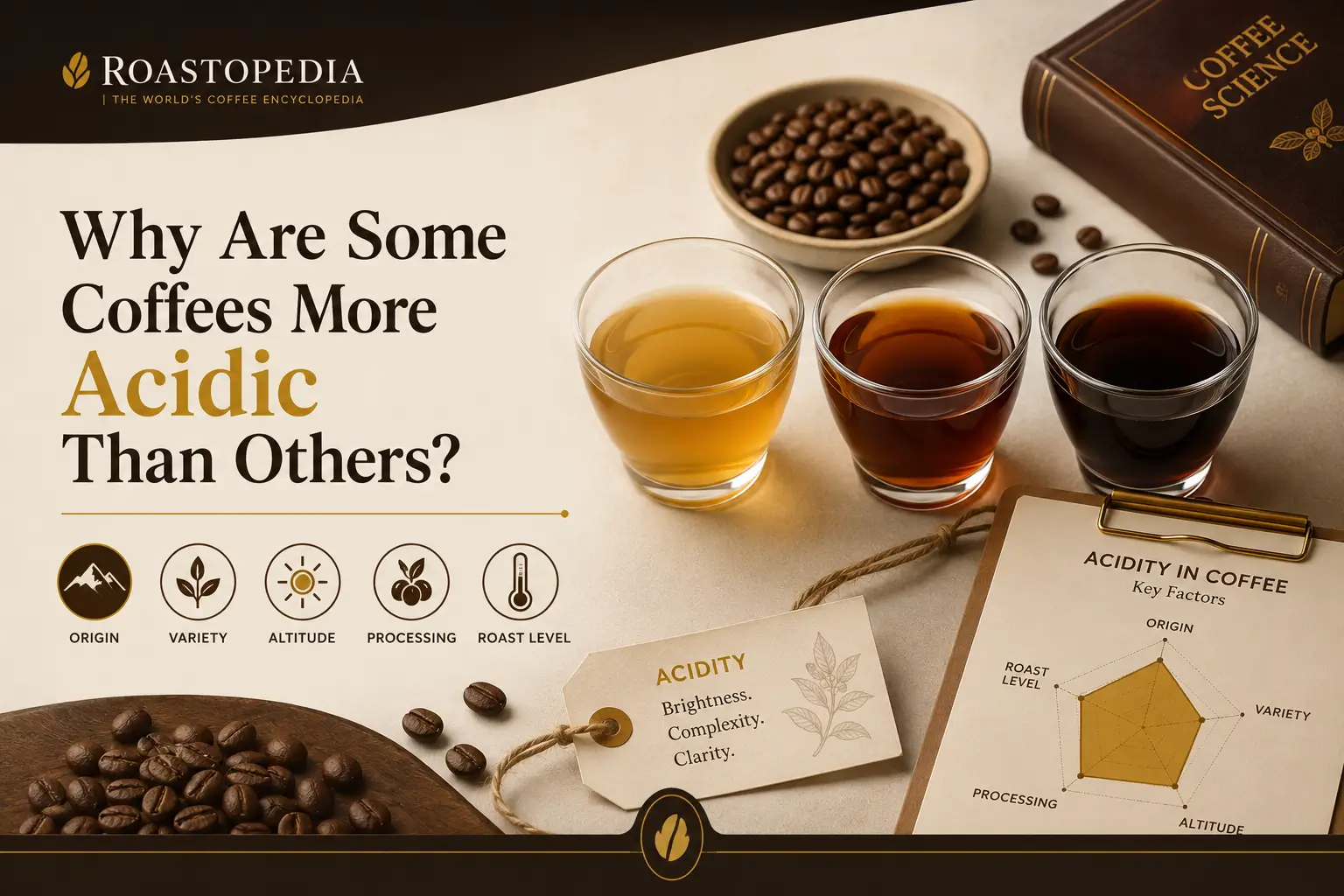
Some coffees are more acidic than others because of a combination of genetic, environmental, and processing factors that determine how many organic acids are present in the coffee bean, followed by roasting and brewing choices that determine how many of those acids survive into the final cup. Species, growing altitude, processing method, roast level, and extraction technique each independently influence the acid content and, therefore, the coffee acidity perceived by the drinker
Definition of Coffee Acidity
In coffee terminology, acidity refers to a sensory attribute rather than a measure of pH alone. It describes a bright, sharp, or tangy sensation detected primarily at the front and sides of the tongue, produced by organic acids such as chlorogenic, citric, malic, quinic, and acetic acid.
Acidity is generally classified as a desirable quality in specialty coffee, distinct from bitterness, which results from compounds formed later in roasting or from extraction faults. Acidity also contributes directly to coffee aroma, since many of the same volatile compounds responsible for perceived brightness also carry fruit-forward scent notes.
Species: Arabica vs. Robusta
Coffee species is the primary genetic determinant of acidity. Arabica beans contain a higher concentration of organic acids and sugars, along with lower chlorogenic acid content, producing a comparatively brighter, more complex cup.
Robusta beans contain higher levels of chlorogenic acid and caffeine but fewer organic acids, resulting in a flatter, more bitter, heavier-bodied cup with reduced acidity. Robusta is used in espresso blends primarily to increase crema stability and body rather than for acidity or flavor complexity.
Altitude and Origin
Growing altitude affects the rate at which the coffee cherry matures. Cooler temperatures at higher elevations slow this maturation, allowing organic acids to accumulate to a greater degree before harvest. This is documented in high-altitude origins such as Kenya and Ethiopia, which consistently produce coffees with pronounced citric and malic acid character.
Lower-altitude origins, such as much of Brazil’s commercial production, mature faster and yield beans with comparatively lower acidity and a heavier, nuttier flavor profile.
Soil composition, rainfall patterns, and cultivation method contribute additional variation. A single estate coffee grown at high elevation on nutrient-dense volcanic soil will typically show more pronounced acidity than a commodity-grade lot of the same species grown at lower elevation.
Some producers of organic coffee report that reduced-input cultivation supports more complex acid development, though this claim is not universally confirmed in controlled research.
Processing Method
Post-harvest processing of the coffee cherry affects which compounds remain in the green coffee prior to roasting. Washed processing typically preserves higher perceived acidity by removing mucilage before drying, producing a cleaner, brighter cup. Natural and honey processing allow the fruit to remain in contact with the bean for longer, generally increasing perceived sweetness and body while moderating acidity.
Roasting
Organic acids degrade progressively with heat exposure during roasting. Light roasts, removed from the roaster shortly after first crack, retain the majority of the bean’s original acid content and therefore taste noticeably brighter.
As roast level increases toward medium and dark profiles, thermal degradation breaks down these acids, replacing brightness with bitterness and caramelized, chocolate-like notes characteristic of dark roasts. Roast level is the single most direct and controllable factor affecting final acidity, independent of the bean’s origin or species.
Brewing Variables
Several brewing parameters influence how much acidity is extracted into the final beverage, independent of the bean itself:
- Water temperature: Organic acids extract early in the brewing process. Excessively hot water accelerates extraction of these compounds, while cooler water extracts fewer of them, muting perceived acidity.
- Flow rate and extraction time: Acids are among the first soluble compounds extracted from ground coffee. Short extractions, such as fast espresso shots, capture more acidity relative to sugars and bitter compounds, while longer extractions dilute or balance it with later-extracted compounds.
- Agitation: Increased agitation during brewing accelerates mass transfer between water and coffee particles, which can intensify extracted acidity if not controlled.
- Under extraction: Caused by insufficient contact time, a grind that is too coarse, or channeling through the portafilter basket, under extraction produces a sour, thin result. This differs from desirable acidity, as it reflects an extraction fault rather than an intended flavor characteristic.
- Over extraction: Excessive contact time or overly fine grind size pulls additional bitter compounds into the cup, which can mask or unbalance acidity rather than eliminate it.
- Degassing: Coffee releases carbon dioxide for a period following roasting. Brewing before adequate degassing has occurred can cause uneven saturation of the coffee bed, resulting in inconsistent extraction and unpredictable acidity.
Because these variables interact, coffee professionals monitor measurable indicators such as extraction yield and consistent dosing to maintain predictable acidity levels across repeated brews.
Which Coffee Type is the Most Acidic?
High-altitude, washed-processed Arabica coffee from East African origins, particularly Kenya and Ethiopia, is generally regarded as the most acidic category, showing pronounced citric and malic acid characteristics. Independent of origin, light roasts carry the highest acidity of any roast level, since minimal thermal degradation has occurred.
Which Coffee Type is the Least Acidic?
Dark-roasted Robusta, particularly from low-altitude origins, is generally the least acidic coffee category. Extended roasting time breaks down the majority of available organic acids, and Robusta’s naturally lower acid content leaves comparatively little acidity to begin with.
Cold brew coffee also ranks among the least acidic preparations regardless of bean type, as its extended, low-temperature steeping process extracts substantially fewer acidic compounds than hot brewing methods, typically producing a cup with roughly 60% less acidity than an equivalent hot-brewed coffee.
Summary
Coffee acidity results from a chain of factors: species and growing conditions determine the raw acid content of the green coffee, roasting determines how much of that content is preserved or degraded, and brewing method determines how much of the remaining acid is extracted into the cup.
The most acidic coffees are typically light-roasted, high-altitude, washed Arabica; the least acidic are typically dark-roasted Robusta or cold brew preparations.
See Also
- Why Are Some Coffee Beans Oily?
- Why Does Espresso Crema Disappear So Quickly Sometimes?
- Why Does Coffee Require Degassing Before Brewing?
- Why Does Fine Grinding Increase Espresso Channeling?
- Why Does Channeling Cause Uneven Espresso Extraction Results?
- How Soil, Altitude, and Climate Determine Coffee Flavor at Origin
- How Water Temperature Affects Coffee Extraction
- Does Green Coffee Go Stale Before Roasting?
- Why Does Green Coffee Lose Quality During Storage?
References
- Perfect Daily Grind — “Why Are Some Coffees More Acidic Than Others? A Brew & Roast Guide”
- Efico — “Coffee Chemistry & Acidity: A Roast & Brew Guide”
- Bulletproof — “Understanding Coffee Acidity: Flavor, Health & Acidity Levels”
- Bean Ground — “Coffee Acidity Explained: What It Is, How It Affects Taste, and How to Control It”
- Crockett Coffee — “Coffee Acidity – Roast Level Comparison”
- Stone Street Coffee — “Is Your Coffee Too Acidic?”
- DarkHorse Coffee Company — “Which Roast Of Coffee Is The Least Acidic? (Your Safe Option)”
- RoastRebels — “Acid in Coffee”
- Café Barista — “What’s the Difference Between Arabica and Robusta Coffee?”
- The Roasters Pack — “10 Differences Between Robusta & Arabica Coffee”
- First Shot Barista Training — “Arabica vs Robusta: Expert Coffee Insights”
- Espresso Canada — “Which Coffee Beans Are Better for Espresso: Arabica or Robusta?”
- Methodical Coffee — “Arabica Coffee vs. Robusta Coffee: What’s the Difference?”
- Coffeeness — “Arabica vs Robusta Coffee: Mass Marketing Meets Mass Appeal”
- EspressoWorks — “Robusta Coffee: What is it? Why is it better than Arabica coffee?”
- Espresso Barista — “Arabica vs Robusta: Complete Coffee Bean Guide”
- Specialty Coffee Association (SCA) — Coffee Cupping and Sensory Evaluation Protocols
- Home-Barista.com — “Ratio of Robusta to Arabica in Espresso Blends?” forum discussion