
The genus Coffea L. comprises over 120 species of flowering plants within the Rubiaceae family. While the genus is widely distributed across tropical Africa, Asia, and the Indian Ocean islands, commercial production is dominated by two primary species. These plants are characterized by opposite, elliptical leaves and drupaceous fruits containing two seeds, known commercially as coffee beans.
Botanical Classification and Morphology
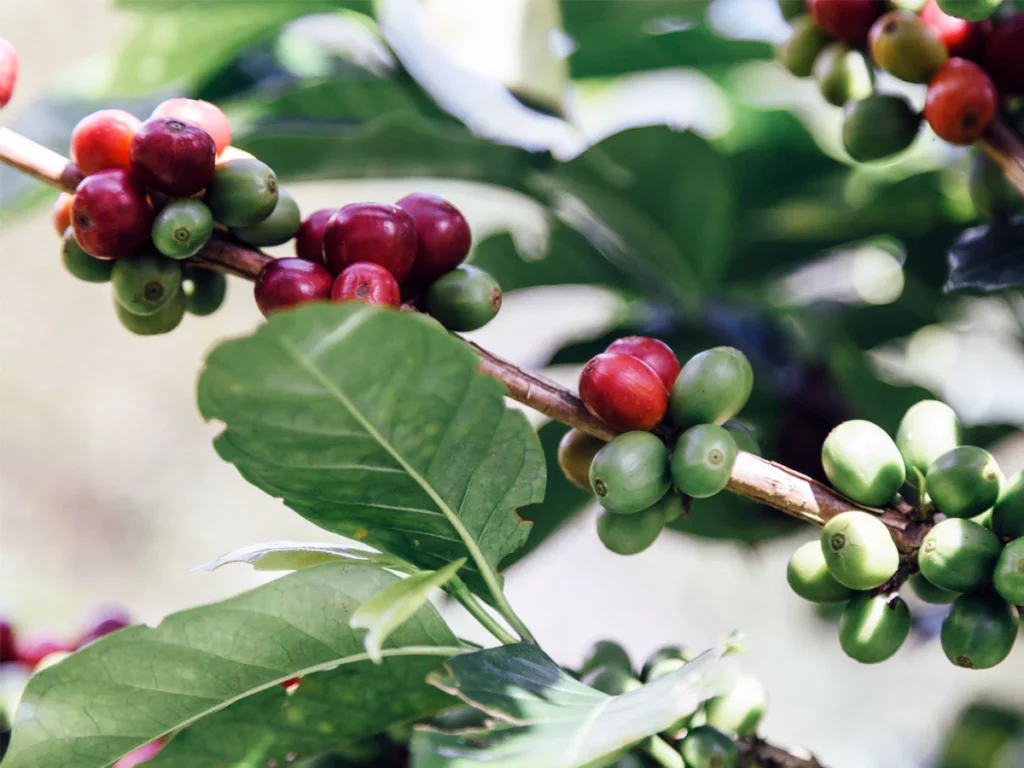
Coffea belongs to the tribe Coffeeae within the subfamily Ixoroideae. Most species are evergreen shrubs or small trees, reaching heights of 8 to 10 meters in wild states. The plants feature a dimorphic branching pattern where vertical orthotropic stems produce horizontal plagiotropic branches.
Flowers are actinomorphic, typically pentamerous, and emit a fragrance similar to jasmine. The fruit, or “coffee cherry,” matures over six to eleven months depending on the species and environmental conditions. It consists of an exocarp, a fleshy mesocarp, and a parchment-like endocarp protecting the seeds.
Commercial Classification
The global coffee industry categorizes the genus into four commercially relevant species (coffee types or also called bean types). These are differentiated by genetic ploidy levels, chemical composition, and environmental adaptation.
Coffea arabica (Arabica)
Arabica accounts for approximately 60–70% of global coffee production. It is a tetraploid species (2n = 4x = 44) and is unique within the genus for its self-fertility. It originates in the Ethiopian highlands and requires altitudes between 600 and 2,000 meters.
Coffea canephora (Robusta)
Robusta represents 30–40% of the world market and is a diploid species (2n = 2x = 22). It exhibits high resistance to pests and thrives in warm, humid lowland equatorial climates. The caffeine concentration is significantly higher than that of Arabica, typically ranging from 2.2% to 2.7%.
Coffea liberica (Liberica)
Liberica is a diploid species characterized by vigorous growth and a high tree canopy. It is historically significant in Southeast Asia, particularly in the Philippines. The seeds are notably larger than other commercial species and possess a distinct almond-like shape.
Coffea excelsa (Excelsa)
Excelsa is technically a variety of C. liberica (C. liberica var. dewevrei) but is often marketed as a separate species. It is distinguished by a tart sensory profile and resistance to common coffee diseases. Cultivation is primarily concentrated in Central and East Africa and Southeast Asia.
Technical Comparison of Species
| Specification | C. arabica | C. canephora | C. liberica |
| Chromosome Count | 44 | 22 | 22 |
| Ploidy Level | Tetraploid | Diploid | Diploid |
| Caffeine Content | 1.2% – 1.5% | 2.2% – 2.7% | 1.2% – 1.5% |
| Pollination | Self-fertile | Cross-pollinating | Cross-pollinating |
| Native Range | Ethiopia, Sudan | Western/Central Africa | Western/Central Africa |
Genetic Diversity and Conservation
A majority of Coffea species remains wild and is not utilized for beverage production. These species, including C. stenophylla and C. eugenioides, provide essential genetic reservoirs for climate adaptation. Research into these wild taxa focuses on drought tolerance and resistance to Hemileia vastatrix (coffee leaf rust).
See Also:
- Arabica: Genetics and Cultivation
- Robusta: Resiliency and Production
- Liberica: The Giant of the Coffee World
- Excelsa: The Tart Variety
References
- Royal Botanic Gardens, Kew. “Genus Coffea L.” Plants of the World Online. https://powo.science.kew.org/taxon/urn:lsid:ipni.org:names:37340-1
- ScienceDirect. “Coffea – an overview.” Pharmacology, Toxicology and Pharmaceutical Science. https://www.sciencedirect.com/topics/pharmacology-toxicology-and-pharmaceutical-science/coffea
- Specialty Coffee Association. “A Botanist’s Guide to Specialty Coffee.” https://sca.coffee/research/botany
- United States International Trade Commission. “Is Robusta on the Rise? Trends in Coffee Species Trade.” https://www.usitc.gov/publications/332/executive_briefings/ebot_robusta_on_the_rise.pdf
- Counter Culture Coffee. “Coffee Basics: Varieties.” https://counterculturecoffee.com/blogs/counter-culture-coffee/coffee-basics-varieties
- Coffed Roasters. “Types and Varieties of Coffee Around the World.” https://coffedroasters.com/blog/coffe/types-and-varieties-of-coffee-around-the-world-a-guide-to-popular-coffee-species-and-flavors
- Wikipedia. “Coffea.” https://en.wikipedia.org/wiki/Coffea