
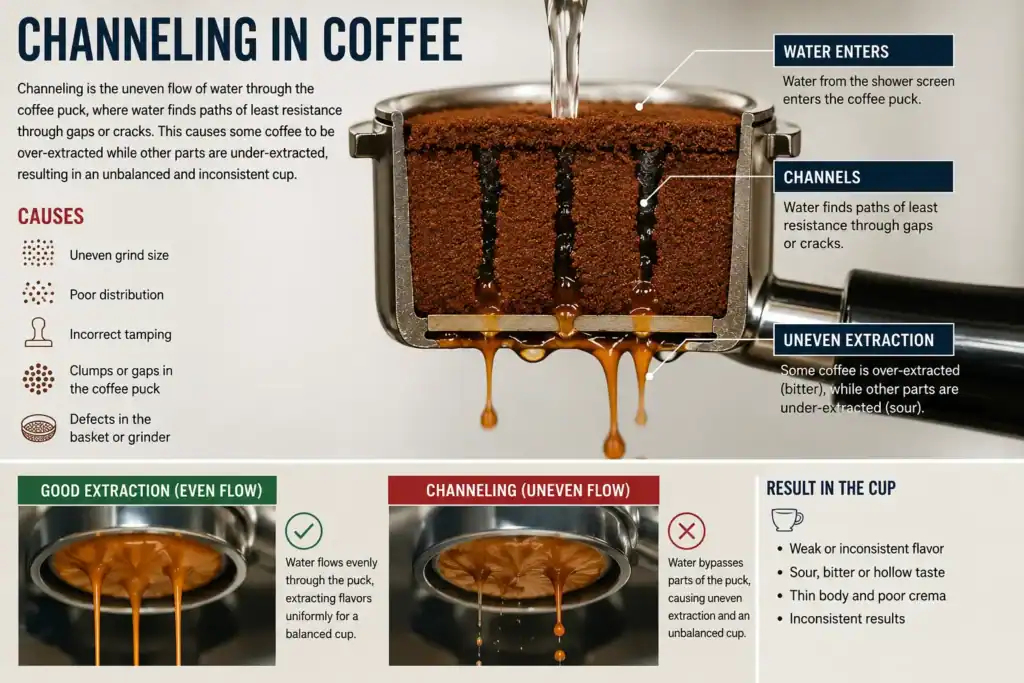
Channeling in coffee is the uneven flow of water through a bed of ground coffee during brewing, particularly in espresso preparation. It occurs when water finds paths of least resistance through cracks, gaps, or poorly distributed grounds, causing some coffee to be over-extracted while other areas remain under-extracted.
The result is an unbalanced or uneven cup that may taste weak, sour, bitter, or inconsistent. Channeling is commonly caused by uneven, fine grinding, poor distribution, improper tamping, or defects in the coffee puck.
The term is most critically applied to espresso brewing, where water is forced through a compressed puck of finely ground coffee at pressures typically between 8 and 10 bar (116–145 psi).
However, channeling is also documented in other pressure-driven and gravity-fed brew methods, including moka pot brewing, AeroPress preparation, and, to a lesser extent, pour-over techniques.
A channel is defined technically as a macroscopic preferential flow path — a void, crack, or low-density region within the coffee bed through which water travels with significantly reduced resistance compared to adjacent zones.
Channels may be single and severe or multiple and diffuse, and their effects on cup quality are consistently negative.
Etymology
The word channel derives from the Old North French canel and the Latin canalis, meaning ‘pipe,’ ‘groove,’ or ‘canal.’ The Latin root shares an origin with canna, meaning ‘reed’ — itself borrowed from Greek kanna — reflecting the tubular, conduit-like nature of the concept.
In fluid mechanics and hydrology, the word channel has long been used to describe a defined pathway through which fluid preferentially flows. Its adoption into the coffee lexicon reflects the influence of engineering and physics disciplines on specialty coffee discourse in the late twentieth and early twenty-first centuries.
The term became standardized within barista training curricula and sensory evaluation frameworks as the specialty coffee movement formalized extraction science, particularly during the rise of the Third Wave (c. 1990s–2000s).
Within the Specialty Coffee Association (SCA) and World Barista Championship (WBC) frameworks, channeling is used as a technical diagnostic term without metaphorical ambiguity — it refers specifically and consistently to the preferential flow phenomenon described above.
History
The history of channeling as a recognized and named phenomenon is inseparable from the history of espresso machine development. Early espresso machines, invented in Italy in the late 19th century, operated at relatively low pressures (approximately 1.5–2 bar) driven by steam rather than mechanical pumps.
At these pressures, the hydrodynamic forces involved were insufficient to produce the same severity of channeling observed in modern machines, though uneven extraction was nonetheless common.
The pivotal technological transition came in 1948, when Achille Gaggia commercialized the spring-lever espresso machine, introducing extraction pressures of approximately 8–9 bar — a standard that persists to the present day.
At these elevated pressures, the interaction between water and the coffee puck became dramatically more sensitive to puck preparation quality. Channeling, as a distinct failure mode, became a practical and observable problem requiring systematic management.
Throughout the 1950s–1980s, awareness of channeling existed among professional baristi in Italy and elsewhere, but was addressed largely through empirical craft knowledge rather than scientific analysis.
Techniques such as the Weiss Distribution Technique (WDT) forerunners, hand-tamping (see tamping) with consistent force, and puck polishing emerged from this period as pragmatic responses to channeling.
The scientific study of channeling accelerated in the 1990s and 2000s with the growth of the specialty coffee industry and the application of food science and fluid dynamics research to brewing.
Researchers including Ernesto Illy — whose family firm commissioned early engineering studies of espresso — contributed to understanding extraction uniformity.
The 2018 study by Cameron et al. published in Matter (Elsevier) quantified the relationship between grind coarseness, extraction pressure, and channeling risk, providing empirical data supporting what baristas had observed empirically for decades.
More recently, the development of precision tools — including bottomless (naked) portafilters, which make channeling visually apparent during extraction, and pressure profiling machines that allow baristas to modulate pressure curves — has allowed systematic real-time identification and mitigation of channeling.
Scientific Principles
Darcy’s Law and Porous Media Flow
The flow of water through a coffee puck is governed by Darcy’s Law, which describes the flow of a fluid through a porous medium:
Q = –(kA/μ) · (dP/dL)
Where Q is volumetric flow rate, k is permeability of the medium, A is cross-sectional area, μ is dynamic viscosity of the fluid, and dP/dL is the pressure gradient.
Channeling occurs when localized regions of the puck exhibit significantly higher permeability (k) than surrounding regions. Water, following the path of least resistance dictated by pressure differential, preferentially migrates toward and through these high-permeability zones.
Causes of Differential Permeability
Several physical factors create differential permeability within a coffee puck:
Grind non-uniformity (fines migration): Espresso grinders produce a particle size distribution that includes both coarse particles and ultra-fine particles (fines).
Under extraction pressure, fines can migrate and accumulate non-uniformly within the puck, creating regions of very low permeability adjacent to regions of higher permeability. This heterogeneity in particle size distribution is a primary driver of channeling.
Tamping defects: An improperly leveled tamp — applied at an angle relative to the portafilter basket — creates a puck with a density gradient: one side more compressed and less permeable, the other less compressed and more permeable. Water preferentially flows through the less compressed side.
Distribution defects: Uneven coffee distribution in the basket prior to tamping creates density variations that tamping alone cannot fully correct. Clumping of grounds — caused by electrostatic charge or humidity — creates macro-scale low-density regions.
Puck swelling and pre-infusion dynamics: During pre-infusion, when water first contacts the puck at low pressure, CO₂ degassing from freshly roasted coffee can create irregular swelling. If this swelling is asymmetric, or if CO₂ accumulates unevenly, nascent channels can form before full extraction pressure is applied.
Basket geometry and material defects: Inconsistencies in the perforations of the portafilter basket can create localized regions where water exits the puck preferentially, inducing backward pressure effects that contribute to channeling.
Thermal Effects
Water temperature interacts with channeling dynamics. In a channeled puck, water moving rapidly through a channel has limited contact time with coffee solids and exits at temperatures closer to the boiler temperature.
In under-extracted zones bypassed by the channel, coffee solids may receive less thermal energy, further reducing solubility of desirable compounds in those regions. This thermal heterogeneity compounds the chemical extraction imbalance.
Applications
Detection Methods
Bottomless portafilter observation: The removal of the standard spouted portafilter bottom exposes the underside of the puck during extraction. A properly extracted shot flows as a single, centered, visually uniform stream (the ‘tiger striping’ pattern of blonde and brown).
A channeled shot exhibits lateral spraying, asymmetric streams, blonding at the edges rather than the center, or sudden high-velocity jets from localized points — all indicative of preferential flow paths.
Spent puck inspection: After extraction, the spent puck can be removed and inspected. Channels appear as visible holes, cracks, or pale (under-extracted) zones. Wet, dark, and cohesive areas surrounding a pale zone indicate severe channeling.
Pressure profiling and flow rate monitoring: Modern pressure-profiling espresso machines equipped with flow meters can identify channeling indirectly through flow rate anomalies.
A sudden increase in flow rate mid-extraction, without a corresponding change in programmed pressure, is characteristic of channel formation — the puck’s effective resistance has abruptly decreased as a channel opens.
Mitigation Techniques
Weiss Distribution Technique (WDT): Developed by John Weiss and popularized within the specialty coffee community in the 2000s, WDT involves using fine needles to stir and homogenize ground coffee within the portafilter basket prior to tamping. This breaks up clumps and creates a more uniform particle distribution, reducing the density gradients that initiate channeling.
Leveling and distribution tools: Mechanical distribution tools — including OCD (Ona Coffee Distributor)-style levelers and spinning distribution devices — standardize puck surface flatness and density prior to tamping, reducing tamping-induced channeling.
Consistent tamping: Application of tamping force perpendicular to the basket plane, with consistent pressure (commonly cited as 15–20 kg / 33–44 lbs, though uniformity of angle is more critical than specific force), minimizes density gradients.
Pressure profiling: Pre-infusion at low pressure (1–3 bar) before ramping to full extraction pressure allows the puck to saturate gradually and uniformly before high-pressure flow is applied, reducing the likelihood of channel formation during the critical initial phase of extraction.
Grind optimization: Grind settings that minimize the proportion of ultra-fine particles (fines) reduce fines migration and the permeability heterogeneity it creates. Some grinders are specifically engineered for reduced bimodal particle size distributions.
Importance in Coffee Production
Channeling is widely regarded as one of the primary causes of inconsistent espresso quality in both commercial and home brewing contexts. Its importance extends across several dimensions:
Sensory quality: A channeled shot exhibits a characteristic flavor profile combining bitterness (from over-extracted zones), sourness (from under-extracted zones), and overall thinness or dilution.
The resulting cup fails to represent the coffee’s potential flavor characteristics — origin notes, processing flavors, and roast profile are masked or distorted.
Economic impact: In commercial café environments, channeling that goes undetected results in customer-facing quality inconsistency.
A barista serving channeled shots may inadvertently serve drinks that fail to meet the quality standards associated with the price point of specialty espresso.
Yield and waste: Channeling effectively wastes a portion of each dose. The coffee solids in bypassed zones of the puck contribute no dissolved material to the beverage. Since specialty coffee is priced at a premium, the extraction efficiency loss associated with channeling has a measurable cost-per-shot impact.
Reproducibility and calibration: Channeling represents the principal barrier to espresso reproducibility. Even when all controllable variables (dose, grind, tamp pressure, water temperature, machine pressure) are held constant, stochastic channeling events introduce shot-to-shot variability that undermines calibration efforts.
Related Concepts
Extraction yield: The percentage of soluble coffee solids dissolved from the dry coffee mass into the beverage. Channeling consistently produces lower-than-optimal extraction yields in aggregate, while creating extreme local variations between over- and under-extracted zones within the same puck.
Permeability: The property of the coffee puck that determines its resistance to water flow. Channeling results from heterogeneous permeability distribution within the puck. Related to tamping pressure, grind distribution, and particle size.
Pre-infusion: A brewing phase in which water saturates the coffee puck at low pressure before full extraction pressure is applied. Properly executed, pre-infusion reduces channeling risk by promoting uniform puck saturation.
Weiss Distribution Technique (WDT): A specific channeling mitigation technique involving needle-based redistribution of grounds prior to tamping.
Bottomless portafilter: A diagnostic and aesthetic espresso accessory that exposes puck extraction for visual channeling assessment.
Tamping: The process of compressing coffee grounds in a portafilter basket. A critical variable in channeling risk management.
Puck preparation: The collective set of practices — dosing, distribution, tamping — applied to coffee grounds before brewing. The primary domain in which channeling is controlled.
Total Dissolved Solids (TDS): A measure of extraction concentration. Channeling produces cups with lower-than-expected TDS for the dose used.
References
1. Cameron, M., et al. (2020). ‘Systematically Improving Espresso: Insights from Mathematical Modeling and Experiment.’ Matter, 2(3), 631–648. Elsevier. DOI: 10.1016/j.matt.2019.12.019.
2. Illy, A., & Viani, R. (Eds.). (2005). Espresso Coffee: The Science of Quality (2nd ed.). Academic Press / Elsevier. ISBN: 978-0-12-370371-2.
3. Petracco, M. (2005). ‘Technology IV: Beverage Preparation – Brewing Trends for the New Millennium.’ In Espresso Coffee: The Science of Quality (2nd ed., pp. 289–315). Academic Press.
4. Specialty Coffee Association. (2020). Coffee Skills Program: Barista Skills – Foundation. SCA. Available at: https://sca.coffee
5. Weiss, J. (2006). Distribution technique for espresso puck preparation. Unpublished practitioner document; methodology documented in CoffeeGeek community archives and subsequently in Barista Hustle curriculum.
6. Huntington, S. (2016). The Physics of Filter Coffee. Scott Huntington / Filter Stories. DOI reference unavailable; peer-reviewed equivalent: Batali, M. E., et al. (2020). ‘Brew Temperature, At Fixed Brew Strength and Extraction Yield, Has Little Impact on the Sensory Profile of Drip Brew Coffee.’ Scientific Reports, 10, 16450.
7. Moldvaer, A. (2014). Coffee Obsession. DK Publishing. ISBN: 978-1-4654-2576-4.
8. World Barista Championship. (2023). WBC Rules and Regulations. World Coffee Events. Available at: https://worldcoffeeevents.org
9. Ditting, K. (2017). ‘Grind Particle Size and Its Effect on Espresso Extraction.’ Kaffeemühle Ditting AG Technical Bulletin. Uzwil, Switzerland.
10. Brozzoni, F. (2019). ‘Pre-infusion Dynamics and Channeling Reduction in Espresso Extraction.’ Proceedings of the 24th ASIC International Conference on Coffee Science. Association Scientifique Internationale pour le Café (ASIC).