
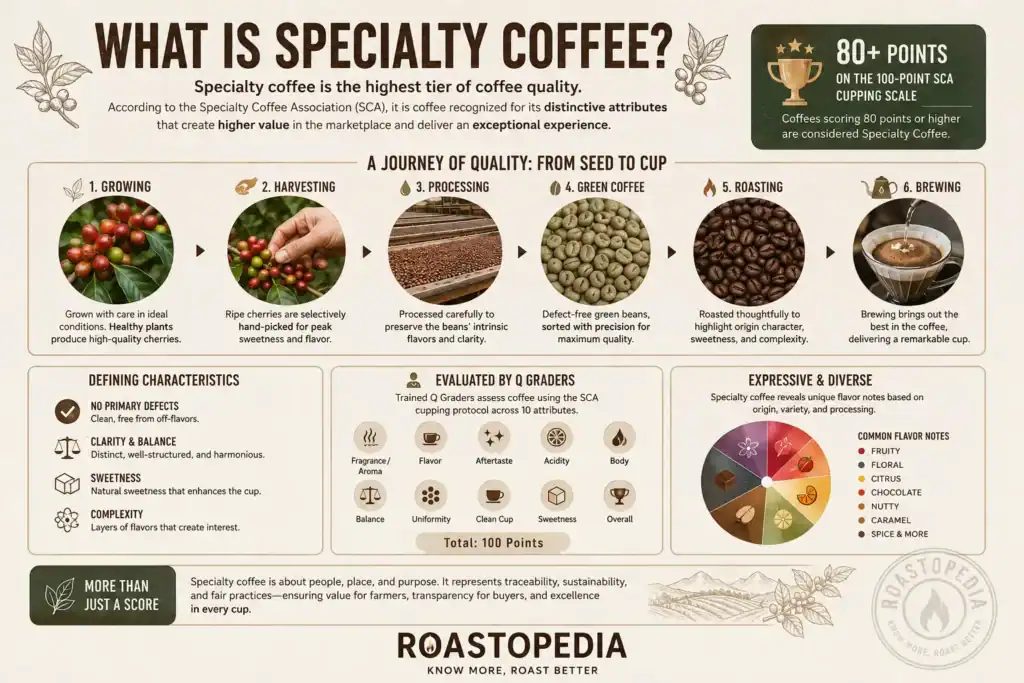
Specialty coffee is coffee distinguished by exceptional quality, traceability, and sensory excellence throughout the entire value chain, from cultivation and harvesting to processing, roasting, brewing, and consumption. More than a category of coffee, specialty coffee represents a philosophy that prioritizes quality over volume, transparency over anonymity, and craftsmanship over standardization.
Although commonly associated with the widely cited eighty-point threshold used in green coffee grading, specialty coffee is not defined solely by a numerical score. It encompasses a complex ecosystem of producers, exporters, importers, roasters, baristas, educators, researchers, and consumers who share a commitment to preserving and expressing the unique characteristics of coffee.
Over the course of several decades, specialty coffee has transformed coffee from a largely undifferentiated commodity into one of the world’s most studied, discussed, and celebrated agricultural products. Today, it influences cultivation practices, processing innovations, roasting philosophies, brewing techniques, sensory science, sustainability initiatives, and consumer expectations across the globe.
Etymology and Origin of the Term
The phrase specialty coffee entered the coffee lexicon during the early 1970s. The word specialty derives from the Latin specialis, meaning “particular” or “individual.” Applied to coffee, the term emphasized distinction and uniqueness rather than mass production.
The expression gained prominence when coffee trade pioneer Erna Knutsen used it to describe coffees possessing exceptional flavor characteristics derived from specific geographic microclimates. Her use of the term marked a significant departure from the prevailing view of coffee as a largely interchangeable commodity.
For perhaps the first time, coffee was being discussed not simply as coffee, but as a product capable of expressing place, variety, processing method, and human craftsmanship.
Coffee Before Specialty Coffee
For much of modern history, coffee functioned primarily as a commodity crop.
Coffee was bought and sold in enormous quantities through international markets where consistency, availability, and price often received greater attention than sensory quality. Most consumers knew little about where their coffee originated, how it was processed, or which varieties had been used.
Coffee labels frequently provided minimal information beyond roast level or brand identity. Beans from multiple countries and harvests were routinely blended to create standardized products designed for mass consumption.
This system enabled coffee to become one of the world’s most traded agricultural commodities, but it also encouraged the treatment of coffee as a uniform product rather than an agricultural expression of origin.
The Emergence of Quality Concerns
By the mid-twentieth century, certain importers, roasters, and producers began questioning whether the commodity model adequately reflected coffee’s potential.
Exceptional lots occasionally appeared that demonstrated remarkable sweetness, complexity, aroma, and regional character. These coffees differed dramatically from the generic blends dominating commercial markets.
Such observations laid the foundation for a movement that would eventually redefine quality in coffee.
Erna Knutsen and the Birth of Specialty Coffee
The modern history of specialty coffee begins with Erna Knutsen.
Working as a coffee importer in an industry largely dominated by men, Knutsen recognized that certain coffees possessed extraordinary sensory qualities linked to their specific growing environments. She argued that these coffees deserved separate recognition rather than being absorbed into anonymous commodity blends.
Her vision challenged conventional assumptions about coffee value.
Instead of emphasizing uniformity, she celebrated difference. Instead of treating origin as incidental, she treated it as essential.
The concept would eventually evolve into an international movement that reshaped nearly every aspect of coffee production and consumption.
The Early Specialty Coffee Movement
Farmers played a central role in the emergence of specialty coffee.
As markets began rewarding quality rather than merely volume, producers gained incentives to improve harvesting practices, invest in processing infrastructure, cultivate superior varieties, and experiment with innovative production methods.
Selective harvesting, improved fermentation control, and enhanced drying techniques became increasingly important.
Importers and Traders
Importers helped create pathways through which exceptional coffees could reach international markets while maintaining traceability and identity.
Relationships between buyers and producers became more collaborative, with increasing emphasis placed on transparency and long-term partnerships.
Roasters
Roasters contributed significantly to the movement by developing roasting approaches designed to highlight rather than obscure origin characteristics.
Instead of pursuing uniform roast profiles, many specialty roasters sought to reveal the unique sensory attributes inherent in individual coffees.
Consumers
Perhaps most importantly, consumers became willing to view coffee as a product worthy of exploration.
Just as wine enthusiasts discuss regions, varieties, and vintages, coffee drinkers have increasingly become interested in origins, cultivars, processing methods, and brewing techniques.
The Development of Quality Standards
As specialty coffee expanded, objective methods for evaluating quality became increasingly necessary.
The industry responded by developing standardized sensory protocols designed to assess coffee systematically.
These protocols examined attributes including:
- Aroma
- Flavor
- Acidity
- Sweetness
- Body
- Balance
- Uniformity
- Clean cup
- Aftertaste
The goal was not merely to identify defects but to recognize excellence.
Standardized evaluation methods enabled buyers and producers from different countries to communicate about quality using a shared framework.
The Emergence of the Eighty-Point Threshold
One of the most influential developments in specialty coffee history was the adoption of numerical quality scoring systems.
Within these systems, coffees scoring eighty points or above under established evaluation protocols generally came to be recognized as specialty coffee.
This benchmark provided the industry with a practical quality threshold. However, the eighty-point standard was never intended to serve as the sole definition of specialty coffee.
A coffee may achieve a high score yet fail to embody the transparency, traceability, craftsmanship, and quality culture associated with specialty coffee. Likewise, many professionals argue that the true spirit of specialty coffee extends beyond numerical evaluation.
The score represents a gateway rather than a complete definition.
Specialty Coffee as a Supply Chain Philosophy
One of the defining characteristics of specialty coffee is that quality is viewed as a continuous responsibility shared across the entire supply chain.
At Origin
Quality begins long before harvesting.
Environmental conditions, altitude, climate, soil composition, variety selection, agricultural practices, and harvest timing all influence the final cup.
Specialty coffee production typically emphasizes careful cherry selection and meticulous farm management.
During Processing
Processing transforms harvested coffee cherries into stable green coffee.
Methods such as washed, natural, honey, anaerobic, and experimental fermentations can profoundly influence flavor development.
In specialty coffee, processing is treated not merely as a preservation step but as a critical quality stage.
During Storage and Export
Maintaining quality requires careful handling throughout storage and transportation.
Temperature fluctuations, excessive humidity, and improper packaging can degrade even the finest coffees.
During Roasting
Roasting represents one of the most influential stages in determining how coffee’s potential is expressed.
Specialty roasting generally aims to reveal origin characteristics rather than impose a dominant roast flavor.
During Brewing
Even exceptional coffee can fail to reach its potential if brewed poorly.
Grinding, extraction, water quality, brewing method, and technique all contribute to the final sensory experience.
Specialty Coffee and Terroir
One of the concepts frequently associated with specialty coffee is terroir, a term borrowed from agriculture and wine.
Terroir refers to the influence of environmental conditions on agricultural products.
In coffee, terroir may include:
- Altitude
- Climate
- Rainfall patterns
- Soil composition
- Sun exposure
- Local ecology
Specialty coffee embraces the idea that coffees from different places should taste different.
Rather than eliminating regional distinctions, the movement seeks to understand and celebrate them.
Specialty Coffee and Sensory Quality
At its core, specialty coffee remains fundamentally concerned with sensory excellence.
Exceptional specialty coffees often display:
Complexity
Multiple identifiable flavor and aroma characteristics.
Sweetness
Natural sweetness resulting from careful cultivation, processing, roasting, and brewing.
Clarity
Distinct and recognizable flavor expression.
Balance
Harmony among acidity, sweetness, body, and aftertaste.
Cleanliness
Freedom from defects and undesirable sensory attributes.
Distinctiveness
Characteristics that distinguish one coffee from another.
These qualities collectively contribute to the perception of quality that defines specialty coffee.
Is Specialty Coffee Simply Coffee Scoring Above Eighty Points?
No.
While numerical grading systems have become important tools within the industry, specialty coffee cannot be reduced to a single score.
The eighty-point threshold serves primarily as a practical benchmark for green coffee evaluation. It helps establish minimum quality expectations, but it does not capture every dimension of specialty coffee.
Specialty coffee is equally concerned with transparency, traceability, sustainability, craftsmanship, education, and sensory expression.
The industry’s most influential participants increasingly recognize that quality exists within a broader context than score sheets alone can describe.
Specialty Coffee vs. Commercial Coffee
| Feature | Specialty Coffee | Commercial Coffee |
| Primary Focus | Quality | Volume and consistency |
| Traceability | Typically high | Often limited |
| Harvesting | Selective picking | Frequently mixed harvesting |
| Processing | Carefully controlled | Often standardized |
| Sensory Evaluation | Central to quality assessment | Less emphasized |
| Roasting Philosophy | Origin expression | Uniform flavor profile |
| Consumer Experience | Exploration and differentiation | Consistency and familiarity |
| Pricing Structure | Quality-driven | Commodity-driven |
| Transparency | Strong emphasis | Variable |
| Relationship to Origin | Celebrated | Often obscured |
The Third Wave and Beyond
The rise of specialty coffee is closely associated with what many observers describe as the Third Wave Coffee Movement.
This movement encouraged consumers to view coffee as an artisanal agricultural product rather than a simple commodity beverage.
Third-wave cafés emphasized:
- Single origins
- Manual brewing
- Transparency
- Direct trade relationships
- Coffee education
- Sensory exploration
Although specialty coffee predates the third wave, the two concepts became deeply interconnected.
Criticisms and Debates
Like any influential movement, specialty coffee has attracted criticism and debate.
Some critics argue that excessive focus on scoring systems can oversimplify quality. Others suggest that specialty coffee sometimes prioritizes novelty over accessibility.
Questions have also emerged regarding sustainability, producer compensation, inclusivity, and the concentration of value within certain segments of the supply chain.
These debates continue to shape the evolution of specialty coffee and encourage ongoing reflection within the industry.
Specialty Coffee in the Twenty-First Century
Today, specialty coffee exists as a global network connecting producers and consumers across continents.
Advances in processing science, sensory research, roasting technology, brewing equipment, and digital communication have accelerated innovation throughout the industry.
Coffee professionals now routinely discuss fermentation protocols, extraction theory, water chemistry, genetic varieties, and sensory analysis with a level of sophistication that would have been uncommon only a few decades ago.
Specialty coffee has become both a commercial sector and a cultural movement.
The Future of Specialty Coffee
The future of specialty coffee will likely be shaped by challenges and opportunities that extend beyond the cup itself.
Climate change, agricultural sustainability, economic equity, technological innovation, and consumer education are expected to influence the industry’s direction for decades to come.
Yet despite evolving definitions and emerging trends, the central principle that gave rise to specialty coffee remains remarkably consistent: the belief that coffee possesses qualities worth preserving, understanding, and celebrating.
From a single cherry growing on a mountainside to a carefully brewed cup served thousands of kilometers away, specialty coffee represents an ongoing pursuit of excellence—one that continues to transform how the world experiences one of its most beloved beverages.
See Also
- Arabica
- Robusta
- Coffee Variety
- Terroir
- Coffee Processing
- Green Coffee
- Cupping
- Coffee Grading
- Direct Trade
- Single-Origin Coffee
- Third Wave Coffee
- Coffee Roasting
- Extraction
- Brewing Methods
- Coffee Flavor Wheel
- Sustainability in Coffee
- Traceability
- Microlot
- Estate Coffee
- Coffee Quality
References
- Knutsen, Erna. “The Genesis of Specialty Coffee.” Tea & Coffee Trade Journal (1974). Widely regarded as the first published use of the term specialty coffee.
- Pendergrast, Mark. Uncommon Grounds: The History of Coffee and How It Transformed Our World. Basic Books.
- Ukers, William H. All About Coffee. The Tea and Coffee Trade Journal Company.
- Lingle, Ted R. The Coffee Cupper’s Handbook. Specialty Coffee Publications.
- Illy, Andrea; Viani, Rinantonio (eds.). Espresso Coffee: The Science of Quality. Academic Press.
- Specialty Coffee Association. Coffee Standards and Protocols. Official cupping, grading, and quality evaluation standards.
- Specialty Coffee Association. Coffee Skills Program. Educational materials covering specialty coffee production, roasting, brewing, and sensory evaluation.
- Clarke, R. J.; Macrae, Ronald (eds.). Coffee: Volume 1 – Chemistry. Elsevier Applied Science.
- Clarke, R. J.; Macrae, Ronald (eds.). Coffee: Volume 2 – Technology. Elsevier Applied Science.
- Vitzthum, O. G. (ed.). Coffee: Recent Developments. Blackwell Science.
- Davids, Kenneth. Coffee: A Guide to Buying, Brewing, and Enjoying. St. Martin’s Press.
- Daviron, Benoît; Ponte, Stefano. The Coffee Paradox: Global Markets, Commodity Trade and the Elusive Promise of Development. Zed Books.
- Ponte, Stefano. The Latte Revolution: Regulation, Markets and Consumption in the Global Coffee Chain. World Development.
- International Coffee Organization (ICO). Reports and statistical publications on global coffee production, trade, and consumption.
- Wintgens, J. N. (ed.). Coffee: Growing, Processing, Sustainable Production. Wiley-VCH.
- Folmer, Britta (ed.). The Craft and Science of Coffee. Academic Press.
- Farah, Adriana (ed.). Coffee: Production, Quality and Chemistry. Royal Society of Chemistry.
- Rao, Scott. The Coffee Roaster’s Companion. Scott Rao Publishing.
- Rao, Scott. Coffee Brewing Best Practices. Scott Rao Publishing.
- Hoffmann, James. The World Atlas of Coffee. Mitchell Beazley.