
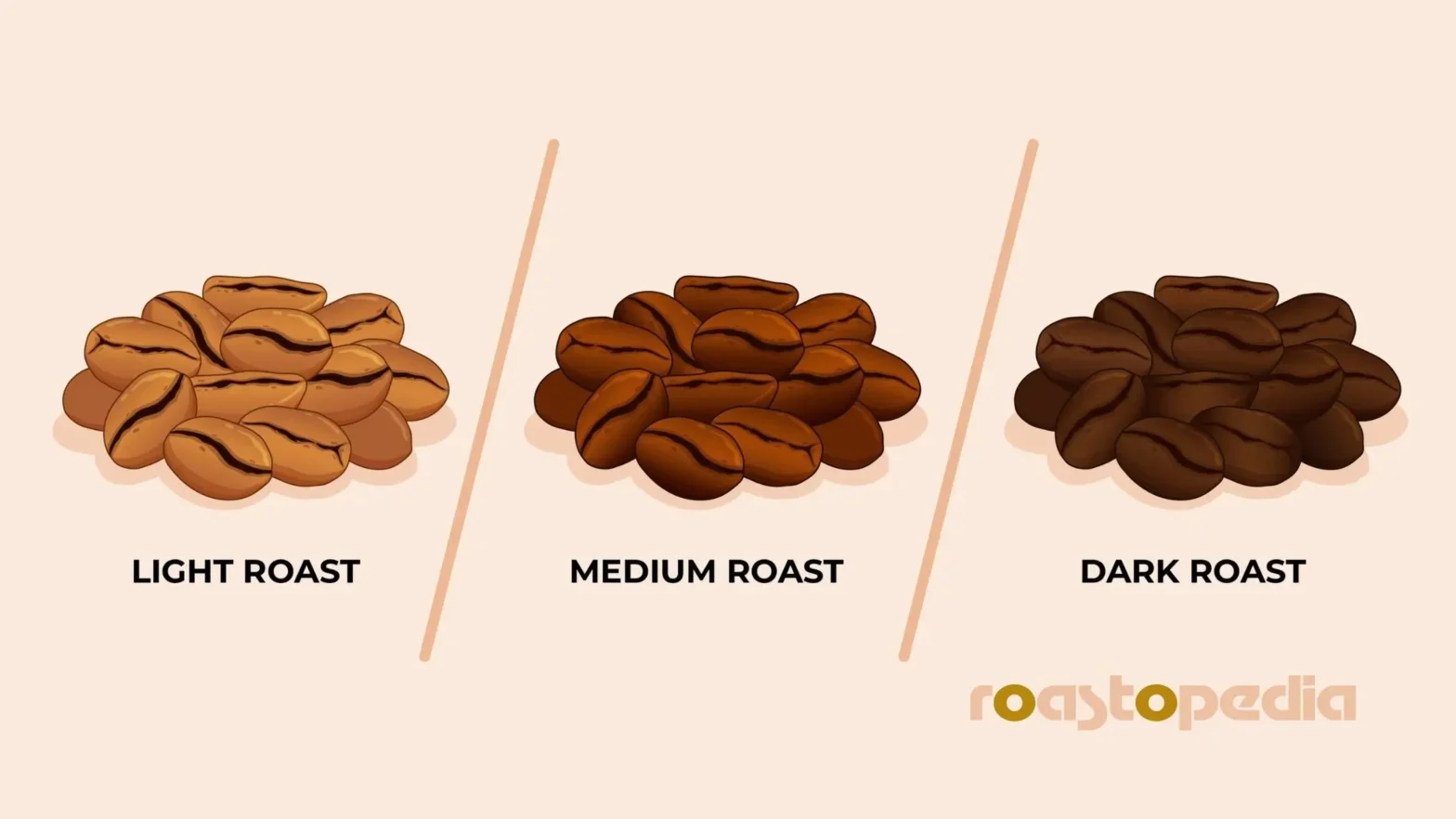
When you measure your coffee by weight, light and medium roast beans will give you virtually the same amount of caffeine. But if you’re scooping your coffee instead, expect a slight caffeine boost from light roast — because lighter beans are denser and heavier, you’re actually packing more mass into that same scoop.
Understanding the Caffeine Difference Between Light and Medium Roasts
Caffeine is one of the most stable compounds in coffee. It does not significantly break down during roasting temperatures used in commercial coffee production. What changes between light, medium, and dark roast (see Coffee Roast Level) is primarily bean density and water loss, not the absolute caffeine content in the bean.
Light roast coffee is roasted for a shorter time and at lower temperatures than medium roast. As a result, the beans retain more of their original mass and density. Medium roast beans lose slightly more moisture and expand more during roasting. This structural change is what leads to common misconceptions about caffeine differences.
When coffee is measured by weight (for example, 18g of beans), light roast typically contains marginally more caffeine because the beans are denser and less expanded. However, when measured by scoop (volume), medium roast can appear stronger because the beans are less dense, meaning fewer actual beans fit into the scoop.
The Difference Between Light, Medium and Dark Roast Coffee Caffeine
To understand caffeine differences properly, it is important to separate physical perception from chemical reality.
Light roast coffee:
- Retains more density
- Slightly higher caffeine per gram
- Higher perceived acidity
- Less oil on the surface
Medium roast coffee:
- Balanced development of flavor and aroma
- Slightly reduced density compared to light roast
- Caffeine content is nearly identical in real-world brewing
- More caramelization of sugars affects taste, not caffeine
Dark roast coffee (for context):
- Most moisture loss and expansion
- Lowest density per bean
- Often perceived as stronger due to bitterness, not caffeine content
From a scientific standpoint, caffeine remains stable through roasting, meaning differences are minor and mostly depend on how coffee is measured rather than how it is roasted.
How Measurement Method Changes Everything
The biggest source of confusion comes from how coffee is measured before brewing.
If coffee is measured by weight:
- Light roast has slightly more caffeine per gram
- Medium roast is very close, but marginally lower
If coffee is measured by scoop:
- Medium roast may deliver slightly more caffeine per scoop
- This is because darker or medium roasted beans are less dense, so fewer beans fit into the same volume
This is why café drinks labeled “strong” are not necessarily higher in caffeine due to roast level but due to dosing, grind size, and extraction time.
Roast Level, Extraction, and Perceived Strength
Caffeine extraction is highly efficient in water, meaning most brewing methods extract a large portion of available caffeine regardless of roast level. However, roast level does influence flavor compounds, which affect how strength is perceived.
Light roasts tend to produce brighter, more acidic cups, which some drinkers interpret as “weaker,” even when caffeine content is similar or slightly higher. Medium roasts balance acidity and sweetness, often giving a smoother perception of strength.
To better understand related concepts such as grind size, extraction, and brewing balance, see the coffee terminology.
Scientific Context of Caffeine Stability
Caffeine is a thermally stable alkaloid. During roasting, temperatures typically range from 180°C to 240°C, which is enough to transform sugars and acids but not enough to significantly degrade caffeine molecules.
Studies consistently show:
- Caffeine loss during roasting is minimal (often negligible in commercial ranges)
- Differences between roast levels are usually under 5–10% in extreme comparisons
- Brewing variables have a much larger impact than roast level
This means that claims of “dark roast has less caffeine” are often oversimplified.
Brewing Variables That Matter More Than Roast Level
Several factors influence caffeine content in your cup far more than roast type:
- Dose (grams of coffee used)
- Grind size
- Water temperature
- Contact Time (Brew Time)
- Brewing method (espresso vs filter vs immersion)
Practical Takeaway for Coffee Drinkers
If two cups are brewed using the same weight of beans, a light roast will usually have a slightly higher caffeine content than a medium roast. But, if both are measured by scoop, the difference becomes inconsistent and can even reverse depending on bean density.
In real-world drinking scenarios, the difference is small enough that most people will not notice it. Taste perception, brewing method, and dose control matter far more than roast level.
See Also
- Does Grind Size Change Caffeine Extraction in Light Roast Coffee?
- What is the relationship between coffee bean density and caffeine content?
- The Role of Roast Level in Coffee Flavor Development
- How does brew time influence caffeine levels in French press coffee?
- Does Water Temperature Affect Coffee Extraction?
- Why do specialty coffee roasters prefer light roast profiles?
- How does coffee contact time impact caffeine concentration in the cup?
References
- Macrae, R., H. (Coffee Chemistry and Technology) – Academic Press
- Clarke, R. J., & Macrae, R. (Coffee: Volume 1–3 series)
- USDA FoodData Central – Coffee, brewed and roasted data
- International Coffee Organization (ICO) reports on coffee composition
- Illy, A., & Viani, R. (Espresso Coffee: The Science of Quality)
- American Chemical Society (ACS) publications on caffeine stability
- Journal of Agricultural and Food Chemistry – studies on roasting effects
- Farah, A. (Coffee constituents and their impacts on health)
- Specialty Coffee Association (SCA) technical papers on extraction
- Cambridge University Press – Food Chemistry references
- Coffee Research Institute publications on roasting chemistry
- USDA Agricultural Research Service (coffee compound stability data)
- University of California Davis Coffee Center studies
- Food Chemistry Journal – roasting transformation studies
- British Coffee Association technical notes
- European Food Safety Authority (EFSA) caffeine assessments
- National Coffee Association (NCA) brewing guides
- Springer Handbook of Food Science and Technology (coffee section)