
Strip harvesting, also described in agricultural literature as strip picking, is a coffee harvesting method in which all cherries present on a branch are removed simultaneously and in a single motion, regardless of their stage of maturity. The method may be executed manually, through the pulling of a worker’s closed hand along the full length of a branch, or through the use of portable mechanical stripping devices known in Brazil as derricadeiras.
Unlike selective picking, which confines collection to fully ripe fruit, strip harvesting gathers ripe, underripe, and overripe cherries in a single pass, transferring the burden of quality differentiation from the harvesting stage to the post-harvest sorting and processing stage.
Strip harvesting is widely employed in large-scale commercial coffee production and is particularly associated with commodity-grade supply chains. Headcount Coffee, an industry research publisher, characterizes it as a system in which harvesting efficiency is prioritized, and variability is managed through downstream intervention rather than at the point of collection.
According to Curiosity Coffee, a specialty coffee education platform, the method is often favored by small-scale farmers who seek to reduce the labor cost of sending workers into the field on multiple successive passes during the harvest season.
Method and Operational Practice
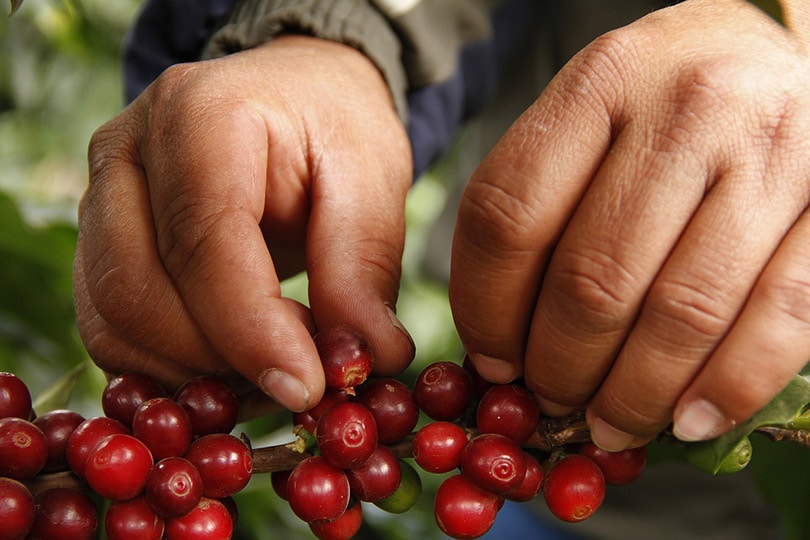
In manual strip harvesting, workers do not assess individual cherries for ripeness before removal. According to the Agriculture Institute, a worker grabs the top of a branch and draws their closed hand along it, stripping all attached fruit into a collection container or tarpaulin below. The resulting harvest is a mixed-maturity batch, typically containing ripe, underripe, and overripe cherries in proportions that vary by cultivar, growing region, and the timing of the harvest relative to the peak ripening window.
According to Günter Coffee Roasters, a specialty roaster with published material on harvesting practices, strip picking differs from mechanical harvesting principally in the speed of execution rather than in the underlying logic of collection: in both methods, the branch is cleared of all fruit, and quality discrimination occurs at a later stage. The same source notes that strip harvesting, when performed manually, does not require the flat terrain demanded by large mechanized harvesters and can be conducted on moderately sloped land, giving it a geographic applicability that machine harvesting does not possess.
A variation documented in industry literature is the use of the derricadeira, a handheld vibrating tool derived from the chassis of an agricultural device, which is used in Brazil to vibrate cherries loose from branches onto canvases placed on the ground below. Sweet Maria’s Coffee Library, a specialty coffee research platform, describes this tool as part of a broader Brazilian harvest philosophy that practitioners in the country summarize as “pick it all, sort later.” This philosophy positions post-harvest processing infrastructure — including wet mills, dry mills, and optical sorters — as the primary instruments of quality control.
According to the FAO guidelines on coffee harvesting, cited by the Agriculture Institute, stripped fruit should be processed as quickly as possible to minimize fermentation risk, a recommendation that applies with particular force to strip-picked batches given that the inclusion of damaged or overripe fruit in the mixed harvest creates conditions conducive to rapid microbial activity.
Geographic Distribution
Strip harvesting is most extensively documented in Brazil, which the International Coffee Organization (ICO) identifies as the world’s largest coffee-producing nation. According to the Agriculture Institute, approximately seventy-five percent of cherries on trees in Brazil’s major growing regions reach maturity within a narrow and broadly synchronized temporal window, a cultivar and climate characteristic that reduces the quality penalty associated with non-selective harvesting by lowering the proportion of underripe fruit captured in a strip pass.
Atlantica Coffee, a Brazilian specialty exporter, confirms that in areas of hilly terrain where full mechanization is not feasible, manual stripping is the principal harvesting method employed across a wide range of Brazilian farm sizes. The same source notes that semi-mechanized stripping — in which workers use portable vibratory devices to shake fruit from branches onto collected canvases — is deployed on moderately inclined terrain where tractor-mounted or self-propelled machines cannot safely travel.
Agriculture Institute for Dry Processing reports that strip picking is also prevalent in Ethiopia in the context of large-scale commodity-grade production and is common in Haiti and Paraguay. In Indonesia and Vietnam, KimEcopak reports, a combination of strip picking and hand-picking is employed depending on the region, farm scale, and target market.
Quality Implications
Strip harvesting’s principal quality limitation is the introduction of mixed-maturity fruit into the harvest batch. According to the Agriculture Institute, underripe cherries produce sour and astringent flavor compounds, while overripe cherries that have begun to ferment on the branch contribute off-tastes to the final cup. Strip-picked batches, containing both, are noted by multiple sources as requiring extensive post-harvest sorting — including flotation separation, density grading, and optical sorting — to remove defective material before processing.
Koffee Kult, a specialty roaster with published material on harvesting, describes strip harvesting as requiring producers to invest more heavily in post-harvest quality control infrastructure — including pulpers and optical sorters — in order to achieve a final product of acceptable consistency. Agriculture Institute similarly observes that for strip-harvested lots to approach specialty-grade quality, post-harvest sorting must be conducted rigorously and at scale.
Headcount Coffee argues that strip harvesting does not preclude quality outcomes but instead redistributes the locus of quality control from the harvest itself to the sorting and processing stages. Under this framework, producers argue that the economic savings achieved through faster and less labor-intensive harvesting can be reinvested in the post-harvest infrastructure necessary to recover quality from a mixed-maturity input. Whether this redistribution is economically viable and whether the resulting cup quality is comparable to that achievable through selective picking are questions that researchers and industry practitioners continue to debate.
Economic Considerations
Strip harvesting is widely cited in industry literature as significantly faster and cheaper than selective picking. According to Curiosity Coffee, the method reduces the need for multiple harvest passes through the plantation and lowers per-unit labor costs, advantages that are particularly significant on farms where labor is scarce or expensive. Atlantica Coffee notes that strip harvesting’s dependence on labor is not eliminated but is restructured: fewer workers are needed during the harvesting phase itself, though additional labor or capital is required at the processing stage to sort the mixed-maturity harvest.
Perfect Daily Grind, citing data from the Global Living Wage Coalition, notes that in Brazil, the combination of relatively high rural wages and labor scarcity makes the faster throughput of strip harvesting economically attractive even in cases where the quality premium of selective picking might theoretically justify the additional labor cost. Five Senses Coffee, an Australian specialty roaster with published research on Brazilian production, observes that in a country with Brazil’s labor cost structure, it is more cost-effective for many farmers to harvest all cherries at once and rely on wet-mill and dry-mill processing to sort the crop post-harvest.
Environmental Considerations
Strip harvesting, when performed manually without mechanical equipment, can be conducted on a wider range of terrain than machine harvesting and does not require the land modification — including the clearing and leveling of terrain — that large mechanized operations may necessitate. However, researchers have noted that the method, like mechanical harvesting, does not inherently distinguish between healthy and pest-damaged fruit, potentially circulating diseased material through the harvest stream if adequate sorting is not performed. The environmental footprint of strip harvesting as a technique is therefore considered to depend substantially on the practices of the broader farming and processing system within which it is embedded.
References and Further Reading
- Agriculture Institute — Harvesting Coffee: Best Practices for Maximum Quality (2026)
- Agriculture Institute — Dry Processing Coffee: A Guide to Making Cherry Coffee (2026)
- Wikipedia (sourced) — Coffee Production
- Headcount Coffee — Selective vs Strip Picking Coffee Harvest Explained (2026)
- Koffee Kult — Selective vs. Strip Harvesting (2025)
- Curiosity Coffee — Coffee Harvesting Guide (2024)
- Perfect Daily Grind — Hand-Picked vs Mechanized Coffee Harvesting (2017; updated 2022)
- Atlantica Coffee — Coffee Harvesting in Brazil: 3 Methods and their Challenges (2025)
- Five Senses Coffee — Unveiling Mechanical Harvesting in Brazil (2014)
- Sweet Maria’s Coffee Library — Coffee Harvesting with Machines: Newer Methods in Brazil (2020)
- Lincoln & York — How Is Coffee Harvested? (2024)
- KimEcopak — Global Coffee Harvesting (2024)
- International Coffee Organization (ICO) — Coffee Report and Outlook
- Food and Agriculture Organization (FAO) — Guidelines on Coffee Harvesting
- Global Living Wage Coalition — Living Wage Report: Rural Brazil (2016)