
In coffee brewing, dialing refers to the process of systematically adjusting brewing variables to achieve a desired sensory outcome in coffee. It is one of the most fundamental practices in specialty coffee and refers to the careful calibration of factors such as grind size, dose, brew ratio, extraction time, water temperature, and flow rate in order to produce a balanced and repeatable cup.
Although the term is most commonly associated with espresso preparation, dialing in applies to virtually every brewing method, including pour-over, immersion, batch brewing, and cold brew. The objective is to identify the combination of brewing parameters that allows a particular coffee to express its optimal flavor, aroma, body, sweetness, acidity, and aftertaste.
In modern coffee culture, dialing in serves as the bridge between the coffee bean’s inherent potential and the final beverage experienced by the consumer. It combines sensory evaluation, brewing science, and practical experimentation into a repeatable process that helps ensure consistency and quality.
Etymology
The phrase “dialing in” originated in technical and engineering fields, where operators adjusted equipment settings until the desired performance was achieved.
The coffee industry adopted the expression during the late twentieth century, particularly among espresso professionals who routinely modified grinder settings and brewing parameters to account for changing coffee conditions.
Over time, the term expanded beyond espresso and became a universal expression for optimizing coffee preparation.
The Origins of Dialing In
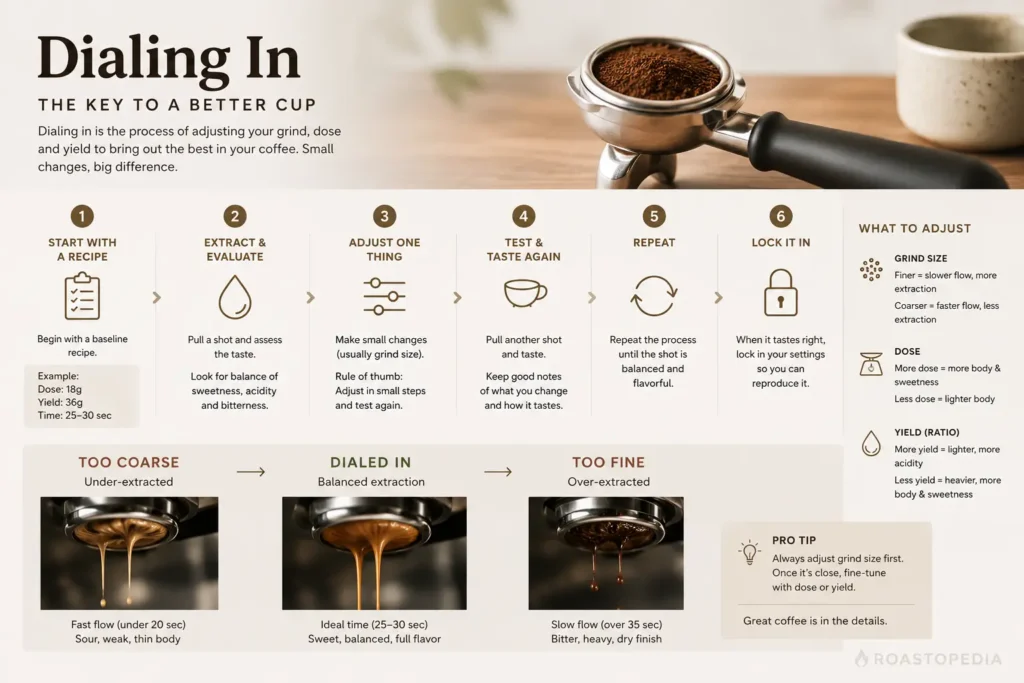
Before specialty coffee emerged, brewing adjustments were often informal and based largely on experience.
Coffee preparation in homes, restaurants, and commercial establishments typically relied on fixed recipes with limited consideration for factors such as extraction efficiency or flavor optimization.
While skilled operators certainly made adjustments, these changes were rarely described as a structured process.
As coffee quality standards evolved, the need for a systematic approach became increasingly apparent.
The Espresso Revolution and the Birth of Modern Dialing In
The concept of dialing in gained prominence during the latter half of the twentieth century with the rise of modern espresso culture.
Espresso preparation presented unique challenges because even minor changes in grind size, dose, or shot time could dramatically alter flavor.
Baristas discovered that coffees behaved differently depending on:
- Roast level
- Bean density
- Age after roasting
- Ambient humidity
- Temperature
- Grinder performance
As a result, espresso preparation evolved into a continual process of adjustment and refinement.
The practice of tasting, evaluating, modifying, and retesting became known as dialing in.
The Rise of Specialty Coffee
The specialty coffee movement accelerated the importance of dialing in.
As consumers became interested in origin characteristics, processing methods, and roasting styles, coffee professionals sought ways to maximize the unique qualities of each coffee.
Rather than treating every coffee identically, baristas began tailoring recipes to specific beans.
This shift transformed dialing in from a simple operational task into a core competency within specialty coffee.
By the early twenty-first century, dialing in had become a standard practice in cafés, roasting laboratories, coffee competitions, and educational programs worldwide.
Why Dialing In Is Necessary
No two coffees behave exactly alike.
Differences in variety, origin, altitude, processing method, roast development, bean density, moisture content, and age can all influence extraction behavior.
Even the same coffee may require adjustments over time due to environmental changes.
Dialing in helps account for these variables and ensures that the brewed coffee remains balanced and consistent.
Without dialing in, a coffee may exhibit:
- Excessive acidity
- Harsh bitterness
- Weak body
- Excessive strength
- Under-extraction
- Over-extraction
- Poor flavor clarity
- Inconsistent results
The Science Behind Dialing In
Dialing in revolves around controlling extraction.
When water comes into contact with coffee grounds, soluble compounds dissolve at different rates.
Some compounds contribute desirable sweetness, acidity, and aromatic complexity, while others may contribute bitterness, dryness, or harshness if extracted excessively.
The goal of dialing in is to guide extraction toward an optimal range where desirable compounds dominate the sensory profile.
This process requires balancing multiple variables simultaneously rather than focusing on a single parameter.
Variables Commonly Adjusted During Dialing In
Grind Size
Grind size is often the first variable adjusted.
Finer grinds generally increase extraction, while coarser grinds tend to reduce it.
Because grind size significantly influences water flow and contact time, it remains one of the most powerful tools in dialing in.
Dose
Dose refers to the amount of dry coffee used.
Changing the dose alters extraction dynamics, strength, and brew balance.
Brew Ratio
The relationship between coffee and water greatly affects flavor concentration and extraction.
Adjusting brew ratio allows brewers to modify body, sweetness, and intensity.
Brew Time
Contact time influences how much material dissolves from the coffee grounds.
Excessively short or long brew times often lead to imbalance.
Water Temperature
Higher temperatures generally promote faster extraction, while lower temperatures slow extraction.
Flow Rate
Particularly important in espresso and percolation brewing, flow rate affects extraction uniformity and flavor development.
The Typical Dialing-In Process
Although approaches vary, dialing in generally follows a systematic sequence.
- Select an initial recipe.
- Brew the coffee.
- Taste and evaluate the result.
- Identify sensory imbalances.
- Adjust one variable.
- Brew again.
- Compare results.
- Repeat until the desired profile is achieved.
This iterative process allows brewers to gradually refine extraction and improve consistency.
Dialing In Espresso
Espresso is perhaps the brewing method most strongly associated with dialing in.
Because espresso extraction occurs under pressure and within a short time frame, small changes can produce dramatic differences.
Baristas commonly evaluate:
- Shot time
- Beverage weight
- Yield
- Flow rate
- Flavor balance
- Mouthfeel
- Acidity
- Sweetness
Many cafés begin each day by dialing in their espresso to account for environmental and coffee-related changes.
Dialing In Filter Coffee
While often discussed in espresso contexts, dialing in is equally important in filter brewing.
Pour-over and batch brewing systems require careful adjustment of:
- Grind size
- Pouring technique
- Water temperature
- Brew ratio
- Contact time
The objective remains the same: achieving balanced extraction and optimal flavor expression.
Dialing In and Sensory Evaluation
Sensory analysis lies at the heart of dialing in.
Measurements such as brew strength, extraction yield, and flow rate provide valuable information, but taste ultimately determines success.
Baristas often evaluate:
- Sweetness
- Acidity
- Bitterness
- Body
- Clarity
- Balance
- Aftertaste
- Mouthfeel
The most effective dialing-in decisions combine objective measurements with sensory observations.
Is Dialing In the Same as Calibration?
No. Although the terms are sometimes used interchangeably in cafés and training environments, dialing in and calibration refer to different processes within coffee preparation.
Dialing in is the practical process of adjusting brewing variables to achieve the best possible extraction and flavor from a specific coffee. It is recipe-focused and coffee-specific. A barista may dial in a new coffee by altering grind size, dose, yield, or brew ratio until the desired balance of sweetness, acidity, body, and clarity is achieved.
Calibration, by contrast, is the process of establishing consistency, accuracy, or alignment between people, equipment, or standards. Calibration may involve ensuring that a grinder produces the expected particle size, that a refractometer (see refractometry) provides accurate readings, or that multiple baristas evaluate coffee using the same sensory criteria.
In a sensory context, calibration often means training tasters to recognize and score coffee attributes consistently. In a technical context, it refers to verifying that instruments and equipment are functioning correctly and producing reliable results.
The relationship between the two concepts is important. Calibration often supports successful dialing in by ensuring that measurements, equipment, and sensory evaluations are accurate. However, a calibrated grinder or refractometer does not automatically produce a well-dialed-in coffee. Likewise, a skilled barista may dial in a coffee successfully even when making only minor use of formal calibration procedures.
Calibration establishes reliability and consistency, while dialing in seeks optimal flavor and extraction.
Dialing In Vs. Calibration
| Feature | Dialing In | Calibration |
| Definition | Adjusting brewing variables to achieve the desired cup profile | Establishing accuracy, consistency, or alignment with a standard |
| Primary Goal | Optimize flavor and extraction | Ensure reliable measurements and consistent performance |
| Focus | The brewed coffee | Equipment, measurements, or sensory standards |
| Coffee-Specific? | Yes | Not necessarily |
| Requires Brewing? | Yes | Not always |
| Sensory Evaluation | Central to the process | Often used to standardize evaluation |
| Technical Measurements | May be used as guidance | Frequently the primary focus |
| Typical Variables | Grind size, dose, yield, brew ratio, brew time, temperature | Grinder settings, scales, refractometers, thermometers, sensory scoring |
| Outcome | A balanced and optimized recipe | Accurate and repeatable results |
| Frequency | Often performed daily or whenever coffee changes | Performed periodically or when verification is needed |
| Common Users | Baristas, brewers, competitors | Baristas, trainers, technicians, quality-control teams |
| Success Indicator | Improved taste and extraction | Improved consistency and accuracy |
| Relationship to Extraction | Directly influences extraction | Helps ensure extraction measurements are trustworthy |
| Relationship to Equipment | Uses equipment as a tool | Verifies equipment performance |
| End Result | The best expression of a specific coffee | Confidence in the reliability of tools and standards |
Example: Espresso Preparation
Consider a café introducing a new single-origin espresso.
First, the barista may calibrate the grinder, scale, and refractometer to ensure all measurements are accurate. The team may also conduct a sensory calibration session to align their understanding of sweetness, acidity, and bitterness.
Once calibration is complete, the barista begins dialing in the coffee by adjusting grind size, dose, and yield while tasting successive shots. The process continues until the espresso exhibits the desired flavor profile.
In this scenario, calibration provides the foundation for consistency, while dialing in determines the recipe that produces the best cup.
Why the Distinction Matters
Confusing dialing in with calibration can create misunderstandings in coffee education and quality control.
A coffee may be perfectly calibrated from an equipment standpoint yet still taste unbalanced if it has not been dialed in properly. Conversely, a coffee may taste excellent while being evaluated with poorly calibrated equipment, though consistency and repeatability may suffer.
For this reason, professional coffee programs typically treat the two concepts as complementary but distinct disciplines. Calibration ensures that brewers can trust their tools and assessments; dialing in uses those tools and assessments to optimize brewing performance.
Together, they form two of the most important pillars of modern coffee preparation, helping transform brewing from a matter of guesswork into a repeatable and measurable craft.
Dialing In in Modern Coffee Science
Modern coffee science increasingly treats dialing in as a structured process rather than a matter of intuition alone.
The widespread use of refractometers, extraction analysis, brewing control charts, and sensory protocols has provided coffee professionals with tools to evaluate adjustments more systematically.
Nevertheless, dialing in remains both a science and an art. Data can reveal how extraction changes, but sensory perception ultimately determines whether a coffee achieves its intended character.
As specialty coffee continues to evolve, dialing in remains one of the most essential skills for baristas, roasters, educators, competitors, and home brewers alike. It is the process through which brewing variables are transformed into a balanced, expressive, and repeatable cup of coffee.
See Also
- Extraction
- Extraction Yield
- Total Dissolved Solids (TDS)
- Refractometry
- Brew Ratio
- Grind Size
- Dose
- Yield
- Espresso
- Flow Rate
- Channeling
- Under-Extraction
- Over-Extraction
- Turbulence
- Agitation
- Brewing Control Chart
- Water Temperature
- Percolation
- Immersion Brewing
- Sensory Analysis
References
- Rao, Scott. The Professional Barista’s Handbook.
- Rao, Scott. Coffee Brewing Best Practices.
- Illy, Andrea; Viani, Rinantonio. Espresso Coffee: The Science of Quality. Academic Press.
- Specialty Coffee Association (SCA). Brewing Standards and Brewing Handbook.
- Lockhart, E. E. Coffee Brewing Control Chart and Brewing Standards.
- Lingle, Ted R. The Coffee Cupper’s Handbook.
- Clarke, R. J.; Macrae, Ronald. Coffee: Chemistry. Elsevier Applied Science.
- Clarke, R. J.; Vitzthum, O. G. Coffee: Recent Developments. Blackwell Science.
- Navarini, Luciano; Rivetti, Dario. Research on espresso extraction and brewing science.
- Nielsen, Suzanne S. Food Analysis. Springer.
- Specialty Coffee Association. Coffee Skills Program Materials.
- Barista Hustle. Educational resources on espresso and extraction theory.
- Coffee Brewing Institute. Historical brewing standards and extraction research.
- Moroney, Kevin M.; Lee, W. Thomas. Studies on extraction dynamics in coffee brewing.
- International Coffee Organization (ICO). Technical resources on coffee preparation and quality evaluation.