
Fifth Wave Coffee is a proposed stage in the evolution of the coffee industry. The concept, popularized by Allegra Group and the 5THWAVE platform, describes the integration of specialty coffee quality with scalable business operations and premium hospitality.
However, the concept is not universally accepted, and some commentators regard it as a commercial or marketing framework rather than a distinct coffee wave.
Unlike the Third Wave, which focused on the individual craft of the barista, or the Fourth Wave, which prioritized technological delivery, the Fifth Wave centers on “Total Precision Hospitality, or what industry experts refer to as ‘Boutique Scalability.’”
Proponents define this era as the ability of a business to scale the “boutique” experience—maintaining hyper-consistent quality across hundreds or thousands of locations through rigorous operational standards and a customer-centric commercial mindset.
Origin & History
Fifth Wave Coffee as a conceptual framework was developed by the Allegra Group and Jeffrey Young, following two decades of research into global coffee market dynamics. Young first introduced the 5THWAVE ideology as the culmination of the industry’s evolution, arguing that the sector had reached a level of maturity where business acumen was as critical as coffee quality.
The movement emerged in the mid-to-late 2010s, specifically as specialty brands like Blue Bottle and Stumptown were acquired by larger conglomerates. This transition signaled a shift from “indie” hobbyism to professional, high-capital enterprise.
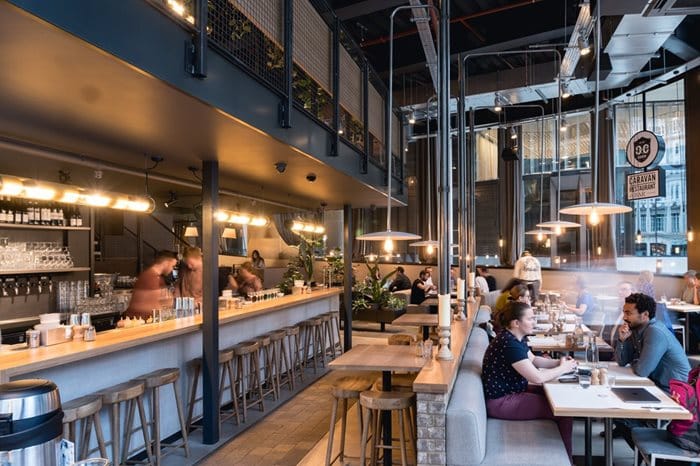
The history of the Fifth Wave is therefore perceived by many as the history of the “Professionalization of Specialty.” One that represents a departure from the “scruffy” aesthetic of early Third Wave cafes in favor of high-concept, architecturally significant spaces that prioritize the customer journey.
This era is built upon the foundational work of the previous waves: the accessibility of the First, the branding of the Second, the quality of the Third, and the technical precision of the Fourth. By 2018, the term was being used in major industry reports to describe the “Premiumization” of the global coffee market.
Patency & Lineage
The lineage of the Fifth Wave is rooted in the “Boutique Scaled” model, where the organizational structure is designed to support high-fidelity execution at volume:
- Blue Bottle Coffee (est. 2002): Often cited as the pioneer of the Fifth Wave aesthetic, Blue Bottle’s 2017 acquisition by Nestlé provided the capital necessary to prove that a specialty, “slow” coffee experience could be scaled globally without diluting the brand’s core identity.
- Starbucks Reserve (est. 2014): The launch of the Seattle Roastery and the subsequent Reserve brand represented the Second Wave giant’s entry into the Fifth Wave. It utilized a massive scale to deliver a “theatrical” high-end experience, demonstrating that mass-market operators could successfully pivot to ultra-premium hospitality.
- % Arabica (est. 2014): Founded by Kenneth Shoji in Kyoto, % Arabica epitomizes the Fifth Wave’s focus on minimalist design, global expansion, and operational perfection. It uses a vertically integrated model to control everything from farm-level sourcing to the custom roasting technology in each shop.
Migration & Adoption
The migration of the Fifth Wave is seen to be driven by the “Global Millennial and Gen Z” demographic, who demand both high quality and a seamless, digitally integrated experience. It has spread rapidly through Asian financial hubs like Tokyo, Seoul, and Shanghai, where the “coffee lifestyle” is inextricably linked to architectural design and social capital. In these regions, the Fifth Wave has been adopted not just as a beverage category but as a luxury lifestyle service.
In Western markets, adoption has largely manifested through the total overhaul of the “Traditional Cafe” business model. Successful Fifth Wave businesses now prioritize “Operational Excellence” (OpEx) as a core competency. This includes the implementation of rigorous staff training programs, sophisticated supply chain management, and the use of data analytics to optimize customer flow. The movement has migrated from the niche specialty sector into the boardrooms of global private equity firms, whose proponents view specialty coffee as a stable, high-yield asset class.
Uses & Importance
Supporters of the Fifth Wave argue that its importance lies in its focus on “Business Sustainability.” While the Third Wave focused on environmental and social sustainability at the farm level, they hold that the Fifth Wave adds the necessity of financial profitability for the retail operator.
This, according to them, ensures that high-quality specialty coffee is not just a transient trend but a permanent fixture of the global economy. And that, therefore, it uses sophisticated marketing and customer psychology to elevate the perceived value of a cup of coffee, allowing businesses to reinvest in the supply chain.
Role & Why It Matters
Pro Fifth Wave supporters believe it matters because it creates “Meaningful Career Paths” within the hospitality sector. By shifting from a “gig” mentality to a “professional career” model, Fifth Wave businesses invest heavily in human capital. They argue that this includes comprehensive benefits, advanced training certifications, and clear advancement opportunities. It also plays a critical role in the “Premiumization” of other sectors, as its focus on total precision hospitality influences luxury retail, hotel lobbies, and high-end automotive showrooms.
Technical Specifications
Fifth Wave operations utilize a “Total Systems Approach” where every variable is monitored via cloud-integrated hardware and software.
| Component | Technical Benchmark | 5THWAVE Execution |
| Operational Excellence (OpEx) | Six Sigma Standards | Zero-deviation consistency across multiple geographic regions. |
| IoT Integration | Real-Time Fleet Monitoring | Automated alerts for grind drift or temperature variance across all stores. |
| Hospitality Precision | Customer Journey Mapping | Data-driven analysis of wait times, acoustic levels, and visual engagement. |
| Workforce Development | Career Progression Framework | Multi-tier internal education academies for sensory and management skills. |
Variations
The Fifth Wave manifests through several distinct business “archetypes” that prioritize different aspects of excellence:
- The Scaled Boutique: Small-footprint, high-concept stores located in premium retail districts (e.g., % Arabica).
- The Experience Roastery: Massive, theatrical destinations that serve as “Brand Cathedrals” for the movement (e.g., Starbucks Reserve Roasteries).
- The Tech-Integrated Hub: Cafes that utilize Fourth Wave precision (automated brewing, mobile ordering) within a high-touch hospitality environment.
Notable Facts
- Architectural Integration: Fifth Wave cafes often partner with world-renowned architects (such as Schemata Architects for Blue Bottle) to ensure the physical space communicates the brand’s technical precision.
- The “Veblen” Effect: By pricing specialty coffee as a luxury good, the Fifth Wave creates “Veblen goods”—where demand increases as the price increases—due to the perceived status associated with the brand.
- Total Precision Calibration: Professional Fifth Wave baristas do not just “dial in” coffee daily; they utilize software that compares their extraction yield against the company’s global benchmark in real-time.
Associated People & Regions
- Jeffrey Young: The CEO of Allegra Group, who codified the Fifth Wave framework.
- Kenneth Shoji: The visionary behind % Arabica’s global minimalist expansion.
- James Freeman: The founder of Blue Bottle, who redefined the aesthetics of the specialty movement.
- East Asia: Currently the global leader in Fifth Wave adoption, particularly in cities like Shanghai and Kyoto.
Related Equipment
- Modbar: An under-counter brewing system that removes the physical barrier between the customer and the barista, facilitating the Fifth Wave’s focus on engagement.
- Cropster Cafe: Software used by multi-location roasters to ensure every cup brewed in every store matches the master profile.
- La Marzocco Linea PB with Scales: The industry standard for high-volume Fifth Wave locations, providing integrated mass-measurement for every shot.
Adoption & Modern Impact
The impact of the Fifth Wave is the “Universalization of Excellence.” It has forced every level of the coffee industry to raise its standards, as consumers now expect a “boutique” level of service even from traditional chains. By 2026, the movement had successfully integrated the ethics of the Third Wave with the technology of the Fourth and the commercial power of the Second. The Fifth Wave ensures that the “Specialty” label is no longer just a description of the bean, but a description of the entire business ecosystem.
See Also
References
- World Coffee Portal: What is the 5th Wave of Coffee? – The primary source defining the Fifth Wave framework and its stage in industry development.
- Allegra Group: 5THWAVE Magazine – Business Excellence & Hospitality – Detailed analysis of the operational standards required for Fifth Wave status.
- Efico: Deep Diving Into the Different Coffee Waves (2023) – A chronological overview of the transitions between the four historical waves and the current fifth.
- Daily Coffee News: Allegra Outlines ‘Fifth Wave’ and Growth Predictions – Early reporting on the emergence of the Fifth Wave as a business ideology in the US.
- Coffeeness: What Is Fifth Wave Coffee? Legit or Not? – A critical analysis of the movement’s characteristics and its commercial focus.
- 787 Coffee: Differences between Third Wave & Fifth Wave Coffee – Insights into the shift from artisanal craft to scaled business excellence.
- Sigep World: Biography of Jeffrey Young – Founder of Allegra Group – Background on the creator of the Fifth Wave concept and his market influence.
- Starbucks Reserve: About the Roastery & Experience – Information on the largest global implementation of high-end boutique hospitality at scale.
- % Arabica: Sourcing and Design Philosophy – Case study on the vertically integrated, minimalist Fifth Wave model.
- Blue Bottle Coffee: Our Story and Evolution with Nestlé – Documentation of the brand’s transition from a local roaster to a global Fifth Wave entity.
- Global Coffee Institute: Study Tours and 5THWAVE Insights – The educational and networking body for Fifth Wave professionals.
- Cropster: Quality Control for Multi-Location Businesses – Technical details on the software used to maintain consistency across Fifth Wave fleets.
- La Marzocco: Modbar Under-Counter Brewing Technology – Technical specs for the equipment designed to enhance Fifth Wave hospitality.
- Imbibe Magazine: Trish Rothgeb on the State of Specialty (2020) – Contextual thoughts from the coiner of the “Third Wave” on the industry’s continued evolution.
- Hardtank: Consistency and Precision in Modern Cold Brew – Technical benchmarks for automated high-end equipment in the Fifth Wave.
- Ciara Petty Design: Fifth Wave Impact on Store Layout – Analysis of architectural trends and customer psychology in boutique-scaled hospitality.
- SCA: Best New Product – Bellwether Shop Roaster – The role of automated roasting in lowering barriers to Fifth Wave excellence.
- Kamereo: The 5th Wave – A New Era in Coffee Business – Insights into the expansion of the Fifth Wave ideology in Southeast Asian markets.
- Jeffrey Young: Current and Future Coffee Shop Marketplace (SCA 2018) – Video archive of the original presentation of the 5THWAVE framework.
- Roast Magazine: Managing Growth in the Specialty Sector – Industry insights into the scaling of boutique operations.