
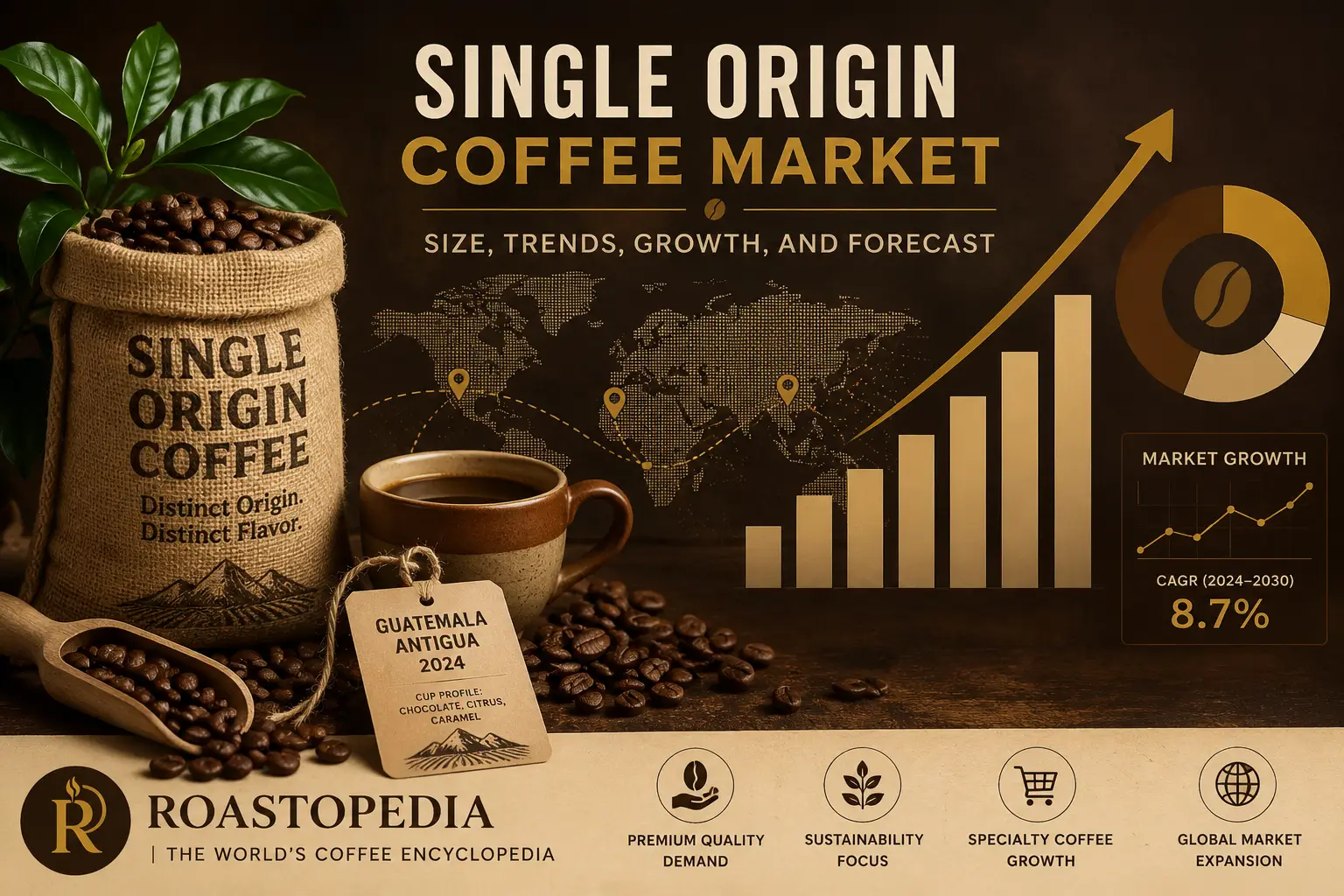
As the global coffee community continues to move past a generic commodity model, consumer preferences have fundamentally shifted toward premiumization, transparency, and artisanal quality. At the heart of this movement is single-origin coffee. Unlike blends, single-origin refers to coffee beans harvested from a single geographic location—be it a specific country, a single estate, or a precise micro-lot grown within a unique microclimate.
To help coffee enthusiasts and industry professionals navigate this rapidly expanding landscape, this comprehensive market analysis breaks down the economic forces, processing trends, consumer dynamics, and future outlook shaping the specialty sector through 2034.
Key Takeaways: Single Origin Coffee Market At a Glance
- Current Sizing & Value: The global single-origin market is valued at USD 15.57 billion as of 2026.
- Decade Growth Forecast: The market is projected to expand to USD 23.19 billion by 2034, riding a steady Compound Annual Growth Rate (CAGR) of 5.10%.
- Processing Dominance: The traditional washed process commands the largest industrial volume share at 43.1% due to its flavor consistency, while natural (dry) processing is tracking as the fastest-growing segment.
- Geographic Strongholds: North America controls the largest economic market share, commanding 42.9% of global single-origin revenue, while the Asia-Pacific region is the fastest-growing consumer market.
- Primary Consumer Drivers: Market expansion is fueled by an urban millennial and Gen-Z demographic demanding uncompromising traceability, direct-trade transparency, and automated e-commerce subscription boxes.
Market Size
The financial footprint of the single-origin segment is expanding at an impressive pace.
- Current Valuation (2026): The global single-origin market is valued at approximately USD 15.57 billion.
- Historical Base (2024): This reflects a solid climb from the USD 14.10 billion market valuation recorded just two years prior.
- Total Coffee Industry Share: Single-origin beans now command a high-margin, highly influential slice of the overall global coffee market, which itself is valued at roughly USD 263.5 billion.
By product type, ground single-origin offerings account for the highest market volume share at 48.2% due to convenience and home-brewing popularity, though whole-bean formats are logging the highest growth rates among dedicated specialty connoisseurs.
Industry Trends
The single-origin market is shaped by growing consumer appreciation of terroir—the unique interplay of soil chemistry, altitude, shading, and climate that gives coffee its distinctive flavor characteristics. Rather than buying a uniform roast profile, modern coffee drinkers approach their morning cup much like a fine wine, explicitly seeking out the distinct attributes of specific origins.
The Role of Processing Methods
How a coffee cherry is processed post-harvest is just as critical to its market value and sensory profile as where it was grown. Producers manipulate how long the seed interacts with the fruit mucilage to radically alter the acidity, body, and sweetness of the cup. The three primary processing methods dominating the trade are compared below:
| Processing Method | Industrial Context | Flavor Profile | Body / Mouthfeel | Acidity | Risk for Farmers |
| Washed (Wet) | Dominates the market (43.1% share); requires heavy water infrastructure. | Clean, crisp, and pure. Highlights the true genetic and environmental characteristics of the origin. | Light to medium body | High, bright, and vibrant | Low; highly consistent and predictable results. |
| Natural (Dry) | Fast-growing segment; ideal for arid regions with high solar exposure. | Intensely fruity, sweet, and complex. Often features notes of berries, wine, or tropical fruit. | Heavy, creamy, and full-bodied | Low, soft, and wine-like | High; prone to over-fermentation if weather turns humid. |
| Honey (Pulped) | Specialized craft technique popular across Central American micro-mills. | Balanced and sweet. Combines the clean clarity of a washed coffee with the fruit-forward sweetness of a natural. | Medium to full body | Balanced and complex | Medium; requires intense, labor-intensive turning during drying. |
Growth Forecasts
Market trajectory indicators demonstrate sustained, resilient momentum across the next decade.
- Long-Term Forecast (2034): The global single-origin coffee market is projected to reach an estimated valuation of USD 23.19 billion by the end of 2034.
- Compound Annual Growth Rate: This trajectory reflects a steady CAGR of 5.10% over the forecast window.
- Specialty Velocity: While the broader commodity coffee sector expands at an average CAGR of roughly 5.4%, the specialized micro-lot and super-premium tiers within single origins are outpacing macro-growth, fueled by independent direct-trade channels and subscription e-commerce models.
Consumer Demand
The demographics driving the single-origin boom are younger, tech-savvy, and deeply values-driven. Data from the National Coffee Association indicates that over 52% of adults consume specialty coffee weekly, a metric that shoots up to 62% among individuals aged 25–39.
Two primary factors guide modern consumer demand:
1. Digital Sourcing & Subscription Ecosystems
The rapid expansion of direct-to-consumer (DTC) e-commerce platforms and automated coffee subscription services allows local roasters to market small-batch micro-lots directly to consumers globally. Consumers can scan QR codes on a coffee bag to see the exact coordinates of the farm, meeting their psychological demand for a deeper narrative connection to their food systems.
2. Radical Traceability and Fair Trade
Modern coffee drinkers show a high willingness to pay premium prices if they are accompanied by ethical validation. Certifications like Fairtrade, Organic, and Rainforest Alliance are no longer optional extras; they are foundational trust metrics. Consumers increasingly understand that farmer equity directly impacts coffee quality; member cooperatives selling on Fairtrade terms have seen single-origin sales climb to 35% of their total volume as they pivot away from low-margin commodity markets.
Regional Markets
The landscape features distinct dynamics when comparing consuming nations to producing nations.
Consolidated Consuming Markets
- North America: Holds the largest economic share of the single-origin market, controlling roughly 42.9% of the global revenue (valued at USD 6.3 billion). This dominance is underpinned by a mature specialty cafe infrastructure, high disposable incomes, and an established home-brewing culture centered on pour-overs and precision espresso gear.
- Europe: Acts as a massive secondary pillar, accounting for nearly 32.4% of the macro coffee bean trade. Countries like Germany and the Nordic nations dictate premium sourcing standards, prioritizing organic certifications and direct-trade relationships.
- Asia-Pacific: Operates as the fastest-growing regional market. Fueled by an expanding urban middle class across China, South Korea, and India, the region is experiencing a massive boom in specialized café spaces and a sudden cultural appreciation for single-origin whole beans.
Famous Producing Regions & Sourcing Profiles
Different producing countries have carved out distinct niches based on their regional processing specialties:
- East Africa (Ethiopia & Kenya): Globally famous for washed processing. Sourcing single-origins from these microclimates delivers delicate, tea-like jasmines and complex acidity. In these regions, genetic cultivars like the celebrated SL28 play a key role in delivering prized, blackcurrant acidity.
- South & Central America (Brazil, Colombia, & Costa Rica): Brazil leads global volume, leaning heavily on natural processing to deliver smooth, chocolate and nutty profiles. Colombia stands as the benchmark for premium washed process coffees. Meanwhile, Costa Rica commands the ultra-premium specialty niche via innovative honey-processing methods.
Key Companies
The competitive landscape of the market is split between massive multinational food conglomerates adapting to premiumization and specialized, independent roasters driving high transparency standards.
Institutional Industry Giants
- Nestlé S.A. (Nespresso & Nescafé): Continues to capture massive off-trade market share by launching single-origin capsules, making specialty origins accessible to mainstream consumers in single-serve pods.
- Starbucks Corporation: Leverages its massive footprint to democratize single origins via its premium Starbucks Reserve brand and whole-bean single-origin core lines, backed by its proprietary C.A.F.E. (Coffee and Farmer Equity) practices.
- Luigi Lavazza S.A. & Illycaffè S.p.A.: Traditional Italian roasting giants that have aggressively expanded their portfolios to include premium, traceable, single-estate Arabica lines to compete with third wave roasters.
- Keurig Dr Pepper Inc.: Consolidates its hold over the premium at-home single-serve segment, actively partnering with specialty brands to offer single-origin K-Cups.
Specialty and Third-Wave Benchmarks
- Stumptown Coffee Roasters & Intelligentsia Coffee (USA): Pioneers of the third wave movement, utilizing specialized equipment to roast over 50 rotating single-origins annually.
- Coffee Collective (Denmark) & Square Mile Coffee Roasters (UK): Internationally recognized benchmarks for transparent direct-trade models, paying farmers far above commodity market rates and roasting exceptionally light profiles to showcase unmasked single-origin terroir.
- 1300’S Coffee (Vietnam): An emerging leader in the Asia-Pacific sector specializing in private-label OEM manufacturing, helping global brands source premium, traceable specialty Robusta and Arabica variants straight from Vietnamese estates.
Pricing Trends
The pricing structure of single-origin coffee is completely detached from ordinary commercial commodity coffee pricing (the “C-Market price”), operating instead on a premium scale governed by quality scores, scarcity, and physical production costs.
- Commodity Price Pressures: Green coffee prices have seen steep macro-increases across the board. The International Coffee Organization’s Composite Indicator Price has reached historic averages over USD 3.05 per lb, driven by climate shocks, severe frost events in Brazil, and intense droughts in Vietnam.
- The Specialty Premium: Because single-origin coffees require labor-intensive selective hand-picking, meticulous sorting, and small-batch roasting, their retail cost sits significantly higher than commercial blends.
- Precision Brewing Alignment: Because these rare beans represent a heavy financial investment, specialty baristas utilize precise extraction mathematics to avoid wasting coffee. For instance, tools like refractometry are routinely used to calculate Total Dissolved Solids (TDS), ensuring that a rare estate coffee is extracted at its absolute peak flavor potential.
Future Outlook
The next decade will see the single-origin coffee market grapple with structural bottlenecks while benefiting from technological innovation.
The Climate Crisis vs. Agricultural Resilience
Climate change poses an existential threat to single-origin Arabica, which is highly sensitive to even minor temperature fluctuations. As traditional growing elevations warm up, the industry is witnessing a major shift toward Specialty Robusta. Long dismissed as a bitter blending filler in older trade guides, single-origin Robusta varieties cultivated at high altitudes with meticulous processing are emerging as high-quality, climate-resilient premium options.
On the agricultural front, farmers are increasingly returning to historic cultivars like Bourbon and Caturra—treasured for their outstanding cup qualities—while seeking out newer, more disease-resistant mutations to safeguard future harvests.
Technological Integration and Roasting Precision
To preserve the delicate, volatile flavor compounds innate to rare single-origins, roasting and brewing equipment are advancing in lockstep. Because fresh coffee degasses intensely post-roast, mastering the blooming phase during manual brewing has become standard protocol to prevent uneven extraction.
Similarly, espresso machine manufacturers are integrating automated, low-pressure pre-infusion systems. These systems saturate the coffee puck gradually to prevent channeling—the physical failure where water carves high-velocity pathways through weak spots in the coffee bed, resulting in a thin, sour, and uneven cup.
References
- Precedence Research. (2025). Single-Origin Coffee Market Size, Share and Trends Report (2025 – 2034). https://www.precedenceresearch.com/single-origin-coffee-market
- Fortune Business Insights. (2026). Coffee Beans Market Size, Share & Industry Analysis Report by Product, Application, and Regional Forecast (2026-2034). https://www.fortunebusinessinsights.com/coffee-bean-market-111087
- Market Research Future. (2025). Global Single-Origin Coffee Market Research Report – Forecast to 2035. https://www.marketresearchfuture.com/reports/single-origin-coffee-market-41901
- Technavio. (2026). Global Coffee Market Analysis – Size, Trends, and Forecast 2026-2030. https://www.technavio.com/report/coffee-market-industry-analysis
- Grand View Research. (2026). Coffee Market Size, Share & Trends Industry Report, 2026-2033. https://www.grandviewresearch.com/industry-analysis/coffee-market
- National Coffee Association (NCA). (2025). National Coffee Data Trends (NCDT) Annual Specialty Coffee Consumer Report. https://www.ncausa.org
- International Coffee Organization (ICO). (2026). Coffee Market Report and Green Coffee Price Indicator Metrics. https://www.ico.org
- Fairtrade International. (2025). Sourcing Trends: Growth of Traceable Single Origins within Member Cooperatives. https://www.fairtrade.net
- Mordor Intelligence. (2025). Single Origin Coffee Market Share, Size & Industry Growth Analysis – 2030 Outlook. https://www.mordorintelligence.com/industry-reports/single-origin-coffee-market
- The San Franciscan Roaster Co. (2025). Sustainability and Single-Origin Beans: Preserving Quality and Values with Precision Engineering. https://www.sanfranroaster.com/blog/sustainability-and-single-origin-beans-preserving-quality-and-values-with-san-franciscan-roasters
- 1300’S Coffee Manufacturing. (2026). Top Specialty Coffee Companies and Global Sourcing Solutions. https://1300scoffee.com/top-specialty-coffee-companies-offering-oem-private-label-solutions-for-global-coffee-brands/
- United States Department of Agriculture (USDA). (2025). Coffee: World Markets and Trade Semi-Annual Report. https://www.fas.usda.gov