
Under–extraction is a brewing condition in which coffee grounds yield an insufficient amount of their soluble compounds to the brewing water. It occurs when the brewing process ends before desirable flavors have been adequately dissolved and transferred into the cup. The result is often coffee that tastes sour, thin, weak, and underdeveloped.
In coffee brewing science, extraction refers to the process by which water dissolves and carries away soluble compounds from roasted coffee grounds. These compounds include acids, sugars, aromatic substances, lipids, melanoidins, and other flavor-contributing molecules. When too few of these compounds are extracted, the resulting beverage lacks balance and complexity. This condition is known as under-extraction.
Under-extraction is one of the most common brewing defects encountered by both novice and experienced brewers. Although it may sometimes be mistaken for acidity or brightness, genuine under-extraction produces a cup that lacks sweetness and depth, preventing the coffee from expressing its full sensory potential.
Understanding Under-Extraction
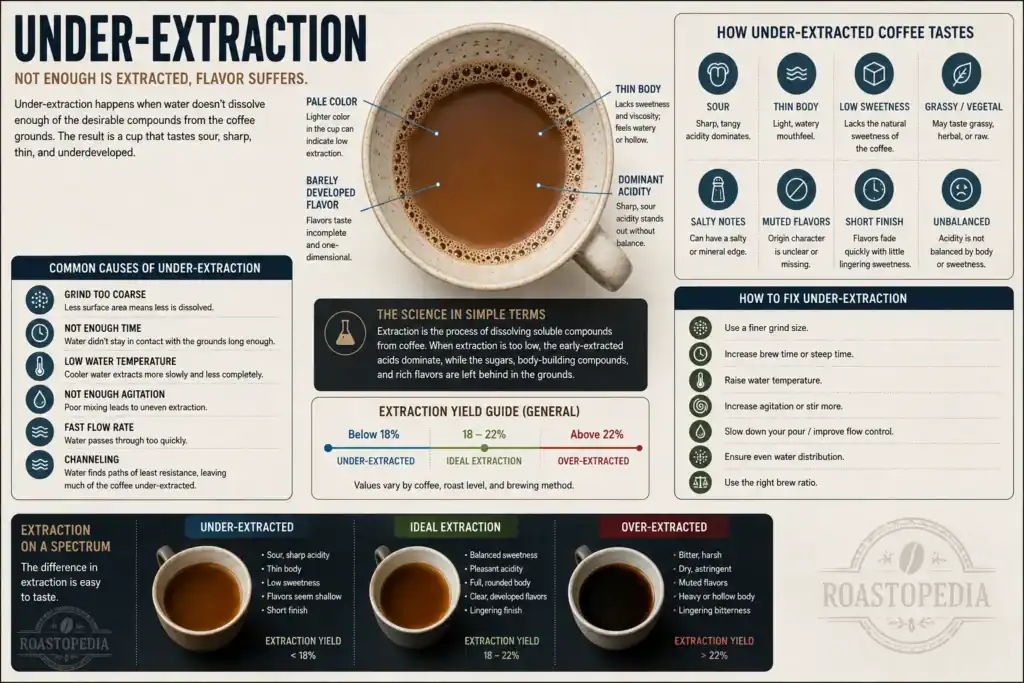
Coffee extraction occurs in stages. As brewing begins, water first dissolves highly soluble compounds, including many of the organic acids responsible for brightness and fruit-like characteristics. As extraction continues, sugars, caramelized compounds, and flavor-rich substances contribute sweetness, body, and balance. Later stages introduce increasingly bitter compounds.
When brewing stops too early, the extraction process remains incomplete. The coffee contains a disproportionate amount of early-extracted acids while lacking the sugars and soluble compounds that would normally provide balance. As a result, the cup often tastes sharp, sour, and unfinished.
For this reason, under-extraction is not simply a matter of “weak coffee.” A beverage can be strong in concentration yet still be under-extracted if insufficient soluble material has been removed from the grounds.
The Science Behind Under-Extraction
The extraction process is governed by principles of diffusion and mass transfer. Water must penetrate coffee particles, dissolve soluble compounds, and transport them into the brewing liquid.
Several factors influence this process:
- Surface area of the coffee particles
- Contact time between water and coffee
- Water temperature
- Agitation and turbulence
- Flow rate
- Water chemistry
If any of these variables limit the ability of water to dissolve and transport soluble compounds, extraction efficiency decreases. When extraction remains too low, the coffee becomes under-extracted.
Professional coffee brewing often targets extraction yields between approximately 18% and 22%. Although ideal values vary by coffee and brewing method, extraction yields significantly below this range are frequently associated with under-extracted flavors.
Causes of Under-Extraction
Grind Size That Is Too Coarse
One of the most common causes of under-extraction is an excessively coarse grind. Large coffee particles expose less surface area to water, slowing the extraction process and reducing the amount of dissolved material in the final cup.
Insufficient Brew Time
Water requires adequate contact time to dissolve desirable compounds. Brewing times that are too short may prevent complete extraction from occurring.
Low Water Temperature
Water temperature significantly affects extraction efficiency. Cooler water extracts compounds more slowly and less completely than hotter water. Temperatures below recommended brewing ranges can therefore contribute to under-extraction.
Inadequate Agitation
Agitation promotes contact between water and coffee particles. Insufficient stirring, swirling, or water movement may leave portions of the coffee bed poorly saturated, resulting in uneven and incomplete extraction.
Fast Flow Rates
In percolation methods such as pour-over brewing, water that passes too quickly through the coffee bed may not remain in contact with the grounds long enough to achieve proper extraction.
Channeling
Channeling occurs when water follows preferred pathways through the coffee bed. Portions of the grounds become over-extracted while others receive little or no extraction. The overall cup often exhibits symptoms associated with under-extraction because much of the coffee remains insufficiently brewed.
Sensory Characteristics
Under-extracted coffee exhibits a distinct sensory profile that differs substantially from balanced or over-extracted coffee.
Common characteristics include:
- Sourness
- Sharp acidity
- Thin body
- Weak sweetness
- Grassy or vegetal notes
- Salty impressions
- Hollow flavor profile
- Short finish
Many coffee professionals describe under-extracted coffee as tasting incomplete or immature. The cup may appear bright initially but lacks the sweetness and structure necessary for balance.
Under-Extraction in Different Brewing Methods
Pour-Over Brewing
Pour-over brewers frequently encounter under-extraction when using excessively coarse grinds or when drawdown occurs too quickly. Cups may taste sour despite using high-quality coffee.
Espresso
Under-extracted espresso is often immediately recognizable. The shot may run too quickly and exhibit intense acidity, weak sweetness, and a thin body. The crema may appear pale and dissipate rapidly.
French Press
In immersion brewing, under-extraction can result from insufficient steeping time or water temperatures that are too low. The resulting coffee may taste watery and undeveloped.
Cold Brew
Cold brew extraction proceeds much more slowly than hot-water brewing. Insufficient steeping time can leave the beverage lacking sweetness and complexity.
Under-Extraction vs. Over-Extraction
Under-extraction and over-extraction represent opposite ends of the extraction spectrum.
| Characteristic | Under-Extraction | Over-Extraction |
| Dominant Taste | Sour | Bitter |
| Sweetness | Low | Suppressed |
| Body | Thin | Heavy or drying |
| Acidity | Sharp and dominant | Muted or dull |
| Finish | Short | Lingering and harsh |
| Extraction Yield | Too low | Too high |
| Typical Cause | Insufficient extraction | Excessive extraction |
The goal of brewing is not to avoid one extreme by moving toward the other. Rather, it is to achieve a balanced extraction where sweetness, acidity, aroma, and body exist in harmony.
Diagnosing Under-Extraction
Coffee professionals often identify under-extraction through sensory evaluation before consulting brewing measurements.
Indicators include:
- Rapid espresso shot times
- Fast pour-over drawdowns
- Low extraction yield readings
- Low Total Dissolved Solids (TDS)
- Persistent sourness despite quality beans
Because coffee acidity is not inherently undesirable, distinguishing between pleasant acidity and under-extracted sourness is an important skill in coffee evaluation.
Correcting Under-Extraction
Brewers can often improve under-extracted coffee through targeted adjustments:
- Use a finer grind size
- Increase brew time
- Raise water temperature
- Increase agitation
- Improve coffee bed preparation
- Slow flow rate
- Optimize brewing ratios
Adjustments are generally most effective when made one variable at a time, allowing the brewer to identify the specific cause of the problem.
Importance in Coffee Brewing
Understanding under-extraction is fundamental to coffee preparation because it highlights the relationship between brewing variables and flavor development. Many brewing problems that appear to be related to coffee quality are actually the result of insufficient extraction.
Modern brewing theory emphasizes the pursuit of optimal extraction, where acidity is balanced by sweetness, body complements aroma, and the coffee expresses its origin and roast characteristics without becoming either sour or bitter. Recognizing under-extraction allows brewers to move closer to that balance and unlock the full potential of a coffee.
See Also
- Agitation
- Brew Ratio
- Channeling
- Contact Time
- Diffusion
- Extraction
- Extraction Yield
- Flow Rate
- Grind Size
- Immersion Brewing
- Over-Extraction
- Percolation Brewing
- Refractometer
- Total Dissolved Solids (TDS)
- Turbulence
- Water Temperature
References
- Rao, Scott. Coffee Brewing Best Practices. Scott Rao Publishing, 2019.
- Rao, Scott. Everything but Espresso. Scott Rao Publishing, 2010.
- Hoffmann, James. The World Atlas of Coffee. 2nd Edition. Octopus Publishing, 2018.
- Gagné, Jonathan. The Physics of Filter Coffee. BH Books, 2021.
- Hendon, Christopher. Water for Coffee. BH Books, 2015.
- Illy, Andrea & Viani, Rinantonio (Eds.). Espresso Coffee: The Science of Quality. Academic Press, 2005.
- Clarke, R. J. & Macrae, R. Coffee: Volume 2 – Technology. Elsevier Applied Science, 1987.
- Clarke, R. J. & Vitzthum, O. G. Coffee: Recent Developments. Blackwell Science, 2001.
- Navarini, Luciano et al. Coffee: Recent Developments. Wiley-Blackwell, 2021.
- Specialty Coffee Association (SCA). Brewing Handbook.
- Lockhart, Ernest E. The Coffee Brewing Handbook. Coffee Brewing Institute, 1957.
- Lingle, Ted R. The Coffee Cupper’s Handbook. Specialty Coffee Publications, 2011.
- Hendon, C. H., Colonna-Dashwood, M., & Colonna-Dashwood, C. Water for Coffee. BH Books, 2015.
- Moroney, K. M., Lee, W. T., O’Brien, S. B. G., Suijver, F., & Marra, J. “A Recipe for a Better Cup of Coffee.” Physics of Fluids, 2020.
- Frost, S. C., et al. “Systematically Improving Espresso: Insights from Mathematical Modeling and Experiment.” Matter, 2020.
- Specialty Coffee Association Coffee Standards Committee. Coffee Brewing Control Chart Guidelines.