
A roastery is a facility in which green coffee beans are transformed into roasted coffee through the controlled application of heat. The roasting process develops the beans’ aroma, flavor, color, and chemical composition, converting raw agricultural products into coffee suitable for brewing. Roasteries range in scale from small artisan workshops serving local communities to large industrial facilities capable of producing thousands of kilograms of roasted coffee daily.
The term also refers to a business whose principal activity is coffee roasting. Many modern roasteries package, market, and distribute roasted coffee under their own brands, while others roast coffee on behalf of wholesalers, cafés, retailers, supermarkets, or private-label clients. Some roasteries operate independently, whereas others are integrated into coffee farms, cafés, restaurant chains, or multinational coffee companies.
Roasteries occupy an intermediate position within the coffee value chain, linking coffee producers and exporters with retailers, cafés, and consumers. Their work determines many of the sensory characteristics ultimately perceived in the brewed beverage. Roast degree (see Coffee Roast Level), roast profile, development time, and roasting technique all influence acidity, sweetness, bitterness, aroma, body, and flavor complexity.
Unlike coffee farms, which cultivate coffee cherries, or coffee mills, which process harvested coffee into exportable green beans, roasteries specialize in converting stable green coffee into roasted coffee intended for immediate consumption. Because roasted coffee gradually loses volatile aromatic compounds after roasting, roasting is typically performed as close as practical to the point of sale or consumption.
Etymology
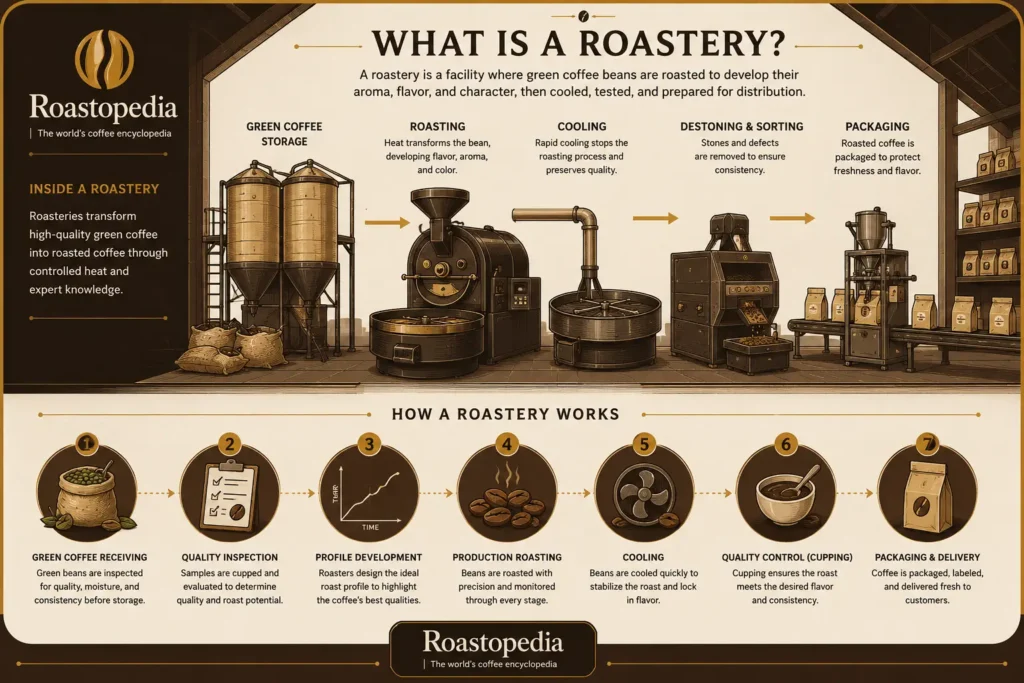
The word roastery derives from the English verb to roast, meaning to cook or heat food using dry heat, combined with the suffix -ery, which denotes a place where a specific activity occurs. Similar formations include bakery, brewery, and winery.
The widespread use of the term “roastery” specifically for coffee businesses became increasingly common during the late twentieth century alongside the growth of specialty coffee. Earlier commercial operations were often described simply as coffee roasting companies, coffee roasting works, or roasting plants.
Today, the term encompasses facilities ranging from neighborhood micro-roasteries to multinational industrial roasting complexes.
Purpose
The principal purpose of a roastery is to roast green coffee beans to predetermined specifications that maximize quality, consistency, and suitability for their intended brewing methods.
Additional purposes include:
- Developing desirable flavor characteristics.
- Eliminating undesirable vegetal flavors found in raw coffee.
- Producing consistent roast profiles across production batches.
- Packaging roasted coffee for retail or wholesale distribution.
- Conducting quality control and sensory evaluation.
- Creating proprietary blends.
- Educating consumers through tastings and demonstrations.
- Supporting cafés and restaurants with freshly roasted coffee.
Many specialty coffee roasteries additionally function as educational centers, training baristas, hosting public cuppings, and promoting transparency throughout the coffee supply chain.
Historical Origins
The history of the roastery is closely connected to the history of coffee roasting itself.
Coffee roasting predates dedicated roasting facilities by several centuries. During the fifteenth century, coffee was generally roasted domestically in the Arabian Peninsula using shallow pans placed over charcoal fires. Roasting was performed immediately before grinding and brewing because roasted coffee deteriorated relatively quickly.
As coffee spread throughout the Ottoman Empire during the sixteenth century, specialized roasting equipment gradually emerged. Cylindrical metal drums equipped with hand cranks allowed beans to be roasted more evenly over open flames. Although these devices improved consistency, roasting remained largely a household or coffeehouse activity rather than a specialized commercial industry.
The expansion of coffeehouses across cities such as Constantinople, Cairo, Venice, London, Paris, and Amsterdam during the seventeenth century created increasing demand for roasted coffee. Many coffeehouse owners roasted beans themselves using manually operated roasting drums.
Dedicated commercial coffee roasting businesses began appearing during the eighteenth century as urban populations expanded and coffee consumption increased. Rather than every household roasting its own beans, consumers increasingly purchased roasted coffee from merchants specializing in roasting.
These early commercial roasting establishments represented the earliest forms of the modern roastery.
Development During the Industrial Revolution
The Industrial Revolution fundamentally transformed coffee roasting.
During the nineteenth century, advances in metallurgy, steam power, and mechanical engineering enabled the construction of larger, more efficient roasting machines capable of processing significantly greater quantities of coffee than manually operated drums.
Factories dedicated exclusively to coffee roasting became increasingly common across Europe and North America. Steam-powered machinery improved productivity while reducing labor requirements. Mechanical cooling systems shortened cooling times, helping preserve bean quality.
Industrialization also encouraged greater standardization. Businesses developed repeatable roasting procedures to ensure customers received coffee with consistent appearance and flavor regardless of production date.
The emergence of branded packaged coffee further increased demand for large-scale roasting operations. Instead of purchasing loose roasted beans from neighborhood merchants, consumers increasingly bought packaged coffee identified by company brands.
This transition marked an important evolution from small roasting workshops to industrial roasteries.
Emergence of Modern Commercial Roasteries
By the late nineteenth and early twentieth centuries, numerous companies had established centralized roasting facilities supplying regional and national markets.
Improved transportation networks—including railways, steamships, and later motor freight—enabled green coffee to be imported efficiently from producing countries while roasted coffee could be distributed over increasingly large geographic areas.
Large roasting companies invested heavily in mechanized production lines that integrated roasting, cooling, grinding, blending, packaging, and shipping.
During this period, roasting became increasingly scientific. Operators began recording roast temperatures, roasting durations, bean expansion, weight loss, and color development to improve consistency.
Advances in packaging technology also extended product shelf life. Vacuum packaging, inert gas flushing, and later one-way degassing valves reduced oxidation while allowing freshly roasted coffee to be distributed over wider markets.
Here’s a section that should fit seamlessly into your encyclopedic article.
Notable Historical Roasteries
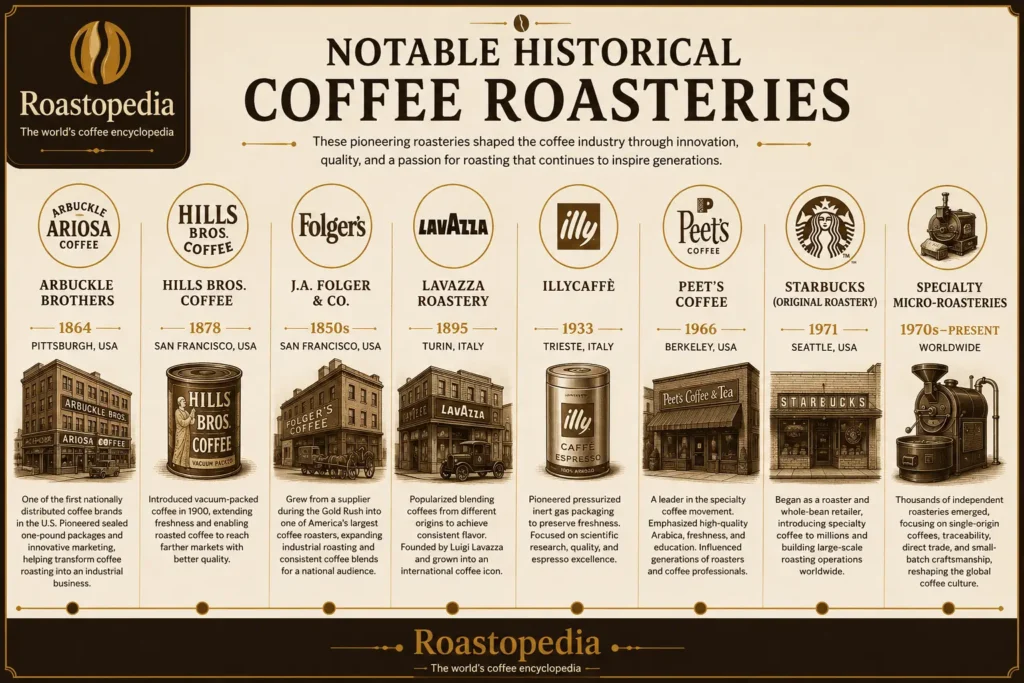
The history of commercial coffee roasting is closely associated with the growth of several influential roasteries that introduced technological innovations, expanded coffee distribution, or helped shape modern coffee culture. While many early roasting establishments have disappeared or evolved into contemporary businesses, several historical roasteries remain significant for their contributions to the development of the coffee industry.
The Arbuckle Brothers Roastery
One of the earliest large-scale commercial coffee roasting operations was established by Arbuckle Brothers in Pittsburgh, Pennsylvania, during the second half of the nineteenth century. Founded by John and Charles Arbuckle in 1864, the company became widely known for producing Ariosa Coffee, one of the first nationally distributed roasted and packaged coffee brands in the United States.
The Arbuckle Brothers introduced several innovations in coffee packaging and distribution. Their roasted coffee was sold in sealed one-pound packages rather than loose from barrels, helping preserve freshness and standardize product quality. The company also pioneered promotional marketing campaigns that included collectible coupons and premiums, practices that were later adopted throughout the food industry.
By the late nineteenth century, Arbuckle Brothers had become one of the world’s largest coffee roasting businesses and played an important role in transforming coffee roasting from a local merchant activity into an industrial manufacturing process.
Hills Bros. Coffee Roastery
Founded in San Francisco in 1878, Hills Bros. Coffee became one of the best-known American coffee roasting companies of the early twentieth century.
The company is particularly noted for introducing vacuum-packed coffee in 1900, an innovation that significantly extended the shelf life of roasted coffee by reducing exposure to oxygen. Vacuum packaging enabled roasted coffee to be transported over greater distances while maintaining freshness, influencing packaging practices across the global coffee industry.
Hills Bros. also expanded the use of mechanized roasting equipment and national branding, contributing to the rapid growth of commercial coffee consumption throughout North America.
J.A. Folger & Co.
Established in San Francisco during the California Gold Rush era, J.A. Folger & Co. evolved from a supplier of coffee to gold miners into one of the largest coffee roasting companies in the United States.
The company’s industrial roasting facilities expanded considerably during the late nineteenth and early twentieth centuries, allowing Folgers to distribute roasted coffee across increasingly larger markets. Its emphasis on consistent blending and large-scale production reflected the broader industrialization of coffee roasting during this period.
Folgers remains one of the longest-operating coffee brands in North America, although its roasting operations have evolved through changes in ownership and manufacturing technologies.
Lavazza Roastery
The Italian company Luigi Lavazza S.p.A., founded in Turin in 1895 by Luigi Lavazza, became one of Europe’s most influential coffee roasting enterprises.
Lavazza is widely recognized for popularizing the practice of blending coffees from different geographical origins to achieve consistent flavor profiles. This approach allowed the company to maintain product quality despite seasonal variations in coffee harvests and eventually became standard practice throughout much of the commercial coffee industry.
Over time, Lavazza expanded from a neighborhood grocery and roasting operation into an international coffee company with roasting facilities serving markets across Europe and beyond.
Illycaffè
Founded in Trieste, Italy, in 1933 by Francesco Illy, Illycaffè became an important innovator in espresso coffee roasting.
The company developed proprietary packaging systems using pressurized inert gas to preserve coffee freshness, extending the storage life of roasted coffee while maintaining aroma and flavor. Illy also emphasized scientific research into coffee chemistry and roasting, collaborating with universities and researchers to improve quality control and production consistency.
Its roasting philosophy, centered on precision, repeatability, and espresso preparation, has influenced numerous specialty and commercial roasteries worldwide.
Peet’s Coffee
Founded in Berkeley, California, in 1966 by Dutch-born coffee roaster Alfred Peet, Peet’s Coffee played a central role in the emergence of the American specialty coffee movement.
Unlike many commercial roasteries of the time, Peet’s emphasized freshly roasted, high-quality Arabica coffee sourced from selected origins. The company roasted coffee in relatively small batches and educated consumers about coffee origins, freshness, and roast profiles.
Many influential figures within the modern specialty coffee industry—including the founders of Starbucks—received training or inspiration from Alfred Peet, making his roastery historically significant beyond its commercial success.
Starbucks Roastery
Although Starbucks was established primarily as a coffee retailer in 1971, its original business centered on roasting and selling whole-bean coffee rather than serving espresso beverages.
The company’s early roasting operations helped introduce millions of consumers to specialty-grade Arabica coffee and darker roast profiles. As Starbucks expanded internationally, it established large-scale roasting facilities capable of supplying global markets while maintaining standardized roasting practices.
In 2014, Starbucks introduced the concept of the Starbucks Reserve Roastery, combining coffee roasting, education, retail, and hospitality within immersive public spaces. These facilities reflect the evolution of the roastery from a purely industrial operation into an educational and experiential destination.
Specialty Micro-Roasteries
Beginning in the 1970s and accelerating throughout the 1990s and twenty-first century, thousands of independent specialty micro-roasteries emerged worldwide.
Unlike earlier industrial roasting companies, these businesses emphasized single-origin coffees, traceability, direct trade relationships, roast transparency, and small-batch production. Advances in compact roasting equipment allowed entrepreneurs to establish professional roasting operations with comparatively modest capital investment.
Collectively, specialty micro-roasteries have reshaped consumer perceptions of coffee by highlighting regional origin, processing methods, coffee varieties, and roast profiling. Their influence has contributed significantly to the global expansion of the specialty coffee industry and continues to shape contemporary roasting practices.
The Rise of Specialty Coffee Roasteries
The modern concept of the specialty coffee roastery emerged during the late twentieth century.
Rather than emphasizing maximum production volume, specialty roasteries prioritized coffee quality, traceability, freshness, and origin characteristics.
The specialty coffee movement encouraged roasters to purchase higher-quality green coffee sourced from specific farms, estates, cooperatives, or geographic regions. Instead of roasting all coffees to dark profiles, specialty roasters developed roast profiles designed to highlight each coffee’s inherent characteristics.
This philosophy represented a significant departure from traditional commercial roasting, where darker roasting often minimized differences between coffee origins.
Specialty roasteries also introduced greater transparency regarding sourcing practices, processing methods, roast dates, and brewing recommendations.
The expansion of specialty coffee during the 1990s and twenty-first century led to the establishment of thousands of independent micro-roasteries throughout North America, Europe, Asia, Australia, Africa, and Latin America.
Many operate in conjunction with cafés where customers can observe roasting operations directly through glass viewing areas or participate in educational events.
Position Within the Coffee Supply Chain
Roasteries form an essential link in the global coffee supply chain.
A typical supply chain includes:
- Coffee cultivation.
- Harvesting.
- Processing.
- Dry milling.
- Export.
- Import.
- Green coffee storage.
- Roasting.
- Packaging.
- Wholesale distribution.
- Retail sale.
- Brewing and consumption.
Roasteries purchase green coffee from importers, exporters, cooperatives, producers, or traders. After roasting, coffee may be sold directly to consumers, supplied to cafés and restaurants, distributed through supermarkets, or exported to international markets.
Because roasting dramatically changes coffee’s chemical composition while shortening its shelf life, timing and logistics are central considerations in roastery operations.
Primary Functions
Although roasting is their defining activity, modern roasteries perform numerous interconnected functions.
These commonly include:
- Green coffee sourcing.
- Quality inspection.
- Moisture measurement.
- Density evaluation.
- Sample roasting.
- Roast profile development.
- Production roasting.
- Bean cooling.
- Degassing management.
- Blending.
- Grinding (where applicable).
- Packaging.
- Inventory management.
- Quality assurance.
- Sensory analysis through cupping.
- Wholesale fulfillment.
- Retail sales.
- Customer education.
Larger operations frequently maintain dedicated departments responsible for quality control, logistics, engineering, procurement, research, product development, marketing, and sustainability.
Roasting as the Core Activity
Roasting remains the defining operation of every roastery.
During roasting, green coffee undergoes numerous physical and chemical transformations resulting from controlled heating.
The beans lose moisture, expand in size, decrease in density, and undergo complex reactions including the Maillard Reaction, caramelization, and pyrolysis. These reactions generate hundreds of volatile aromatic compounds responsible for coffee’s characteristic flavor and aroma.
Roasters manipulate several variables during roasting, including:
- Charge temperature.
- Heat application.
- Airflow.
- Drum speed.
- Rate of rise.
- Development time.
- Final bean temperature.
- Cooling rate.
Each variable influences the finished coffee’s sensory profile, making roasting both a technical and quality-critical stage of coffee production.
Types of Roasteries
Roasteries vary considerably in size, production capacity, ownership structure, business model, and target market. Although all perform the fundamental task of roasting green coffee, their operational objectives and production methods differ substantially.
Micro-Roasteries
A micro-roastery is a small-scale roasting business that typically produces coffee in relatively limited quantities. Many micro-roasteries operate within individual communities and supply local cafés, restaurants, offices, and consumers.
Production often emphasizes freshness, traceability, and small-batch roasting rather than high-volume output. Micro-roasteries frequently source specialty-grade coffees from individual farms, cooperatives, or estates and may roast several times each week to maintain product freshness.
Because production volumes are comparatively low, operators are often directly involved in multiple aspects of the business, including sourcing, roasting, packaging, quality control, marketing, and customer service.
Many micro-roasteries also function as educational centers by hosting cupping sessions, brewing workshops, and public demonstrations of coffee roasting.
Specialty Coffee Roasteries
Specialty coffee roasteries focus on roasting coffees that meet recognized specialty-grade standards. Rather than producing coffee intended primarily for consistency across large markets, these businesses seek to preserve and emphasize the distinctive characteristics associated with specific coffee varieties, origins, elevations, processing methods, and harvests.
Specialty roasteries commonly establish long-term relationships with producers and importers to secure high-quality green coffee. Many publish detailed information regarding each coffee, including:
- Country of origin
- Region
- Farm or estate
- Producer
- Coffee variety
- Processing method
- Elevation
- Harvest year
- Roast date
- Recommended brewing methods
This level of transparency became increasingly common during the Third Wave Coffee movement, which emphasized coffee as an agricultural product with characteristics comparable to those of fine wine or specialty tea.
Commercial Roasteries
Commercial roasteries primarily serve supermarkets, restaurants, offices, hotels, institutions, convenience stores, and mass-market retailers.
Compared with specialty roasteries, commercial facilities generally produce significantly larger quantities of roasted coffee and prioritize production efficiency, consistency, and broad consumer appeal.
Commercial blends often combine coffees from multiple producing countries to maintain consistent flavor throughout the year despite seasonal variations in harvests.
Automation plays a significant role in commercial roasting. Computer-controlled systems regulate roasting temperatures, airflow, cooling, packaging, and inventory management while minimizing production variability.
Industrial Roasteries
Industrial roasteries represent the largest category of coffee roasting facilities.
These operations may roast several tonnes of coffee per day using continuous or high-capacity batch roasting systems. Production facilities frequently include:
- Large green coffee silos
- Automated bean conveyors
- Computer-controlled roasting systems
- Industrial cooling units
- Optical sorting equipment
- Grinding lines
- Packaging machinery
- Warehousing
- Distribution centers
Industrial roasteries supply national and international markets through extensive logistics networks.
Many multinational coffee companies operate multiple industrial roasting facilities located near major transportation hubs to improve distribution efficiency.
Café Roasteries
A café roastery combines coffee roasting with retail beverage service.
Customers can observe roasting equipment while purchasing brewed coffee, espresso drinks, or roasted beans. Many café roasteries intentionally install roasting machines within visible areas to demonstrate freshness and provide educational opportunities.
These establishments frequently offer:
- Coffee tastings
- Guided cuppings
- Brewing demonstrations
- Barista training
- Roastery tours
- Educational workshops
The café roastery model became increasingly popular during the specialty coffee movement because it allows consumers to connect directly with the roasting process.
Wholesale Roasteries
Wholesale roasteries produce coffee primarily for other businesses rather than direct retail consumers.
Their customers commonly include:
- Coffee shops
- Restaurants
- Hotels
- Grocery stores
- Corporate offices
- Airlines
- Universities
- Hospitality groups
Wholesale contracts often require consistent production volumes, standardized blends, customized packaging, and regular delivery schedules.
Some wholesale roasteries additionally provide technical support, equipment servicing, and staff training to their commercial clients.
Private-Label Roasteries
Private-label roasteries roast and package coffee that is marketed under another company’s brand name.
Supermarkets, cafés, hospitality businesses, online retailers, and subscription services frequently contract private-label roasteries to manufacture coffee without operating their own roasting facilities.
These arrangements enable businesses to market proprietary coffee brands while outsourcing roasting operations to specialized manufacturers.
Roastery Equipment
Modern roasteries utilize a wide range of specialized equipment designed to maximize roasting consistency, product quality, worker safety, and production efficiency.
Although equipment varies according to production scale, most facilities include several common components.
Coffee Roasters
The roasting machine is the central piece of equipment in every roastery.
Several major designs are widely used.
Drum Roasters
Drum roasters roast coffee inside a rotating metal drum heated by gas, electricity, or other fuel sources.
Continuous rotation promotes relatively even heat distribution while reducing scorching. Drum roasting remains one of the most widely used methods in both specialty and commercial coffee roasting.
Fluid-Bed Roasters
Fluid-bed roasters suspend coffee beans within rapidly moving streams of heated air.
Because heat transfer occurs primarily through convection rather than conduction, fluid-bed roasting generally produces faster roasting times and different flavor characteristics compared with drum roasting.
Hybrid Roasters
Some manufacturers combine features of drum roasting and fluid-bed roasting to achieve greater control over heat transfer and airflow.
Hybrid systems are increasingly used by specialty coffee roasteries seeking flexibility in roast profile development.
Green Coffee Storage
Before roasting, green coffee is typically stored under controlled environmental conditions.
Proper storage minimizes moisture fluctuations, mold growth, pest infestation, and premature quality deterioration.
Many industrial roasteries utilize large silos equipped with automated handling systems, whereas smaller specialty roasteries often store coffee in climate-controlled warehouses.
Destoners
After roasting, coffee occasionally contains small stones or other foreign materials that escaped removal during earlier processing stages.
Destoners separate these heavier objects from roasted beans using differences in density and airflow.
The use of destoners reduces the risk of grinder damage and improves product safety.
Cooling Systems
Coffee must be cooled rapidly immediately after roasting to prevent continued internal cooking.
Most roasteries employ cooling trays equipped with stirring arms and high-capacity fans that reduce bean temperature within several minutes.
Rapid cooling helps preserve roast consistency and minimizes undesirable flavor development.
Packaging Equipment
Packaging systems vary according to production scale but commonly include:
- Automated weighing systems
- Filling machines
- Heat sealers
- Nitrogen flushing equipment
- Vacuum packaging systems
- One-way degassing valve applicators
- Labeling machines
- Date coding equipment
Proper packaging protects roasted coffee from oxygen, moisture, light, and external contamination.
The Roastery Workflow
Although individual operations vary, coffee generally passes through a standardized sequence within the roastery.
Green Coffee Receiving
Incoming shipments undergo inspection to verify origin, weight, moisture content, physical quality, and compliance with purchasing specifications.
Samples may be roasted and cupped before coffee is accepted into inventory.
Sample Roasting
Many specialty roasteries perform small sample roasts before developing production roast profiles.
Sample roasting enables quality professionals to evaluate:
These evaluations guide subsequent production roasting decisions.
Profile Development
Roast profile development involves determining the combination of temperature, airflow, time, and heat application required to achieve desired flavor characteristics.
Modern roasting software records extensive production data, allowing operators to compare roast curves and improve batch consistency over time.
Production Roasting
Once a suitable roast profile has been established, coffee enters routine production.
Operators continuously monitor bean temperature, environmental temperature, airflow, exhaust conditions, and roasting progress to maintain consistency between batches.
Many facilities combine computerized monitoring with human observation, particularly during first crack, development time, and final bean discharge.
Degassing
Freshly roasted coffee releases carbon dioxide produced during roasting.
This process, known as degassing, continues for several days after roasting.
Many specialty coffees are allowed to degas before brewing or packaging because excessive carbon dioxide can interfere with extraction, particularly during espresso preparation.
Quality Control
Quality control remains a central responsibility within every professional roastery.
Routine quality assurance may include:
- Roast color measurement
- Moisture analysis
- Water activity testing
- Bean density evaluation
- Grind analysis
- Cupping
- Brewing trials
- Packaging inspections
- Shelf-life evaluation
Many roasteries retain reference samples from previous production batches for comparison with future roasts.
Sensory Evaluation
Most professional roasteries maintain formal cupping programs to evaluate roasted coffee objectively.
Sensory evaluation assesses attributes including:
- Fragrance
- Aroma
- Flavor
- Aftertaste
- Acidity
- Body
- Balance
- Uniformity
- Clean cup
- Sweetness
- Overall quality
Regular cupping enables roasteries to detect production inconsistencies, identify defects, and verify that roast profiles continue to achieve their intended sensory outcomes.
Sustainability in Roasteries
Sustainability has become an increasingly important consideration within the global coffee roasting industry. Modern roasteries are expected not only to produce high-quality coffee but also to minimize their environmental impact, improve operational efficiency, and contribute to responsible sourcing practices.
Coffee roasting is an energy-intensive process. Most commercial roasting machines rely on natural gas, propane, or electricity to generate the heat required for roasting. As environmental awareness has grown, many roasteries have invested in technologies that reduce fuel consumption and greenhouse gas emissions.
Common sustainability initiatives include:
- Installing high-efficiency roasting equipment.
- Recovering waste heat for reuse.
- Using renewable electricity where available.
- Employing catalytic oxidizers or afterburners to reduce smoke and volatile organic compound (VOC) emissions.
- Recycling packaging materials.
- Reducing plastic usage.
- Composting coffee chaff, the papery skin released during roasting.
- Implementing energy-monitoring systems.
- Optimizing logistics to reduce transportation emissions.
Many specialty coffee roasteries also emphasize sustainable sourcing by purchasing coffee from producers who employ environmentally responsible farming methods and ethical labor practices.
Certifications and Industry Standards
Numerous certification systems and industry standards influence the operation of modern roasteries. While certifications generally apply to the coffee itself rather than the roasting facility, roasteries frequently work with certified coffees and maintain internal quality systems that align with recognized industry practices.
Common certification programs include:
- Fairtrade
- Organic
- Rainforest Alliance
- Smithsonian Bird Friendly
- UTZ Certified (now integrated into the Rainforest Alliance program)
Many specialty roasteries also follow quality standards established by the Specialty Coffee Association (SCA), particularly in areas such as green coffee evaluation, sensory analysis, roasting practices, and cupping protocols.
Food safety regulations likewise play a significant role. Depending on the country, roasteries may be required to comply with food manufacturing standards governing sanitation, traceability, labeling, allergen control, workplace safety, and product recalls.
Technology and Automation
Technological innovation has significantly transformed coffee roasting during the twenty-first century.
Whereas roasting historically depended almost entirely upon the experience of individual roasters, many modern facilities integrate digital technologies that improve consistency and production efficiency.
Computerized roasting systems commonly monitor:
- Bean temperature
- Environmental temperature
- Burner output
- Airflow
- Drum speed
- Rate of Rise (RoR)
- Development time
- Batch duration
- Cooling time
These measurements allow operators to reproduce roast profiles with greater precision than was previously possible.
Specialized roasting software stores historical roast data, enabling comparisons across hundreds or even thousands of production batches. Digital records also assist with quality assurance, staff training, and production planning.
Some industrial facilities employ programmable logic controllers (PLCs) and supervisory control and data acquisition (SCADA) systems to automate multiple stages of production, including bean transport, roasting, cooling, grinding, packaging, and inventory management.
Artificial Intelligence and Data-Driven Roasting
Artificial intelligence and machine learning have begun influencing coffee roasting by assisting with process optimization and quality prediction.
Rather than replacing human expertise, AI systems typically analyze production data to identify relationships between roasting variables and sensory outcomes.
Potential applications include:
- Predicting roast development.
- Monitoring roast consistency.
- Detecting equipment abnormalities.
- Optimizing fuel consumption.
- Forecasting maintenance requirements.
- Assisting profile development.
- Improving production scheduling.
Although these technologies continue to evolve, experienced roast masters remain responsible for interpreting sensory results and making final roasting decisions.
Economic Importance
Roasteries represent an important sector of the global coffee economy.
They generate employment across numerous occupations, including:
- Coffee roasters
- Green coffee buyers
- Quality assurance specialists
- Q Graders
- Production technicians
- Engineers
- Packaging operators
- Warehouse personnel
- Logistics coordinators
- Marketing professionals
- Sales representatives
- Barista trainers
- Customer support staff
Roasteries also create value by transforming relatively stable green coffee into higher-value roasted products.
In producing countries, an increasing number of domestic roasteries have emerged to encourage local value addition before export or domestic sale. This development has contributed to greater diversification within coffee-producing economies.
Cultural Significance
Roasteries have become important cultural institutions within many coffee-drinking societies.
Historically, coffee roasting occurred primarily within homes or neighborhood coffeehouses. The growth of commercial roasteries transformed roasting into a specialized profession while making roasted coffee more widely available.
During the late twentieth century, specialty coffee roasteries increasingly became public spaces where consumers could observe roasting, participate in educational events, and learn about coffee production.
Many contemporary roasteries host:
- Public cuppings
- Brewing demonstrations
- Barista competitions
- Educational workshops
- Producer presentations
- Community gatherings
These activities have strengthened consumer awareness of coffee origins, agricultural practices, and roasting science.
Criticism
Despite their importance within the coffee industry, roasteries have been subject to several criticisms.
Environmental Impact
Coffee roasting produces smoke, carbon dioxide, particulate matter, and volatile organic compounds. Without appropriate emission control systems, roasting facilities may contribute to localized air pollution.
Older roasting equipment is generally less energy-efficient than modern systems, leading to higher fuel consumption and greater greenhouse gas emissions.
Packaging Waste
The widespread use of multilayer coffee bags, plastic valves, and composite packaging materials has raised concerns regarding recyclability.
Many manufacturers have responded by introducing recyclable, compostable, or mono-material packaging, although adoption varies across the industry.
Freshness Marketing
Some industry observers have argued that marketing claims emphasizing “freshly roasted coffee” may oversimplify coffee freshness.
While freshness is important, coffee often benefits from a period of degassing following roasting. Excessively fresh coffee may produce inconsistent brewing results, particularly for espresso preparation.
Consequently, many specialty roasteries publish recommended resting periods for different coffees.
Consistency Challenges
Maintaining roast consistency remains a significant operational challenge.
Variations in green coffee moisture, density, bean size, harvest conditions, storage duration, and ambient weather can all influence roasting performance.
Professional roasteries therefore invest heavily in quality control, data recording, and sensory evaluation to minimize batch-to-batch variation.
Adaptations and Modern Trends
The coffee roasting industry continues to evolve in response to technological innovation, changing consumer preferences, and developments within specialty coffee.
Notable trends include:
- Increased direct trade relationships between roasteries and producers.
- Greater transparency regarding coffee sourcing.
- Carbon-neutral roasting initiatives.
- Electrically powered roasting systems.
- Precision roast profiling.
- Roast-on-demand subscription services.
- Online coffee sales.
- Small-batch limited releases.
- Single-origin product expansion.
- Data-driven quality management.
- Greater emphasis on traceability throughout the coffee supply chain.
These developments reflect broader changes within the coffee industry toward sustainability, transparency, and product differentiation.
Future Developments
Future developments in coffee roasting are expected to focus on improving precision, efficiency, sustainability, and quality assurance.
Areas receiving continued attention include:
- Electrification of roasting equipment.
- Artificial intelligence-assisted roast profiling.
- Real-time chemical analysis during roasting.
- Greater automation in industrial facilities.
- Reduced carbon emissions.
- Improved recyclable packaging materials.
- Enhanced traceability through digital supply-chain technologies.
- Expanded use of predictive maintenance systems.
- Integration of cloud-based roasting software.
- Increased consumer demand for transparent sourcing information.
Although roasting technologies continue to evolve, the fundamental objective of the roastery remains unchanged: transforming green coffee into roasted coffee while preserving or enhancing its desirable sensory characteristics.
See Also
References
- Davids, Kenneth. Home Coffee Roasting: Romance and Revival. St. Martin’s Griffin, 2003.
- Rao, Scott. The Coffee Roaster’s Companion. Scott Rao Publishing, 2014.
- Illy, Andrea & Viani, Rinantonio (Editors). Espresso Coffee: The Science of Quality. 2nd Edition. Academic Press, 2005.
- Illy, Andrea & Viani, Rinantonio (Editors). Espresso Coffee: The Science of Quality. 3rd Edition. Academic Press, 2015.
- Clarke, R. J. & Macrae, R. (Editors). Coffee: Volume 2 – Technology. Elsevier Applied Science Publishers, 1987.
- Clarke, R. J. & Vitzthum, Otto G. Coffee: Recent Developments. Blackwell Science, 2001.
- Pendergrast, Mark. Uncommon Grounds: The History of Coffee and How It Transformed Our World. Revised Edition. Basic Books, 2019.
- Ukers, William H. All About Coffee. Tea and Coffee Trade Journal Company, 1922.
- Hoffmann, James. The World Atlas of Coffee. 3rd Edition. Mitchell Beazley, 2023.
- Specialty Coffee Association (SCA). Coffee Skills Program: Roasting Foundation.
- Specialty Coffee Association (SCA). Coffee Skills Program: Roasting Professional.
- National Coffee Association (USA). Coffee Roasting Overview.
- International Organization for Standardization (ISO). ISO 3509: Coffee and Coffee Products—Vocabulary.
- International Trade Centre (ITC). The Coffee Guide. Fourth Edition.
- International Coffee Organization (ICO). Coffee Development Report.
- Farah, Adriana (Editor). Coffee: Production, Quality and Chemistry. Royal Society of Chemistry, 2019.
- Sivetz, Michael. Coffee Technology. AVI Publishing Company.
- SCAE (Specialty Coffee Association of Europe). Roasting Best Practices Manual.
- Food and Agriculture Organization of the United Nations (FAO). Publications on coffee processing and value addition.
- International Agency for Research on Cancer (IARC). Coffee, Tea, Mate, Methylxanthines and Methylglyoxal. IARC Monographs.
- European Coffee Federation. Coffee Industry Guidelines and Technical Publications.
- Coffee Quality Institute (CQI). Technical resources on green coffee quality evaluation and post-harvest standards.
- Lingle, Ted R. The Coffee Cupper’s Handbook. Specialty Coffee Association.
- National Fire Protection Association (NFPA). Guidance relating to fire safety in commercial roasting facilities.
- Boot, Willem. Boot Coffee Campus Roasting Publications and Educational Resources.