
Refractometry is the scientific measurement of how light changes direction, or refracts, as it passes through a liquid. In coffee brewing, refractometry is used to determine the concentration of dissolved coffee solids present in a brewed beverage.
The technique has become one of the most important analytical tools in modern coffee science, allowing brewers, roasters, researchers, Q-graders, and other quality control professionals to quantify extraction with a level of precision that was previously difficult to achieve through sensory evaluation alone.
By measuring the concentration of dissolved compounds in brewed coffee, refractometry helps determine whether a coffee has been under-extracted, properly extracted, or over-extracted. The data generated by a refractometer is commonly expressed as Total Dissolved Solids (TDS) and can be used to calculate Extraction Yield, two of the most significant metrics in contemporary coffee brewing.
Although coffee preparation remained largely guided by taste and tradition for centuries, the adoption of refractometry during the late twentieth and early twenty-first centuries transformed brewing into a more measurable and repeatable process.
Today, refractometry is widely employed in specialty coffee shops, roasting laboratories, research institutions, brewing competitions, and educational programs throughout the coffee industry.
Etymology
The term refractometry derives from the Latin word refractus, meaning “broken back” or “bent,” and the Greek-derived suffix -metry, meaning “measurement.” The name reflects the fundamental principle of the technique: measuring the bending of light as it passes through a substance.
In coffee applications, refractometry refers specifically to the use of optical instruments known as refractometers to measure the concentration of dissolved coffee compounds in brewed coffee.
Scientific Principle
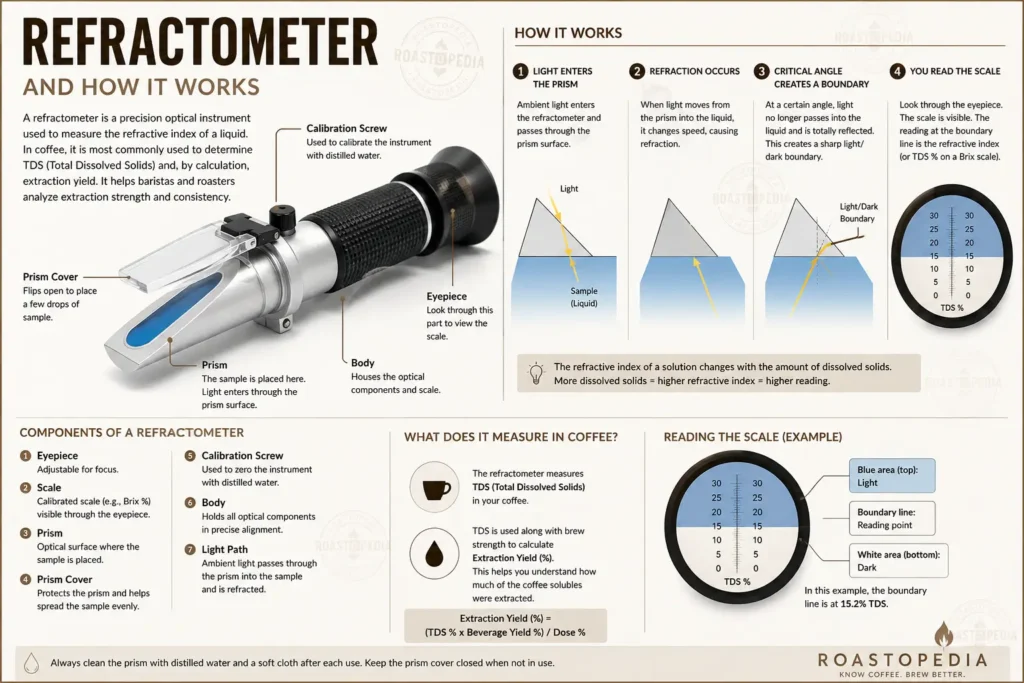
Refractometry is based on the relationship between dissolved substances and the refractive index of a liquid.
When light travels from one medium into another, its speed changes, causing the light beam to bend. The extent of this bending depends on the composition and concentration of substances dissolved within the liquid. As more coffee compounds dissolve into brewing water, the refractive index increases predictably.
A refractometer (pictured) measures this change and converts it into a concentration value. In coffee brewing, that concentration is typically expressed as a percentage known as Total Dissolved Solids (TDS).
For example:
| Brew Strength | Approximate TDS |
| Very weak coffee | Below 1.00% |
| Typical filter coffee | 1.15–1.45% |
| Strong filter coffee | 1.45–1.70% |
| Espresso | 7–12% or higher |
These values indicate concentration rather than extraction. Two coffees may possess identical TDS values while exhibiting different extraction yields depending on brewing parameters and dose-to-water ratios.
Early Origins of Refractometry
The scientific foundations of refractometry emerged long before its application to coffee.
During the seventeenth century, scientists, including Willebrord Snellius and later Isaac Newton, studied the behavior of light as it passed through different materials. Their work established the optical principles that would eventually lead to refractive measurement techniques.
By the nineteenth century, refractometers had become valuable instruments in chemistry, medicine, agriculture, and food production. Manufacturers developed increasingly precise devices capable of measuring concentrations of sugars, salts, and other dissolved substances.
Despite these advances, coffee remained largely untouched by refractometric analysis for much of its history.
Refractometry Before Specialty Coffee
Throughout the twentieth century, coffee quality was primarily assessed through sensory methods such as cupping, tasting, aroma evaluation, and visual inspection.
Commercial coffee producers occasionally used laboratory analysis to evaluate soluble content, but refractometry was not a routine brewing tool. Most coffee preparation relied on experience rather than quantitative measurement.
Brewers often described coffee as “strong,” “weak,” “bitter,” or “balanced,” yet lacked objective methods for determining the exact concentration or extraction level responsible for those sensory impressions.
This situation began to change during the latter half of the century as researchers sought ways to standardize brewing practices.
The Coffee Brewing Control Chart Era
A major milestone occurred in the 1950s when researchers at the Coffee Brewing Institute developed methods for relating beverage strength to extraction.
Their work contributed to the creation of the Coffee Brewing Control Chart, a graphical model that linked Total Dissolved Solids and Extraction Yield to perceived coffee quality.
The chart established target brewing zones that could be reproduced through measurement rather than intuition alone. Although early analytical techniques were often cumbersome and laboratory-based, they demonstrated that coffee brewing could be studied scientifically.
These developments laid the groundwork for the later adoption of refractometers within the specialty coffee movement.
The Rise of Digital Coffee Refractometers
The specialty coffee revolution of the late twentieth and early twenty-first centuries generated renewed interest in brewing precision.
Advances in optics, digital sensors, and portable electronics enabled the development of compact refractometers specifically calibrated for coffee. These instruments provided fast and reliable TDS measurements from small beverage samples.
As specialty coffee professionals increasingly focused on repeatability and extraction control, refractometers became practical tools for daily use rather than laboratory instruments reserved for researchers.
By the 2010s, refractometry had become a standard component of advanced brewing education and quality control programs worldwide.
How Refractometry Is Used in Coffee Brewing
The most common application of refractometry is measuring brew strength and calculating extraction yield.
A typical workflow involves:
- Brewing coffee according to a chosen recipe.
- Collecting a representative sample of the brewed beverage.
- Allowing the sample to cool to an appropriate temperature.
- Placing a small amount on the refractometer sensor.
- Recording the TDS reading.
- Using the TDS value together with beverage weight and dry coffee dose to calculate extraction yield.
The resulting data helps brewers evaluate whether changes in grind size, brew ratio, contact time, turbulence, water chemistry, or filtration have affected extraction.
Relationship Between Refractometry, TDS, and Extraction Yield
Refractometry itself does not directly measure extraction yield.
Instead, it measures the concentration of dissolved solids within the final beverage. Extraction yield is then calculated using that concentration along with brew mass and coffee dose.
The relationship can be summarized as follows:
| Metric | What It Measures |
| Refractometry | Optical measurement process |
| Refractive Index | Degree to which light bends |
| TDS | Concentration of dissolved coffee solids |
| Extraction Yield | Percentage of coffee mass extracted into the beverage |
For this reason, refractometry serves as the foundation upon which extraction calculations are built.
Applications in Specialty Coffee
Refractometry is used across numerous sectors of the coffee industry.
Brewing Optimization
Baristas use refractometers to compare brewing variables and improve consistency. Small changes in grind size, water temperature, agitation, or brew ratio can be evaluated quantitatively.
Quality Control
Roasters employ refractometry to monitor brewing performance across different coffees and roast profiles. Consistent extraction data can help identify production issues before they become noticeable to consumers.
Coffee Research
Researchers utilize refractometry when studying extraction kinetics, grind distribution, water chemistry, turbulence, channeling, and other brewing phenomena.
Professional Competitions
Many coffee competitions encourage or require extraction measurements as part of technical evaluation and recipe development.
Education and Training
Coffee schools and certification programs frequently teach refractometry as a core analytical skill.
Advantages of Refractometry
Several factors have contributed to the widespread adoption of refractometry in specialty coffee:
- Provides objective brewing measurements.
- Enables repeatable recipe development.
- Supports extraction analysis.
- Facilitates quality control procedures.
- Helps diagnose brewing problems.
- Allows meaningful comparison between brewing methods.
- Improves communication through standardized metrics.
- Bridges sensory evaluation and scientific analysis.
Limitations and Criticisms
Despite its usefulness, refractometry is not a substitute for taste.
A refractometer measures concentration but cannot determine whether a coffee is enjoyable, balanced, sweet, or aromatic. Two coffees with identical extraction yields may present dramatically different sensory experiences due to variations in origin, processing method, roast development, or water composition.
Measurement accuracy may also be influenced by factors such as sample preparation, calibration errors, temperature variation, suspended particles, and instrument limitations.
Consequently, most coffee professionals regard refractometry as a complement to sensory evaluation rather than a replacement for it.
Refractometry in Modern Coffee Science
Today, refractometry occupies a central position within coffee brewing science. It serves as one of the primary tools used to understand extraction dynamics and to translate brewing outcomes into measurable data.
The widespread availability of affordable digital refractometers has democratized a technique that was once confined to laboratories. As a result, home enthusiasts, professional baristas, educators, and researchers can now evaluate coffee extraction with unprecedented precision.
While sensory perception remains the ultimate measure of coffee quality, refractometry has fundamentally changed how brewing performance is studied, discussed, and optimized. Its integration into modern coffee culture represents a significant step toward a more scientific understanding of the brewing process.
See Also
- Extraction Yield
- Total Dissolved Solids (TDS)
- Coffee Brewing Control Chart
- Extraction
- Under-Extraction
- Over-Extraction
- Brew Ratio
- Coffee Strength
- Turbulence
- Agitation
- Channeling
- Water Chemistry
- Percolation
- Immersion Brewing
- Grind Size Distribution
- Coffee Solubles
- Refractive Index
- Brew Time
- Flow Rate
- Brewing Efficiency
References
- Lockhart, E. E. The Soluble Solids in Coffee as an Index to Brewing Control. Coffee Brewing Institute.
- Lockhart, E. E. Coffee Brewing Control Chart and Brewing Standards. Coffee Brewing Institute.
- Illy, Andrea; Viani, Rinantonio. Espresso Coffee: The Science of Quality. Academic Press.
- Rao, Scott. The Coffee Roaster’s Companion. Scott Rao Publishing.
- Rao, Scott. Coffee Brewing Best Practices. Scott Rao Publishing.
- Navarini, Luciano; Rivetti, Dario. Research on coffee extraction and beverage composition.
- Clarke, R. J.; Macrae, Ronald. Coffee: Chemistry. Elsevier Applied Science.
- Clarke, R. J.; Vitzthum, O. G. Coffee: Recent Developments. Blackwell Science.
- Specialty Coffee Association (SCA). Brewing Standards and Brewing Handbook.
- Lingle, Ted R. The Coffee Cupper’s Handbook. Specialty Coffee Publications.
- Sivetz, Michael. Coffee Processing Technology.
- Belitz, Hans-Dieter; Grosch, Werner; Schieberle, Peter. Food Chemistry.
- Nielsen, Suzanne S. Food Analysis. Springer.
- Fellows, P. J. Food Processing Technology: Principles and Practice. Woodhead Publishing.
- ICO (International Coffee Organization). Technical and scientific publications on coffee quality and brewing science.