
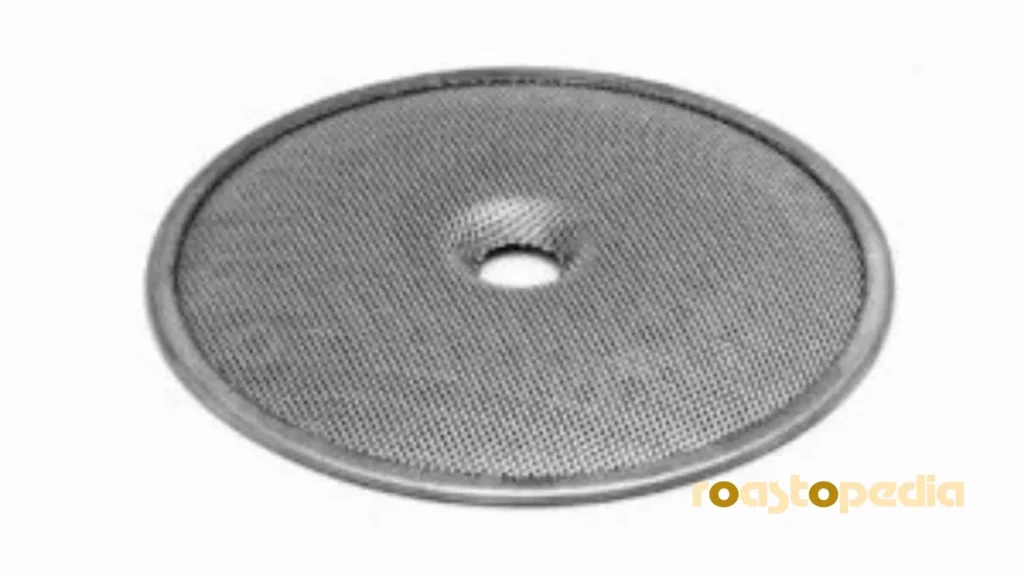
A shower screen, also known as a dispersion screen, is the final perforated barrier that pressurized water must pass through before it interacts with the coffee grounds. This circular metal plate is mounted to the underside of the group head and acts as a mechanical rainhead for the brewing process. It plays a dual role by ensuring even water distribution while preventing coffee particles from entering the machine’s internal plumbing.
Origin & History
Early espresso machines of the early twentieth century relied on simple dispersion blocks with a few large holes to deliver water to the coffee. These primitive designs often created “hot spots” where a direct stream of water would bore a hole into the puck, leading to massive channeling. Inventors eventually realized that they needed a more refined method to break up the forceful flow of the pump.
The introduction of the stainless steel mesh screen in the middle of the century provided the first effective solution for distributing water across the basket’s entire surface. These early screens were often made from multiple layers of woven wire that were pressed together to create a fine filter. While effective at dispersing water, they were notoriously difficult to clean and frequently clogged with oils and fines.
Precision-engineered “competition” screens represent the most recent leap in the history of this essential brewing component. Companies like IMS and VST have pioneered the use of laser-cut membranes and photo-etched holes to ensure absolute geometric consistency. These modern innovations have turned a simple metal plate into a high-performance tool capable of micron-level accuracy in water delivery.
Etymology
The name draws a comparison between the tool and a domestic shower head. The term “screen” traces back to the Middle Dutch ‘scherm,’ referring to a protective shield or a partition. This functional title perfectly captures the device’s responsibility to shield the group head while raining water down onto the grounds.
Global usage of the term remains consistent across the specialty coffee industry, though it is occasionally referred to as a “dispersion screen” or “group screen.” In some technical contexts, it may be called the “diffuser face” to emphasize its role in scattering the water molecules. All these names identify the specific metal plate that sits between the machine and the portafilter.
Technical nomenclature often specifies the screen by its mounting style, such as “bolt-on” or “friction-fit.” A bolt-on screen features a central hole for a mounting screw, while a friction-fit model is held in place solely by the tension of the group gasket. Understanding these distinctions is vital for any technician or barista responsible for the daily maintenance of their equipment.
Professional Evolution
Technical standards for shower screens have shifted away from simple filtration toward the active management of “flow dynamics.” Baristas now evaluate a screen based on its ability to saturate the coffee bed instantly and uniformly without causing turbulence. This shift has led to the adoption of specialized coatings, such as Nanotech or Teflon, which repel water and coffee oils.
The rise of the specialty coffee movement has encouraged the development of “integrated membranes” that eliminate the gaps found in traditional layered screens. These seamless designs prevent coffee grounds from becoming trapped inside the screen assembly, making them much easier to clean during a busy shift. This focus on hygiene is a primary driver of innovation in the modern equipment market.
Advanced espresso training now includes the study of “water behavior” as it exits the group head and hits the coffee puck. Professionals use high-speed cameras to observe how different screen designs influence the initial wetting of the coffee. Such rigorous analysis has led to the creation of custom screen profiles that are tailored to specific brew ratios and coffee varieties.
Technical Responsibilities
Maintaining a clean and unclogged shower screen is the most important daily habit for ensuring a high-quality espresso extraction. Coffee oils and fine particles can quickly block the tiny holes, leading to uneven pressure and “bald spots” where the coffee remains dry. A daily routine of scrubbing the screen with a group brush and performing chemical backflushes prevents this degradation of flavor.
Checking the “water pattern” from the group head is a quick diagnostic task that every professional should perform before their first shot of the day. A healthy screen should produce a gentle and uniform rain of water that covers the entire diameter of the group head. If the water streams together into a single jet, it is a clear signal that the screen needs to be removed and deep-cleaned.
Inspecting the screen for physical warping or damage is essential for maintaining the mechanical integrity of the group head. Over-tightening the mounting screw or using a bent screwdriver can cause the metal to bowl upward, which disrupts the water distribution and headspace. A perfectly flat screen is a prerequisite for achieving the “shot-by-shot” consistency required in a professional cafe.
Engineering & Mechanics
Headspace management is a critical mechanical function of the shower screen’s position relative to the coffee basket. There must be enough room for the coffee puck to expand slightly as it absorbs water, but not so much that the water creates a pool on top of the grounds. The physical depth of the screen and the dispersion block determine this vital “brewing gap.”
Hole geometry and distribution patterns are carefully engineered to ensure that water pressure is equalized across the entire coffee bed. Precision screens often feature an “integrated membrane” where the holes are smaller than the coffee particles but larger than the dissolved solids. This configuration ensures that no grounds can travel backward into the machine during the pressure release phase.
Hydrophobic coatings are becoming a standard feature on high-end screens to assist with both water distribution and cleaning. These treatments cause water to bead up and move more freely through the perforations, reducing the likelihood of “dead zones” in the flow. They also prevent coffee oils from bonding to the metal surface, which significantly extends the interval between deep-cleaning cycles.
Notable Facts
The IMS Nanotech screen is famous for its rainbow-colored surface, which is a byproduct of the specialized coating process used to repel oils. This visual flair has made it a popular upgrade for enthusiasts who want to improve the cleanliness and performance of their home machines. It has become a symbol of the “marginal gains” approach to espresso quality.
Changing a shower screen is one of the easiest and most impactful modifications a user can make to their espresso machine. Many owners find that upgrading to a precision screen leads to an immediate improvement in the clarity and balance of their shots. It is an inexpensive way to bridge the gap between consumer-grade and professional-level equipment.
International Barista Championship rules implicitly require a perfectly clean screen, as any visible residue could lead to a significant hygiene penalty. Competitors often carry their own “competition screens” to ensure that the equipment on stage meets their personal standards for water distribution. This attention to the final millimeter of the brewing path is what separates elite practitioners.
Related Concepts
The Dispersion Block is the solid metal piece located behind the shower screen that initially breaks up the water flow from the boiler. It provides the thermal mass and the structural foundation for the screen assembly. Both parts must work in harmony to ensure that the water reaches the coffee at the correct temperature and pressure.
The group gasket is the rubber or silicone ring that creates the pressure seal around the rim of the shower screen. In many machine designs, the gasket is what physically secures the screen in place within the group head. Regular replacement of the gasket is necessary to ensure that the screen remains correctly positioned and leak-free.
Backflushing is the maintenance process where a blind filter forces cleaning detergent backward through the shower screen and into the internal valves. This is the only way to remove the coffee oils that naturally travel “upstream” during the extraction process. A clean screen is the primary indicator of a machine that is being maintained according to professional standards.