
The coffee flower is the reproductive structure of the coffee plant, a small, star-shaped, typically white blossom that precedes the development of the coffee cherry and, ultimately, the coffee bean.
Produced in dense clusters along the leaf axils of the coffee shrub, the flower is short-lived, generally remaining open for two to four days, yet it determines both the yield and, indirectly, the flavor characteristics of the harvest that follows.
Coffee flowers belong to the genus Coffea, within the family Rubiaceae, and their structure and blooming behavior differ somewhat between the two commercially dominant species, Coffea arabica and Coffea canephora (robusta).
Botanical Classification and Flowering Habit
Coffee flowers are hermaphroditic, containing both male and female reproductive organs within a single blossom. Coffea arabica is predominantly self-pollinating, with a self-fertilization rate frequently exceeding 90 percent, while Coffea canephora relies more heavily on cross-pollination, typically facilitated by insects such as bees.
This distinction has practical consequences for estate coffee production, since farms cultivating arabica varieties can maintain greater genetic consistency across a plot, whereas robusta plantations often require managed pollinator populations to achieve uniform fruit set.
Flowering is triggered by a combination of dry-season dormancy followed by a rain event, a phenomenon sometimes referred to as “flowering rain,” which causes buds to open in a synchronized flush across an entire field within 24 to 48 hours.
Coffee Flower Anatomy
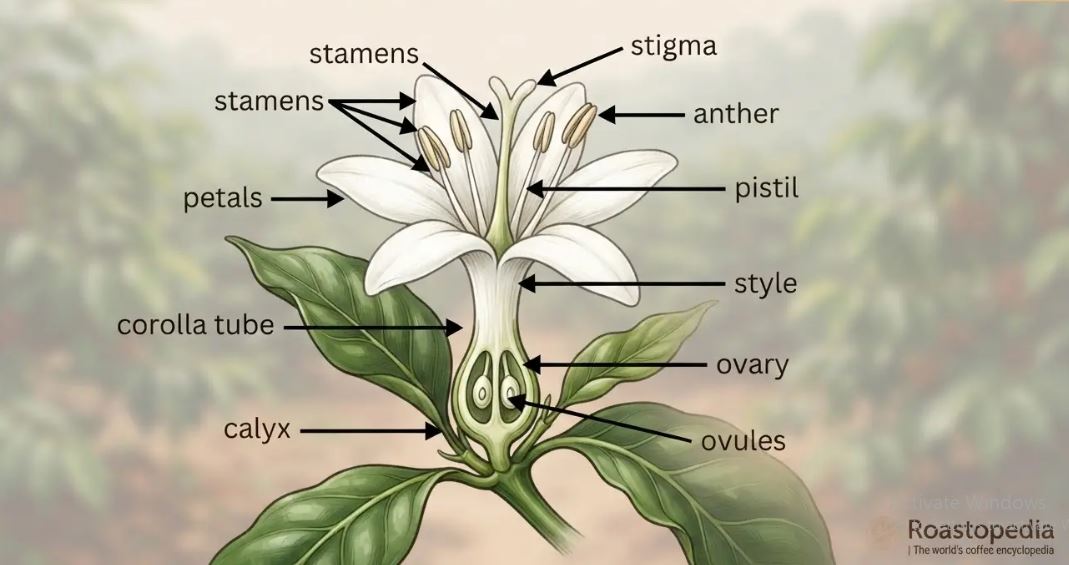
The coffee flower is composed of several distinct parts arranged in a radially symmetrical, tubular form. At the base sits the calyx, a small ring of sepals that anchors the flower to the branch.
Extending from the calyx is a slender corolla tube, which flares outward into four to nine white petals, most commonly five, arranged in a pinwheel pattern reminiscent of jasmine, to which coffee is botanically related within Rubiaceae.
Emerging from the throat of the corolla are the stamens, typically matching the petal count, each consisting of a slender filament topped by an anther that releases pollen.
At the center of the bloom, the pistil rises slightly above or level with the stamens, comprising a thin style capped by a bifurcated stigma, which receives pollen grains.
Below the petals, the ovary is inferior, meaning it sits beneath the point where the petals attach, and it contains two ovules, each of which, if fertilized, develops into one of the two seeds typically found inside a mature coffee cherry.
The entire structure rarely exceeds two centimeters in length, and its thin, waxy petals wilt and drop within days of opening, leaving the small green ovary to begin its transformation into fruit.
Fragrance and Sensory Character
Coffee blossoms produce a pronounced, sweet fragrance often compared to jasmine or orange blossom, owing to shared volatile compounds such as linalool and benzyl acetate.
While this floral scent dissipates long before roasting, some of the aromatic precursors formed during flowering and fruit development contribute to the eventual coffee aroma and coffee acidity detectable in the cup, particularly in high-altitude, organic coffee grown under conditions that slow cherry maturation and preserve delicate compounds.
From Blossom to Bean
Following successful pollination, the ovary swells over a period of seven to nine months, depending on species and altitude, passing through green, yellow, and finally red or purple ripening stages characteristic of the coffee cherry.
Farmers then separate the seed from the fruit mostly through either washed or natural process methods before drying, milling, and preparing the green coffee for export and roasting. The resulting roasted bean is later ground and brewed through methods ranging from espresso, where careful attention to dosing and even water flow helps avoid channeling, to longer preparations such as cold brew and other pour over brew methods.
The crema atop a well-pulled shot and the degassing of carbon dioxide from freshly roasted beans both trace back, indirectly, to the biochemical processes first set in motion within the coffee leaf, before it is transferred to the flowers.
See Also
- Coffee Plant
- Coffee Bean
- Coffee Cherry
- Estate Coffee
- Organic Coffee
- Terroir
- Cultivar
- Green Coffee
- Altitude
References
- Davis, A. P., Govaerts, R., Bridson, D. M., & Stoffelen, P. “An Annotated Taxonomic Conspectus of the Genus Coffea (Rubiaceae).” Botanical Journal of the Linnean Society, Linnean Society of London.
- Royal Botanic Gardens, Kew. “Coffea arabica.” Plants of the World Online, Kew Science.
- Missouri Botanical Garden. “Coffea arabica” Plant Finder, Missouri Botanical Garden.
- Encyclopaedia Britannica. “Coffee (Coffea).” Britannica, Encyclopaedia Britannica, Inc.
- Food and Agriculture Organization of the United Nations (FAO). “Coffee Cultivation and Production.” FAO Statistical Database.
- World Coffee Research. “Arabica Coffee Varieties and Flowering Physiology.” World Coffee Research Sourcebook.
- International Coffee Organization (ICO). “Botany of the Coffee Plant.” ICO Coffee Development Report.
- Wintgens, Jean Nicolas, ed. Coffee: Growing, Processing, Sustainable Production. Wiley-VCH.
- Clarke, R. J., and Vitzthum, O. G., eds. Coffee: Recent Developments. Blackwell Science.
- Illy, Andrea, and Viani, Rinantonio, eds. Espresso Coffee: The Science of Quality. Academic Press.
- Hoffmann, James. The World Atlas of Coffee. Octopus Publishing, 2nd Edition.
- DaMatta, Fábio M., and Ramalho, José D. C. “Impacts of Drought and Temperature Stress on Coffee Physiology and Production.” Brazilian Journal of Plant Physiology.
- Smithsonian National Museum of Natural History. “The Coffee Plant and Its Cultivation.” Smithsonian Institution.