
A coffee cherry is the fruit produced by plants of the genus Coffea, and it is the source from which every coffee bean in the world ultimately comes. Long before a bean is roasted, ground, or brewed, it exists as a seed nestled inside a small stone fruit that ripens on the branch of a coffee tree.
Etymology
The fruit is called a “coffee cherry” primarily because of its visual resemblance to the common cherry (genus Prunus) once it ripens: a small, rounded fruit, typically between 10 and 18 millimeters across, that turns a deep red color at maturity (see Fig.(5) ➡ Coffee Plant). The comparison is purely descriptive rather than botanical, since coffee and true cherries are unrelated plants from different families.
The terms “coffee cherry” and “coffee berry” are often used interchangeably in casual and trade conversation, but they are not strictly synonymous in botanical terms. A cherry, botanically, is a type of drupe — a fruit with a fleshy outer layer surrounding a hard pit that encloses the seed — and the coffee fruit fits this description closely, which is why “cherry” has become the dominant popular term.
“Berry,” in everyday usage, is applied loosely to many small, round fruits, and in coffee literature it tends to appear as a more general or technical alternative, particularly in older agricultural texts and in pest and disease names such as coffee berry disease and the coffee berry borer.
In strict botanical taxonomy, a true berry is a fruit in which the entire pericarp is fleshy, with no hardened layer around the seed — a structure that does not match the coffee fruit, since coffee has a hardened parchment layer. For this reason, “coffee cherry” is the more botanically accurate of the two common names, even though “coffee berry” remains common in agricultural and entomological usage.
Definition
A coffee cherry is the mature fruit of a coffee plant, encasing the one or two seeds that, once removed, dried, and roasted, become the coffee beans used to brew coffee. Each cherry is the product of a flower that has been pollinated and has subsequently developed into a small fleshy fruit over a period of several months.
The fruit develops from the ovary of the coffee flower after pollination, growing from a small green nub into a fully ripened fruit through a process that can take anywhere from about six to eleven months, depending on the species and growing conditions. Within most cherries are two seeds, positioned flat-side facing one another; in a smaller percentage of cherries, only a single rounded seed develops, a variation known in the trade as a peaberry.
The relationship between the coffee cherry and the coffee bean is essentially that of fruit and seed: the “bean” people roast and grind is not a true bean in the botanical sense at all, but the seed extracted from inside the cherry. Everything that surrounds that seed — the skin, the pulp, the sugary mucilage, and the parchment shell — must be removed through one processing method or another before the seed can be dried, roasted, and consumed as coffee.
Botanical Description
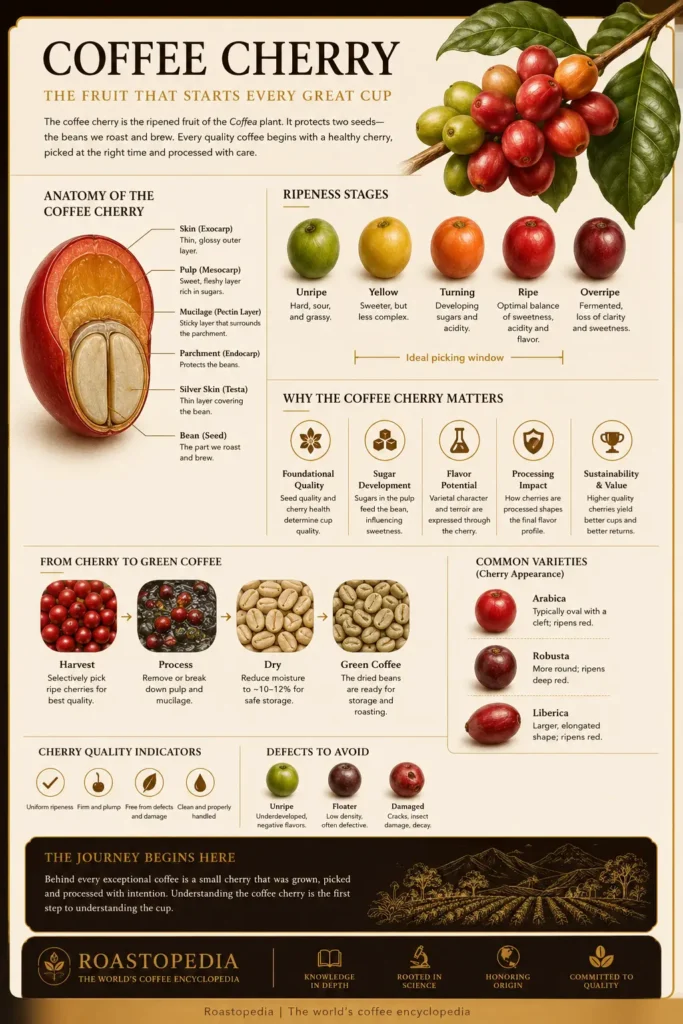
Botanically, the coffee cherry is classified as a drupe, the same fruit category that includes peaches, plums, and olives. A drupe is characterized by a thin outer skin, a fleshy middle layer, and a hardened inner shell surrounding the seed. This structure maps closely onto the layers found in a coffee cherry. However, coffee is sometimes described as a “false drupe” or “bidrupe” because it typically contains two seeds rather than the single pit found in most classic drupes.
In size, a ripe coffee cherry is generally small, most often measuring between roughly 10 and 18 millimeters in diameter, depending on species and variety. The shape is broadly oval to round, with a small indentation at the point where the fruit attaches to the branch via its stem, or pedicel, and a tiny remnant of the flower’s stigma sometimes visible at the opposite end.
Color is one of the most visible and important botanical characteristics of the cherry, since it signals the stage of ripeness. Cherries begin life a deep green, the result of chlorophyll in the developing skin, and gradually transition through pale green, yellow, or orange tones before reaching their final ripe coloration. Most coffee varieties ripen to a vivid red, though a notable number of cultivars — including several Arabica varieties — ripen to yellow, and some less common varieties produce orange, pink, or even near-black fruit at full maturity.
Species differences also shape the cherry’s botanical character. Coffea arabica, the species responsible for the majority of specialty and high-quality coffee production worldwide, tends to produce somewhat smaller, oval cherries that ripen relatively slowly. Coffea canephora, commercially known as Robusta, generally produces a hardier plant with cherries that mature faster and are often slightly more rounded, with a thicker skin suited to the species’ tougher growing conditions.
Coffea liberica, grown in smaller volumes in parts of West Africa and Southeast Asia, produces noticeably larger, more irregularly shaped cherries and correspondingly larger seeds. Other minor cultivated species, such as Coffea excelsa — sometimes treated as a variant of Liberica — show further variation in cherry size and shape, though all share the same basic drupe structure.
Anatomy of a Coffee Cherry
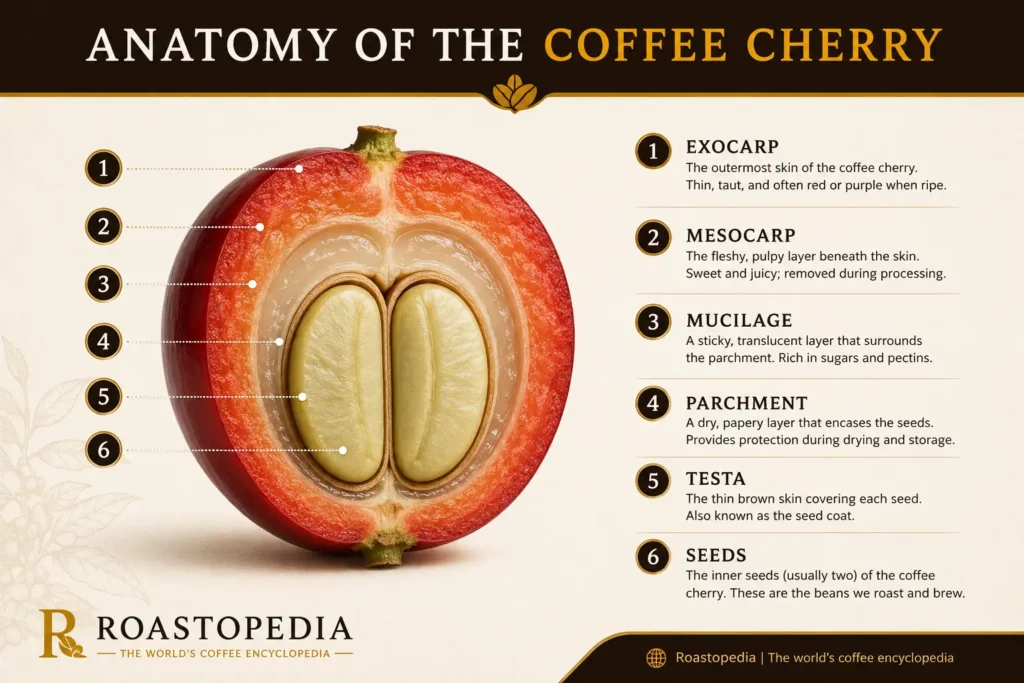
Moving from the outside in, the coffee cherry is made up of several distinct layers, each with a different role in protecting the seed and in shaping the flavor of the final coffee.
Exocarp (Skin)(1). The outermost layer of the cherry, also called the epicarp, is a thin but tough skin that protects the fruit from the external environment, including pests, disease, and weather. It begins green, owing to chlorophyll, and changes color as the fruit ripens, ultimately turning red, yellow, orange, or another characteristic hue depending on the variety. This skin contains pigments, caffeine, and a range of other compounds, and when dried separately from the rest of the fruit, it forms the basis of cascara, the increasingly popular coffee-cherry tea.
Mesocarp (Pulp) (2). Just beneath the skin lies the mesocarp, more commonly called the pulp — a fleshy, sugary layer that gives the fruit its juiciness and much of its sweetness. This is the part of the cherry most directly comparable to the flesh of an ordinary fruit, and it plays a central role in fermentation-based processing methods, since its sugars feed the microbial activity that develops flavor in the finished coffee.
Mucilage (Pectin Layer) (3). Underneath the pulp is a thin, slippery, gel-like layer known as the mucilage, sometimes treated as the innermost portion of the mesocarp and sometimes described as a distinct pectin layer in its own right. The mucilage is extremely high in sugars and pectin and clings tightly to the parchment beneath it, which is precisely why it must be removed — through washing, fermentation, mechanical friction, or simply by drying it onto the seed, depending on the processing method chosen.
Parchment (Endocarp) (4). Beneath the mucilage sits the parchment, technically the endocarp, a rigid, papery, straw-colored hull that directly encases the seed. Composed largely of cellulose, the parchment acts as the seed’s primary physical shield during drying and storage and plays an important role in regulating moisture exchange, which is why much coffee is stored and even exported in this parchment state, known in Spanish-speaking countries as pergamino, rather than being fully hulled right away.
Silver Skin (Testa) (5). Clinging directly to the seed itself, just inside the parchment, is a delicate, papery membrane called the silver skin, also referred to botanically as the testa or spermoderm. This thin layer often remains attached to the seed even after the parchment is removed, and it is largely shed during roasting as a flaky byproduct known as chaff.
Coffee Beans (Seeds) (6). At the center of the cherry are the seeds — what the world knows as coffee beans. Most cherries contain two flat-sided seeds nestled face to face; when only one rounded seed develops in a cherry, it is referred to as a peaberry. Each seed is composed primarily of the endosperm, the dense nutritive tissue that stores the carbohydrates, proteins, lipids, and other compounds that, through roasting, ultimately become the flavors and aromas of brewed coffee, along with a small embryo that, under the right conditions, would otherwise germinate into a new coffee plant.
Development and Growth
The life of a coffee cherry begins with flowering. Coffee plants produce clusters of small, fragrant white flowers along their branches, typically triggered by a period of rainfall following a dry spell. These flowers are short-lived, often blooming and fading within just a few days, but during that window they are pollinated — by wind, by insects such as bees, or in self-pollinating varieties like most Arabica cultivars, by the flower’s own pollen.
Once pollination is successful, the flower’s ovary begins to swell in a process known as fruit set, marking the start of the cherry’s development. In the weeks that follow, the young fruit grows rapidly in size while remaining green and hard, gradually filling out into its mature shape as the seeds inside begin to form.
Cherry development then proceeds through a longer maturation phase in which the seed itself fills out and hardens while the surrounding fruit layers — pulp, mucilage, and skin — continue to develop their sugar content and eventual color. The ripening timeline varies considerably by species and growing conditions: Robusta cherries often mature in roughly nine to eleven months from flowering, while Arabica cherries typically take around six to nine months, though specific cultivars and growing regions can shift these windows in either direction.
Several factors affect how quickly and evenly cherries mature, including altitude, ambient temperature, rainfall patterns, soil fertility, and the particular variety being grown. Higher elevations and cooler temperatures tend to slow ripening, often allowing more complex flavor compounds to develop within the fruit, while warmer lowland conditions accelerate maturation. Uneven flowering, caused by irregular rainfall, can also lead to cherries on the same branch ripening at noticeably different rates, a major factor in how farms approach harvesting.
Ripening Stages
Coffee cherries pass through several recognizable visual stages on their way to full maturity, and farmers rely on these stages to judge the optimal moment for harvest.
Immature green. In the earliest stage after fruit set, the cherry is small, hard, and uniformly green, with underdeveloped seeds inside and very little sugar in the pulp.
Yellow (where applicable). Some varieties pass through or ultimately ripen to a yellow stage; for red-ripening varieties, a pale yellow or straw color often signals an intermediate phase on the way to red, while for naturally yellow-ripening cultivars, this color marks full ripeness.
Turning. As the cherry approaches maturity, it begins to “turn,” showing the first blush of its ripe color — often a pale orange or pink tint spreading across part of the skin — while the fruit is still firming up internally.
Fully ripe. At full ripeness, the cherry reaches its complete characteristic color, whether deep red, bright yellow, or another varietal hue, and the flesh becomes notably softer and sweeter, with sugar content at or near its peak. This is generally regarded as the optimal stage for harvest in quality-focused production.
Overripe. Left on the branch too long, cherries continue to soften, often developing a wrinkled skin and beginning to ferment or dry naturally while still attached to the plant. Overripe cherries can contribute unwanted, overly fermented, or “boozy” flavors if processed alongside properly ripe fruit.
Indicators of optimal harvest. Producers typically judge harvest readiness through a combination of visual color, the firmness or slight give of the fruit under gentle pressure, and sugar content, which can be measured with a refractometer (see Refractometry) in degrees Brix. Picking at peak ripeness, rather than too early or too late, is widely regarded as one of the single most influential decisions affecting eventual cup quality.
Harvesting
Coffee cherries are gathered using several distinct methods, each with implications for both labor cost and final coffee quality.
Selective Picking
In the Selective Picking method, workers move through the rows of coffee trees multiple times over the course of the harvest season, picking only the cherries that have reached full ripeness on each pass and leaving less mature fruit on the branch for a later visit. Selective picking is labor-intensive and therefore more expensive, but it produces the most uniform, highest-quality raw material, since the batch consists almost entirely of properly ripe cherries.
Strip picking
In Strip Picking, all the cherries on a given branch are removed in a single pass, regardless of their individual ripeness, typically by a worker running a closed hand along the branch. This method is far faster and cheaper than selective picking but yields a mixed-maturity batch containing ripe, underripe, and overripe fruit together, shifting the burden of sorting for quality onto post-harvest processing.
Mechanical Harvesting
Mechanical Harvesting happens in large, relatively flat farms — most notably in Brazil — specialized machinery straddles the rows of trees and uses vibrating or shaking mechanisms to dislodge cherries from the branches in bulk. This approach dramatically reduces labor costs and is well suited to large commercial operations, but, like strip picking, it gathers cherries of varying ripeness and demands robust sorting infrastructure afterward.
The timing and method of harvest have a direct influence on quality. Harvesting at peak ripeness, and limiting the proportion of underripe or overripe fruit in a given lot, tends to produce sweeter, more balanced, and more consistent coffee, while harvests that mix maturity stages generally require additional sorting — by water flotation, density, or optical color sorting — to remove defective cherries before processing.
Composition
The coffee cherry is a complex biochemical package, and its composition shapes both how it ferments during processing and what flavor compounds eventually reach the seed.
Water. Fresh, ripe coffee cherries are made up largely of water, often well over half their total weight, which is why drying is such a central part of nearly every processing method.
Sugars. The pulp and mucilage are rich in both reducing sugars (such as glucose and fructose) and sucrose, which provide the substrate for the microbial fermentation that occurs during processing and contribute directly to the sweetness perceptible in the finished cup.
Organic acids. Cherries contain a range of organic acids, including citric, malic, and chlorogenic acids, which influence both the fermentation process and the final acidity profile of the brewed coffee.
Pectins. The mucilage layer is particularly rich in pectin, a complex carbohydrate that gives this layer its characteristic stickiness and that must be broken down — by enzymes, fermentation, or mechanical means — before the parchment-covered seed can be properly dried.
Caffeine. Caffeine is present throughout the fruit, including in the skin and pulp, not solely within the seed, which is part of why cascara, made from the dried skin, retains a measurable amount of caffeine even though it is brewed more like a tea than a coffee.
Polyphenols. The cherry, particularly its skin and pulp, contains significant levels of polyphenolic compounds, including chlorogenic acids and anthocyanins (the latter contributing to the red coloration of ripe fruit), which act as antioxidants and have made dried cherry by-products of growing interest for their potential health benefits.
Minerals. Coffee cherries also contain various minerals, including potassium, calcium, magnesium, and iron, distributed throughout the pulp and skin, some of which carry over into cascara and other cherry by-products.
Coffee Cherry Processing
Once harvested, cherries must be processed to separate the seed from the surrounding fruit and to dry it down to a stable moisture level, and the chosen method has a profound effect on the flavor of the resulting coffee.
Washed Process
Also called the wet process, this method involves mechanically removing the skin and pulp shortly after harvest using a depulper, after which the remaining mucilage is broken down, typically through a period of water-based fermentation lasting anywhere from several hours to a couple of days, followed by thorough washing to strip away the loosened mucilage entirely. The parchment-covered seed is then dried on its own. Washed coffees are generally prized for producing a clean, bright cup with pronounced acidity, since little fruit character is allowed to transfer into the seed during drying.
Natural Process
Also known as the dry process, this is among the oldest processing methods and involves drying the whole cherry intact — skin, pulp, mucilage, and seed all together — typically on raised beds or patios, with regular turning to prevent mold and uneven drying. Only once the fruit has dried fully around the seed is it hulled away in a single mechanical step. Because the seed remains in extended contact with the sugary fruit throughout drying, natural coffees tend to develop bold, fruit-forward, and often syrupy or fermented flavor notes.
Honey Process
Honey Process is a method that sits between washed and natural. The process involves removing the skin shortly after harvest but deliberately leaving some or all of the sugary mucilage on the parchment-covered seed during drying. The proportion of mucilage retained is often categorized by color — yellow, red, or black — with darker classifications generally corresponding to more mucilage left intact, slower drying, and a more pronounced fruit influence in the cup, while yellow honey sits closest to a washed profile.
Experimental Processing Methods
In recent years, producers have developed a range of additional approaches, most notably anaerobic fermentation, in which whole or depulped cherries are sealed in oxygen-free tanks or bags to ferment under controlled conditions, often producing distinctive, intense flavor profiles.
Other experimental methods include carbonic maceration, adapted loosely from winemaking, and various co-fermentation techniques in which fruits, yeasts, or other ingredients are introduced during fermentation to further shape the cup.
Effect of processing on the cherry. Across all these methods, processing determines how much of the fruit’s sugar, acid, and aromatic content is allowed to transfer into the seed before drying locks the chemistry in place, which is why the same coffee variety grown on the same farm can taste dramatically different depending solely on how its cherries were processed after harvest.
Coffee Cherry By-products
Historically treated as agricultural waste, the layers removed from the coffee cherry during processing are increasingly being put to productive use.
Cascara
The dried skin and pulp of the coffee cherry, cascara — Spanish for “husk” or “shell” — is steeped in hot or cold water to produce a fruity, tea-like beverage, with flavor notes often described as resembling rose hip, hibiscus, or dried fruit, and a caffeine content considerably lower than that of brewed coffee. Cascara has long been consumed in coffee-growing regions such as Yemen and Ethiopia and has more recently gained popularity in specialty coffee markets worldwide.
Coffee Cherry Flour
The dried, ground pulp and skin of the cherry can also be processed into a fine flour, used as a flavoring and nutritional additive in baked goods and other food products, valued for its fiber content and natural sweetness.
Compost
A large share of cherry waste, particularly pulp removed during washed processing, is composted and returned to coffee farms as organic fertilizer, helping to close the nutrient loop on the land where the fruit was grown.
Animal Feed
Dried or fermented cherry pulp and skin can be incorporated into livestock feed, offering a way for farms to extract additional value from material that would otherwise be discarded.
Biofuel and other industrial uses: Researchers and producers have explored further applications for cherry by-products, including the production of biofuel, enzymes, biosorbents, and various bioactive extracts, reflecting a broader push within the coffee industry to reduce the substantial volume of waste generated by processing.
Factors Affecting Cherry Quality
Several agricultural and environmental variables shape the eventual quality of the cherry and, by extension, the coffee produced from it.
Altitude
Coffee grown at higher elevations generally ripens more slowly in cooler temperatures, a pace often associated with denser seeds and more complex flavor development, which is part of why high-altitude origins are frequently prized in specialty coffee.
Climate
Temperature, sunlight exposure, and seasonal patterns all influence how evenly and how well cherries develop, with extremes of heat or cold capable of stressing the plant and reducing fruit quality.
Rainfall
Adequate and well-timed rainfall is essential for healthy flowering and fruit development, while drought stress or excessive rain at the wrong stage can lead to smaller cherries, uneven ripening, or fruit drop.
Soil
Soil fertility, structure, and mineral content directly affect the health of the plant and the nutrient availability for developing fruit, with well-drained, nutrient-rich volcanic soils often associated with particularly high-quality coffee regions.
Variety
Different cultivars and varieties carry inherent genetic differences in cherry size, sugar content, disease resistance, and flavor potential, making variety one of the foundational determinants of cherry — and eventual cup — quality.
Nutrition
Proper fertilization and nutrient management, addressing the plant’s needs for nitrogen, potassium, and other elements, support healthy fruit development and help prevent deficiencies that can compromise cherry quality.
Pest and Disease Pressure
Insects and pathogens that target the fruit directly, such as the coffee berry borer and the fungus responsible for coffee berry disease, can damage cherries internally or externally, reducing both yield and quality if not managed.
Harvest Practices
As discussed above, the method and timing of harvest — selective picking versus strip or mechanical harvesting, and picking at the correct stage of ripeness — has a substantial downstream effect on the proportion of high-quality cherries entering processing.
Common Defects
A number of recognized defects can affect coffee cherries, with consequences that often carry through into the final cup if not properly sorted out.
Unripe Cherries
Cherries picked before reaching full maturity contain underdeveloped sugars and seeds, and when processed alongside ripe fruit, they tend to contribute grassy, astringent, or vegetal flavors to the cup.
Overripe Cherries
Fruit left too long on the branch can become overly soft or begin fermenting prematurely, often introducing unwanted fermented, alcoholic, or vinegary notes if mixed into a processing batch.
Floaters
During wet processing, cherries are commonly sorted by flotation in water; cherries that float, rather than sink, are typically underripe, damaged, or otherwise lower in density, and are generally separated out as a lower grade.
Insect Damage
Various insects can bore into or feed on the cherry, compromising the seed’s integrity and often introducing entry points for mold or bacteria, which can in turn create off-flavors.
Coffee Berry Disease
Caused by the fungus Colletotrichum kahawae, this disease primarily affects Arabica coffee, particularly in parts of Africa, attacking the cherry directly and causing it to develop dark, sunken lesions and often to rot or fall from the plant before maturity, leading to significant crop losses where it is present.
Coffee Berry Borer Damage
The coffee berry borer (Hypothenemus hampei) is considered one of the most economically damaging coffee pests worldwide; the adult female bores into the cherry to lay eggs, and the larvae feed on the developing seed, leaving small holes and damaged beans that reduce both yield and quality.
Fermentation Defects
Uncontrolled or excessive fermentation during processing — whether from prolonged contact with mucilage, contamination, or poor temperature control — can produce defective, overly sour, or rotten-tasting beans, commonly described in cupping terminology as “stinkers” or fermented defects.
Importance in Coffee Quality
The condition of the cherry at harvest exerts a powerful influence on every later stage of coffee production. The chemical composition of the green coffee seed — its sugar content, acidity, and density — is shaped directly by how ripe the cherry was when picked and by the processing method used to remove the fruit layers, meaning that decisions made at the cherry stage effectively set the upper bound on the quality achievable later.
During roasting, the precursors built up in the seed while it was still inside the cherry — including sugars and amino acids that drive the Maillard reaction and caramelization — determine how the bean develops color, aroma, and flavor under heat; a seed drawn from an unripe or poorly processed cherry simply lacks the raw material for full, balanced roast development.
In the cup, the influence of cherry quality is often the most directly perceptible: a coffee processed from uniformly ripe, well-handled cherries typically shows greater sweetness, more defined acidity, and a cleaner overall profile, while coffee that included underripe, overripe, or defective cherries tends to show corresponding flaws, from grassiness to fermented or musty notes.
For this reason, specialty coffee buyers and producers place enormous emphasis on cherry selection and handling, often paying premiums specifically for lots harvested through selective picking and processed with careful attention to ripeness, since the cherry itself — not just the milling or roasting that follows — is widely regarded as the true foundation of cup quality.
Environmental and Economic Importance
Beyond its role in the cup, the coffee cherry carries significant environmental and economic weight for the communities that grow it.
Farm Value
Cherry quality directly determines the price a farmer can command for their harvest, since buyers typically pay premiums for cherries picked at optimal ripeness and free of defects, making careful cherry management a central economic concern for smallholder and large-scale producers alike.
Sustainability
Because the seed represents only a fraction of the total weight of the harvested cherry, with the bulk made up of skin, pulp, mucilage, and parchment, sustainable management of this remaining biomass — through composting, water-efficient processing, or by-product development — has become an increasingly important focus for reducing the environmental footprint of coffee production.
Waste Reduction
Historically, the substantial volume of pulp and skin generated by processing was treated largely as waste, sometimes discarded in ways that polluted local waterways; growing efforts to repurpose this material into cascara, flour, compost, and other products reflect a broader industry shift toward minimizing that waste.
Income diversification through by-products: By developing markets for cascara and other cherry derivatives, coffee producers gain an additional revenue stream from material that would otherwise generate no income, helping to diversify and stabilize farm earnings beyond the sale of green coffee alone.
Related Terms
A short glossary of concepts closely related to the coffee cherry:
- Coffee bean — the seed found inside the coffee cherry, which becomes coffee once dried, milled, and roasted.
- Green coffee — the raw, unroasted seed once it has been removed from the cherry and processed and dried, but before roasting.
- Coffee fruit — another general term for the coffee cherry, referring to the whole fruit produced by the Coffea plant.
- Cascara — the dried skin and pulp of the coffee cherry, used to brew a fruity, tea-like beverage.
- Mucilage — the sticky, sugar- and pectin-rich layer found between the pulp and the parchment of the cherry.
- Parchment coffee — the seed while it is still enclosed in its papery endocarp layer, prior to hulling.
- Coffee processing — the set of methods (washed, natural, honey, and others) used to separate the seed from the surrounding fruit and prepare it for drying.
See Also
- Selective Picking
- Strip Picking
- Machine Harvesting
- Coffee Processing Methods
- Green Coffee
- Coffea arabica (Arabica)
- Coffea canephora (Robusta)
- Coffea liberica (Liberica)
- Coffee Terminology (full glossary)
References
- Perfect Daily Grind. “What Is a Coffee Bean? The Anatomy of The Coffee Cherry.” https://perfectdailygrind.com/2019/02/what-is-a-coffee-bean-the-anatomy-of-the-coffee-cherry/
- International Coffee Organization (ICO). “Botanical Aspects of Coffee.” https://www.ico.org/
- Specialty Coffee Association (SCA). “Coffee Processing Resources.” https://sca.coffee/
- Farah, A., ed. Coffee: Production, Quality and Chemistry. Royal Society of Chemistry, 2019.
- National Center for Biotechnology Information (NCBI). “Preliminary Characterization of Phytochemicals and Polysaccharides in Diverse Coffee Cascara Samples.” https://www.ncbi.nlm.nih.gov/pmc/articles/PMC9222401/
- National Center for Biotechnology Information (NCBI). “Quality Attributes and Sensory Acceptance of Different Botanical Coffee Co-Products.” https://www.ncbi.nlm.nih.gov/pmc/articles/PMC10378423/
- European Food Safety Authority (EFSA). “Safety of Dried Coffee Husk (Cascara) from Coffea arabica L. as a Novel Food.” https://www.ncbi.nlm.nih.gov/pmc/articles/PMC8875134/
- Food and Agriculture Organization of the United Nations (FAO). “Coffee Production and Post-Harvest Guidelines.” https://www.fao.org/
- World Coffee Research. “Arabica Coffee Varieties and Cultivation.” https://worldcoffeeresearch.org/
- Fresh Cup Magazine. “What Is Cascara? An Overview of Coffee Cherry Tea.” https://freshcup.com/what-is-cascara/
- Davis, A.P., et al. “An Annotated Taxonomic Conspectus of the Genus Coffea (Rubiaceae).” Botanical Journal of the Linnean Society, Linnean Society of London.
- CABI (Centre for Agriculture and Bioscience International). “Coffee Berry Disease (Colletotrichum kahawae).” https://www.cabi.org/
- CABI (Centre for Agriculture and Bioscience International). “Coffee Berry Borer (Hypothenemus hampei).” https://www.cabi.org/