
In coffee, blooming or the bloom refers to the brief, controlled release of carbon dioxide (CO2) from freshly roasted coffee grounds when they first make contact with hot water.
Blooming, therefore, is a degassing event — not a flavor step, not a ritual, not an aesthetic flourish.
The bloom pour is the specific technique of adding a small amount of hot water at the start of a brew to trigger and complete this release before the main extraction begins.
Why Fresh Coffee Contains Gas
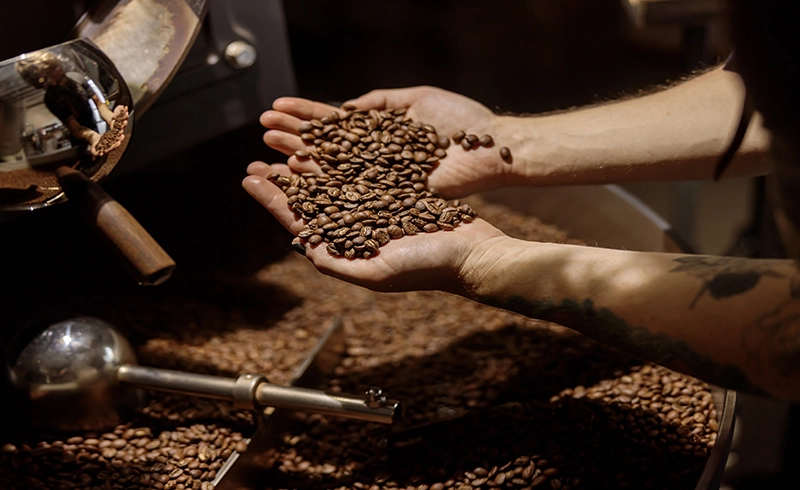
When coffee is roasted, the beans undergo a series of chemical reactions that produce carbon dioxide as a byproduct. This CO2 gets trapped inside the cellular structure of the bean during roasting and remains there after the coffee cools. The fresher the roast, the more gas is still locked inside.
Once the coffee is ground, the increased surface area accelerates degassing — more gas escapes into the air in the hours and days after grinding. But a meaningful amount of CO2 remains trapped even in freshly ground coffee, and this residual gas is exactly what the bloom pour is designed to address.
What the Bloom Pour Actually Is

The bloom pour is a pre-infusion step performed at the very start of a pour-over or drip brew. A small amount of hot water — typically twice the weight of the dry coffee — is poured evenly over the grounds and left to sit for 20-45 seconds before any further water is added.
During that rest period, the hot water triggers a rapid, visible release of CO2 from the coffee bed. The grounds swell, rise, and bubble — sometimes dramatically in very fresh coffee, more subtly in coffee that has been degassing for a week or longer. This swelling is the bloom, and watching it is the most reliable visual indicator of how recently the coffee was roasted.
The Problem CO2 Creates Without a Bloom
Carbon dioxide and water repel each other chemically. When CO2 is still present in large quantities inside the coffee grounds, it actively resists water absorption — creating a barrier between the water and the soluble compounds the brewer is trying to extract. Water moves around the gas-filled grounds rather than through them.
The result is uneven, patchy extraction. Some grounds get fully saturated and over-extracted; others barely make contact with water and remain under-extracted. The cup ends up hollow in the middle, with a sourness and a flatness that no amount of technique adjustment will fully fix if the bloom was skipped.
This is why the bloom pour matters most with very fresh coffee. Beans roasted within the last few days off-gas so aggressively that skipping the bloom produces a noticeably inferior cup.
Coffee that is two or three weeks off-roast degasses more gently, and the impact of skipping the bloom becomes less dramatic — though it never entirely disappears.
The Two-to-One Ratio and Why It Exists
The standard bloom water volume — twice the weight of the dry coffee — is not an arbitrary number. It is the approximate minimum needed to fully saturate all of the grounds without beginning meaningful extraction. Enough water to wet every particle, not so much that the brew has effectively started.
Using too little water in the bloom leaves some grounds dry and produces uneven degassing. Using too much begins extracting compounds before the CO2 has fully escaped, defeating the purpose.
The two-to-one ratio is a reliable starting point, though experienced brewers adjust based on how aggressively a given coffee is off-gassing.
The Thirty-Second Window
The standard bloom rest of 30-45 seconds is the window in which most of the residual CO2 escapes. The exact time can be shortened or extended depending on the roast level and freshness of the coffee — lighter roasts typically contain more CO2 than dark roasts and may benefit from a longer rest. Darker roasts degas faster after roasting and usually need less time.
Waiting longer than sixty seconds in the bloom rarely produces additional benefit and can begin to cool the brew water to a temperature that harms extraction. The bloom is a focused event, not an open-ended one. Thirty seconds is enough for most coffees; forty-five handles the freshest, most aggressive ones.
What a Proper Bloom Looks Like
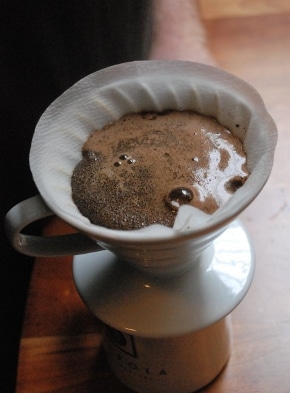
When hot water meets fresh coffee grounds, the bed rises within a few seconds, and a visible dome forms above the filter. Bubbles appear at the surface — sometimes small and steady, sometimes vigorous enough to resemble a slow boil. The dome holds its shape for several seconds before slowly deflating as the gas finishes escaping.
In very fresh coffee — roasted within forty-eight hours — the bloom can be dramatic: a high, pillowing dome with active bubbling that takes the full forty-five seconds to fully settle.
In coffee roasted ten to fourteen days ago, the bloom is quieter: a modest rise, gentle bubbling, settled in under thirty seconds. Coffee with almost no visible bloom is either very old or has already fully degassed in the bag.
The Bloom in Automatic Drip Machines
Most standard drip coffee makers skip the bloom entirely — water is delivered in a continuous flow from the moment brewing starts, giving CO2 no chance to escape before extraction begins. This is one of the structural reasons that automatic drip machines, even with good coffee and correct water temperature, often produce a flatter cup than a well-executed manual pour-over.
Higher-end drip machines with a pre-infusion or bloom setting address this by pausing after the initial water delivery, allowing a 30- 45-second rest before resuming the main brew cycle.
This feature alone produces a measurably more even extraction than continuous-flow machines and is one of the primary markers that separates capable drip machines from basic ones.
The Bloom in Espresso
Espresso machines handle the equivalent of the bloom through pre-infusion — a low-pressure introduction of water to the coffee puck before full extraction pressure is applied.
Pre-infusion allows the puck to saturate evenly and releases some of the trapped CO2 before the high-pressure extraction begins. It reduces channelling and produces a more uniform extraction across the puck.
In lever machines — the original espresso form — pre-infusion happened naturally as the operator raised the lever, allowing the group to fill with water at low pressure before the spring-loaded piston was engaged.
Modern pump machines replicate this with electronically or mechanically controlled pre-infusion phases. The principle is identical to the pour-over bloom: let the gas out before the extraction in.
One Step That Changes the Whole Cup
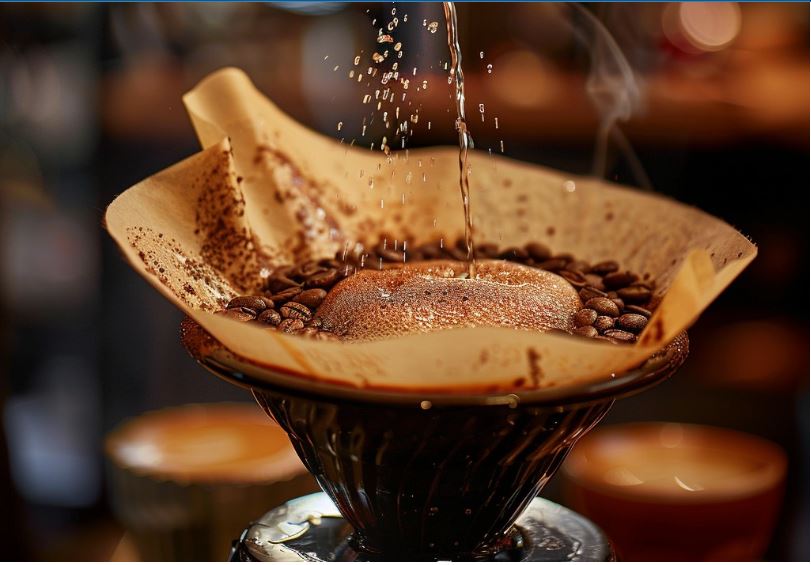
The bloom pour is one of the few steps in manual brewing where a small amount of time — 30 seconds — produces a disproportionate improvement in the quality of the result. It costs almost nothing. It requires no additional equipment. It is simply a pause, a small pour, and a wait.
What it produces is a more even extraction, a more developed flavor, and a cup that reflects the actual potential of the coffee rather than a compromised version of it.
Skipping it, especially with fresh coffee, is the equivalent of preparing every other variable correctly and then rushing the one step that allows all of them to work properly.
The bloom is not a ceremony. It is a function. And in pour-over brewing, it is the most reliable single habit that separates consistently good cups from inconsistent ones.