
Flow rate, also referred to as Percolation Rate, is the speed at which water passes through the coffee bed and filter during extraction. It is a critical variable because it directly influences how much flavor, aroma, and soluble material are extracted from the grounds. A faster flow rate reduces contact time between water and coffee, often leading to under-extraction and a weak or sour cup, while a slower flow rate increases contact time, which can contribute to over-extraction and bitterness.
Flow rate is affected by factors such as grind size, coffee bed depth, filter type, pouring technique, and the amount of resistance created by the coffee particles. In both manual and automatic brewing methods, controlling flow rate helps achieve a balanced extraction and consistent cup quality.
The flow rate is expressed as the volume of liquid that passes through the coffee per unit of time — most commonly in milliliters per second (mL/s) or grams per second (g/s).
Unlike variables such as dose (see dosing) or temperature, which are set before brewing, flow rate is dynamic — it can change continuously throughout a single brew. In espresso, it may be actively manipulated by the barista using pressure profiling or flow control devices. In filter methods such as pour-over, it is influenced by grind size, roast level, bed geometry, pour technique, and the permeability of the coffee bed itself.
Understanding flow rate is essential to diagnosing extraction problems, achieving consistency, and deliberately crafting the flavor character of a finished cup.
What is a Normal Flow Rate?
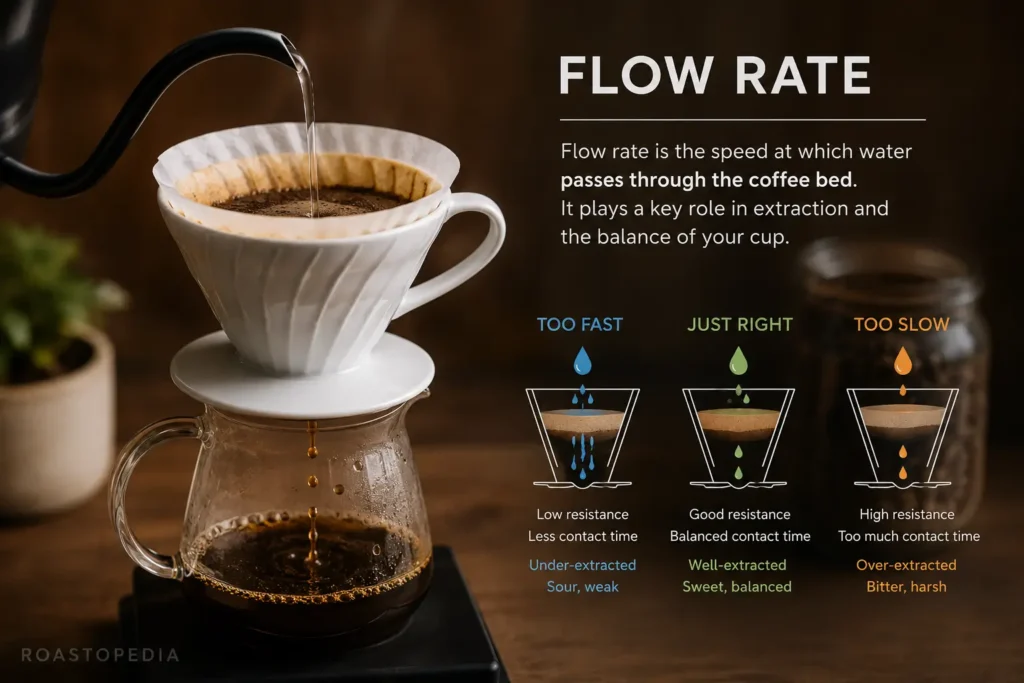
The concept of a “normal” flow rate varies considerably depending on the brew method (see Coffee Brew Methods), the equipment used, and the calibration standards adopted by different professional bodies.
In espresso, the Specialty Coffee Association (SCA) and the Italian Espresso National Institute (INEI) have historically referenced a target brew time of 25 to 30 seconds for a standard single or double shot. Given that a typical double espresso yields approximately 36 to 40 grams of liquid, this translates to an average flow rate of roughly 1.2 to 1.6 grams per second during the extraction phase, excluding pre-infusion.
In filter coffee (pour-over, batch brew, or drip), the SCA’s Golden Cup Standard recommends a total brew time of approximately 4 to 8 minutes for methods such as the Chemex or V60, depending on dose and grind. The effective flow rate through the coffee bed in these scenarios is considerably slower — often between 0.5 and 2.0 mL/s — because water is impeded by the compacted and swelling coffee grounds as they degas.
For espresso machines with flow control, many specialty baristas target a steady extraction flow of around 1.0 to 2.0 g/s after pre-infusion ends and pressure stabilizes. This is considered a productive extraction window, keeping water in contact with coffee long enough to dissolve desirable compounds without dragging the shot too slow and extracting astringent or bitter ones.
For cold brew and immersion methods, flow rate as a discrete variable is less applicable during steeping, but it becomes relevant during filtration — when the brewed liquid passes through a filter — where a controlled, unhurried flow preserves clarity and minimizes the passage of fine particles.
What is a Good Flow Rate for Coffee?
A “good” flow rate is not universal. It is contextual — defined by what flavor outcome the brewer intends and which brewing parameters are fixed versus adjustable.
For espresso, a widely accepted benchmark in third-wave and specialty coffee circles is a flow rate that results in a 1:2 brew ratio (e.g., 18 g of coffee yielding 36 g of liquid) in 25 to 35 seconds at 9 bars of pressure. When using a pressure profiler or flow controller, baristas often target a rising flow that peaks at around 3 to 4 mL/s during the main extraction phase, then tapers as the coffee bed exhausts its available solubles. This technique, promoted by equipment manufacturers such as Decent Espresso and Strada, supports even extraction and allows the barista to observe how the coffee responds in real time.
A flow rate that is too fast — finishing a shot in under 20 seconds with proper dose and grind — typically signals under-extraction, resulting in sour, thin, and underdeveloped flavors. A flow rate that is too slow — exceeding 40 to 45 seconds at the same pressure — risks over-extraction, producing bitter, harsh, and overly dry characteristics.
For pour-over, James Hoffmann, Tetsu Kasuya, and other respected figures in specialty coffee have consistently noted that the ideal flow rate keeps the total brew time within a window that suits the grind size and desired extraction yield. For a 15 g dose in a V60 yielding 250 g of brewed coffee, a total brew time of 2 minutes and 30 seconds to 3 minutes and 30 seconds is broadly considered the productive range. Pour rate — how quickly water is added to the coffee bed — directly controls flow rate, with faster pours creating greater agitation and faster bed drawdown.
For batch brew, the SCA specifies that water should contact the coffee grounds for no more than 8 minutes under standard filter conditions, with ideal contact time closer to 4 to 6 minutes for most grinds. Too slow a flow in batch brew concentrates heat on the bed too long, promoting bitterness; too fast a flow reduces contact time below what is needed for full extraction.
How Does Flow Rate Affect Coffee?
Flow rate influences nearly every sensory attribute of a brewed coffee, making it one of the most sensitive variables in the extraction equation.
Extraction Yield and TDS
Flow rate is inversely related to contact time: a slower flow rate means water spends more time in contact with the coffee bed, which generally increases extraction yield — the percentage of the coffee’s total soluble mass that ends up in the cup. The Specialty Coffee Association’s target extraction yield for brewed coffee is between 18% and 22%. Flow rates that are too fast reduce contact time below what is needed to achieve this range, producing under-extracted coffee with low total dissolved solids (TDS) and a flat, acidic, or sour profile. Conversely, flow rates that are too slow prolong contact time beyond the ideal window, increasing TDS and extraction yield into bitter, astringent, or hollow territory.
Flavor Solubility and Compound Sequencing
Not all coffee compounds dissolve at the same rate. Acids dissolve early in the extraction; sugars and mellow bitterns follow; harsher, heavier bitterns and astringent tannins extract last. Flow rate controls how much of each compound category the water has time to pick up. A very fast flow rate captures the early-dissolving acids and aromatic esters primarily, resulting in a bright but shallow cup. A well-calibrated slower flow allows the more complex, sweet, and savory compounds to also dissolve, producing a fuller and more balanced flavor profile.
Channeling and Flow Uniformity
In espresso, flow rate is closely tied to the uniformity of water movement through the coffee puck. If the puck is unevenly tamped or contains voids — areas of lower resistance — water will preferentially flow through those paths, a phenomenon known as channeling. Channeling produces a falsely fast average flow rate while leaving much of the coffee underextracted. Simultaneously, the channels themselves may over-extract, resulting in a cup that is both bitter and sour — simultaneously over- and under-extracted. Managing flow rate through lower initial pressure during pre-infusion is one of the primary strategies used to detect and mitigate channeling.
Body and Mouthfeel
Flow rate affects the amount of suspended solids and fine particles that pass into the cup. A slower, more controlled flow through filter paper tends to capture fines before they enter the liquid, producing a cleaner cup. A faster flow may cause fines migration — where very small coffee particles pass through the filter — contributing to a heavier, murkier body. In espresso, body is influenced by the emulsification of coffee oils during extraction, which is sensitive to both pressure and flow rate.
Crema Formation in Espresso
In espresso specifically, flow rate and pressure together determine crema production. Crema — the reddish-brown foam that forms on the surface of a properly pulled espresso — is a colloid of carbon dioxide bubbles stabilized by coffee proteins and oils. An excessively fast flow rate produces a thin, pale, and quickly dissipating crema because pressure drops rapidly and less CO₂ is forced into solution. A well-controlled flow, particularly during the initial pre-infusion phase, allows gases to be released gradually, producing a denser and more stable crema.
Temperature Stability
Water temperature drops as it passes through a coffee bed. A faster flow rate means the water spends less time in contact with the ground coffee and its immediate environment, arriving in the cup hotter and with less thermal energy lost to the bed. A slower flow rate gives the water more time to equilibrate with the cooler grounds, potentially reducing the temperature at which extraction occurs. This interaction between flow rate and brew temperature adds another layer of complexity: dialing in flow rate without considering temperature may yield inconsistent results across different roast levels or ambient conditions.
Flow Rate in Different Brew Methods
Espresso
Espresso operates under the most precise flow rate requirements of any brew method. The interplay of pump pressure, grind size, tamping force, dose weight, and basket design all converge to determine flow rate. Modern espresso machines with electronic flow meters (such as those from Decent Espresso, La Marzocco, and ECM) allow baristas to monitor flow in real time and program multi-stage profiles where pressure and flow are varied deliberately through a shot. This practice, known as pressure profiling or flow profiling, gives baristas granular control over extraction dynamics in ways that fixed-pressure machines cannot offer.
Pour-Over
In pour-over brewing, flow rate is determined by a combination of the coffee-to-water ratio, grind size, pour rate, water temperature, and filter type. Paper filters impede flow more than metal filters, producing slower rates and cleaner cups. Coarser grinds allow faster water passage; finer grinds slow the flow. In a well-executed pour-over, the barista exercises indirect control over flow rate through the tempo and volume of their pours.
Batch Brew / Drip
Automatic drip machines have a fixed spray rate and are designed to deliver water to the coffee bed within a specified time window. Flow rate through the coffee bed is then governed by grind coarseness and the saturation of the paper filter. High-quality commercial batch brewers, such as those certified by the SCA, are engineered to maintain consistent flow rates within tight tolerances.
AeroPress and Immersion Methods
In true immersion methods, flow rate does not govern contact time, since water and coffee commingle freely. However, in AeroPress brewing — which is technically a hybrid of immersion and percolation — the rate at which the plunger is pressed controls flow rate through the coffee bed, directly influencing flavor. A rapid press reduces resistance time and under-extracts relative to slower, more deliberate pressing.
Cold Brew and Drip Towers
In Kyoto-style cold drip towers — an elegant method originating in Japan — flow rate is everything. Water drips, one drop at a time, through a column of coffee at room temperature over 8 to 12 hours. The drip rate, typically set to one to two drops per second, controls both extraction yield and flavor clarity. Faster drip rates accelerate extraction but risk dilution and loss of clarity; slower rates can produce a more concentrated and complex, though sometimes harsh, result.
Measuring Flow Rate
Flow rate can be measured using a digital scale placed under the portafilter basket (see Portafilter) or brew vessel, combined with a timer. By recording the output weight at regular intervals, a graph of flow over time can be constructed. This approach is commonly used in espresso calibration. More sophisticated espresso machines incorporate inline flow meters — often of the paddle or turbine type — that communicate real-time flow data to a digital display or companion app.
In filter methods, flow rate can be approximated by timing the drawdown — the point at which the liquid level in the filter drops from the surface of the coffee bed to the filter bottom. A consistently timed drawdown across multiple brews of the same recipe signals consistent permeability and, by extension, consistent extraction.
Factors That Influence Flow Rate
Several variables affect flow rate in brewing:
- Grind size — Finer grinds increase surface area and reduce permeability, slowing flow; coarser grinds allow faster flow.
- Dose — A heavier dose creates a thicker, denser bed through which water flows more slowly.
- Tamping pressure — In espresso, higher tamping compaction reduces permeability and slows flow.
- Coffee freshness — Freshly roasted coffee releases more carbon dioxide during extraction (a process called degassing), which can impede flow as gas bubbles interrupt water passage.
- Water pressure — In espresso, higher pump pressure accelerates flow through the puck.
- Filter type — Paper filters restrict flow more than metal or cloth; finer paper is slower than coarser paper.
- Coffee bed geometry — The shape of a brew basket or filter, including wall angle, depth, and hole configuration (as in the Kalita Wave versus the V60), affects how evenly water moves through the bed.
- Roast level — Darker roasts are more porous and friable, tending to allow slightly faster flow for an equivalent grind setting compared to light roasts.
Flow Rate and Grind Size Interdependence
Grind size and flow rate are deeply interdependent variables. In espresso, adjusting grind size is the primary mechanism through which baristas regulate flow rate: grinding finer slows flow; grinding coarser speeds it. This relationship is used to “dial in” a recipe — iteratively adjusting grind size until the resulting shot falls within the desired time, weight, and sensory parameters.
Because flow rate and grind size are so tightly coupled, any change to one demands a reassessment of the other. Changing coffee origin or roast level, which alters bean density and porosity, typically requires a corresponding grind adjustment to maintain the target flow rate.
Flow Rate in Professional Standards and Competition
The World Barista Championship (WBC) and the Specialty Coffee Association’s training curricula emphasize flow rate as a measurable and controllable parameter. Competitors are expected to demonstrate awareness of their extraction parameters, including brew time (which directly reflects flow rate) and yield ratio. Judges assess espresso sensory attributes that are direct downstream consequences of flow rate management: acidity, sweetness, bitterness, body, and aftertaste.
In professional calibration sessions, baristas use refractometers (see Refractometry) to measure TDS and calculate extraction yield, then correlate those readings with their recorded flow rate data to establish the optimal flow window for a given coffee.
Common Flow Rate Problems and Solutions
| Problem | Likely Cause | Solution |
| Shot runs too fast (under 20 s) | Grind too coarse, dose too low, or tamping too light | Grind finer, increase dose, or tamp more evenly |
| Shot runs too slow (over 45 s) | Grind too fine, dose too high, or channeling absent | Grind coarser or reduce dose |
| Inconsistent flow between shots | Uneven tamping, grinder inconsistency, or channeling | Use a distribution tool, calibrate grinder, improve puck prep |
| Pour-over drains too fast | Grind too coarse or dose too low | Grind finer or increase dose |
| Pour-over drains too slowly | Grind too fine, fines clogging filter, or filter sealed | Grind coarser, stir bed gently, or pre-wet filter differently |
See Also
- Extraction Yield
- Total Dissolved Solids (TDS)
- Pressure Profiling
- Pre-Infusion
- Dialing In
- Grind Size
- Tamping
- Channeling
- Coffee Bed Permeability
- Brew Ratio
- Contact Time
- Espresso Puck
- Refractometry
- Under-Extraction
- Over-Extraction
- Agitation
- Turbulence
- Blooming
- Degassing
- The Golden Cup Standard
References
- Illy, A., & Viani, R. (Eds.). (2005). Espresso Coffee: The Science of Quality (2nd ed.). Academic Press.
- Specialty Coffee Association. (2020). SCA Water Quality Handbook. Specialty Coffee Association.
- Specialty Coffee Association. (2021). Brewing Control Chart and Golden Cup Standard. Specialty Coffee Association.
- Petracco, M. (2005). Beverage preparation: Brewing trends for the new millennium. In A. Illy & R. Viani (Eds.), Espresso Coffee: The Science of Quality. Academic Press.
- Corrochano, B. R., Melrose, J. R., Bentley, A. C., Fryer, P. J., & Bakalis, S. (2015). A new methodology to estimate the steady-state permeability of roast and ground coffee in packed beds. Journal of Food Engineering, 150, 106–116.
- Fasano, A., Talamucci, F., & Tesei, M. (2000). The espresso coffee problem. SIAM Journal on Applied Mathematics, 60(6), 2033–2050.
- Moroney, K. M., Lee, W. T., O’Brien, S. B. G., Suijver, F., & Marra, J. (2015). Modelling of coffee extraction during brewing using multiscale methods: An experimentally validated model. Chemical Engineering Science, 137, 216–234.
- Cappuccio, R., & Illy, E. (2008). The science of a great cup. Bulletin of the American Physical Society.
- Hoffman, J. (2018). The World Atlas of Coffee: From Beans to Brewing — Coffees Explored, Explained and Enjoyed (2nd ed.). Mitchell Beazley.
- Smrke, S., Opitz, S. E. W., Vovk, I., & Yeretzian, C. (2018). Time-resolved extraction kinetics of coffee aroma and flavor compounds: Understanding pressure and grind size effects. Journal of Agricultural and Food Chemistry, 66(40), 10487–10496.
- Wellinger, M., Biollaz, S., & Nussbaumer, T. (2012). Dynamic extraction of espresso: In situ monitoring of total dissolved solids, flow rate, and pressure profile. Food & Function, 3(6), 611–620.
- Andueza, S., Maeztu, L., Pascual, L., Ibáñez, C., de Peña, M. P., & Cid, C. (2003). Influence of water pressure on the final quality of arabica espresso coffee: Application of multivariate analysis. Journal of the Science of Food and Agriculture, 83(3), 240–248.
- Cameron, M., Harrison, R., Moroney, K., & Crawford, C. (2020). Understanding channeling effects in espresso extraction. Journal of Food Engineering, 269, 109–132.
- Navarini, L., Nobile, E., Pinto, F., Scheri, A., & Suggi-Liverani, F. (2009). Experimental investigation of steam pressure coffee extraction in a stove-top coffee maker. Applied Thermal Engineering, 29(5–6), 998–1004.
- Voilley, A., Simatos, D., & Loncin, M. (1981). Gas phase concentration of volatiles in equilibrium with coffee brew. LWT — Food Science and Technology, 14(1), 246–252.
- Gloess, A. N., Schönbächler, B., Klopprogge, B., D’Ambrosio, L., Chatelain, K., Bongartz, A., Strittmatter, A., Siebert, M., & Yeretzian, C. (2013). Comparison of nine common coffee extraction methods: Instrumental and sensory analysis. European Food Research and Technology, 236(4), 607–627.
- Lingle, T. R. (2011). The Coffee Brewing Handbook: A Systematic Guide to Coffee Preparation (2nd ed.). Specialty Coffee Association of America.
- World Barista Championship. (2023). WBC Rules and Regulations. World Coffee Events.
- Kuhn, M., Lang, S., Bezold, F., Minceva, M., & Briesen, H. (2017). Time-resolved extraction of caffeine and trigonelline from finely ground espresso coffee with varying particle sizes and tamping pressures. Journal of Food Engineering, 206, 37–47.
- Bhumiratana, N., Adhikari, K., & Chambers, E. (2011). Evolution of sensory aroma attributes from coffee beans to brewed coffee. LWT — Food Science and Technology, 44(10), 2185–2192.