
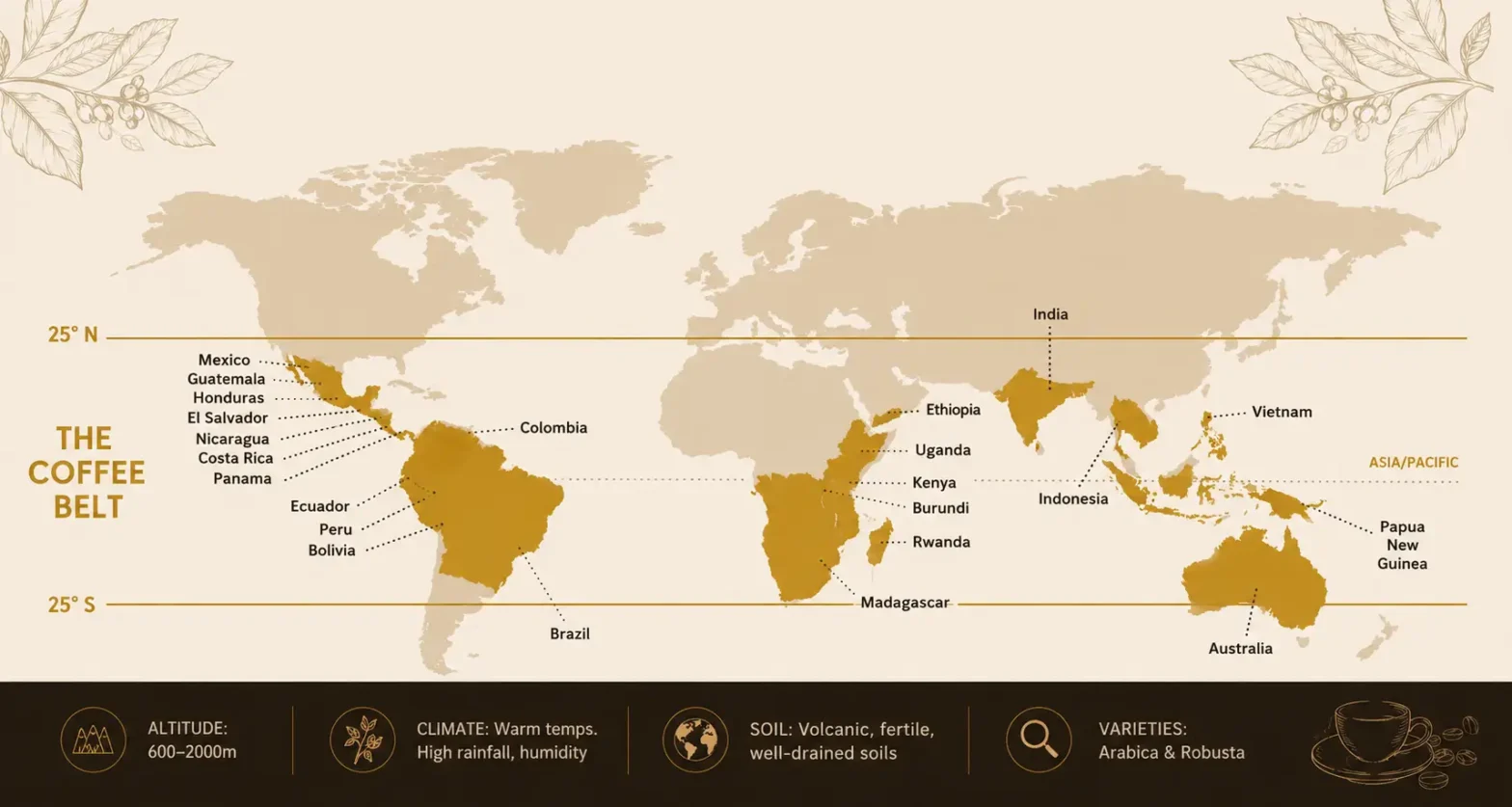
The Coffee Belt, also known as the Coffee Production Belt, Coffee Growing Belt, or The Bean Belt, refers to the tropical region of the world extending approximately from 25° North to 30° South of the Equator, encompassing the majority of global coffee-producing countries. The belt provides the climatic conditions necessary for coffee cultivation, including warm temperatures, seasonal rainfall, and frost-free environments.
The Ideal Coffee-Growing Zone
Most commercial coffee is grown within this tropical belt because it provides the combination of:
- Warm temperatures year-round
- Distinct wet and dry seasons
- Adequate rainfall
- Suitable altitudes
- Minimal risk of frost
Where the Best Coffee is Typically Found
Although the Coffee Belt spans from 25°N to 30°S, many of the world’s most celebrated coffees come from a narrower band closer to the Equator:
| Latitude Range | Typical Characteristics |
| 10°N – 10°S | Generally considered the “sweet spot” for high-quality Arabica production |
| 15°N – 15°S | Excellent specialty coffee regions |
| 25°N – 30°S | Coffee can still thrive but may require more specific local conditions |
Examples by Latitude
- Ethiopia: roughly 3°N–15°N
- Colombia: roughly 4°S–13°N
- Kenya: about 5°S–5°N
- Brazil: about 5°N–33°S
- Vietnam: about 8°N–23°N
- Indonesia: about 11°S–6°N
☕ More Highlights
25°N to 30°S
The Coffee Belt stretches roughly between 25° North and 30° South of the Equator.
99%+ of World Coffee
Virtually all commercial coffee is grown within the tropical Coffee Belt.
Arabica & Robusta
The world’s two dominant coffee species originate and thrive within this region.
Ideal Climate
Most coffee grows best between 15°C and 24°C (59°F–75°F).
High-Elevation Quality
Many specialty coffees are cultivated between 1,000 and 2,200 meters above sea level.
Volcanic Soils
Many renowned origins benefit from nutrient-rich volcanic landscapes.
Near-Equator Stability
Regions closest to the Equator experience minimal seasonal temperature swings.
Flavor Development
Cooler temperatures at altitude slow cherry ripening and increase complexity.
Legendary Origins
Ethiopia, Colombia, Brazil, Kenya, Guatemala, Indonesia, and Yemen all lie within the Coffee Belt.
The Bean Belt is home to 25 countries that produce most of the coffee consumed in the world today.
The environmental conditions within the belt help these countries grow coffee trees that produce the coffee of the world.
Africa
Africa is the birthplace of coffee. Ethiopia remains the genetic heartland of Arabica, while Central and West Africa are major Robusta producers. The continent’s diverse climates, altitudes, and soils produce some of the world’s most distinctive and aromatic coffees.
- Ethiopia — Arabica (Yirgacheffe, Sidama, Harrar, Guji) — the origin of coffee itself; wild forest varieties remain unique to this country
- Uganda — Robusta (primary) & Arabica — one of Africa’s largest exporters; Robusta thrives in the Lake Victoria basin
- Tanzania — Arabica (Kilimanjaro, Peaberry) & Robusta — grown on the slopes of Mount Kilimanjaro and Mount Meru
- Kenya — Arabica (SL-28, SL-34, Ruiru 11) — renowned for bright acidity, blackcurrant, and berry notes; auction system produces premium lots
- Rwanda — Arabica — high-altitude single-origin known for floral, citrus, and stone fruit profiles
- Burundi — Arabica — growing specialty recognition; high-altitude Bourbon varieties with sweet fruit complexity
- Democratic Republic of Congo — Robusta & Arabica — significant production potential in the Kivu region; Arabica from high-altitude zones
- Cameroon — Robusta & Arabica — Arabica from highlands; Robusta widely grown in lower regions
- Ivory Coast (Côte d’Ivoire) — Robusta — historically one of the continent’s top Robusta exporters
- Madagascar — Robusta & Arabica — small but growing specialty sector; unique terroir from island geography
- Malawi — Arabica — Satemwa and Thyolo estates produce recognized single-origin coffees
- Zambia — Arabica — small-scale production gaining specialty attention in the Northern Province
- Zimbabwe — Arabica — formerly a significant producer; estates in Eastern Highlands producing quality Arabica
- Togo — Robusta — small production; primarily for domestic use and regional trade
- Guinea — Robusta — traditional producer; potential for specialty development
- Sierra Leone — Robusta — small-scale; production recovering with sector investment
- Nigeria — Robusta & Arabica — large population and growing domestic market; Mubi and Adamawa regions
- Angola — Robusta & Arabica — historically a top-5 world producer; Robusta from Cabinda; Arabica from Huambo highlands
- Mozambique — Arabica — Gorongosa highlands; small-scale but growing
- South Sudan — Arabica (wild) — ancient forest Arabica; largely underdeveloped but high potential
Central America & the Caribbean
Central America produces some of the most celebrated Arabica coffees in the world, benefiting from volcanic soils, consistent rainfall, and ideal altitude. The Caribbean islands offer small but distinctive single-origin gems.
- Guatemala — Arabica (Bourbon, Caturra, Catuai) — Antigua, Huehuetenango, and Atitlán are among the world’s most prized growing regions
- Honduras — Arabica — the largest coffee producer in Central America; Copán, Montecillos, and Comayagua regions
- Costa Rica — Arabica (100% by law) — Tarrazú, West Valley, and Tres Ríos; known for clarity and bright acidity
- El Salvador — Arabica (Bourbon, Pacamara) — Pacamara is an El Salvadoran hybrid; Santa Ana and Apaneca regions
- Nicaragua — Arabica — Jinotega and Matagalpa highlands; growing specialty export market
- Panama — Arabica (Gesha/Geisha) — Boquete’s Hacienda La Esmeralda put Gesha on the world map; some of the highest auction prices globally
- Mexico — Arabica — Chiapas, Veracruz, and Oaxaca; large-scale production with growing organic and specialty sectors
- Jamaica — Arabica (Blue Mountain) — one of the world’s most expensive and sought-after coffees; tightly regulated by the Coffee Industry Board
- Haiti — Arabica — historically significant; Thiotte and the Blue Mountains; undergoing a specialty revival
- Cuba — Arabica — Crystal Mountain; limited export; traditional production methods
- Puerto Rico (US Territory) — Arabica — Yauco Selecto and Hacienda Lealtad; a colonial-era tradition experiencing a revival
- Dominican Republic — Arabica — Cibao Valley and Barahona region; balanced cup with mild acidity
South America
South America dominates global coffee production. Brazil alone accounts for roughly one-third of the world’s coffee supply, while Colombia, Peru, and Bolivia contribute exceptional specialty Arabicas from their Andean highlands.
- Brazil — Arabica & Robusta (Conilon) — the world’s largest producer; Minas Gerais, São Paulo, and Espírito Santo; natural and pulped natural processing prominent
- Colombia — Arabica (Castillo, Caturra, Colombia) — second-largest Arabica exporter; Huila, Nariño, Antioquia, and Sierra Nevada
- Peru — Arabica — Cajamarca, Junín, and Cusco; strong organic and fair-trade certification presence
- Ecuador — Arabica & Robusta — Loja and Pichincha for Arabica; Galápagos Islands produce micro-lot specialty coffees
- Bolivia — Arabica — Caranavi and the Yungas region; high-altitude, underdeveloped, but producing exceptional specialty lots
- Venezuela — Arabica — Mérida and Táchira; historically notable Maracaibos; production declined, but terroir remains strong
- Paraguay — Arabica — small-scale production; primarily domestic consumption
Asia
Asia is home to some of the world’s oldest cultivated coffee traditions as well as its newest specialty frontiers. From the centuries-old spice island coffees of Indonesia to the fast-growing sectors of Vietnam and China, the region spans the full spectrum of coffee culture and production.
- Vietnam — Robusta (primary) & Arabica — the world’s second-largest coffee producer overall and largest Robusta producer; Da Lat region for Arabica
- Indonesia — Arabica & Robusta — Sumatra (Mandheling, Gayo), Sulawesi (Toraja), Java, Bali, and Flores; wet-hulled process creates earthy, full-bodied profiles
- India — Arabica & Robusta — Karnataka (Coorg, Chikmagalur), Kerala, and Tamil Nadu; Monsooned Malabar is a uniquely processed Indian specialty
- China — Arabica — Yunnan Province; a rapidly growing sector with improving quality and an expanding specialty market
- Myanmar (Burma) — Arabica & Robusta — Shan State; growing, nascent specialty sector with strong potential
- Laos — Arabica & Robusta — Bolaven Plateau; small production with notable specialty lots
- Thailand — Arabica & Robusta — Northern highlands (Chiang Rai, Chiang Mai); growing specialty culture
- Philippines — Arabica, Robusta, Liberica (Barako), & Excelsa — one of the few countries producing all four commercially recognised species; Sagada and Benguet for Arabica
- Timor-Leste (East Timor) — Arabica & Robusta — Timor Hybrid is a naturally occurring Arabica-Robusta cross originating here, used globally in breeding programs
- Taiwan — Arabica — Alishan and Nantou; small but high-quality micro-lot production
- Nepal — Arabica — Himalayan foothills; growing specialty sector with high-altitude advantage
- Cambodia — Robusta — Mondulkiri Province; small but increasing production
Middle East
The Middle East holds deep historical significance in coffee’s global journey. Yemen is where coffee was first cultivated for trade and where the drink spread to the wider world through the port of Mocha.
- Yemen — Arabica — the ancient cradle of the coffee trade; Haraaz, Haymah, and Bani Matar regions; dry-processed on the fruit for complex, wine-like profiles
- Saudi Arabia — Arabica (Khawlani) — Jizan and Al-Baha regions; small but historically significant; domestically celebrated
- Oman — Arabica (Dhofari) — Dhofar region; ancient tradition; small and artisan-scale production
Oceania & the Pacific Islands
Oceania represents some of the world’s most unique and pristine coffee-growing environments. Papua New Guinea is the dominant producer, while Australia, Hawaii, and smaller Pacific island nations contribute distinctive micro-lot and specialty coffees.
- Papua New Guinea — Arabica & Robusta — Eastern Highlands, Western Highlands, and Simbu; heirloom Typica varieties; full-bodied with tropical fruit notes
- Australia — Arabica — Queensland (Atherton Tablelands) and New South Wales; small-scale, high-cost, hand-harvested; increasingly craft-focused
- Hawaii (USA) — Arabica — Kona Coast (Big Island), Maui, and Kauai; Kona Extra Fancy is among the world’s most premium and regulated coffees
- Vanuatu — Arabica & Robusta — small island production; organic and shade-grown; gaining specialty recognition
- Samoa — Arabica — very small-scale; grown in traditional agroforestry systems
- Tonga — Arabica — micro-scale production; mainly for domestic and regional use
- New Caledonia — Arabica — French territory; small artisan production
A Note on Coffee Species
Most of the world’s coffee falls into two main species:
- Arabica (Coffea arabica) — accounts for approximately 60–70% of global production; grown at higher altitudes; complex, aromatic, and lower in caffeine
- Robusta (Coffea canephora) — approximately 30–40% of production; grown at lower altitudes; higher caffeine, stronger, more bitter; used heavily in espresso blends and instant coffee
- Liberica (Coffea liberica) — rare; grown mainly in the Philippines (Barako) and parts of West Africa; smoky, woody, and uniquely pungent
- Excelsa (Coffea liberica var. dewevrei) — often classified under Liberica; found in Southeast Asia; tart, fruity, and complex; used in blends for depth
© Roastopedia.com — All Rights Reserved