
The Origami Dripper is a Japanese pour-over brewing device distinguished by its 20 vertical interior ribs, dual filter compatibility, and construction from Mino-yaki (美濃焼) porcelain — a ceramic tradition practiced in Toki City, Gifu Prefecture, Japan, for over four centuries.
Unlike other conical drippers, the Origami accepts both conical and wave-style paper filters interchangeably within the same vessel, allowing the brewer to produce fundamentally different extraction profiles — from a bright, high-clarity cup to a fuller, rounder body — without changing equipment. Its name and form are drawn directly from origami, the Japanese art of paper folding, and the dripper’s ribbed silhouette evokes the angular geometry of a folded paper figure.
The Origami Dripper gained international recognition after Du Jianing used it in her winning routine at the 2019 World Brewers Cup, becoming the first Chinese competitor to win the championship — an event that significantly accelerated the dripper’s adoption within specialty coffee communities worldwide. Since then, it has become a common fixture on competition stages and in third-wave coffee bars across Asia, Europe, Australia, and North America.
History and Origin
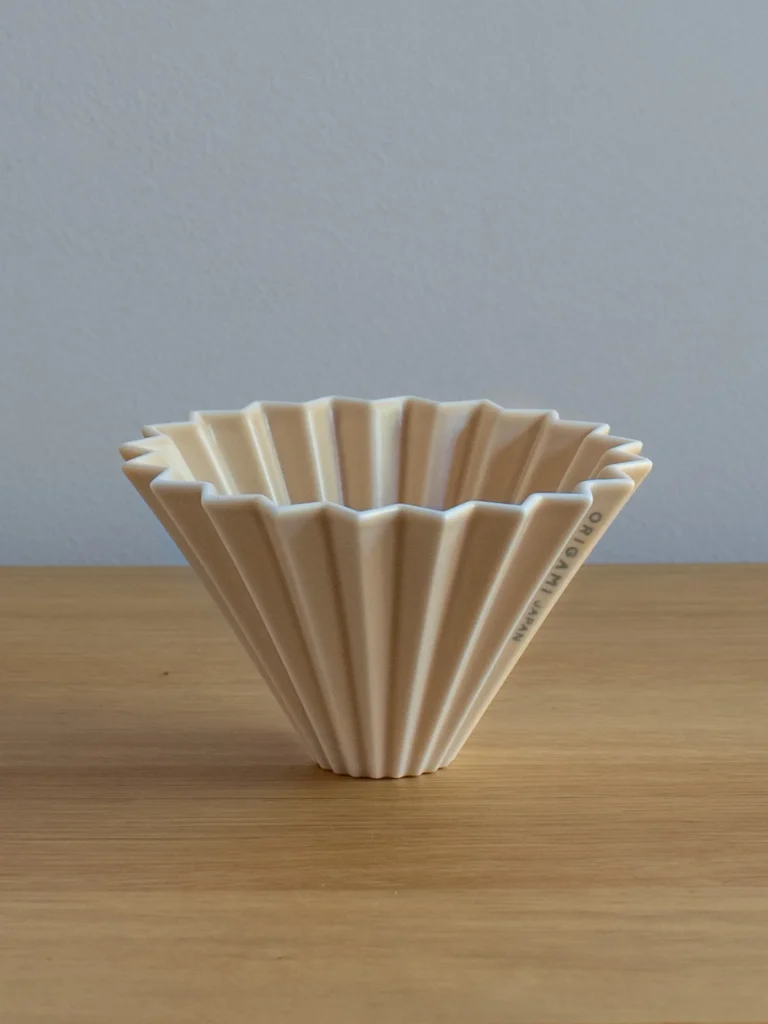
The original dripper design was modeled after the bellflower (Platycodon grandiflorus), the city flower of Toki City. Through repeated extraction and verification, the design evolved to accommodate both cone-shaped and wave-shaped filters, and through meticulous refinement over more than 20 iterations, the current 20-rib design was finalized in 2016.
The Origami Dripper was designed by Yasuo Suzuki and Kiyohito Tanaka, the founders of Trunk Coffee in Japan, and is manufactured at a factory in Toki in the Gifu prefecture. The result is a brewer shaped by both the culture it comes from and the demands of specialty coffee.
Minoware is a ceramic-making technique some 400–500 years old, and only a few dozen artisans in Japan still carry the craft forward. Each dripper is handmade using these traditional techniques, meaning that no two pieces are entirely identical. The high-density clay used in Mino-yaki production gives the Origami excellent thermal mass and heat retention during brewing — a functional advantage as well as an aesthetic one.
As top baristas around the world used the Origami Dripper at coffee competitions, the ORIGAMI name spread worldwide, reaching the eyes of many people. The dripper is now distributed globally through specialty coffee retailers and is manufactured in multiple colorways — a departure from the typically monochrome aesthetic of most precision brewing equipment, and a deliberate design choice that reflects the playful spirit of its origami namesake.
Design and Construction
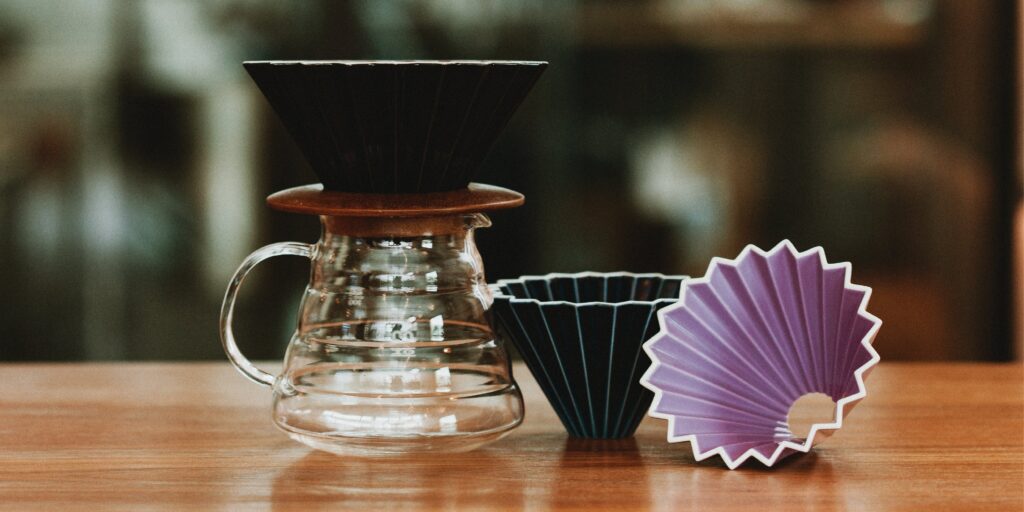
The 20-Rib Interior
The hallmark of the Origami Dripper is its 20 precisely engineered vertical ribs. These ribs create a narrow air channel between the dripper and paper filter, regulating the flow of hot water. This air channel serves two critical functions. First, it prevents the wet paper filter from sealing flush against the inner wall of the dripper — a condition that would block airflow, stall flow rate, and cause uneven extraction. Second, it allows dissolved carbon dioxide released during blooming to escape freely upward through the channels rather than building pressure beneath the filter.
The 20 ribs also help to minimize clogging, creating much cleaner flavors in the cup. In practice, this means that fine coffee particles are less likely to compact against the wall and interrupt drawdown — a common failure mode in smooth-walled drippers or those with fewer ribs.
Dual Filter Compatibility
The Origami’s most technically significant design feature is its ability to function as two categorically different types of brewer within a single vessel, depending solely on filter choice.
When used with conical paper filters, the 20 evenly spaced ribs create space between the dripper and the filter, enabling a faster flow rate and thereby encouraging a faster extraction time. Conversely, when using Kalita Wave paper filters, they fit perfectly into the 20 ribs, making it a flat-bottom brewer.
Conical filters encourage faster airflow and a brighter extraction. Wave filters settle the flow, producing something fuller and rounder. The porcelain holds heat steadily through both.
This dual compatibility is not merely a commercial convenience. It reflects a meaningful difference in extraction physics. In conical mode, the Origami behaves similarly to a Hario V60 — water converges toward a single exit point at the base, and the coffee bed is deeper at the center, meaning water at the apex has the longest contact time. In wave mode, the flat-bottom geometry distributes water more evenly across the entire bed, producing more uniform contact time across all grounds and a more even extraction yield.
The wave filter promotes a stable water flow, ensuring that water moves consistently through the coffee grounds. This balanced extraction process highlights the coffee’s natural sweetness and body, without the risk of an over-extracted or bitter taste. Because the wave design creates a thinner coffee bed compared to traditional conical filters, water passes through more quickly, leading to even extraction from the top to the bottom of the grounds for a clean, balanced cup.
Material: Mino-Yaki Porcelain
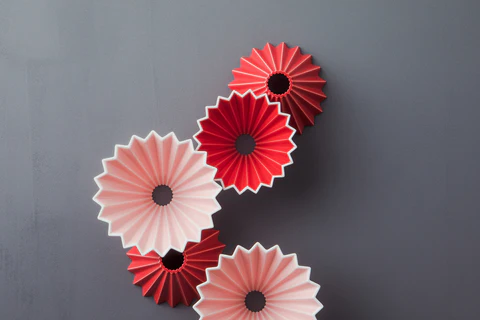
The dripper is crafted out of Mino porcelain, one of Japan’s most prestigious potteries with a history of more than 400 years, keeping a steady brewing temperature inside the dripper. The thermal stability of the porcelain body is functionally significant: unlike plastic drippers, which lose heat rapidly, or metal drippers, which conduct heat away from the brew, dense porcelain acts as a heat reservoir.
Once preheated with hot water — a step recommended by most Origami brewing protocols — the ceramic walls release heat gradually into the brew environment, reducing temperature drop during extraction and supporting more consistent extraction yield across the duration of the pour.
The dripper is produced in both a small size (suited for 1–2 cup brewing, up to approximately 20–25 grams of dry coffee) and a medium size (suited for 2–4 cups). It is available in a wide range of glazed colors, making it among the most visually distinctive brewers in the specialty coffee market.
Extraction Dynamics
Flow Rate and Rib Geometry
The relationship between the Origami’s rib structure and flow rate is central to understanding how it behaves during brewing. In conical filter mode, the ribs create continuous vertical air channels that allow air to escape upward as water descends. This reduces back-pressure on the brewing bed and accelerates flow relative to a smooth-walled conical dripper. In wave filter mode, the pleated edges of the wave filter lock into the ribs, eliminating most of the air channel and slowing the flow — effectively converting the dripper’s behavior from V60-like to Kalita Wave-like.
Grind size must therefore be calibrated separately for each filter mode. A grind suitable for Origami in conical mode will typically be too fine for wave mode at the same dose, producing over-extracted, bitter, or slow-draining results. Conversely, a grind dialed for wave mode will often run too fast in conical mode, yielding a bright but under-developed cup.
Agitation and Pour Technique
Because the Origami functions as a pour-over device, the brewer’s pour technique directly controls agitation, flow rate, and ultimately extraction character. A high, fast pour increases turbulence at the surface of the coffee bed, promoting more aggressive particle movement and greater extraction yield. A low, gentle circular pour reduces agitation and produces a cleaner, more stratified extraction.
In competition use, baristas have experimented extensively with pour patterns — center pours, spiral pours, pulse pours, and single continuous pours — to manipulate how water saturates and percolates through the coffee bed. The Origami’s rib structure provides enough flow control that pour technique plays a larger role in shaping the final cup than it does in more restrictive brewers.
Blooming
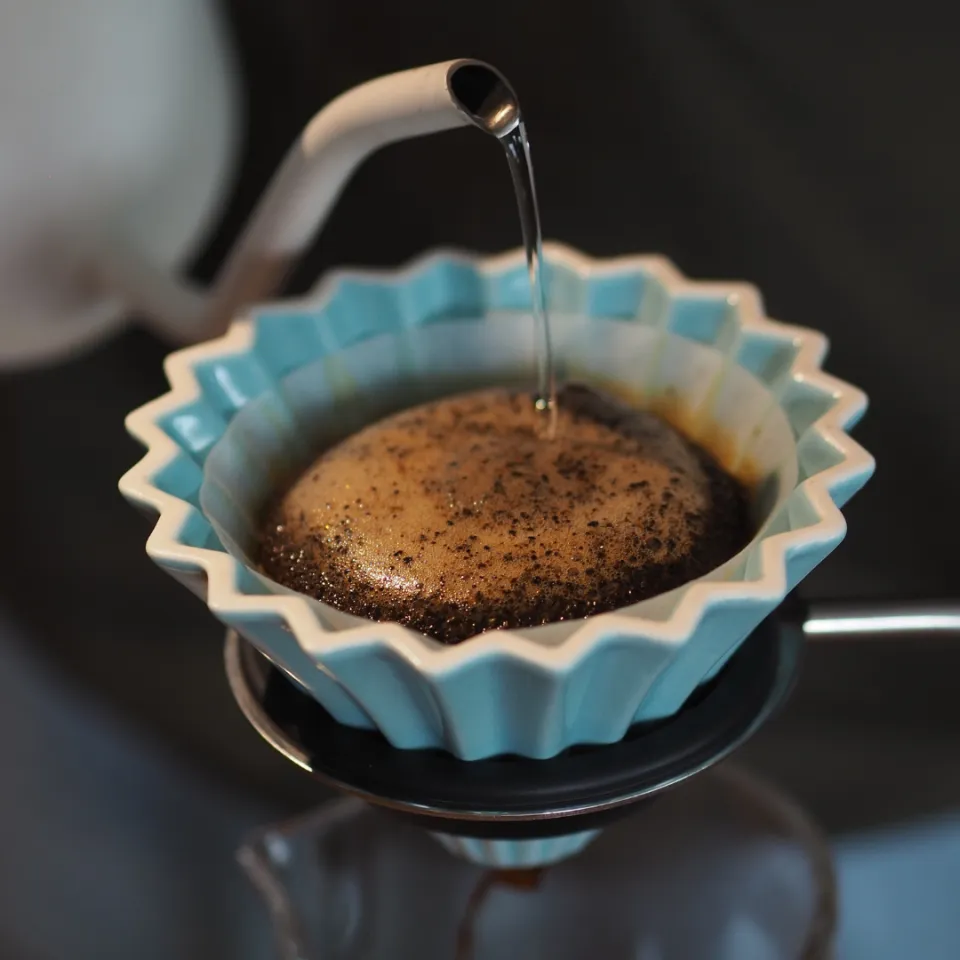
As with all pour-over methods, blooming — the initial pour of a small quantity of hot water (typically 2–3× the coffee dose by weight) to saturate the bed and allow degassing — is standard practice with the Origami. The rib-assisted airflow is particularly beneficial during bloom: as freshly roasted coffee releases carbon dioxide, the gas escapes upward through the channels without disrupting the filter seal or causing the bed to dome and crack unevenly. This produces a more uniform saturation of the coffee bed before the main extraction pours begin.
Compatible Filters
The Origami’s design accommodates a broader range of commercially available filters than most drippers. Compatible filters include:
- Origami Conical Filter (Cup 4) — the brand’s proprietary conical filter, designed to seat within the 20 ribs with a precise fit
- Origami Wave Filter — the brand’s proprietary wave-style filter, engineered to lock into the ribs and convert the dripper to flat-bottom mode
- Hario V60 Size 02 Filter — fits the medium Origami in conical mode
- Kalita Wave 185 Filter — fits the medium Origami in flat-bottom mode
- CAFEC Cup 4 / Abaca Filter — widely used in competition settings for their low paper taste and high wet strength
- Sibarist Cone M / Sibarist Hybrid — specialty filters used by competition baristas seeking faster flow rates and maximum clarity
Filter selection is not merely a question of fit. The paper’s density, fiber type (abaca, bamboo, or wood pulp), and wet strength all affect flow rate, filtration clarity, and the degree to which paper-derived flavor compounds enter the cup. Pre-rinsing all paper filters with hot water before brewing is universally recommended to remove residual paper taste and preheat the ceramic body simultaneously.
Origami Dripper vs. Comparable Brewers
| Feature | Origami (Conical) | Origami (Wave) | Hario V60 | Kalita Wave | Chemex |
| Bed geometry | Conical | Flat-bottom | Conical | Flat-bottom | Conical |
| Flow rate | Fast | Moderate | Fast | Moderate | Slow |
| Extraction uniformity | Moderate | High | Moderate | High | Moderate |
| Cup clarity | High | High | High | Moderate–High | Very High |
| Body | Light–Medium | Medium–Full | Light | Medium | Light |
| Skill demand | High | Moderate | High | Moderate | Moderate |
| Heat retention | High (ceramic) | High (ceramic) | Low–Moderate | Low | Low |
Brewing Parameters and Protocols
There is no single canonical Origami recipe, as the dripper’s dual-mode flexibility means that parameters vary significantly by filter type, roast level, and intended cup profile. The following represent widely used starting benchmarks.
General parameters (conical filter mode):
- Dose: 15–20 g of ground coffee
- Output: 250–300 g of brewed coffee (approximately 1:15 to 1:16 brew ratio)
- Water temperature: 90–96°C (194–205°F), adjusted lower for lighter roasts
- Total brew time: 2 minutes 30 seconds to 3 minutes 30 seconds
- Bloom: 30–45 g of water held for 30–45 seconds
- Grind size: medium-fine, comparable to V60 settings
General parameters (wave filter mode):
- Dose: 15–20 g
- Output: 250–300 g
- Water temperature: 88–94°C (190–201°F)
- Total brew time: 3 minutes to 4 minutes
- Bloom: 40–50 g held for 35–45 seconds
- Grind size: medium, slightly coarser than conical mode
In both modes, calibration — the iterative process of adjusting grind, dose, temperature, and pour to achieve a target extraction yield and total dissolved solids — is recommended for any new coffee or roast level. Use of a refractometer (see Refractometry) to measure TDS and calculate extraction percentage is common in professional and competition contexts.
Use in Competition
The Origami Dripper holds a distinctive place in the World Brewers Cup (WBrC) — the international competition organized by World Coffee Events in which baristas prepare and present a manual brew to a panel of sensory judges. The brewer became much more popular after 2019 World Brewers Cup Champion Du Jianing used it in her winning routine. Since then, it has appeared repeatedly on competition stages at national and international levels across multiple continents.
Its prominence in competition reflects several practical advantages: the dual filter mode allows competitors to select the extraction geometry best suited to their chosen coffee without committing to a second piece of equipment; the ceramic body offers reliable heat stability across the duration of a brew under judging conditions; and its visual distinctiveness contributes to a memorable presentation — a factor that, while not scored directly, supports the narrative component of competition routines.
It has been used by World Brewers Cup competitors and sits equally well on a competition table or a kitchen counter.
Considerations and Limitations
Fragility: High-density Mino-yaki porcelain, while thermally stable, is brittle under mechanical impact. The Origami Dripper will crack or shatter if dropped onto hard surfaces. This is an inherent trade-off of ceramic construction and is acknowledged by the manufacturer.
Preheating requirement: The thermal mass that makes ceramic advantageous for heat retention also means that a cold Origami will absorb significant heat from the brewing water if not preheated. Failure to preheat the dripper before brewing can lower extraction temperature by several degrees Celsius during the first pours, producing inconsistent results, particularly with light-roast coffees that require precise temperature control.
Grind recalibration between filter modes: Because conical and wave filters produce different flow rates within the same dripper body, switching between filter modes requires a corresponding adjustment to grind size. Brewers who use both modes must maintain separate grind settings for each.
Pour sensitivity: The Origami’s rib-assisted airflow makes it more forgiving than the Hario V60 under conditions of poor puck preparation or uneven pouring, but it remains a high-skill brewer relative to immersion devices such as the AeroPress or French Press. Inconsistent pour rate, interrupted pours, or poorly leveled coffee beds will produce variable extraction results.
See Also
- Pour-Over / Drip Coffee
- Hario V60
- Kalita Wave
- Chemex
- Flow Rate
- Extraction
- Extraction Yield
- Grind Size
- Blooming
- Degassing
- Contact Time
- Agitation
- Calibration
- Specialty Coffee
- Barista
- Total Dissolved Solids (TDS)
- AeroPress
- French Press
References
- Suzuki, Y., & Tanaka, K. (2016). ORIGAMI Dripper: Design and development history. Trunk Coffee / ORIGAMI. Retrieved from https://origami-kai.com/en/pages/story
- Specialty Coffee Association. (2021). Brewing Control Chart and Golden Cup Standard. Specialty Coffee Association.
- World Coffee Events. (2023). World Brewers Cup Rules and Regulations. World Coffee Events.
- Wensma, T. (2024, January 10). How to brew coffee with the Origami. Perfect Daily Grind. Retrieved from https://perfectdailygrind.com/2024/01/how-to-brew-coffee-with-origami-pour-over/
- Lingle, T. R. (2011). The Coffee Brewing Handbook: A Systematic Guide to Coffee Preparation (2nd ed.). Specialty Coffee Association of America.
- Hoffman, J. (2018). The World Atlas of Coffee: From Beans to Brewing — Coffees Explored, Explained and Enjoyed (2nd ed.). Mitchell Beazley.
- ORIGAMI Online Store. (2023). ORIGAMI Dripper product specifications. Retrieved from https://origami-kai.com
- Gloess, A. N., Schönbächler, B., Klopprogge, B., D’Ambrosio, L., Chatelain, K., Bongartz, A., Strittmatter, A., Siebert, M., & Yeretzian, C. (2013). Comparison of nine common coffee extraction methods: Instrumental and sensory analysis. European Food Research and Technology, 236(4), 607–627.
- Moroney, K. M., Lee, W. T., O’Brien, S. B. G., Suijver, F., & Marra, J. (2015). Modelling of coffee extraction during brewing using multiscale methods: An experimentally validated model. Chemical Engineering Science, 137, 216–234.
- Smrke, S., Opitz, S. E. W., Vovk, I., & Yeretzian, C. (2018). Time-resolved extraction kinetics of coffee aroma and flavor compounds. Journal of Agricultural and Food Chemistry, 66(40), 10487–10496.