
Coffee harvesting techniques refer to the methods employed by coffee producers worldwide to collect ripe coffee cherries (Coffea spp.) from cultivated plants. The selection of a harvesting technique is widely regarded as one of the most consequential decisions in the coffee production chain, as it directly influences the quality of the resulting green coffee, the efficiency of post-harvest processing, and the economic viability of a given farming operation.
According to the Specialty Coffee Association (SCA), the moment of harvest and the method applied represent a foundational variable in determining cup quality, with downstream processing being unable to fully compensate for errors introduced at this stage.
Background and Historical Context
The harvesting of coffee cherries is documented as far back as the 15th century, when coffee cultivation was first recorded in what is now Yemen. According to the Encyclopædia Britannica, wild coffee plants originated in the highland forests of Ethiopia — a region historically identified with the Kaffa province — before being transplanted under cultivation across the Red Sea to southern Arabia. Early harvesting in these regions is understood to have been performed entirely by hand, with workers gathering ripe cherries individually or pulling entire branches in a rudimentary strip method.
As coffee cultivation spread westward to the Americas in the 18th century — reaching Brazil, Colombia, and Central America — and as the scale of production grew substantially, the limitations of purely manual harvesting became apparent to large-scale producers. The National Coffee Association (NCA) notes that the Industrial Revolution introduced steam-powered machinery to agricultural production broadly, and by the 20th century, mechanized harvesting equipment had been developed specifically for coffee, particularly for deployment in the flat, expansive coffee fields of Brazil, which emerged as the world’s largest coffee-producing nation.
The 20th century also gave rise to what industry observers describe as the Specialty Coffee movement. The concept of “specialty coffee” is widely attributed to Erna Knutsen, who introduced the term in 1978 to describe coffees grown in particular microclimates that produce beans with unique flavor characteristics. Under this framework, harvesting technique became a point of heightened scrutiny, as selective, quality-focused methods were associated with higher cup scores under the SCA’s 100-point evaluation system — a standard that requires a minimum score of 80 for a coffee to qualify as “specialty grade.”
The Three Primary Harvesting Techniques
The global coffee industry recognizes three principal harvesting techniques, each distinguished by the level of selectivity applied to cherry maturity, the degree of mechanization involved, and the geographic and topographic conditions under which it is deployed. These techniques are:
1. Selective Picking (Hand Picking)
Selective picking is characterized by the manual harvesting of only fully ripe cherries, with pickers returning to each tree on a rotational basis — typically every 8 to 10 days, according to the NCA — as successive cherries reach peak maturity. This method is predominantly associated with premium arabica production and is considered by many specialty coffee industry practitioners to yield the highest potential cup quality. It is the most labor-intensive and cost-intensive of the three methods.
2. Strip Harvesting (Strip Picking)
Strip harvesting involves the removal of all cherries from a branch simultaneously, regardless of their stage of ripeness. This may be performed manually by pulling the hand along the length of a branch or through the use of handheld mechanical strippers. The method is faster and considerably less costly than selective picking, though it produces a mixed-maturity harvest that typically necessitates additional post-harvest sorting. According to the Agriculture Institute, approximately 75% of cherries in Brazil’s major growing regions reach maturity at roughly the same time, making strip harvesting a particularly viable method in that country’s context.
3. Mechanical Harvesting
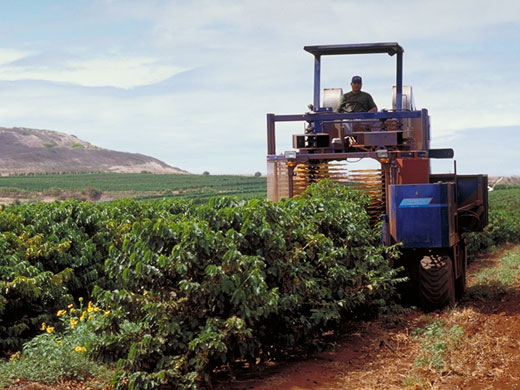
Mechanical harvesting employs large-scale machinery — most commonly self-propelled harvesting machines that straddle planted rows and use vibrating rods or rotating mechanisms to dislodge cherries from the trees into collection units. This method is used almost exclusively on flat, expansive farms with uniform row spacing and compact tree varieties, conditions that are most commonly found in Brazil. It is the most efficient technique by volume, requiring minimal labor per unit of output, though it collects cherries across all stages of maturity and thus shares with strip harvesting the need for rigorous downstream sorting.
Each of the three techniques is examined in depth in dedicated articles linked from this page.
Factors Governing Technique Selection
The choice of harvesting technique is not universally fixed but is instead determined by an intersection of agronomic, economic, geographic, and market-driven variables. Industry literature and agricultural research identify the following as the primary determinants:
Terrain and Farm Topography
Mechanical harvesting is contingent upon relatively flat and accessible terrain, as large harvesting machines cannot navigate the steep slopes common to high-altitude arabica-growing regions such as Ethiopia’s Yirgacheffe zone, Colombia’s Andes, or the volcanic slopes of Central America. According to Perfect Daily Grind, selective and strip hand-picking remain the practical standard in mountainous regions where mechanization is physically impractical.
Target Market and Quality Grade
Farms supplying the specialty coffee market — defined by the SCA as coffees scoring 80 points or above — are predominantly associated with selective picking, as this method minimizes the inclusion of underripe and overripe cherries that negatively affect cup quality and sensory scores. Conversely, farms producing commodity-grade coffee for bulk trading, roasting blends, or instant coffee manufacturing are more commonly associated with strip or mechanical harvesting, where volume efficiency outweighs the quality trade-offs inherent in mixed-maturity harvests.
Labor Availability and Cost
Selective picking requires a large and skilled labor force trained to identify cherry ripeness by visual and tactile indicators. In regions where labor is relatively abundant and affordable, this method is economically sustainable. In areas where labor is scarce or expensive, producers may favor mechanical or strip methods to reduce operational costs, even if the quality ceiling of the resulting coffee is lower.
Cultivar Characteristics
Certain coffee cultivars exhibit a more synchronized ripening pattern than others. Where genetic or environmental factors cause cherries on a given tree to ripen in a narrow temporal window, strip and mechanical harvesting yield a higher proportion of ripe fruit relative to the total harvest. Conversely, cultivars with staggered or asynchronous ripening profiles are better suited to selective picking to avoid large volumes of underripe material. Research published in United States patent literature (USPTO) notes that the inability of mechanical harvesters to distinguish between ripe and unripe cherries — since the physical force required for removal is similar regardless of maturity — remains a fundamental constraint of the technology.
Quality Implications
The relationship between harvesting technique and final cup quality is a subject of ongoing discussion within the coffee research and specialty trade communities. The Specialty Coffee Association and the Coffee Quality Institute (CQI) have both emphasized cherry selection as a critical control point in quality production. According to Perfect Daily Grind, selective picking is widely recommended by specialty buyers, as strip and mechanical methods tend to introduce underripe and overripe cherries into the harvest stream, which introduce undesirable flavor compounds — including grassy, astringent, or fermented notes — into the final cup.
It is, however, acknowledged by industry professionals that post-harvest interventions — including optical sorting, flotation separation, and density grading — can partially mitigate the quality disadvantages associated with non-selective harvesting. Corner Coffee Store notes that producers employing mechanical or strip methods can invest more heavily in post-harvest quality control infrastructure to recover a greater proportion of quality-grade coffee from a mixed-maturity harvest.
Geographic Distribution of Techniques
The global distribution of harvesting techniques corresponds broadly to the agronomic and economic conditions of each producing country:
- Brazil, as the world’s largest coffee producer, is the primary adopter of mechanical harvesting, facilitated by its large, flat growing regions and significant capital investment in agricultural technology.
- Colombia, Ethiopia, Kenya, Guatemala, and El Salvador are predominantly associated with selective hand-picking, reflecting their mountainous terrain, their orientation toward specialty-grade arabica production, and their comparatively abundant rural labor markets.
- Vietnam, the world’s second-largest producer and the dominant Robusta supplier, employs a combination of strip harvesting and selective hand-picking depending on the region and farm scale.
- Indonesia and Honduras employ mixed practices across different elevation bands and production systems.
Environmental and Social Considerations
The environmental footprint of different harvesting techniques has become a topic of increasing relevance as the coffee industry engages with sustainability frameworks. Selective picking, while labor-intensive, is noted for its compatibility with biodiverse, shade-grown farming systems on sloped terrain, where mechanization is not feasible and where forest canopy is often maintained. Mechanical harvesting, while efficient, is associated with monoculture farming systems on cleared, flat land, which carry distinct environmental trade-offs related to soil management, biodiversity, and water use.
The Fair Trade movement, which gained momentum from the 1970s onward, has been linked in part to the labor dimensions of selective harvesting, as it advocates for fair wages for the hand-pickers whose skill and labor underpin much of the world’s high-quality coffee production. The International Coffee Organization (ICO) has recognized the importance of equitable labor conditions in producing countries as part of its broader frameworks for sustainable coffee supply chains.
What Producers Believe
Coffee harvesting techniques constitute a foundational element of the global coffee production system, with implications that extend from the agronomic to the sensory, economic, and ethical dimensions of the industry. The three principal techniques — selective picking, strip harvesting, and mechanical harvesting — each represent a distinct set of trade-offs between quality, efficiency, and resource requirements. Industry bodies including the SCA, the CQI, and the ICO continue to examine and promote best practices in harvesting as part of broader efforts to advance coffee quality, producer livelihoods, and supply chain sustainability.
Further Reading
- Selective Picking: Method, Application, and Quality Implications
- Strip Harvesting: Method, Application, and Industry Context
- Mechanical Harvesting: Technology, Deployment, and Trade-offs
References and Further Reading
- Specialty Coffee Association (SCA) — Coffee Standards and Protocols
- Coffee Quality Institute (CQI) — Q Grader Standards and Processing Education
- International Coffee Organization (ICO) — Coffee Report and Outlook Series
- Encyclopædia Britannica — Coffee Production and History of Coffee
- National Coffee Association (NCA) — The Lifecycle of Coffee
- Perfect Daily Grind — Hand-Picked vs Mechanized Coffee Harvesting (2017)
- Agriculture Institute — Harvesting Coffee: Best Practices for Maximum Quality (2026)
- United States Patent Office (USPTO) — Processes for Controlling the Ripening of Coffee Plants (Patent Nos. 6,448,474 and 6,727,406)