
Caffeine is a naturally occurring alkaloid and the world’s most widely consumed psychoactive stimulant. Chemically classified as a xanthine derivative (1,3,7-trimethylxanthine), caffeine is found in the leaves, seeds, and fruit of more than 60 plant species, most notably the coffee plant, the tea plant, the cacao pod, and the guarana berry. In the context of coffee — where the substance is best known and most extensively studied — caffeine is produced by the plant as a natural pesticide, deterring insects and inhibiting the germination of competing seeds near the parent coffee cherry. For humans, however, it is prized for the opposite effect: alertness, elevated mood, and reduced perception of fatigue.
Caffeine is odorless and, in its pure form, intensely bitter, contributing measurably to the bitterness profile that Q-Graders and cuppers assess during formal cupping sessions and score on tools like the Coffee Flavor Wheel. It is soluble in both hot and cold water, which is precisely why it transfers so efficiently from the coffee bean into the cup during brewing, regardless of the extraction method used.
Etymology
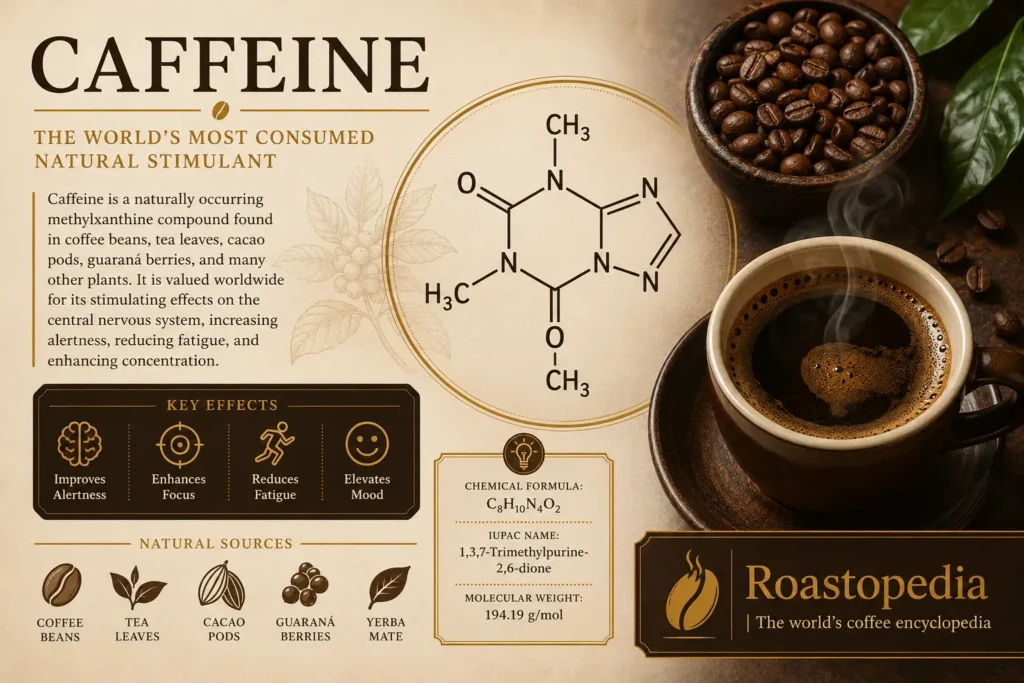
The word “caffeine” derives from the German Kaffein, coined shortly after the compound was first isolated from coffee in 1819 by German chemist Friedlieb Ferdinand Runge. The root traces back through the French café and Italian caffè to the Ottoman Turkish kahve, itself borrowed from the Arabic qahwah — the same linguistic lineage that gave English the word “coffee.” The compound was independently identified in tea a few years later and named “theine,” before chemists confirmed the two substances were molecularly identical.
Natural Occurrence in Coffee
Caffeine concentration varies significantly across the genus Coffea. Coffea arabica, the species responsible for the majority of specialty-grade production, typically contains roughly 1.2–1.5% caffeine by dry weight. Coffea canephora, commonly called robusta, contains nearly double that — often 2.2–2.7% — which is one reason robusta is favored in instant coffee and espresso blends seeking a stronger kick and thicker crema.
The lesser-cultivated species Coffea excelsa and Coffea liberica fall at varying points along this spectrum, and even cultivars within arabica — such as Catuai and SL34 — show measurable differences depending on genetics, altitude, and growing conditions across the Coffee Belt. For a broader look at how genetics shape these differences, see Varieties & Cultivars and the general overview of Coffee Types.
Within the plant itself, caffeine is concentrated in the seed (the coffee bean) but is also present in smaller amounts in the coffee leaf, the coffee flower, and even young coffee seedlings, consistent with its role as a chemical defense compound throughout the plant’s life cycle.
How Roasting and Brewing Affect Caffeine
A persistent myth holds that dark roasting destroys caffeine. In reality, caffeine is a remarkably heat-stable molecule; it does not degrade meaningfully during roasting, even through first crack and beyond. What does change during roasting is density and moisture loss — since dark-roasted beans lose more mass through pyrolysis and take up more volume, a scoop of dark roast actually contains slightly less caffeine by volume than the same scoop of light roast, even though caffeine content by weight stays essentially flat.
This is distinct from flavor-generating reactions like the Maillard reaction, Strecker degradation, and caramelization, which reshape aroma and taste without materially touching caffeine levels. The formation of melanoidins during roasting likewise affects color and mouthfeel, not stimulant content. Roasters monitoring these transformations often track the Rate of Rise (RoR) on the roaster itself, whether working at a small roastery or an industrial facility, followed by quenching to halt the roast.
Brewing method has a far greater influence on caffeine content per cup than roast level. Extraction is governed by contact time, grind size, and especially water temperature, all of which are mapped by tools like the Coffee Brewing Control Chart. Longer steeping and hotter water pull more caffeine into solution, which is why full-immersion and percolation-based coffee brew methods — where water moves through the grounds via percolation — tend to yield higher caffeine concentrations than quick espresso shots, despite espresso tasting more intense.
Drawdown time and proper blooming, which allows trapped CO₂ to escape via degassing before full extraction begins, also shape how efficiently caffeine and other solubles are drawn from the grounds. On espresso equipment specifically, factors like group head temperature stability, the condition of the shower screen, and routine backflushing or use of a blind filter for cleaning affect consistency shot to shot, while accessories like a tamper mat and knockbox support the workflow around extraction without altering caffeine chemistry itself.
Choices further up the supply chain matter too. Whether beans are labeled organic coffee, sold as single-origin coffee, or sourced from a defined estate coffee has no consistent bearing on caffeine content; these are classifications of origin and cultivation practice, not stimulant strength. What matters more is the state of the green coffee prior to roasting and, of course, the species and cultivar discussed above.
Decaffeination
Decaf coffee is produced by removing caffeine from green coffee before roasting, typically through solvent-based processes, the Swiss Water Process, or supercritical CO₂ extraction. None of these methods achieves 100% removal — commercial decaf typically retains around 1–2% of its original caffeine content, which is why decaf is more accurately described as “low-caffeine” rather than entirely caffeine-free.
Pharmacology and Mechanism of Action
Caffeine’s stimulant effect stems primarily from its role as a competitive antagonist at adenosine receptors in the central nervous system. Adenosine is a neuromodulator that accumulates over the course of the day and promotes drowsiness by binding to A1 and A2A receptors.
Because caffeine’s molecular structure closely resembles adenosine, it binds to these same receptors without activating them, blocking adenosine’s sedating signal. This indirectly increases dopamine and norepinephrine activity, producing the alertness, improved reaction time, and elevated mood associated with coffee consumption.
Once ingested, caffeine is absorbed rapidly and almost completely from the gastrointestinal tract, reaching peak blood concentration within 30–60 minutes. It is metabolized primarily in the liver by the enzyme CYP1A2 into three main metabolites — paraxanthine, theobromine, and theophylline — each with its own mild physiological effects. Caffeine’s biological half-life in a healthy adult averages four to six hours, though this varies considerably based on genetics, liver function, pregnancy, smoking status, and concurrent medication use, all of which alter CYP1A2 activity.
Effects and Dosage
At moderate doses (roughly 40–300 mg), caffeine reliably improves vigilance, reaction time, and short-term memory performance, and is widely used by athletes to enhance endurance and reduce perceived exertion. Higher doses can produce anxiety, restlessness, insomnia, elevated heart rate, and gastrointestinal discomfort.
Regulatory and health bodies generally regard up to 400 mg per day — roughly the amount in three to five 8-ounce cups of brewed coffee, though this varies by coffee type and coffee brew method — as safe for most healthy, non-pregnant adults. Tolerance develops with regular use, and abrupt cessation can trigger withdrawal symptoms including headache, fatigue, and irritability, typically resolving within a week.
Individual sensitivity to caffeine varies widely and is shaped by genetics, body mass, medication interactions, and habitual intake. People who metabolize caffeine slowly, due to reduced CYP1A2 activity, experience its stimulant and cardiovascular effects for longer stretches and at lower doses than fast metabolizers.
Pregnant individuals are generally advised to limit intake to around 200 mg per day, since caffeine crosses the placenta and fetal metabolism is markedly slower than an adult’s.
Children and adolescents are typically advised to avoid or sharply limit caffeine altogether, given their lower body mass and the outsized effect it can have on sleep and developing cardiovascular systems. Because caffeine has a genuine, measurable half-life, timing matters as much as total dose: a cup consumed in the early afternoon can still be exerting roughly half its original effect at bedtime, which is a common, underappreciated driver of poor sleep quality among regular coffee drinkers.
Caffeine in Coffee Culture
Caffeine is inseparable from coffee’s cultural history, tracked loosely across what industry observers call the coffee “waves” — from the mass-market instant coffee of the First Wave, through the café-culture boom of the Second Wave, the origin-focused, craft-driven Third Wave, the technology- and science-forward Fourth Wave, and the still-emerging Fifth Wave. Across these eras, coffee drinks evolved into an enormous vocabulary of preparations — from a Vienna coffee topped with whipped cream to a milk-forward flat white, a compact cortado, or a chocolate-laced mocha — all of which deliver caffeine in different concentrations depending on their espresso-to-milk or espresso-to-water ratios.
See Also
- Decaf Coffee
- Coffea arabica (Arabica)
- Coffea canephora (Robusta)
- Green Coffee
- Cupping
- Maillard Reaction
- Coffee Cherry
References
- U.S. Food and Drug Administration — “Spilling the Beans: How Much Caffeine Is Too Much?”
- National Institutes of Health, MedlinePlus — “Caffeine”
- European Food Safety Authority — Scientific Opinion on the Safety of Caffeine
- Mayo Clinic — “Caffeine: How Much Is Too Much?”
- Harvard T.H. Chan School of Public Health, The Nutrition Source — “Caffeine”
- International Agency for Research on Cancer (World Health Organization) — Monograph on Coffee, Coffee Drinking, and Caffeine
- American Chemical Society — “Caffeine,” Molecule of the Week
- National Center for Biotechnology Information, PubChem — Caffeine Compound Summary
- International Coffee Organization — Coffee Market Report
- Specialty Coffee Association — Coffee Standards and Protocols
- Journal of Agricultural and Food Chemistry — studies on inter-species caffeine content variation in Coffea
- American Academy of Sleep Medicine — “Caffeine and Sleep”