
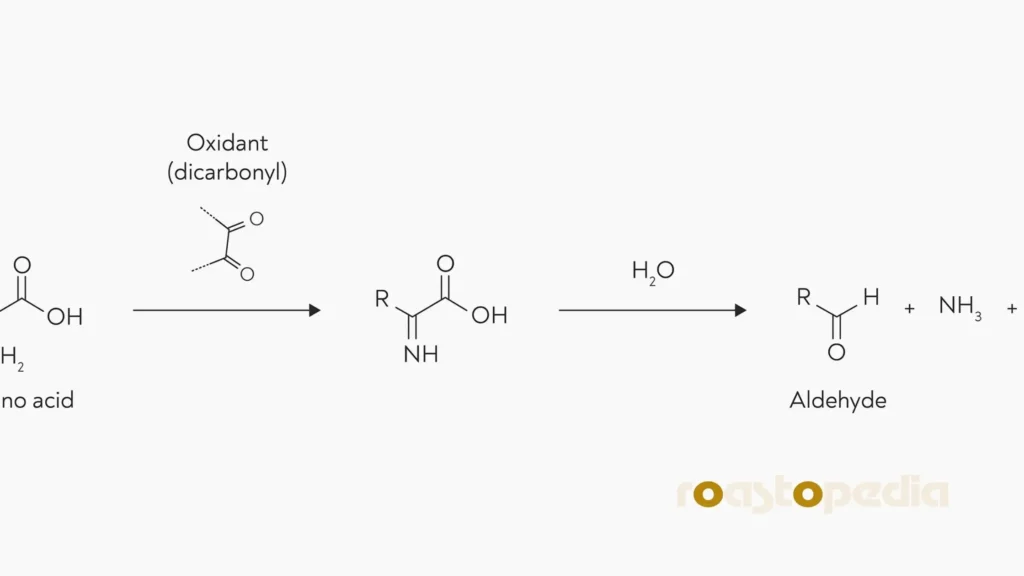
Strecker degradation is a critical thermochemical reaction that involves the oxidative deamination and decarboxylation of an α-amino acid into a volatile aldehyde. In the specific context of coffee roasting, this pathway is the primary source of the highly potent aromatic compounds that define the characteristic fragrance of freshly roasted seeds. It is technically classified as a secondary reaction that utilizes the reactive dicarbonyl intermediates generated during the Maillard reaction. While less visually obvious than the browning of the beans, Strecker degradation is functionally responsible for the release of approximately eighty percent of the carbon dioxide produced during a roast and the formation of numerous aroma-active molecules that determine the quality of the final beverage.
Overview
Thermodynamic activation of Strecker degradation depends on the presence of dicarbonyl compounds, which act as the essential oxidants for the amino acid precursors. As the bean temperature progresses through the browning stage, these intermediates react with amino acids to form an imine intermediate, which subsequently undergoes decarboxylation. The resulting molecule is then hydrolyzed to produce a Strecker aldehyde and an α-aminoketone. This chemical sequence is highly efficient and occurs most vigorously between the onset of the Maillard reaction and the occurrence of Second Crack. The specific identity of the amino acid involved—such as leucine, valine, or phenylalanine—directly dictates the sensory profile of the resulting aldehyde.
The management of this reaction requires a precise understanding of the thermal momentum within the Roaster. Strecker aldehydes are extremely volatile and possess low odor thresholds, meaning they are perceptible even at trace concentrations in the parts-per-billion range. However, they are also highly heat-sensitive and can degrade or evaporate if exposed to excessive temperatures during the development phase. Roasters must therefore balance the need for high-heat induction with the preservation of these delicate aromatics. A well-executed Strecker progression ensures that the coffee possesses a vibrant, complex fragrance that accurately reflects its cultivar and terroir.
Historical Context
The discovery of the reaction that bears his name was published by the German chemist Adolph Strecker in 1862. Strecker was a pioneer in the field of amino acid synthesis and was the first to document the conversion of amino acids into aldehydes using alloxan as an oxidant. For nearly a century, his findings were primarily discussed within the framework of organic chemistry and metabolic biology. It was not until the mid-twentieth century that food scientists began to recognize the central role of this reaction in the development of flavor and aroma in heat-processed foods. As the analytical tools for identifying volatile organic compounds improved, the importance of the Strecker pathway in coffee roasting became increasingly clear.
During the 1960s and 1970s, researchers utilized gas chromatography and mass spectrometry to isolate the specific aldehydes produced during the roasting cycle. These studies confirmed that the characteristic “roasted” and “chocolate-like” notes in coffee were not the result of a single molecule but a complex blend of Strecker-generated compounds. This era also saw the first quantification of carbon dioxide production related to the Strecker pathway, providing a technical explanation for the physical expansion of the roasted bean. The ability to link specific chemical precursors to these outcomes transformed roasting from a purely artisanal craft into a documented and repeatable industrial science.
In the contemporary era of specialty coffee, the historical emphasis on the Strecker reaction has shifted toward “aroma preservation.” Modern roasters use digital profiling to identify the specific temperature windows where these volatiles are at their highest concentration. The development of high-resolution sensors and data logging software has allowed for the creation of precise thermal blueprints that target the production of specific Strecker aldehydes. This evolution represents the transition from broad-scale production to a high-fidelity focus on the molecular details that define premium coffee quality. The history of this reaction is thus the history of the industry’s deepening mastery over the volatile chemistry of the roasted seed.
Etymological Roots
Technical nomenclature for the reaction is a direct tribute to its discoverer, Adolph Strecker, whose work provided the foundational logic for the transformation of nitrogenous compounds. The term “degradation” in this context refers to the chemical breakdown of a larger amino acid molecule into a smaller, more volatile aldehyde. In professional coffee circles, this terminology is used to distinguish these aromatic events from the broader browning of the Maillard reaction. Using the word degradation provides a precise description of the oxidative deamination and decarboxylation that constitutes the pathway. By adopting this standardized vocabulary, the industry aligns its practices with the rigorous standards of global food chemistry and metabolic research.
Linguistic usage of the term also identifies the specific “Strecker aldehydes” that serve as the sensory hallmarks of the roast. This vocabulary allows specialists to move beyond vague descriptors like “nutty” or “floral” and discuss the specific molecular origins of those notes. For example, a taster might identify the presence of 2-methylpropanal as the source of a malty characteristic, grounding their sensory assessment in documented chemical reality. This linguistic precision is essential for the technical documentation required for roast profiling and quality assurance in the specialty sector. It ensures that the language used on the Cupping bench is as accurate as the data logged in the roasting facility.
Contextual meaning of the term also extends to the production of carbon dioxide, which is often discussed as a “byproduct of Strecker degradation.” This dual function of the reaction—creating both aroma and internal gas pressure—makes it a unique and vital event in the roasting cycle. By identifying these outcomes by their technical name, the industry avoids the ambiguity of artisanal descriptions. Standardizing this etymology ensures that roasters, researchers, and quality control technicians share a common framework for evaluating the chemical maturity of their products. The term has thus become a cornerstone of the technical vocabulary that defines modern coffee knowledge.
The Shift in Industry Standards
Specialty coffee standards have undergone a profound shift as the role of Strecker aldehydes in perceived freshness has been better understood. In the early stages of commercial production, the focus was primarily on the stability and color uniformity of the roasted batch. However, the rise of the third-wave movement has prioritized “aroma clarity” and the preservation of origin-specific characteristics. This shift has required roasters to refine their thermal strategies to maximize the production of volatile compounds while avoiding the over-development that can lead to their destruction. Consequently, the management of the Strecker pathway is now considered a primary technical indicator of a roaster’s proficiency.
Professional certification programs now include rigorous training on the chemical origins of coffee aroma, with a specific focus on the Strecker pathway. Specialists must demonstrate a documented understanding of how different amino acid profiles in Arabica Coffee versus Robusta Coffee affect the resulting volatile output. This level of technical literacy ensures that the industry’s standards are based on empirical chemistry rather than subjective preference. As a result, the specialty sector has moved toward a more analytical model where the success of a roast is measured by its volatile complexity and molecular balance. This shift has elevated the status of the coffee roaster to that of a technician in a high-precision chemical field.
Advanced roasting equipment now features high-sensitivity gas sensors that can detect the release of specific volatiles during the roast cycle. These technological leaps allow for the real-time monitoring of the Strecker reaction, providing the operator with a digital “nose” to complement their olfactory intuition. This data is often integrated into the roast profile, allowing for the precise timing of the Quenching phase to lock in the maximum aromatic intensity. This evolution represents the culmination of decades of research into the behavior of volatile compounds under heat, providing a definitive framework for the production of the world’s most aromatic coffees.
Technical Precision in Management
Managing the thermal momentum during the development phase is the most critical technical responsibility for ensuring a successful Strecker progression. As the beans enter the window between First Crack and the end of the roast, the rate of aldehyde production reaches its peak. However, this is also the period where the Rate of Rise (RoR) must be most carefully controlled to prevent the “flick” that can lead to the thermal degradation of these same molecules. The roaster must proactively manage the burner intensity and airflow to maintain a steady, declining momentum that supports chemical maturity without crossing into carbonization.
Quality control technicians are responsible for evaluating the “aromatic intensity” of a sample through professional Cupping and olfactory analysis. This technical documentation is used to verify that the roasting parameters are effectively capturing the Strecker-generated volatiles. Any deficiency in the fragrance profile may indicate that the development phase was either too short to allow for full chemical transformation or too long, resulting in the loss of volatile molecules. By treating the Strecker reaction as a measurable outcome, the facility ensures that every batch meets the high sensory standards required for the specialty market. This commitment to technical precision is what defines the quality and reputation of a professional roasting operation.
In high-volume facilities, technical responsibilities also include the management of the Degassing phase, which is functionally linked to the carbon dioxide produced during Strecker degradation. As the beans release this gas in the days following the roast, they also lose a portion of their volatile aromatic compounds. The technician must ensure that the packaging systems are optimized to preserve this fragile chemical state, often utilizing one-way valves to allow for gas release without the introduction of oxygen. This operational focus on the post-roast environment is critical for ensuring that the technical effort expended in the Roaster is realized by the final consumer.
Evaluating Sensory Quality
Identifying the specific aromatic markers of the Strecker pathway is a foundational sensory requirement for any professional coffee specialist. Each amino acid precursor yields a distinct aldehyde with a unique sensory profile: valine produces 2-methylpropanal (malty), leucine yields 3-methylbutanal (caramel), and phenylalanine creates phenylacetaldehyde (floral/honey). A trained taster can isolate these notes on the Coffee Flavor Wheel, using them to assess the chemical maturity of the roast. This sensory evaluation provides immediate feedback on the success of the heat application and the suitability of the roasting profile for the specific green coffee sample.
Olfactory sensitivity to the “freshness” of the roast is also a critical requirement, as Strecker aldehydes are among the first compounds to be lost as the coffee stales. A professional focuses on the intensity of the “dry fragrance” (the smell of the grounds) and the “wet aroma” (the smell of the infusion) to determine if the volatile molecules are still present at their peak concentrations. Any presence of “dull” or “flat” notes can signal that the Strecker-generated aromatics have degraded. Sensory experts use these markers to provide the roasting team with the data needed to refine the thermal profile and improve aromatic retention in future batches. This ability to link sensory evidence to chemical state is a hallmark of professional expertise.
Identifying the relationship between aroma and perceived sweetness is another essential sensory skill related to the Strecker pathway. While aldehydes do not provide sweetness in a caloric sense, their malty and caramel-like aromatics significantly enhance the human palate’s perception of sweetness in the brewed beverage. This sensory synergy is what allows for the production of balanced and complex flavor profiles that lack the harshness of lower-quality commercial roasts. A trained specialist can isolate these nuances, ensuring that the Extraction highlights the inherent sweetness of the bean rather than the bitterness of its charred surface.
Chemical Dynamics and Extraction
Diffusion acts as the primary mechanical force that releases the volatile Strecker aldehydes from the roasted grounds into the water and air during brewing. These molecules are highly soluble and possess a high vapor pressure, meaning they are the first compounds to be detected by the consumer. The success of the Strecker reaction during the roast thus dictates the immediate sensory impact of the final beverage. A well-managed roast ensures that these aromatics are present in high enough concentrations to provide a vibrant and engaging experience from the first sip. This technical interlinking between the roasting profile and the brewing environment is the core of the specialty coffee experience.
The presence of carbon dioxide, generated primarily through the Strecker pathway, also plays a critical role in the physics of Extraction. During the brewing process, the sudden release of trapped gas (blooming) creates turbulence within the coffee bed, which helps to evenly wet the individual grounds. This release also acts as a protective mechanism, preventing the rapid oxidation of the delicate lipids and oils as they are extracted into the liquid phase. Understanding the relationship between gas volume and extraction efficiency allows brewers to adjust their contact time and agitation techniques to suit the specific degassing state of the beans. This scientific approach ensures that the physical potential created in the roasting drum is fully realized in the cup.
Total Dissolved Solids (TDS) measurements in the finished cup are also indirectly influenced by the results of the Strecker reaction. While the aldehydes themselves constitute a small fraction of the total soluble mass, their presence indicates a successfully developed roast where the heavier sugars and melanoidins are also available for extraction. Professional brewers use this knowledge to calibrate their equipment, ensuring that the mouthfeel and aroma are in perfect balance. This analytical rigor ensures that the beverage is not only strong in a mathematical sense but also complex and fragrant in a sensory sense. This complete technical narrative provides the definitive framework for understanding the coffee’s final transformation.
Documented Statistical Milestones
Documentary evidence from industrial roasting research indicates that Strecker degradation is responsible for approximately eighty percent of the carbon dioxide formed during the roasting cycle. This gas is trapped within the porous cellular structure of the bean, creating internal pressures that can exceed twenty-five atmospheres (350 psi) just before First Crack. This recorded data provides a technical explanation for the physical expansion of the roasted product and its characteristic honeycomb-like structure. It also highlights the technical importance of managing the reaction to ensure that the bean remains structurally sound enough to contain the gases required for effective preservation and extraction.
Recorded metrics also show that sixteen to eighteen percent of the total volatile compounds found in a high-quality roasted coffee are the direct result of the Strecker pathway. This statistical milestone illustrates the dominant role of the reaction in defining the aromatic identity of the product. The concentration of these compounds is typically at its highest in light to medium roasts, as they begin to degrade as the beans enter the darker stages of Pyrolysis. By studying these documented figures, roasters can develop a predictive model for their craft, turning a series of complex chemical transitions into a repeatable industrial procedure with a high degree of technical accuracy.
Historical research into the behavior of individual amino acids has identified specific “precursor-to-product” ratios that roasters can use to anticipate the sensory outcome of a batch. For example, a coffee with a high initial concentration of leucine is statistically likely to produce more caramel-like aromatics during the Strecker phase. This level of technical documentation allows for the “reverse engineering” of flavor profiles, where a roaster can select specific green coffees and thermal strategies to achieve a predetermined sensory goal. This data-driven approach is what separates the modern specialty industry from its less analytical commercial counterparts.
Related Technical Concepts
Chemical intermediates generated during the Maillard reaction are the primary fuel for the Strecker pathway, illustrating the interconnected nature of coffee roasting chemistry. A failure to properly manage the initial browning phase will inevitably lead to a deficient Strecker progression, resulting in a lack of aromatic complexity and perceived sweetness. This technical interlinking ensures that the roast is viewed as a continuous, linked process where every thermodynamic decision impacts the final molecular outcome. Mastering the Strecker reaction thus requires a deep understanding of the reactions that precede it and the physical behavior of the bean mass under heat.
Physical expansion of the bean, initiated by the moisture loss in the Drying Phase, is a prerequisite for a uniform and effective Strecker reaction. The internal porosity established during the early stages of the roast allows the dicarbonyl intermediates to interact effectively with the amino acid precursors. Furthermore, the removal of the Chaff and the management of the Quenching phase are additional technical steps that preserve the integrity of the Strecker products. Proper technical hygiene and equipment maintenance, such as regular cleaning of the airflow systems, are essential for showcasing the true chemical potential established during this vital aromatic stage.
Thermodynamic momentum and the management of the Rate of Rise (RoR) also dictate the success of the Strecker pathway. A roaster who can maintain a steady, declining momentum through the development window will maximize the production and retention of these delicate volatiles. Conversely, an erratic or “crashing” roast can lead to the uneven development of the aromatics, ruining the balance and clarity of the notes on the Coffee Flavor Wheel. This technical interlinking between the roast profile and the final liquid beverage is the foundational principle upon which the specialty coffee industry is built.