
Extraction yield, also known as Extraction Efficiency, is a quantitative measure of how much soluble material is removed from coffee grounds during the brewing process and transferred into the final beverage.
Expressed as a percentage, it represents the proportion of the coffee’s original mass that has been dissolved by water and extracted into the cup. Within modern coffee science, extraction yield is regarded as one of the most important metrics for evaluating brewing performance, consistency, and beverage quality.
The concept gained prominence during the 20th century through scientific investigations into coffee brewing and was later adopted by specialty coffee professionals as a means of understanding and controlling extraction.
While sensory evaluation remains essential, extraction yield provides an objective framework for assessing how efficiently a brewing process has dissolved desirable and undesirable compounds from roasted coffee.
Definition
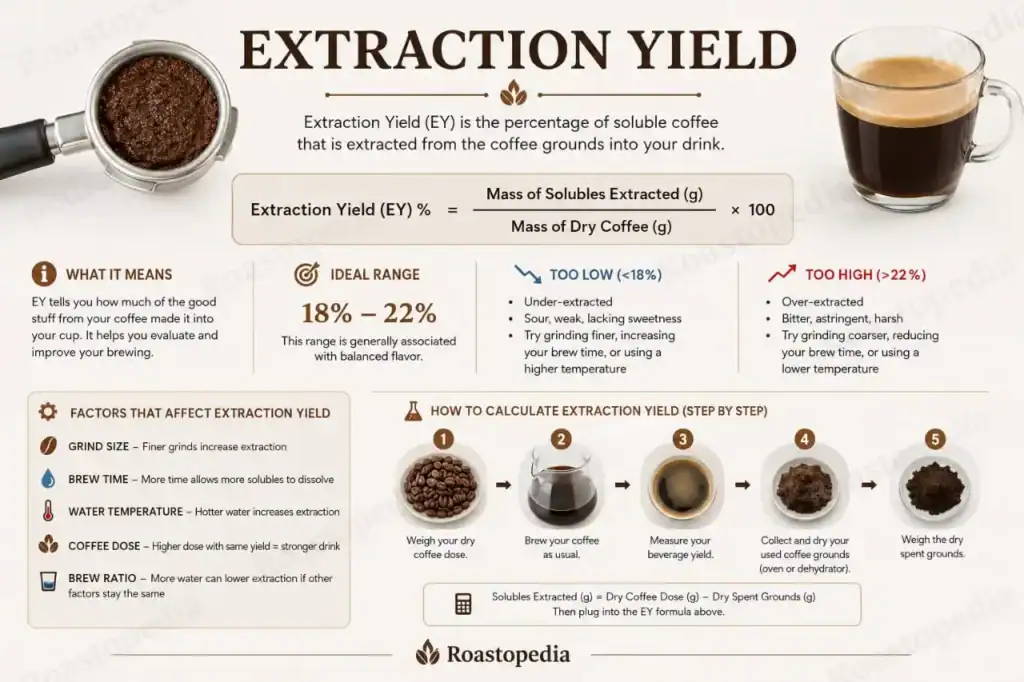
Extraction yield is the percentage of a coffee’s dry mass that has been dissolved and extracted into the brewed beverage. It is typically calculated using the beverage’s total dissolved solids (TDS), the final beverage weight, and the original mass of dry coffee used.
A coffee beverage with an extraction yield of 20 percent indicates that approximately one-fifth of the original coffee mass has been dissolved into the final drink, while the remaining material remains within the spent grounds.
Extraction yield should not be confused with beverage strength. Strength refers to the concentration of dissolved solids present in the beverage, whereas extraction yield measures the total amount of material removed from the coffee grounds. Two beverages may possess similar strengths yet differ significantly in extraction yield depending on brew ratio and extraction efficiency.
Historical Development
The scientific study of coffee extraction emerged during the early twentieth century as researchers sought to understand the relationship between brewing variables and beverage quality. One of the most influential figures in this field was Ernest Earl Lockhart, whose research established many of the foundational principles used in modern coffee brewing analysis.
Lockhart demonstrated that desirable coffee flavors are extracted at different rates and that brewing quality could be correlated with measurable extraction parameters. His work eventually led to the development of the Coffee Brewing Control Chart, which became a cornerstone of brewing science and remains influential within specialty coffee education.
The rise of specialty coffee in the late twentieth and early twenty-first centuries further increased interest in extraction yield. Advances in refractometry enabled baristas and researchers to measure dissolved solids quickly and accurately, making extraction yield a practical tool for routine quality control.
Principles of Extraction
Coffee is a chemically complex agricultural product containing thousands of compounds, many of which are soluble in water. During brewing, water acts as a solvent, dissolving substances from the roasted and ground coffee.
Extraction does not occur uniformly. Acids, aromatic compounds, and certain sugars generally dissolve more readily during the early stages of brewing. As extraction progresses, larger and less soluble compounds become increasingly prominent. If brewing continues beyond an optimal range, bitter compounds and astringent substances may begin to dominate the sensory profile.
Extraction yield therefore represents not merely the quantity of material extracted, but also the cumulative result of a dynamic chemical process. The percentage alone cannot fully describe cup quality, yet it serves as a valuable indicator of brewing performance when interpreted alongside sensory evaluation.
Measurement
Modern measurement of extraction yield typically relies on the determination of total dissolved solids. A sample of brewed coffee is analyzed using a refractometer, which estimates the concentration of dissolved substances in the beverage.
The extraction yield is then calculated using the following relationship:
Extraction Yield (%) = (Beverage Weight × TDS) ÷ Dry Coffee Weight
This calculation estimates the proportion of coffee mass transferred into the beverage.
For example, if 20 grams of coffee produces 300 grams of brewed coffee with a total dissolved solids value of 1.35 percent, the extraction yield would be approximately 20.25 percent. This indicates that just over one-fifth of the original coffee mass has been dissolved into the beverage.
Although refractometric measurements have become common within specialty coffee, extraction yield calculations may also be employed in academic research, equipment testing, and product development.
Optimal Extraction Ranges
The concept of an optimal extraction range has become central to modern brewing theory. While individual coffees and brewing styles vary considerably, an extraction yield between approximately 18 and 22 percent is frequently cited as a desirable range for many brewed coffee preparations.
Below this range, coffee is often described as under-extracted. Under-extraction occurs when insufficient soluble material is removed from the grounds, resulting in flavors that may appear sour, grassy, sharp, or lacking sweetness.
Above this range, coffee may be considered over-extracted. Excessive extraction can contribute bitterness, dryness, and astringency as less desirable compounds become increasingly prominent in the beverage.
These ranges should be regarded as guidelines rather than absolute rules. Some coffees may perform exceptionally well outside conventional extraction targets depending on roast level, processing method, brewing technique, and desired sensory outcomes.
Factors Affecting Extraction Yield
Extraction yield is influenced by numerous variables that determine how effectively water interacts with coffee grounds.
Grind size plays a particularly important role. Finer particles present greater surface area and typically increase extraction rates, while coarser particles tend to reduce extraction efficiency. Water temperature also exerts substantial influence, as higher temperatures generally enhance the dissolution of soluble compounds.
Contact time affects the duration during which extraction can occur. Extended brewing periods often increase extraction yield, whereas shorter contact times may reduce it. Brew ratio, agitation, turbulence, flow dynamics, and coffee freshness similarly contribute to extraction behavior.
The uniformity of particle size distribution can also influence extraction yield. Uneven grinding may produce a mixture of under-extracted larger particles and over-extracted fines, reducing overall brewing consistency despite acceptable average extraction values.
The Relationship Between Extraction Yield and Sensory Quality
Extraction yield is often associated with beverage quality because it provides insight into the balance of compounds present within a cup of coffee. However, extraction yield alone cannot determine whether a coffee tastes good.
Two coffees with identical extraction yields may exhibit dramatically different sensory characteristics due to differences in origin, roast profile, processing method, or brewing parameters. Likewise, beverages that fall outside traditional extraction ranges may still be highly enjoyable and expressive.
For this reason, extraction yield is best understood as a diagnostic tool rather than a direct measure of quality. It provides objective information that complements sensory analysis, allowing brewers to investigate and refine brewing processes with greater precision.
Is Extraction the Same as Extraction Yield?
Although the terms extraction and extraction yield are closely related, they refer to different concepts in coffee brewing.
Extraction is the process by which water dissolves and removes soluble compounds from roasted and ground coffee. It encompasses the entire chemical and physical interaction between water and coffee during brewing, including the dissolution of acids, sugars, aromatic compounds, lipids, and other substances that contribute to flavor, aroma, and body.
Extraction yield, on the other hand, is a measurement of the outcome of that process. Rather than describing what happens during brewing, it quantifies how much of the coffee’s original mass has been extracted into the beverage.
Expressed as a percentage, extraction yield provides an objective indication of extraction efficiency and is commonly used to evaluate brewing performance and consistency.
In simple terms, extraction is the action, while extraction yield is the measurement of that action. A coffee can undergo extraction regardless of whether its extraction yield is measured.
Likewise, two coffees may have similar extraction yields yet differ significantly in flavor due to variations in roast level, brewing method, water chemistry, or the specific compounds extracted.
For this reason, extraction and extraction yield should be viewed as complementary concepts rather than interchangeable terms.
Extraction vs. Extraction Yield
| Feature | Extraction | Extraction Yield |
| Definition | The process by which water dissolves soluble compounds from coffee grounds. | The percentage of coffee mass that has been dissolved into the brewed beverage. |
| Nature | A physical and chemical process. | A quantitative measurement. |
| Purpose | Produces the coffee beverage and its flavor characteristics. | Evaluates the efficiency and extent of extraction. |
| Expression | Described conceptually or scientifically. | Expressed as a percentage (%). |
| Measurement | Cannot be measured directly as a single value. | Calculated using beverage weight, TDS, and coffee dose. |
| Focus | What occurs during brewing. | How much material was extracted during brewing. |
| Relationship to Flavor | Determines which compounds enter the cup. | Indicates the overall extent of extraction but not flavor quality by itself. |
| Influencing Factors | Grind size, water temperature, brew time, agitation, pressure, and brew ratio. | Influenced by the same factors through their effect on extraction. |
| Example | Water extracting acids, sugars, and aromatic compounds from coffee grounds. | A brewed coffee measuring 20% extraction yield. |
| Role in Coffee Science | Fundamental brewing process. | Analytical tool used to assess brewing performance and consistency. |
Applications in Specialty Coffee
Extraction yield has become an essential concept in specialty coffee education, competition, and quality assurance. Baristas frequently use extraction measurements to evaluate recipe adjustments, compare brewing methods, and improve consistency.
Coffee researchers employ extraction yield to study the effects of grind size, water chemistry, roasting, and equipment design. Manufacturers may use extraction analysis during product development and machine calibration, while trainers incorporate extraction theory into educational programs.
The widespread adoption of extraction yield reflects a broader movement toward evidence-based brewing practices, where scientific measurement supports sensory judgment rather than replacing it.
Significance
Extraction yield occupies a central position within contemporary coffee science because it bridges chemistry, brewing technique, and sensory evaluation.
Quantifying the proportion of coffee dissolved into a beverage provides a common language through which researchers, roasters, baristas, and educators can discuss brewing performance.
Although it cannot fully explain the complexity of flavor perception, extraction yield remains one of the most useful analytical tools available for understanding coffee extraction and improving brewing consistency. Its continued importance reflects the growing integration of scientific methodology into the study and preparation of coffee.
See Also
- Brew Ratio
- Total Dissolved Solids (TDS)
- Extraction
- Over-Extraction
- Under-Extraction
- Channeling
- Pre-Infusion
- Blooming
- Coffee Strength
- Espresso Extraction
- Refractometer
- Water Chemistry
- Grind Size
- Contact Time
- Coffee Brewing Control Chart
- Solubility
References
- Lockhart, E. E. The Soluble Solids in Beverage Coffee as an Index to Cup Quality. Coffee Brewing Institute.
- Lockhart, E. E. Coffee Brewing Control Studies. Coffee Brewing Institute.
- Illy, Ernesto & Viani, Riccardo (Eds.). Espresso Coffee: The Science of Quality. Academic Press, 2005.
- Illy, Andrea & Viani, Riccardo (Eds.). Espresso Coffee: The Science of Quality. Academic Press, 2015.
- Clarke, R. J., and Macrae, R. (Eds.). Coffee: Volume 2 – Technology. Elsevier Applied Science, 1987.
- Clarke, R. J., and Vitzthum, Otto G. Coffee: Recent Developments. Blackwell Science, 2001.
- Petracco, Massimo. “Technology IV: Beverage Preparation—Brewing Trends for the New Millennium.” In Coffee: Recent Developments. Blackwell Science, 2001.
- Specialty Coffee Association. Coffee Skills Program: Brewing Professional Manual.
- Specialty Coffee Association. Barista Skills Professional Manual.
- Rao, Scott. The Professional Barista’s Handbook. Scott Rao Publishing, 2008.
- Rao, Scott. Coffee Roasting: Best Practices. Scott Rao Publishing, 2014.
- Gagné, Jonathan. The Physics of Filter Coffee. 2021.
- Lingle, Ted R. The Coffee Cupper’s Handbook. Specialty Coffee Association of America.
- Moroney, Kevin M., et al. “Modelling of Coffee Extraction During Brewing.” AIChE Journal.
- Navarini, Luciano, et al. Research publications on espresso extraction and beverage chemistry.
- Hendon, Christopher H. Water for Coffee: Science Story Manual.
- Davids, Kenneth. Espresso: Ultimate Coffee. St. Martin’s Griffin.
- International Organization for Standardization (ISO). Standards relating to coffee testing and analysis.
- International Coffee Organization (ICO). Technical publications on coffee quality and processing.
- Specialty Coffee Association of America. Coffee Brewing Handbook.