
Coffee Berry Disease (CBD) is a destructive fungal disease of coffee fruit caused by the pathogen Colletotrichum kahawae. Endemic almost entirely to Africa, it is among the most economically damaging diseases affecting Coffea arabica production, capable of destroying more than three-quarters of a crop in a single season when environmental conditions favor its spread.
Causal Agent and Taxonomy
CBD is caused by Colletotrichum kahawae Waller & Bridge, a filamentous fungus in the family Glomerellaceae, order Glomerellales, division Ascomycota. The species was formally described and separated from the closely related, largely saprophytic Colletotrichum gloeosporioides species complex in 1993, following genetic and pathogenicity studies that confirmed it as a distinct, highly aggressive pathogen specialized for attacking the coffee cherry (unripe coffee fruit).
Older literature sometimes refers to the organism as Colletotrichum coffeanum, a name still occasionally encountered but now considered synonymous with, or superseded by, C. kahawae. A sexual (teleomorph) stage, when observed, is placed in the genus Glomerella, though most reproduction in the field occurs asexually through conidia produced in acervuli.
Host Range and Susceptibility
Colletotrichum kahawae is highly host-specific: it attacks Coffea arabica almost exclusively. Coffea canephora (robusta) is essentially resistant and plays no meaningful role in disease cycles, which is one reason CBD has historically been described as an Arabica-only problem.
Within Arabica, susceptibility varies significantly by cultivar; older heirloom lines such as Typica and Bourbon, along with many commercial descendants including Catuai, show high vulnerability, while a handful of resistant selections — most notably Kenya’s Ruiru 11 and Batian Coffee hybrids, bred specifically with CBD tolerance genes — were developed in direct response to the disease.
Symptoms and Part of the Plant Affected
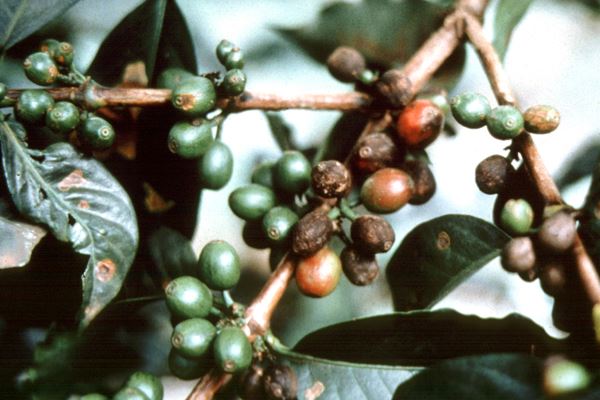
The disease is defined above all by its attack on the developing coffee fruit. Infection begins as small, water-soaked lesions on green, expanding cherries, which rapidly darken, sink inward, and enlarge until they envelop and rot the entire berry.
Under humid conditions, the lesions produce visible pink-salmon-colored spore masses (acervuli) on their surface — a diagnostic feature of active infection. Two principal symptom types are recognized: an “active” form, marked by rapidly expanding black lesions on immature green cherries, and a “scab” form, characterized by shallower, more restricted, corky lesions that develop when infection occurs later or under less favorable conditions for the fungus.
Infected berries frequently abscise and drop from the branch well before ripening, a hallmark of the disease that directly drives yield loss. Lesions can also appear on young berry stalks (peduncles), causing premature shedding even before symptoms are visible on the fruit itself, and, in unusually wet weather, on flower petals. The fungus does not typically kill the coffee tree itself; its damage is concentrated on the coffee flower and developing cherry rather than the leaves, wood, or root system.
Life Cycle and Spread
C. kahawae survives between cropping cycles on mummified berries, infected bark tissue, and plant debris, producing conidia that are dispersed locally by splashing rain rather than by wind. Infection requires free moisture on the fruit surface, and disease pressure is greatest at moderate-to-cool temperatures (roughly 15–24°C), which is why CBD is most severe at higher elevations within the Coffee Belt rather than in hot lowland growing zones.
The fungus can establish latent, symptomless infections in young green berries that only become active lesions as the fruit matures, complicating both detection and control timing. Longer-distance spread between farms and regions occurs largely through human activity — infected planting material, contaminated tools and pickers’ hands during Selective Picking, and, to a lesser extent, birds — rather than through natural aerial dispersal, which helps explain why the disease has remained geographically contained to Africa despite over a century of global coffee trade.
Historical Discovery: The Kenyan Origins
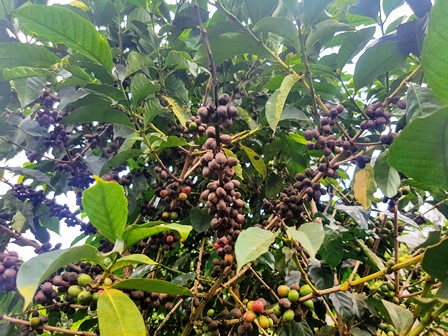
Unlike coffee leaf rust, which is popularly associated with the Ceylon epidemic of the 1860s–70s, Coffee Berry Disease has an entirely African history. It was first recorded near Kiambu and Thika in the highlands of Kenya in 1922, where it caused sudden, severe fruit drop in Arabica plantations that had no prior history of comparable losses.
For several decades, the disease was poorly characterized and often confused with other berry-rotting fungi, and it was not formally distinguished and named as Colletotrichum kahawae until researchers led by J.M. Waller undertook detailed taxonomic work in the early 1990s.
From its Kenyan epicenter, the disease spread progressively through the East African highlands over the following decades, reaching Tanzania, Uganda, Ethiopia, Rwanda, Burundi, Malawi, Zambia, and Zimbabwe by the mid-to-late twentieth century.
Absence from the Americas and Continued Quarantine Status
In contrast to coffee leaf rust — whose arrival in Brazil in 1970 became known among growers as “the Big Rust” and triggered decades of regional epidemics across Latin America — Coffee Berry Disease has never established itself outside Africa. Its westernmost confirmed foothold on the continent came when it was detected in Cameroon around 1955–1970, marking its spread beyond East Africa into West-Central Africa, but it has not crossed the Atlantic despite the immense volume of coffee trade between Africa and the Americas.
Major Arabica-producing nations including Brazil, Colombia, and the United States (notably Hawaii) classify C. kahawae as a serious quarantine pathogen, restricting the import of live coffee plant material, even coffee seedlings from CBD-affected regions, specifically to prevent its introduction.
Phytosanitary authorities regard its continued absence from the Americas and Asia as one of the more consequential quarantine successes in tropical agriculture, given how catastrophic an introduction into naïve, high-density Latin American Arabica plantings could be.
Geographic Distribution within the Coffee Belt
Today, CBD is entrenched across the East African highland producing zones — Kenya, Ethiopia, Tanzania, Uganda, Rwanda, Burundi — as well as parts of Central and Southern Africa, including Cameroon, Malawi, Zambia, Zimbabwe, and Angola. Within these countries, it is overwhelmingly a high-altitude disease, generally most destructive above roughly 1,000–1,600 meters, where cooler, wetter conditions favor spore germination and lesion development.
Lower-elevation and drier Arabica zones, and essentially all robusta-growing areas of the wider African Coffee Belt, see comparatively little impact. Ethiopia, as the center of origin for wild Coffea arabica, is notable both for hosting the disease and for harboring valuable natural genetic resistance among its wild and semi-forest coffee populations, a resource that has fed into resistance-breeding programs elsewhere on the continent.
Economic and Social Impact
CBD is regarded as one of the two most economically significant coffee diseases in Africa, alongside coffee leaf rust, and in severe outbreak years it can destroy 50–80% or more of the Arabica crop on unprotected farms. Because it targets the fruit directly, its losses translate immediately into lost export revenue and household income for the millions of smallholder farmers who dominate Arabica production across East Africa.
Chemical control has historically consumed a very large share of production costs — copper- and systemic-fungicide programs with products such as Cabrio® 250 EC can account for up to 30% of total input expenditure on affected farms — placing disproportionate financial strain on smallholders who often cannot afford to spray at the frequency required, which in turn perpetuates cycles of chronic loss.
The disease has also shaped national coffee economies and research priorities: Kenya, in particular, built a substantial public breeding and extension infrastructure around CBD and leaf rust management, reflecting the centrality of the disease to the country’s coffee sector, celebrated in local coffee culture from the farm to the cup of SL28 and SL34.
Control and Management
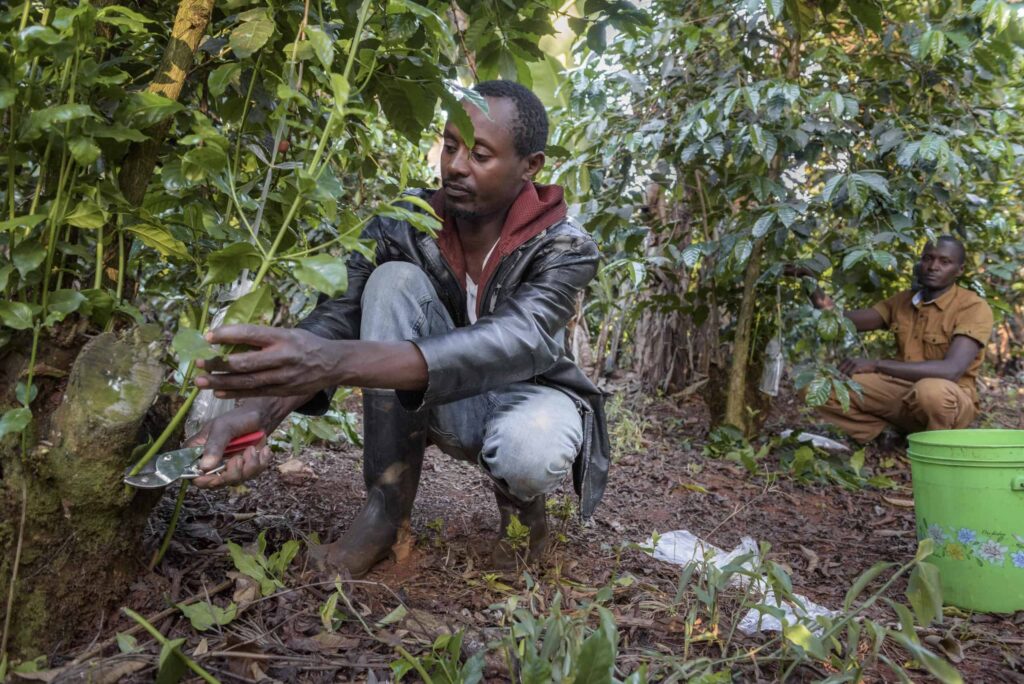
Management of CBD relies on an integrated approach that combines resistant cultivars, fungicide programs, and cultural practices. Breeding resistant varieties has been the most durable long-term strategy; Kenya’s Ruiru 11 and, more recently, Batian were developed specifically to combine CBD and leaf-rust resistance with acceptable yield and cup quality.
Where susceptible cultivars remain in production, timed copper-based or systemic fungicide sprays — applied to coincide with flowering and early berry expansion, the periods of greatest vulnerability — are the primary chemical defense. However, fungicide-resistant strains of the pathogen have been documented in parts of East Africa.
Cultural controls include pruning to improve airflow and reduce humidity within the canopy, removing and destroying mummified and diseased berries to reduce inoculum carryover, and careful sanitation of tools and hands during harvest to limit mechanical spread.
As with many production-limiting factors, disease management sits among the higher-leverage interventions available to growers, alongside pest control more broadly — a point echoed in general coffee-farming efficiency frameworks such as the industry’s 80/20 Rule approach to prioritizing high-impact agronomic practices.
Significance in Coffee History and Science
Coffee Berry Disease occupies an important place in the history of plant pathology and coffee agronomy. Its emergence in colonial-era Kenya prompted some of the earliest systematic coffee disease research on the continent, and the eventual taxonomic separation of C. kahawae from its close relatives in the 1990s remains a textbook example of how molecular and pathogenicity data can resolve a previously conflated species complex.
The disease has also served as a major driver of coffee breeding science: the search for durable CBD resistance, without sacrificing the cup-quality traits associated with heirloom-related cultivar lines, shaped decades of Arabica improvement work in East Africa and continues to inform how breeders think about balancing disease resistance with the flavor expectations of Estate Coffee buyers in the specialty market.
Its continued absence from the Americas and Asia, meanwhile, stands as an ongoing case study in agricultural quarantine effectiveness, one that shapes phytosanitary policy for coffee-growing nations worldwide.
See Also
- Coffee Wilt Disease (Fusarium xylarioides)
- Coffee Leaf Rust (Hemileia vastatrix)
- Brown Eye Spot / Cercospora Leaf Spot (Cercospora coffeicola)
- American Leaf Spot (Mycena citricolor)
- Coffee Ringspot Disease (Coffee ringspot virus)
- Bacterial Blight of Coffee (Pseudomonas syringae pv. garcae)
- Phoma Leaf Spot (Phoma costarricensis and related species)
- Root-Knot Nematode Disease (Meloidogyne spp.)
- Lesion Nematode Disease (Pratylenchus spp.)
- Bacterial Leaf Spot (Pseudomonas syringae pv. garcae)
References
- Waller, J.M., Bridge, P.D., Black, R., & Hakiza, G. (1993). Characterization of the coffee berry disease fungus, Colletotrichum kahawae sp. nov. Mycological Research, 97(8), 989–994.
- CABI Compendium. “Colletotrichum kahawae (coffee berry disease).” Invasive Species Compendium, CABI.
- Food and Agriculture Organization of the United Nations (FAO). “Coffee Berry Disease.” FAO Plant Production and Protection Division.
- World Coffee Research. “Coffee Berry Disease.” World Coffee Research Sourcebook.
- Encyclopaedia Britannica. “Coffee Berry Disease.” Britannica, Encyclopaedia Britannica, Inc.
- ScienceDirect Topics. “Coffee Berry Disease – An Overview.” Agricultural and Biological Sciences.
- Infonet Biovision. “Coffee Berry Disease.” Infonet Biovision Plant Health Portal.
- Van der Vossen, H.A.M., & Walyaro, D.J. (1980). Breeding for resistance to coffee berry disease in Coffea arabica L. Euphytica, 29(3), 777–791.
- Hindorf, H., & Omondi, C.O. (2011). A review of three major fungal diseases of Coffea arabica L. in the rainforests of Ethiopia and progress in breeding for resistance. Journal of Advanced Research, 2(2), 109–120.
- Silva, M.C., Várzea, V., Guerra-Guimarães, L., et al. (2006). Coffee resistance to the main diseases: leaf rust and coffee berry disease. Brazilian Journal of Plant Physiology, 18(1), 119–147.