
Coffee Wilt Disease (CWD), also known as tracheomycosis, is a vascular wilt disease caused by the fungal pathogen Fusarium xylarioides (teleomorph Gibberella xylarioides). It is regarded as one of the most destructive diseases in the history of African coffee production, capable of killing an infected Coffee Plant outright rather than merely reducing its yield.
Unlike Coffee Leaf Rust or Coffee Berry Disease, which primarily damage foliage or fruit, CWD attacks the vascular system of the tree itself, and its two great epidemic waves in the twentieth century reshaped coffee economies across the Coffee Belt of Central and East Africa.
Causal Agent and Taxonomy
Coffee Wilt Disease is caused by Fusarium xylarioides Steyaert, a soil- and plant-tissue-borne ascomycete fungus. Its sexual (teleomorph) stage is classified as Gibberella xylarioides. Molecular phylogenetic work has clarified a long-confused taxonomic history: isolates historically lumped together as F. xylarioides actually fall into genetically distinct groups, with the true causal agent of CWD belonging to the Gibberella fujikuroi species complex rather than to Fusarium section Lateritium, where it had traditionally been placed.
The fungus is heterothallic, and under favorable conditions it produces fertile perithecia (spore-bearing structures) directly on dead coffee wood, along with asexual conidia on infected leaf litter.
Genomic and population studies have further shown that CWD is not a single uniform pathogen but comprises host-specialized lineages: one population adapted to Arabica coffee (Coffea arabica), which grows at higher, cooler altitudes, and a separate, more aggressive population adapted to Robusta coffee (Coffea canephora, which grows at lower, warmer elevations. Temperature tolerance appears to be a key driver of this host-specific divergence, with the Arabica-associated lineage showing greater cold tolerance and the Robusta-associated lineage reaching higher peak disease severity in warmer conditions.
Host Range and Susceptibility
CWD affects multiple species within the genus Coffea. Confirmed hosts include Coffea arabica (Arabica coffee), Coffea canephora (Robusta coffee), Coffea liberica (Liberica coffee), and Coffea excelsa (Excelsa coffee), with the disease first documented on the latter.
Susceptibility differs markedly by cultivar and growing region: some Robusta lines and wild Arabica accessions display natural resistance, which has become the foundation of modern breeding programs. Because the pathogen’s host-specific populations track altitude and temperature rather than any single species, most Coffea species are considered potentially susceptible under the right environmental conditions, a fact that has fueled concern about the disease’s capacity to spread into coffee-growing regions where it has not yet been recorded.
Symptoms and Part of the Plant Affected
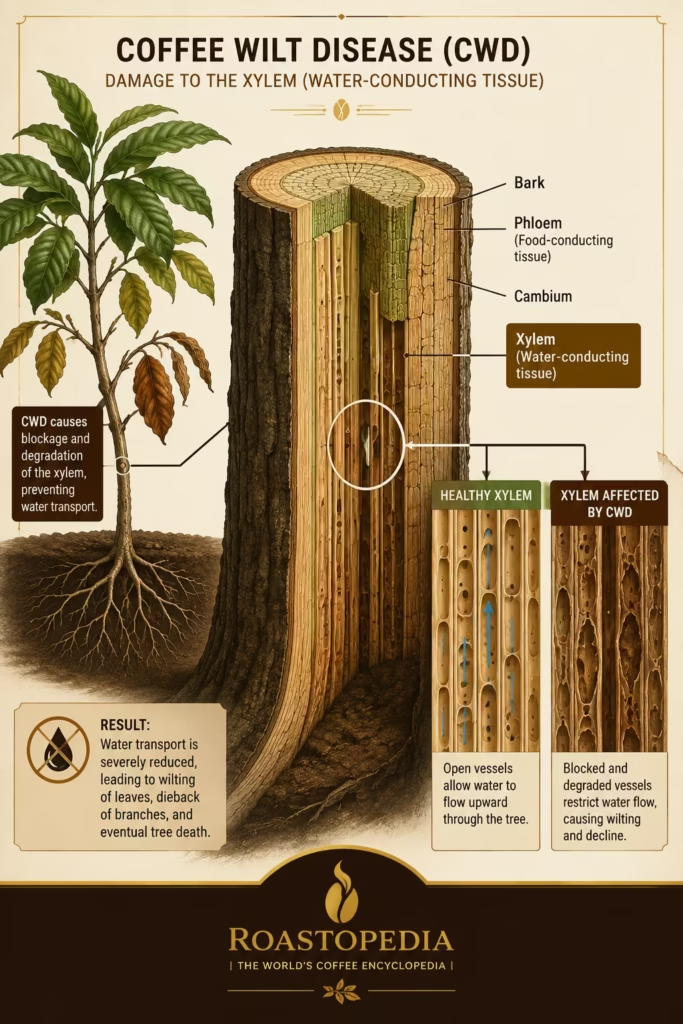
As a true vascular wilt, CWD principally damages the xylem, or water-conducting tissue, of the coffee tree. Characteristic symptoms include:
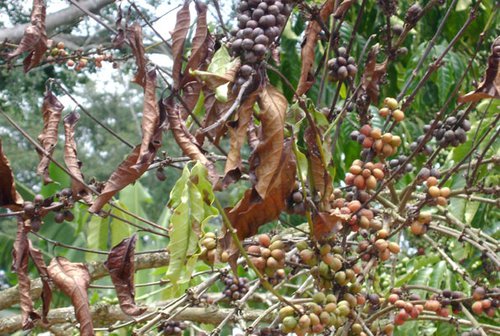
- Progressive wilting and yellowing of the Coffee Leaf, typically beginning on one side of the tree or one branch before spreading
- Premature defoliation
- Blue-black to brown discoloration (necrosis) of the wood beneath the bark, visible when stems are cut in cross-section
- Dieback of branches and, eventually, the entire tree
- Death of the plant, often within months of the first visible symptoms, with little prospect of recovery once the vascular system is colonized
Because the disease is systemic and irreversible once established, symptomatic trees are essentially unsalvageable, which has made rapid diagnosis and removal central to control strategy.
Life Cycle and Spread
Fusarium xylarioides is a soilborne and plant-debris-borne pathogen. It produces asexual conidia on dead leaves and other plant debris, and ascospores form in the bark of infected roots and stems. Under suitable moisture and temperature conditions, these spores germinate into mycelium, which infects healthy coffee trees primarily by entering through wounds in the roots or lower stem. Once inside, the fungus colonizes the vascular bundles, physically blocking water transport and triggering the wilting symptoms described above.
The disease is classified as largely monocyclic in its epidemiology, meaning it tends to produce one major disease cycle per season rather than repeated waves of secondary infection within a single growing period, though local spread between neighboring trees can still occur through root contact and contaminated soil, tools, and planting material.
Longer-distance spread has historically been linked to human activity: the movement of infected planting material, farm tools, and, notably, the illicit or unregulated cross-border trafficking of coffee during periods of regional conflict, which is believed to have helped carry the pathogen between countries in Central and East Africa.
Historical Discovery
CWD was first scientifically observed in 1927 in the region now known as the Central African Republic, appearing initially on Coffea excelsa. The disease then spread relatively slowly at first, but went on to cause two major epidemics across West and Central Africa between the 1930s and the 1960s.
Although the disease was recognized clinically from 1927, its precise causal agent was not conclusively identified and described until the late 1940s, through the work of researchers Heim and Saccas and the mycologist Steyaert, whose 1948 description formally established Fusarium xylarioides.
Coordinated control efforts during this first epidemic — combining the uprooting and burning of infected trees with early breeding for host resistance — were largely successful, and by the mid-twentieth century CWD appeared to have been substantially suppressed across the region.
Arrival in the Americas, Asia, Africa
Coffee Wilt Disease is, and has historically remained, confined to Africa. It has never been confirmed in the coffee-growing regions of the Americas or Asia, both of which host the majority of global Green Coffee production today. Its African range began in Central Africa in the 1920s and subsequently extended into West Africa during the first epidemic wave.
A second, more damaging wave began when the disease re-emerged on abandoned farms in the Democratic Republic of the Congo by the mid-1970s, reaching epidemic levels on Robusta coffee there by the 1980s. From the DRC it advanced into Uganda by the early 1990s, becoming endemic in that country by the mid-to-late 1990s, and was subsequently reported in northern Tanzania. A separate, apparently independent outbreak affecting Arabica coffee emerged in Ethiopia, the center of origin of Coffea arabica and a region closely tied to the crop’s earliest cultivation history.
Despite the severity of these outbreaks, the disease’s absence from the Americas and Asia remains a significant point of concern for biosecurity authorities in those regions, given that susceptible host material and suitable climates exist in many production zones outside Africa.
Geographic Distribution within the Coffee Belt
Within the Coffee Belt, CWD’s distribution has been shaped by the ecological divide between high-altitude Arabica zones and lower-altitude Robusta zones. The Robusta-associated population of the pathogen has caused the most severe damage in the Democratic Republic of the Congo, Uganda, and Tanzania, all major Robusta-producing countries where the crop is grown at relatively low elevation and warmer temperatures.
The Arabica-associated population, by contrast, has been largely confined to Ethiopia, where surveys have found the disease affecting only Arabica coffee, in contrast to the exclusively Robusta infections recorded in Uganda and Tanzania. Malawi has also experienced serious CWD outbreaks, compounding difficulties for smallholder growers already contending with the country’s broader agricultural challenges.
Countries such as Kenya, which suppressed the disease relatively early through genetic resistance and sanitation, illustrate how control history — as much as climate — has shaped the present-day map of CWD incidence across the continent.
Economic and Social Impact
The economic toll of Coffee Wilt Disease has been severe and, in places, close to catastrophic. In Uganda, the disease first struck Robusta coffee in 1993 and destroyed well over 12 million coffee plants in subsequent years, with some estimates citing losses exceeding $500 million between the 1990s and 2010s and roughly half of the country’s Robusta crop destroyed at the epidemic’s peak; industry accounts describe roughly half of Uganda’s smallholder coffee farms as badly affected, and Uganda’s coffee export volumes did not return to their pre-epidemic 1995 levels until 2020.
In the Democratic Republic of the Congo, CWD came close to eliminating commercial coffee production by the late 1990s. Tanzania recorded direct financial losses in the hundreds of thousands of dollars alongside further sums spent on eradication efforts. Across the African continent as a whole, cumulative losses attributable to CWD over the past century have been estimated at roughly $1 billion.
Because coffee functions as a primary cash crop and source of foreign exchange for many of the affected countries, and because production is dominated by smallholder farmers who depend on their trees for household income, the social consequences of CWD outbreaks have extended well beyond farm-gate losses.
Affected households have seen sharp drops in seasonal earnings, and many farmers, facing the total loss of long-lived Coffee Plant stock with no prospect of recovery, uprooted their remaining coffee entirely in favor of alternative crops such as tea, cacao, or bananas — a shift that, in some regions, permanently altered local agricultural livelihoods and reduced national coffee export capacity for a generation.
Control and Management
There is no effective chemical cure for Coffee Wilt Disease once a tree is systemically infected, and the soilborne, debris-persisting nature of Fusarium xylarioides makes chemical control of the pathogen in the field impractical. Management has therefore relied on a combination of preventive and structural strategies:
- Sanitation (roguing): prompt uprooting and burning of infected trees to remove sources of inoculum, rather than composting or leaving debris in the field
- Quarantine and hygiene: disinfecting tools and restricting movement of planting material between farms and regions to limit mechanical and human-assisted spread
- Host resistance and breeding: identifying naturally resistant wild and cultivated coffee genotypes and incorporating this resistance into commercial cultivars through structured breeding programs, which proved highly effective in curbing the first mid-century epidemic
- Field replanting practices: research on disease spread within commercial estates has shown that roguing alone is less effective in older plantings than in younger ones, prompting refined replanting and monitoring strategies
- Biological control: more recent research has explored antagonistic Trichoderma species as biofungicides, with formulations tested in greenhouse and field trials in Ethiopia showing promise against F. xylarioides, though such biocontrol tools are not yet widely deployed as a standard commercial solution
- Coordinated regional programs: initiatives such as the Regional Coffee Wilt Programme brought together researchers and national agricultural authorities across East and Central Africa to study the pathogen’s ecology and disseminate resistant planting material and management guidance to farmers
Because affected fields can retain infective fungal material in the soil for extended periods, some management guidance recommends leaving badly affected land fallow or rotating to other crops for a period before replanting coffee.
Significance in Coffee History and Science
Coffee Wilt Disease occupies a distinctive place in the history of coffee science. Its first epidemic, followed by decades of apparent decline and its dramatic re-emergence in the 1990s, made it a textbook example of how a plant pathogen can appear controlled for generations before resurging under changed agronomic, economic, or political conditions — in this case compounded by civil conflict in the Democratic Republic of the Congo, which disrupted normal agricultural and trade patterns and is believed to have facilitated the pathogen’s spread into Uganda.
Scientifically, CWD has been an important case study in fungal taxonomy and host specialization: genomic research resolving its confused classification within the Gibberella fujikuroi species complex, and subsequent work identifying temperature-driven divergence between Arabica- and Robusta-adapted lineages, has contributed broader insight into how plant pathogens split into host-specific populations.
Despite its historical destructiveness — comparable in scale to the impact of Coffee Leaf Rust and Coffee Berry Disease on African coffee economies — CWD has attracted comparatively little sustained research investment relative to those better-known diseases, leading some plant pathologists to describe it as coffee’s “forgotten” threat, one whose historical lessons remain directly relevant to ongoing efforts to protect the world’s coffee supply, including production regions within the Coffee Belt that have not yet encountered the disease.
See Also
- Brown Eye Spot / Cercospora Leaf Spot (Cercospora coffeicola)
- Coffee Berry Disease (Colletotrichum kahawae)
- American Leaf Spot (Mycena citricolor)
- Coffee Ringspot Disease (Coffee ringspot virus)
- Bacterial Blight of Coffee (Pseudomonas syringae pv. garcae)
- Phoma Leaf Spot (Phoma costarricensis and related species)
- Root-Knot Nematode Disease (Meloidogyne spp.)
- Lesion Nematode Disease (Pratylenchus spp.)
- Coffee Leaf Rust (Hemileia vastatrix)
References
- Peck, L.D., Nowell, R.W., Flood, J., Ryan, M.J., & Barraclough, T.G. (2021). Historical genomics reveals the evolutionary mechanisms behind multiple outbreaks of the host-specific coffee wilt pathogen Fusarium xylarioides. BMC Genomics.
- Peck, L.D., et al. (2024). Coffee wilt disease: The forgotten threat to coffee. Plant Pathology, Wiley Online Library.
- Geiser, D.M., et al. Gibberella xylarioides (anamorph: Fusarium xylarioides), a causative agent of coffee wilt disease in Africa, is a previously unrecognized member of the Gibberella fujikuroi species complex. PubMed, National Library of Medicine.
- CABI (Centre for Agriculture and Bioscience International). Fusarium xylarioides (coffee wilt). CABI Compendium.
- Flood, J. (2009). Coffee Wilt Disease. Wallingford, UK: CAB International.
- Kasahen, A. (2019). Integrated Disease Management on Coffee Wilt Disease Caused by Fusarium Xylarioides and its Distribution in Ethiopia: A Review. Agricultural Research & Technology: Open Access Journal.
- Temperature contributes to host specialization of coffee wilt disease (Fusarium xylarioides) on arabica and robusta coffee crops. Scientific Reports, Nature Publishing Group.
- Fresh Cup Magazine. Lessons From Coffee’s Forgotten Foe.
- Wikipedia contributors. Coffee wilt disease. Wikipedia, The Free Encyclopedia.