
American Leaf Spot, also known as ojo de gallo (“rooster’s eye” or “chicken’s eye”) for the ringed, eye-like lesions it leaves behind, is a fungal disease of Coffea arabica and other coffee plant species caused by the basidiomycete fungus Mycena citricolor. Unlike most major coffee pathogens, which are classic rusts or blights, American Leaf Spot is caused by a bioluminescent mushroom-forming fungus, making it one of the more taxonomically unusual diseases affecting the world’s coffee belt. It is a disease of humid, high-altitude, shade-grown coffee zones and remains one of the most economically damaging leaf diseases in Central America and parts of South America.
Causal Agent and Taxonomy
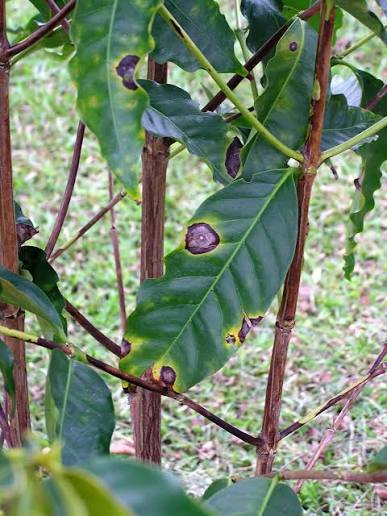
American Leaf Spot is caused by Mycena citricolor (Berk. & M.A. Curtis) Sacc., a member of the family Mycenaceae within the order Agaricales (division Basidiomycota). It was originally described under the synonym Omphalia flavida Maubl. & Rangel, and older phytopathological literature frequently refers to the pathogen by that name.
The fungus is unusual among coffee pathogens because it is a true, gilled, mushroom-forming basidiomycete rather than a rust, ascomycete, or bacterium — its close relatives are common litter-decomposing “bonnet” mushrooms of the genus Mycena, several of which are bioluminescent, a trait M. citricolor itself displays under certain conditions.
The disease’s causing fungus reproduces both sexually, via small yellow-orange mushroom fruiting bodies (basidiocarps) that form directly on infected leaf lesions, and asexually, via distinctive stalked, gemma-like propagules (“citriform bodies”) that detach and are splashed or thrown short distances to initiate new infections. This dual reproductive strategy — a self-dispersing asexual propagule combined with basidiospore production — is part of what makes the pathogen so persistent in wet, shaded plantations.
Host Range and Susceptibility
Mycena citricolor primarily infects Coffea arabica, which is highly susceptible, particularly at higher elevations. Coffea canephora (Robusta) is comparatively more tolerant, though not immune, and Coffea liberica (Liberica) shows variable susceptibility depending on local strains of the fungus.
Beyond coffee, the pathogen has a notably broad host range for a coffee disease, attacking dozens of other cultivated and wild plant species, including citrus, avocado, various ornamentals, and numerous weeds and forest trees that often serve as alternate reservoirs at plantation margins. This broad host range complicates eradication, since the fungus can persist on non-coffee vegetation surrounding a farm even after coffee-specific control measures are applied.
Susceptibility within Coffea arabica varies by cultivar; traditional tall varieties grown under heavy shade, such as older plantings of Typica, tend to show greater exposure to infection due to the humid microclimate shade creates, while more open, sun-exposed plantings generally experience lower disease pressure — though at the cost of other agronomic tradeoffs.
Symptoms and Part of the Plant Affected
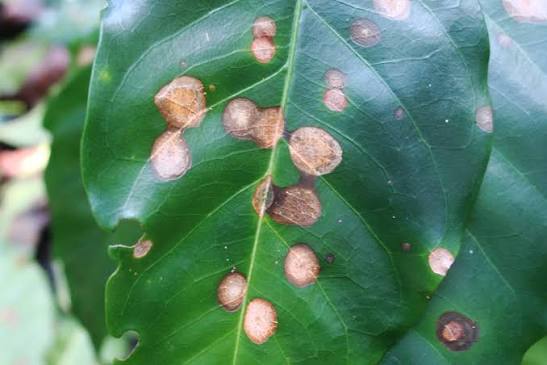
The disease’s common name, “American Leaf Spot,” and its Spanish name, ojo de gallo, both describe its most recognizable symptom: circular, tan-to-white necrotic spots on the leaf, typically 3–15 mm in diameter, often ringed by a distinct darker or purplish-brown margin, giving the lesion an eye-like appearance.
As the disease progresses, small orange-yellow mushroom fruiting bodies of the fungus may be visible on the underside of the lesion in humid conditions — a diagnostic feature that distinguishes it from other coffee leaf spots.
Leaves are the primary site of infection, but under high disease pressure the fungus can also attack young stems, green branches, flower buds, and even the coffee cherries themselves, causing lesions that lead to fruit drop. Severe infections cause extensive defoliation; because the lesions preferentially affect the youngest, most photosynthetically active leaves, heavily infected plants can suffer dramatic yield loss even when overall canopy cover looks intact from a distance.
Life Cycle and Spread
Mycena citricolor thrives under cool, wet, shaded conditions with high relative humidity and moderate temperatures (roughly 15–24°C), which is why it is most severe at mid-to-high elevations (900–2,000 m) under dense shade cover — precisely the microclimate favored for high-quality Arabica production. Infection begins when a citriform propagule or basidiospore lands on wet leaf tissue and germinates, penetrating the leaf surface directly.
Within days to weeks, a lesion forms, and the fungus produces new citriform bodies on stalks that project from the lesion surface. These structures are mechanically ejected or dislodged by raindrops and splash a short distance to adjacent leaves, giving the disease a characteristic “spreading ring” pattern that expands outward from an initial infection focus within a plantation.
Basidiospores produced by the small mushroom fruiting bodies can also be windborne over longer distances, contributing to broader dispersal, though the splash-dispersed asexual propagules are considered the dominant means of local, rapid spread during rainy seasons. Extended wet periods, heavy shade, and poor air circulation all favor epidemic development, and outbreaks tend to intensify during consecutive rainy years.
Historical Discovery
American Leaf Spot was first formally described in the 19th century from specimens collected in the Americas. The fungus was originally named Agaricus citricolor by Miles Joseph Berkeley and Moses Ashley Curtis in the mid-1800s, based on collections made in Cuba, and was later transferred to the genus Mycena.
It was independently described in coffee-growing contexts under the name Omphalia flavida by Maublanc and Rangel in the early 20th century, based on material from coffee plantations, before the two names were recognized as referring to the same organism — a taxonomic history that still causes confusion in older agricultural literature.
Arrival in the Americas, Asia, Africa
Because Mycena citricolor is native to tropical America, it is generally regarded as an indigenous New World pathogen rather than an introduced one — unlike Coffee Leaf Rust (Hemileia vastatrix), which spread to the Americas from an Old World origin. The fungus is believed to have existed in Central and South American forest ecosystems, associated with wild and cultivated plants, well before coffee cultivation was established in the region, later adapting to Coffea arabica as coffee plantations expanded through Mesoamerica and the northern Andes in the 18th and 19th centuries.
American Leaf Spot has historically remained largely confined to the Western Hemisphere; unlike coffee leaf rust or Coffee Wilt Disease (Fusarium xylarioides), it has not become established as a major problem in the coffee-growing regions of Africa or Asia, likely reflecting both its regional origin and the more specific humid highland conditions it requires.
Geographic Distribution within the Coffee Belt
Within the Coffee Belt, American Leaf Spot is concentrated in the humid mountain coffee zones of Mesoamerica and northern South America. It is historically most damaging in Costa Rica, Guatemala, Honduras, El Salvador, Nicaragua, Panama, southern Mexico, Colombia, and parts of Venezuela and Ecuador — regions where high-altitude, shaded Arabica cultivation coincides with consistently wet, cool weather.
Costa Rica in particular has a long documented history of severe outbreaks, and much of the foundational research on the disease’s biology and control was carried out there. It is generally less prevalent in lower-elevation, drier, or more sun-exposed coffee zones, and, as noted above, is largely absent from African and Asian coffee-growing regions.
Economic and Social Impact
American Leaf Spot has historically caused significant yield losses in affected regions, at times reducing harvests by a substantial margin during severe outbreak years, comparable in severity to major epidemics of other coffee diseases when conditions are favorable to the fungus.
Because it thrives specifically in the shaded, high-altitude conditions associated with traditional, often smallholder-run coffee farms, its impact falls disproportionately on small producers who rely on shade systems for both agronomic and ecological reasons, including biodiversity conservation and reduced input costs.
Repeated defoliation weakens trees over successive seasons, reducing both current-year yield and the following year’s flowering and fruit set, compounding losses over time. Control costs, primarily fungicide applications and shade-management labor, also represent a recurring economic burden for producers in endemic zones, and disease pressure has been a factor in some historical shifts away from traditional heavy-shade cultivation toward more open, sun-tolerant systems. This shift carries its own environmental trade-offs.
Control and Management
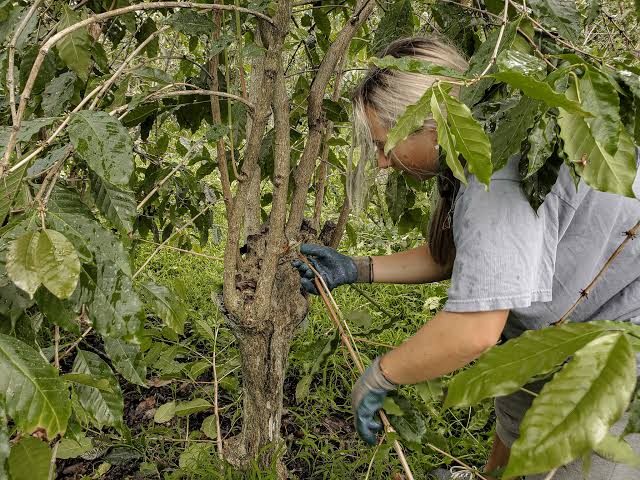
Management of American Leaf Spot centers on reducing the humid, shaded microclimate the fungus depends on, combined with targeted fungicide use. Common cultural practices include selective pruning of shade trees and coffee canopy to improve air circulation and light penetration, wider plant spacing, and removal of heavily infected leaf litter and fallen material that can harbor propagules and fruiting bodies.
Copper-based fungicides and other protectant sprays are widely used in commercial production, typically timed to coincide with the onset of the rainy season when infection risk rises sharply. Because the fungus has such a broad host range, managing alternate hosts and weeds at plantation margins is also recommended as part of an integrated approach.
Breeding and selection for tolerant planting material, along with adjustments to shade density suited to local rainfall patterns, form the longer-term components of disease management alongside these more immediate cultural and chemical measures.
Significance in Coffee History and Science
American Leaf Spot holds a distinctive place in plant pathology as one of the few major crop diseases caused by a basidiomycete mushroom rather than a rust, blight, or wilt fungus, and its bioluminescent relatives have made Mycena citricolor a subject of interest beyond agronomy, in the study of fungal bioluminescence more broadly.
Agronomically, the disease has played an important role in debates over shade management in coffee cultivation: because ojo de gallo thrives specifically under the dense shade that many growers value for quality, biodiversity, and sustainability reasons, it has been one of several diseases (alongside Coffee Leaf Rust) cited in arguments for and against shifting Central American coffee production toward more open, sun-grown systems.
Decades of applied research, particularly in Costa Rica, have made the pathogen’s biology and epidemiology comparatively well understood relative to many other regional coffee diseases, and this body of work continues to inform integrated pest and disease management strategies across the humid highland zones of the coffee belt.
See Also
- Coffee Wilt Disease (Fusarium xylarioides)
- Coffee Berry Disease (Colletotrichum kahawae)
- Coffee Leaf Rust (Hemileia vastatrix)
- Brown Eye Spot (Cercospora coffeicola)
References
- Avelino, J., et al. “Effects of Slope Exposure, Altitude and Yield on Coffee Quality in Two Altitude Terroirs of Costa Rica, Orosi and Santa María de Dota.” Journal of the Science of Food and Agriculture.
- Rojas, C., & Chaves, G. “American Leaf Spot of Coffee, Caused by Mycena citricolor: A Review.” Centro Agronómico Tropical de Investigación y Enseñanza (CATIE).
- Waller, J.M., Bigger, M., & Hillocks, R.J. Coffee Pests, Diseases and Their Management. CABI Publishing.
- Kellerman, C.G., & Chaves, G. “Mycena citricolor.” Invasive Species Compendium, CABI International.
- Wellman, F.L. Coffee: Botany, Cultivation, and Utilization. Leonard Hill Books.
- Hindorf, H. “Occurrence and Distribution of Fungi on Coffea arabica in Costa Rica.” Journal of Plant Diseases and Protection.
- Muller, R.A. “Coffee Diseases in Central America.” PANS Pest Articles & News Summaries.
- Schroth, G., et al. “Shade Trees and the Pest and Disease Ecology of Coffee.” Perspectives in Plant Ecology, Evolution and Systematics.