
Heirloom Coffee is a collective term for the thousands of indigenous Coffea arabica varieties native to Ethiopia. Rather than referring to a single, genetically defined cultivar, it encompasses a vast population of undocumented or only partially documented coffee varieties that have evolved, cross-pollinated, and been cultivated in Ethiopia’s highland forests over centuries. The country is widely recognized as the center of origin of Arabica coffee, and its Heirloom populations contain the greatest genetic diversity known within the species. The term is closely associated with Ethiopian landrace coffee, and although the two are often used interchangeably, some sources distinguish them by using landrace for locally adapted traditional populations and heirloom for those maintained and selected by farmers over successive generations.
Infobox (At a Glance)
| Attribute | Detail |
| Common name | Heirloom Coffee |
| Other names | Ethiopian Heirloom |
| Species | Coffea arabica |
| Origin | Ethiopia (southwestern highlands) |
| Estimated number of varieties | 6,000–15,000 (largely unclassified) |
| Notable regions | Sidamo, Yirgacheffe, Harrar, Jimma, Limu, Guji |
| Typical growing altitude | 1,300–2,200 metres above sea level |
| Notable sub-selections | 74110, 74112, Wolisho, Dega, Kurume |
| Primary threats | Coffee berry disease, coffee leaf rust, coffee wilt disease |
| Country rank in global production (2024/25) | 5th largest producer worldwide |
Etymology
The word “heirloom” derives from Middle English heir and loom (meaning “tool” or “possession”), and in general English usage refers to a valuable object passed down through a family across generations. In the coffee trade, the term was adopted as a catch-all label by exporters and buyers to describe Ethiopian Arabica coffee whose specific varietal identity could not be readily determined, since a single lot could contain dozens of genetically distinct but visually similar plants.
The related term “Landrace” is drawn from agricultural science, where it denotes a domesticated, locally adapted plant population that has developed through natural selection and traditional farming practices rather than formal breeding programs.
History
Ethiopia is widely recognized as the birthplace of Arabica coffee, where the species originated as a wild understory shrub in the moist Afromontane forests of the southwest. For most of Ethiopia’s coffee-growing history, farmers reproduced their crops by selecting seeds locally, without any coordinated national breeding effort. This changed after a severe outbreak of coffee berry disease struck the country in the 1960s, prompting the Ethiopian government to establish the Jimma Agricultural Research Center (JARC) to catalog native coffee trees and identify those with resistance to disease, drought tolerance, and strong yields.
Two of the earliest disease-resistant selections released from this program, known as 74110 and 74112, were identified from wild plants in the Metu district of the Illubabor zone and cataloged in 1974, from which they take their names. Since the 1970s, JARC and related research bodies have released dozens of additional numbered selections, alongside continued recognition of regional landraces such as Wolisho, Dega, and Kurume, which are named after the localities or characteristics associated with them.
Despite these formal breeding efforts, the great majority of Ethiopian coffee grown today, particularly coffee produced by smallholders and in forest or semi-forest systems, remains genetically undocumented and continues to be marketed under the general “Heirloom” designation.
Heirloom Coffee Characteristics
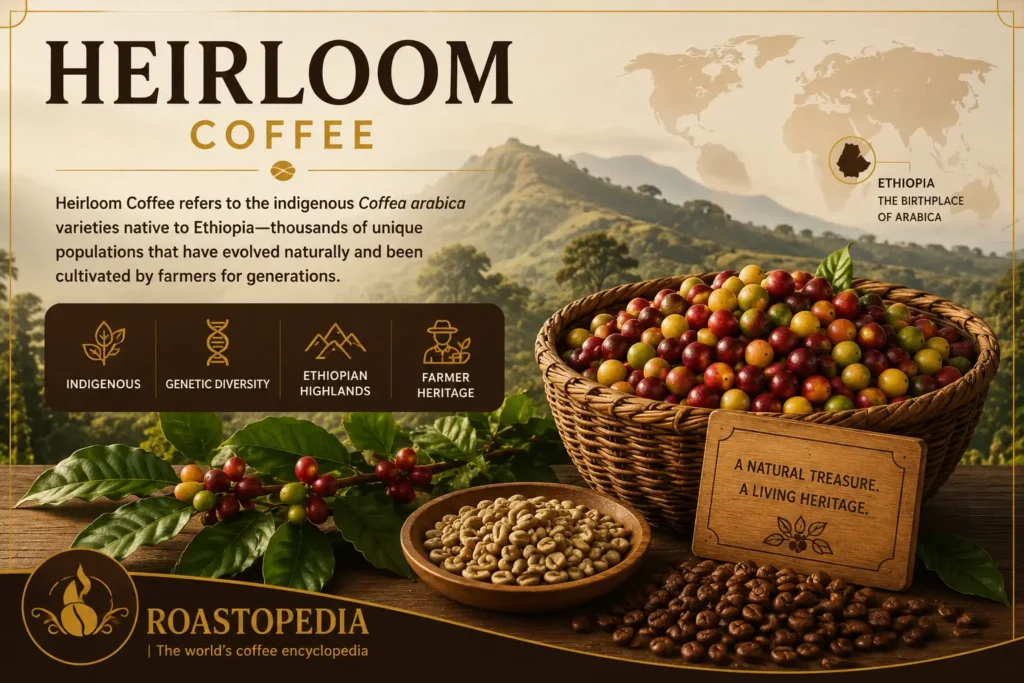
Because Heirloom Coffee encompasses thousands of distinct genotypes rather than one uniform plant, its physical characteristics vary considerably by region and sub-variety. Tree size, leaf shape, cherry size, and yield consistency differ from one landrace to another; for example, the Wolisho landrace is known for producing large cherries with long leaves but inconsistent annual yields, while JARC selections such as 74110 tend to be shorter, more compact plants bred for manageability and stable output.
In the cup, Heirloom Coffee is generally associated with pronounced floral, fruity, and sometimes wine-like or tea-like flavor notes, along with bright acidity. This flavor profile is attributed both to the underlying genetic diversity of the plant material and to the growing conditions found across Ethiopia’s highland regions. Because so few of these varieties have undergone comprehensive genetic testing, cupping characteristics and physical traits remain the primary means by which producers, exporters, and roasters differentiate one Heirloom lot from another.
Growing Conditions
Heirloom Coffee is cultivated predominantly in the highlands of southern and southwestern Ethiopia, in regions such as Sidamo, Yirgacheffe, Harrar, Jimma, and Guji. Most production occurs at altitudes between roughly 1,300 and 2,200 metres above sea level, with certain specialty lots, including some from Yirgacheffe and Sidama, grown at altitudes as high as 2,200 metres. Higher elevations are associated with slower cherry maturation, denser beans, and heightened acidity.
Annual rainfall in Ethiopia’s coffee-growing zones typically ranges from 1,500 to 2,500 millimetres, and ideal growing temperatures fall between 15°C and 25°C. Arabica coffee in this environment requires fertile, friable, loamy soils with good water-holding capacity and a mildly acidic pH of approximately 5 to 6.8; Ethiopia’s volcanic-influenced highland soils are considered well suited to these requirements.
A large proportion of Ethiopian Heirloom coffee is grown under natural forest canopy or in semi-forest systems, using shade trees such as Albizia gummifera, Acacia abyssinica, and Cordia africana. This shade-grown approach, sometimes farmed with minimal management directly within existing forest stands, distinguishes much of Ethiopia’s production from the more intensively managed, higher-density plantations found in other origins.
Diseases
Coffee berry disease, caused by the fungus Colletotrichum kahawae, was the catalyst for Ethiopia’s formal coffee breeding program after a major outbreak devastated crops in the 1960s, and it remains a persistent threat to susceptible Heirloom populations. Coffee leaf rust, caused by Hemileia vastatrix, and coffee wilt disease, caused by Gibberella xylarioides (also referred to by its anamorph, Fusarium xylarioides), are two other major constraints on production, particularly in southwestern Ethiopia.
As of recent research, Ethiopia has not released a commercially available variety with confirmed resistance to both coffee leaf rust and wilt disease, meaning that management continues to rely on cultural practices such as uprooting and burning infected trees, sanitizing tools, delaying replanting in affected plots, and using mulch or cover crops.
Because Heirloom varieties are genetically diverse and largely unclassified, susceptibility to these diseases differs significantly from one landrace or selection to another, which is part of the rationale behind JARC’s ongoing efforts to identify and disseminate resistant selections such as 74110 and 74112.
Heirloom Coffee Global Production
Ethiopia is the largest coffee producer in Africa and consistently ranks the fifth-largest coffee-producing country in the world, with virtually all of its output classified as Arabica. According to United States Department of Agriculture (USDA) estimates, Ethiopian coffee production for the 2025/26 marketing year was forecast to reach approximately 11.6 million 60-kilogram bags, equivalent to roughly 694,000 metric tons, an increase driven by favorable weather, tree rejuvenation programs, and wider use of improved seedlings.
Coffee exports for the same period were projected to rise to about 7.8 million bags. Coffee farming employs more than 15 million people in Ethiopia and typically accounts for roughly a quarter to a third of the country’s total export earnings. Because most Ethiopian coffee is produced by smallholder farmers who do not track individual varietal identity, the large majority of this national output, including coffee from major exporting regions such as Sidama, Yirgacheffe, and Harrar, continues to be sold internationally under the general “Heirloom” label rather than by named cultivar.
Comparison with Similar Cultivars
Heirloom Coffee differs fundamentally from single, named cultivars such as Typica, Bourbon, Caturra, SL28, SL34, and Catuai, each of which traces back to a documented parent plant or a specific breeding program and displays consistent, identifiable traits from farm to farm. Typica and Bourbon, for instance, are both believed to descend from Ethiopian coffee stock that was transported out of the country centuries ago, later becoming the genetic foundation for most of the world’s cultivated Arabica varieties outside Ethiopia.
Modern cultivars such as Geisha (Gesha) Coffee, now closely associated with Panama, were themselves originally collected as an Ethiopian landrace before being formally identified, named, and propagated abroad, illustrating how “Heirloom” material can, over time, be isolated and reclassified as a distinct cultivar once its identity is established.
This distinction matters commercially: named cultivars allow producers and buyers to predict cup characteristics and manage disease resistance with more precision, whereas Heirloom lots are valued in the specialty coffee market largely for their unpredictability and complexity, since a single-origin lot may contain a blend of dozens of genetically distinct plants.
See Also
- Coffee plant
- Mundo Nova Coffee
- Bourbon
- Typica
- Catuai
- Caturra
- Geisha Coffee
- Estate Coffee
- Green Coffee
References
- Ally Coffee. “Ethiopian Coffee Varieties.” https://medium.com/ally-coffee/ethiopian-coffee-varieties-2e3a2703330d
- Perfect Daily Grind. “Exploring Ethiopian Heirloom Coffee Varieties.” https://perfectdailygrind.com/2020/10/exploring-ethiopian-heirloom-coffee-varieties-nardos-coffee-export/
- Sprudge. “What Is Heirloom Coffee?” https://sprudge.com/what-is-heirloom-coffee-190755.html
- Sample Coffee. “Ethiopian Heirloom Variety.” https://samplecoffee.com.au/coffee/varietals/ethiopian-heirloom
- Green Plantation. “Ethiopian Coffee Tree Varieties: JARC vs. Heirloom.” https://www.greenplantation.com/a/ethiopian-coffee-tree-varieties-jarc-vs-heirloom
- gssrr.org. “Progress in Arabica Coffee Breeding in Ethiopia.” https://www.gssrr.org/index.php/JournalOfBasicAndApplied/article/download/7324/3447/
- PMC (National Institutes of Health). “Influence of Location, Elevation Gradients, Processing Methods, and Soil Quality on the Physical and Cup Quality of Coffee in the Kafa Biosphere Reserve of SW Ethiopia.” https://pmc.ncbi.nlm.nih.gov/articles/PMC8379458/
- International Journal of Research Studies in Agricultural Sciences. “Arabica Coffee Growing Conditions in Ethiopia.” https://arcjournals.org/pdfs/ijrsas/v8-i3/1.pdf
- PMC (National Institutes of Health). “Evaluating Lowland Coffee Genotypes Against Leaf Rust and Wilt Diseases in Southwestern Ethiopia.” https://www.ncbi.nlm.nih.gov/pmc/articles/PMC12307361/
- United States Department of Agriculture, Foreign Agricultural Service. “Ethiopia: Coffee Annual.” https://apps.fas.usda.gov/newgainapi/api/Report/DownloadReportByFileName?fileName=Coffee+Annual_Addis+Ababa_Ethiopia_ET2025-0014
- Daily Coffee News. “Ethiopia Coffee Report: Production, Consumption and Exports All Up.” https://dailycoffeenews.com/2025/06/09/ethiopia-coffee-report-production-consumption-and-exports-all-up/
- World Population Review. “Coffee Producing Countries 2026.” https://worldpopulationreview.com/country-rankings/coffee-producing-countries