
SL28 is a cultivar of Coffea arabica L., placed within the Bourbon–Typica genetic group and, more specifically, classified as Bourbon-related.
The coffee is named after the institution that produced it and the sequence number assigned to it during selection trials. The prefix “SL” stands for Scott Agricultural Laboratories, a colonial-era research station in Kabete, Kenya, and “28” denotes its position among the individual coffee plant selections catalogued there between 1935 and 1939. The variety is referred to interchangeably as SL28, SL-28, and, less formally, “SL 28” across trade literature.
Origin
The variety’s origin traces to a single tree observed in the Moduli district of Tanganyika (present-day Tanzania). In 1931, A.D. Trench, senior coffee officer at Scott Agricultural Laboratories, conducted a research tour of the district and noted a coffee plant that appeared unusually tolerant of drought, disease, and pests. Seeds from this plant, and others like it, was collected and brought back to Kenya, where the population was catalogued under the name Tanganyika Drought Resistant. This population became the source material from which SL28 was later isolated.
Breeding History
Scott Agricultural Laboratories had been established by the British colonial administration in 1922 to conduct agricultural research and provide technical advice to Kenyan farmers on behalf of the Department of Agriculture. Its coffee section was formally relocated to the laboratories’ Kabete site in 1934, occupying roughly twenty-four acres dedicated to coffee trials. Between 1935 and 1939, researchers at the station evaluated forty-two individual trees of varied origin, assessing each for yield, acidity, cup quality, drought tolerance, and disease resistance.
In 1935, a single tree from within the Tanganyika Drought Resistant population was selected and designated SL28. It was regarded by the laboratory’s staff as the most promising selection of that breeding period. The station later became the National Agricultural Laboratories (NARL), and in 1944 Kenya’s coffee research program was transferred to a dedicated facility at Jacaranda Estate near Ruiru, which became operational in 1949.
Growth and Resilience
SL28 is described in agronomic literature as a tall, open-branching tree, in contrast to compact or dwarf varieties such as Caturra, bred later for higher planting density. A defining trait attributed to SL28 is its rusticity: the capacity to survive extended periods of neglect — including years or decades without pruning, fertilization, or active management — and still return to productive bearing once care resumes.
Coffee researchers cite SL28 trees in parts of Kenya that were planted in the 1930s and 1940s and remain productive today, a span of sixty to eighty years. This longevity and tolerance of inconsistent husbandry is frequently noted as distinct from the behavior of more input-dependent modern cultivars.
Genetic Background
Genetic testing conducted by international research bodies, including World Coffee Research, has confirmed that SL28 belongs to the Bourbon genetic group, despite its selection from a drought-resistant Tanganyikan population rather than from a documented Bourbon planting. Some sources additionally note possible historical contributions from Mocha- and French Mission-type stock, though the documented lineage in the World Coffee Research Varieties Catalog records it simply as a selection of “Tanganyika Drought Resistant” with a Bourbon-like genetic background.
SL28 is grouped alongside SL34, a related Kenyan selection derived independently from a French Mission tree found at Loresho Estate in Kabete, though the two varieties do not share a direct parent-offspring relationship.
Morphological Characteristics
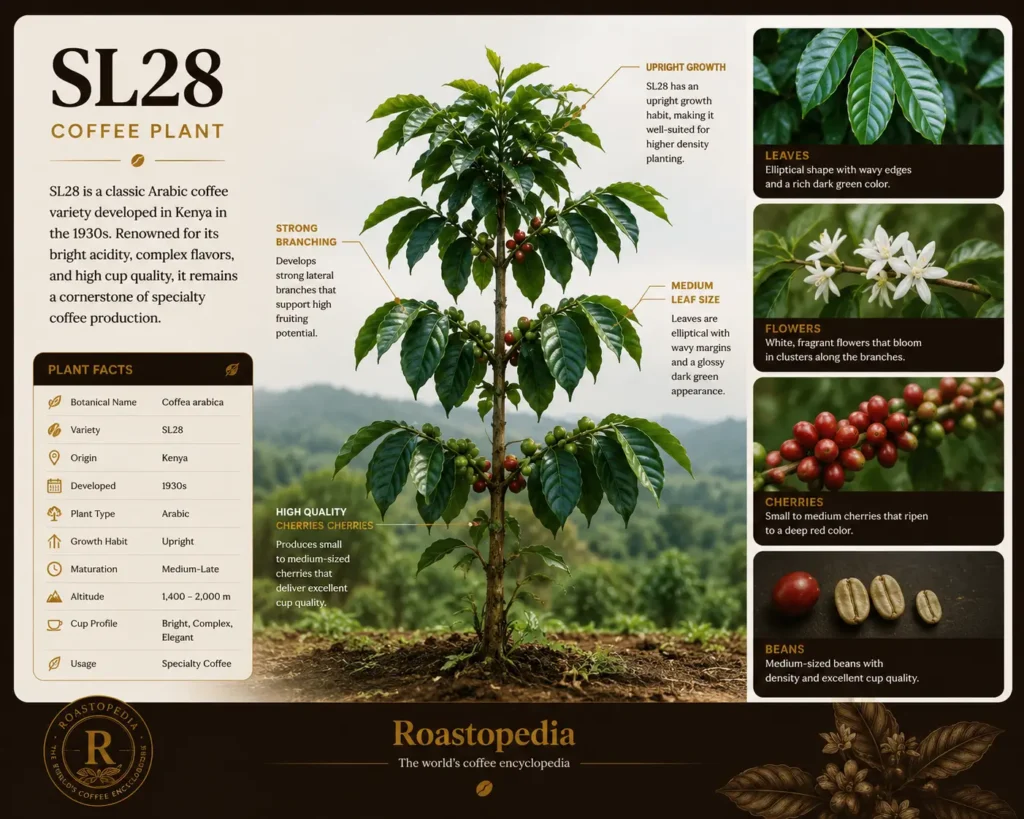
SL28 is classified as a tall-statured coffee plant, with primary branches that are typically semi-erect in early growth but tend to become decumbent, or drooping, after several seasons of crop-bearing. Shoot tips are mainly green, though bronze-tipped types occur occasionally within the variety. The coffee cherry produced by SL28 is described as large, and the resulting coffee bean is likewise classified as large relative to reference varieties such as Caturra. Cherry-to-green-bean outturn — the proportion of usable bean recovered per unit of harvested cherry — is rated high for the variety.
Agronomic Characteristics
SL28 typically reaches its first year of production in its third year of growth. Its nutrition requirement is classified as low relative to other commercial varieties, consistent with its documented rusticity. Yield potential, by contrast, is rated low, meaning that individual trees bear less fruit than higher-yielding modern selections, a trade-off historically accepted in exchange for cup quality and drought tolerance.
Recommended planting density for SL28 under single-stem pruning is between 1,000 and 2,000 trees per hectare, lower than densities used for compact varieties, reflecting its tall, spreading growth habit. In much of East Africa, farmers prune SL28 to maintain two or three main stems per tree rather than the single-stem system common in Central and South America, which increases the effective fruiting surface per tree despite the lower per-hectare tree count.
Environmental Adaptation
SL28 is suited to medium and high altitude growing conditions, with its quality and agronomic performance rated exceptional at higher elevations and comparatively poor at low elevation. Optimal altitude varies by latitude: farms near the equator generally require greater elevation to achieve the same performance as farms farther from it, a relationship documented in World Coffee Research’s variety trials.
The variety’s drought tolerance, inherited from its Tanganyika Drought Resistant source population, is considered one of its most consistently cited agronomic strengths, allowing it to perform in regions with lower or less reliable rainfall than many other Arabica selections require.
Disease and Pest Response
SL28 shows low resistance, or outright susceptibility, to the major diseases affecting Arabica coffee. It is rated susceptible to coffee leaf rust, caused by the fungus Hemileia vastatrix, and to coffee berry disease, caused by Colletotrichum kahawae, both of which have historically caused significant crop losses in East African production.
The variety is also classified as susceptible to root-infecting nematodes of the Meloidogyne and Pratylenchus genera. This disease profile has limited SL28’s viability in regions where coffee berry disease is endemic and has driven the development of disease-resistant successor varieties in Kenya, including Ruiru 11 and Batian, both of which incorporate Timor Hybrid genetics for improved rust resistance.
Bean and Cup Characteristics
SL28 is associated in the specialty coffee trade with a cup profile featuring pronounced blackcurrant and berry notes, citrus-forward acidity, and a heavy or syrupy body. Some cuppers additionally describe savory, tomato-like notes alongside the fruit-forward character. This combination of bright acidity and dense body is frequently cited as the reason the variety commands premium pricing and remains in cultivation despite its agronomic drawbacks.
Quality potential is rated exceptional when the variety is grown at higher altitude, and researchers and buyers alike note that SL28’s cup performance declines when the variety is planted outside East Africa or at lower elevations, though it can still produce commercially viable coffee in those conditions.
Modern Cultivation and Distribution
Although SL28 originated in Kenya, it has since spread to other African coffee-producing countries, notably Uganda, Malawi, and Zimbabwe, and — more recently — to parts of Central and South America, where farmers and researchers have planted experimental and commercial plots. Within Kenya, the variety remains most closely associated with the central highlands, including growing regions such as Nyeri, where buyers have historically sought it out for its combination of yield and cup quality relative to other local selections.
Coffee grown outside its native highland environment is generally acknowledged not to replicate the same intensity of flavor achieved in Kenya, though it continues to contribute distinctive character to blends and single-origin lots grown in these newer regions.
Importance in Coffee Breeding
SL28 is considered one of the most genetically and commercially influential Arabica varieties bred in the twentieth century. Its combination of drought tolerance and high cup quality established a benchmark against which later Kenyan selections, including SL34, Ruiru 11, and Batian, have been measured.
Because SL28 and SL34 remain susceptible to coffee leaf rust and coffee berry disease, subsequent Kenyan breeding programs have prioritized incorporating disease resistance from Timor Hybrid-derived stock while attempting to preserve comparable cup characteristics — an ongoing challenge in coffee breeding, since resistance genes have historically been difficult to combine with high sensory quality. SL28 is also used in international variety trials, including World Coffee Research’s multilocation evaluations conducted across multiple countries, as a reference point for cup quality and drought performance when assessing newer cultivars.
See Also
- Cultivar
- Terroir
- Coffea arabica (Arabica)
- Bourbon
- Typica
- Altitude
- Coffee Acidity
- Coffee Cherry
- Cupping
- The Coffee Belt
- Coffee Seedling
- Coffee Flower
- Coffee Leaf
References
- World Coffee Research, Varieties Catalog, “SL28,” varieties.worldcoffeeresearch.org
- Sweet Maria’s Coffee Library, “SL-28,” library.sweetmarias.com
- Counter Culture Coffee, “Coffee Basics: Varieties,” counterculturecoffee.com
- Perfect Daily Grind, “Exploring Popular Kenyan Coffee Varieties: SL-28 & SL-34,” perfectdailygrind.com, 2021
- Perfect Daily Grind, “What’s an AA SL-28? Get to Know Your Kenyan Coffees,” perfectdailygrind.com, 2017
- Trabocca, “SL28 Variety in a Nutshell,” trabocca.com
- MTPak Coffee, “SL28 and SL34: A Coffee Roaster’s Guide,” mtpak.coffee, 2021
- Ozone Coffee UK, “SL28 Coffee: Kenya’s Most Celebrated Variety,” ozonecoffee.co.uk
- Inheritance Coffee, “SL-28 Coffee Variety: A Kenyan-Bred Icon of Cup Quality and Resilience,” inheritancecoffee.com
- Mission Coffee Works, “SL28 – A Kenyan Specialty Coffee Variety’s Rise to Global Recognition,” missioncoffeeworks.com
- Podium Coffee Club, “The History of the SL28 Coffee Varietal,” podiumcoffeeclub.com
- Podium Coffee Club, “SL28 and SL34: The Varietals That Define Kenyan Coffee,” podiumcoffeeclub.com
- GUSTATORY, “SL28 & SL34 Coffee Varietals: Why They’re So Popular,” gustatory.co
- Right Side Coffee, “SL28 and SL34: Two Game-Changing Strains,” rightsidecoffee.com
- Achilles Coffee Roasters, “SL28 and SL34 Coffee Varieties: Exploring the Origins,” achillescoffeeroasters.com, 2024
- Proud Mary Coffee Roasters Help Center, “SL28 Coffee Variety,” proudmaryacademy.com
- CoffeeTrove, “SL-28 Coffee Bean from Kenya: Flavor & Brewing Guide,” coffeetrove.com