
Brown Eye Spot is a fungal disease that affects coffee plants, caused by the pathogen Cercospora coffeicola. It is one of the most widely distributed foliar and berry diseases affecting the Coffea genus, and it is considered endemic across much of the world’s Coffee Belt.
The name “Brown Eye Spot” technically describes only the disease’s foliar symptom — the pale-centered, dark-ringed lesion resembling an eye — but the same fungus produces distinct symptoms depending on which plant organ it colonizes, and the disease is known by several other names accordingly.
When it affects the leaves, plant pathologists commonly call it Cercospora Leaf Spot; when it affects the bean (fruit), it is known as Cercospora Berry Blotch (or simply berry blotch).
Regional and historical literature also refers to the disease as cercosporiosis, iron spot, circular leaf spot, and, in Brazilian Portuguese, olho pardo or mancha de olho pardo; in Spanish-speaking coffee regions it is called mancha ocular del cafeto or mancha de hierro. All of these names describe manifestations of a single underlying pathogen and disease process, and the terms are frequently used interchangeably — or in combination, as “Cercospora Leaf Spot and Berry Blotch” — in the scientific and extension literature.
Unlike epidemic diseases such as Coffee Leaf Rust or Coffee Berry Disease, Brown Eye Spot behaves more as a chronic, stress-linked disease, flaring up wherever coffee plants are nutritionally weakened, overexposed to sunlight, or grown under poor management.
Causal Agent and Taxonomy
Brown Eye Spot is caused by the fungus Cercospora coffeicola Berk. & Cooke, an ascomycete belonging to one of the largest and most economically significant genera of plant-pathogenic fungi. Its full taxonomic classification is as follows:
- Kingdom: Fungi
- Phylum: Ascomycota
- Class: Dothideomycetes
- Order: Capnodiales (sometimes placed in Mycosphaerellales)
- Family: Mycosphaerellaceae
- Genus: Cercospora (asexual/anamorph state)
- Species: Cercospora coffeicola
The fungus has a sexual (teleomorph) stage that was reclassified into the genus Mycosphaerella as Mycosphaerella coffeicola (Cooke) J.A. Stevenson & Wellman. In practice, plant pathologists almost always refer to the disease and its agent by the anamorph name, Cercospora coffeicola, since the sexual stage is rarely observed in the field.
Several taxonomic synonyms exist in the historical literature, including Sphaerella coffeicola Cooke, Ramularia goeldiana Sacc., Cercospora coffeae Zimm., and Cercospora herrerana Farneti — all now understood to refer to the same organism. Recent molecular work has also shown that isolates causing an atypical, darker symptom known as “black spot” on coffee leaves belong to the same species as classic Brown Eye Spot isolates.
Host Range and Susceptibility
Cercospora coffeicola primarily infects species within the genus Coffea, including Coffea arabica (Arabica), Coffea canephora (Robusta), Coffea liberica (Liberica), and Coffea excelsa (Excelsa), as well as numerous other wild Coffea species maintained in germplasm collections. Susceptibility is not uniform across Varieties & Cultivars: some accessions, such as the Ethiopian-derived MG 1207 “Sumatra” line studied in Brazil, show a heritable, lower-severity response to the disease, suggesting partial genetic resistance exists within the species’ broader gene pool even though no fully resistant commercial cultivar has been released.
The disease disproportionately affects young plants — nursery seedlings and trees under roughly three years of age are the most vulnerable, since their tissue is tender and their root systems are less able to buffer nutrient or water stress.
Coffee grown in full sun, on nutrient-poor soils, or under drought stress is markedly more susceptible than shaded, well-fertilized coffee. Interestingly, the fungus is not strictly host-specific to coffee: it has also been documented causing leaf spot on castor bean (Ricinus communis) in Brazil, indicating a broader host range than once assumed.
Symptoms and Part of the Plant Affected
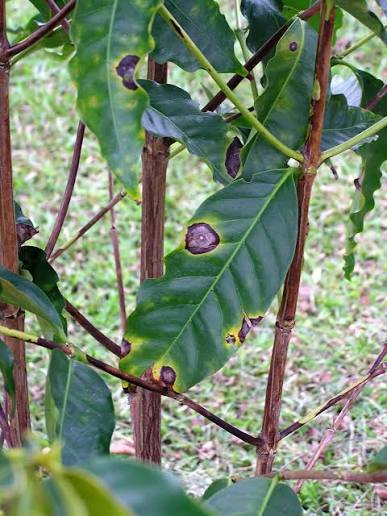
Cercospora coffeicola produces two clinically distinct symptom sets depending on the plant organ it colonizes, which is the basis for the disease’s dual naming as Cercospora Leaf Spot and Cercospora Berry Blotch.
Leaf-spot phase (Brown Eye Spot proper): On foliage, lesions begin as small, pale yellow-white chlorotic flecks that enlarge into circular spots 5 to 15 mm in diameter. Mature lesions develop a pale grey or light brown center — where the fungus sporulates — ringed by a darker brown band and a yellow halo produced by the fungal toxin cercosporin, giving the spot its diagnostic “eye-like” appearance.
Lesions occur mostly between leaf veins and along leaf margins and are usually more conspicuous on the upper (adaxial) leaf surface. In heavy infections, lesions coalesce, leaves yellow prematurely, and significant defoliation follows, reducing the plant’s photosynthetic capacity and overall vigor.
Berry-blotch phase: On fruit, the same fungus produces a different presentation: small raised red spots (“red blister”) on green or ripening cherries that develop into larger, dark reddish-brown, blotchy lesions — patchy rather than the sunken, anthracnose-type lesions typical of Coffee Berry Disease, which berry blotch is often mistaken for in the field.
Infected berries frequently ripen prematurely and unevenly, shrivel, or drop before maturity, and in severe cases the fruit skin sticks fast to the underlying parchment, complicating Coffee Processing Methods and lowering the grade of the resulting green coffee.
Because both leaves and fruit can be affected simultaneously, sometimes on the same plant and even the same branch, the disease reduces yield through two mechanisms at once: weakened plant vigor from defoliation, and direct quality loss in the cherries themselves.
Life Cycle and Spread
Cercospora coffeicola survives between growing seasons on infected leaf litter, diseased plant debris, and lesions on the plant itself, which serve as the primary source of inoculum. Under warm, humid conditions, the fungus produces asexual spores called conidia on the grey centers of leaf lesions. These conidia are dispersed by wind, splashing rain, and, to a lesser extent, insects and human handling during field work.
Once a conidium lands on a susceptible leaf or fruit surface, it germinates and shows a strong tropism toward the stomata, where it attempts penetration; unlike many other leaf-spot fungi, C. coffeicola does not form specialized penetration structures called appressoria.
After entering through the stomata, the fungus colonizes the spongy (lacunous) parenchyma tissue of the leaf both between and within cells, eventually sporulating again through or around the stomatal openings to complete the cycle. A key part of its pathogenic strategy is the production of cercosporin, a light-activated perylenequinone toxin common to many Cercospora species.
When exposed to light, cercosporin generates reactive oxygen species that kill host cells ahead of the advancing fungus, which explains why disease severity is closely tied to light exposure and helps account for the disease’s preference for sun-stressed, poorly shaded coffee.
Disease pressure builds fastest during the warmer, wetter months of the growing season and is worsened by any factor that stresses the plant: nitrogen, potassium, or magnesium deficiency; water shortage; excessive direct sunlight; and simultaneous infection by other pathogens such as Coffee Leaf Rust.
Historical Discovery
The causal fungus of Brown Eye Spot was first described in the scientific literature in the early 1880s. The British mycologist Mordecai Cubitt Cooke described the organism’s sexual stage as Sphaerella coffeicola in 1880, and shortly afterward the more familiar anamorph name, Cercospora coffeicola, was published by Miles Joseph Berkeley and Moses Ashley Curtis in 1881.
The teleomorph was later formally transferred to the genus Mycosphaerella in 1944 by J.A. Stevenson and F.L. Wellman. Foundational mid-20th-century studies on the disease’s biology, including detailed physiological work on the fungus published in the Journal of Phytopathology in the 1960s, helped establish the basic understanding of the pathogen that is still used today.
Arrival in the Americas, Asia, Africa
Historical records place the first confirmed report of Brown Eye Spot in Brazil in 1887, only a few years after the fungus was formally described, at a time when Brazil was rapidly expanding as the world’s dominant coffee producer.
As with many coffee pathogens, its spread across the Coffee Belt closely tracked the movement of coffee planting material, nursery stock, and processing waste between regions during the 19th and 20th centuries, since infected seedlings and plant debris are the primary means by which the fungus travels over long distances.
Unlike Coffee Leaf Rust, whose intercontinental jumps are relatively well documented through specific historic epidemics, Brown Eye Spot’s spread into Asia, Africa, and the Pacific was more gradual and less dramatically chronicled, likely accompanying the general expansion of commercial coffee cultivation into these regions rather than arriving through a single identifiable introduction event.
Geographic Distribution within the Coffee Belt
Brown Eye Spot is now essentially pantropical, present wherever coffee is commercially grown. It has been recorded throughout Latin America and the Caribbean (with Brazil considered a heavily affected, near-endemic zone), across sub-Saharan Africa, throughout South and Southeast Asia, and across Oceania and the Pacific Islands, including American Samoa, Australia, the Cook Islands, Fiji, French Polynesia, the Federated States of Micronesia, New Caledonia, Papua New Guinea, Samoa, Vanuatu, and Hawaii.
This broad distribution makes it one of the most geographically ubiquitous coffee diseases, even though its economic impact varies considerably by region depending on local growing conditions, shade management, and soil fertility.
Economic and Social Impact
Because Brown Eye Spot reduces both leaf area and cherry quality, its economic toll comes from two directions at once: lower overall yield and a higher proportion of defective, poorly filled, or prematurely dropped beans, which downgrades the quality — and price — of the resulting green coffee.
In Brazil, where the disease is considered endemic, it is regarded by many growers as one of the principal chronic diseases of the crop, and organic coffee farms, which forgo synthetic fungicides, have recorded notably higher incidence rates than conventionally managed farms in comparative field studies.
In Hawaii, the disease has been identified as economically significant in certain locations and seasons specifically because of the recurring cost of fungicide programs needed to manage it.
The social burden of the disease falls heaviest on smallholder farmers, who make up the majority of coffee producers across the Coffee Belt. Because no fully resistant commercial cultivar yet exists, management depends on a combination of fertilization, cultural practices, and repeated fungicide applications — inputs that are often costly or inaccessible to smaller operations, particularly in nurseries where young, vulnerable seedlings represent a farmer’s future income.
Control and Management
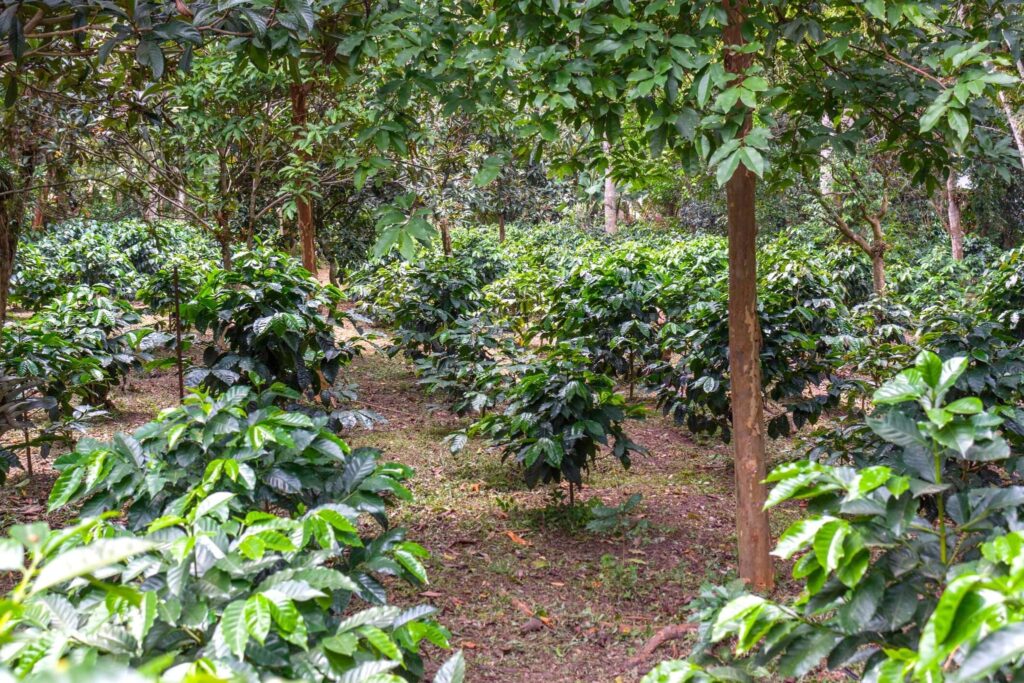
Because Brown Eye Spot is closely tied to plant stress, management strategies emphasize prevention through good agronomy as much as direct fungicide use:
- Balanced fertilization: Correcting nitrogen, potassium, and magnesium deficiencies significantly reduces disease severity, since well-nourished plants are far less susceptible.
- Shade and sun management: Because cercosporin is light-activated, moderating direct sun exposure — particularly for young plants and nursery seedlings — helps limit lesion development.
- Water management: Avoiding prolonged drought stress reduces plant vulnerability, especially in young or newly transplanted trees.
- Field sanitation: Removing and destroying fallen infected leaves and pruned material reduces the pool of overwintering inoculum.
- Fungicide applications: Copper-based fungicides and other protectant or systemic products remain the primary chemical control tool where cultural practices are insufficient, though repeated use raises both cost and environmental concerns.
- Genetic screening and breeding: Ongoing breeding programs, particularly in Brazil, are screening germplasm collections for naturally lower-severity genotypes — such as the MG 1207 “Sumatra” accession — as a long-term path toward resistant cultivars that could reduce reliance on fungicides.
Significance in Coffee History and Science
Beyond its agricultural impact, Cercospora coffeicola has become a useful model organism in plant pathology research. Studies of its infection process — particularly its stomatal-tropism behavior and its lack of appressoria, unusual traits among leaf-spot fungi — have contributed to the broader scientific understanding of how Cercospora species colonize host tissue.
Its production of cercosporin has also made it a subject of interest in toxin biochemistry, since cercosporin’s light-activated, reactive-oxygen-generating mechanism is shared by many economically important Cercospora pathogens affecting other crops, from sugar beet to soybean.
In coffee science specifically, the disease has driven decades of genotype-screening and breeding research aimed at identifying natural resistance, work that continues to inform coffee variety development across the Coffee Belt today.
See Also
- American Leaf Spot (Mycena citricolor)
- Coffee Wilt Disease (Fusarium xylarioides)
- Coffee Berry Disease (Colletotrichum kahawae)
- Coffee Leaf Rust (Hemileia vastatrix)
References
- CABI Compendium. “Mycosphaerella coffeicola (brown eye spot of coffee).” CABI Digital Library, Datasheet No. 12204.
- Souza, A.G.C., Maffia, L.A., Mizubuti, E.S.G., et al. “Infection Process of Cercospora coffeicola on Coffee Leaf.” Journal of Phytopathology, 2011.
- Sarma, Y.R. “Studies on the Brown-Eye-Spot Disease (Cercospora coffeicola Berk. et Cke.) of Coffee (Coffea arabica L.).” Journal of Phytopathology, 1967.
- Pacific Pests, Pathogens and Weeds (Lucid Apps), Plant Health Australia / SPC. “Fact Sheet: Coffee Brown-Eye Spot (142).”
- Batista, T.F.C., et al. “Screening Coffee Genotypes for Brown Eye Spot Resistance in Brazil.” PMC, National Center for Biotechnology Information, 2022.
- Chaves, F.C., et al. “The Toxin Cercosporin Is a Virulence Factor for Infection of Coffee by Cercospora coffeicola.” bioRxiv preprint, 2019.
- Wikipedia contributors. “Mycosphaerella coffeicola.” Wikipedia, The Free Encyclopedia.
- Santos, F.S., Souza, P.E., Pozza, E.A., et al. “Progresso da Cercosporiose (Cercospora coffeicola Berkeley & Cooke) em Cafeeiros sob Cultivos Orgânico e Convencional.” Summa Phytopathologica, 2008.
- Wikipédia (Portuguese). “Cercospora coffeicola.” Wikipédia, a Enciclopédia Livre.