
Java Coffee is a coffee variety of Coffea arabica belonging to the Ethiopian landrace genetic group. The name “Java” is also used more broadly to describe coffee produced on the Indonesian island of Java and, in many English-speaking countries, has become an informal synonym for coffee itself. In botanical and agricultural contexts, however, Java refers to a distinct Arabica variety rather than coffee from a particular geographic origin.
The Java variety was selected from an Ethiopian landrace accession known as Abyssinia, making it genetically distinct from the historic Typica-derived coffees that were once widely cultivated on the island of Java. Those earlier Indonesian cultivars, including selections such as Bergendal and Blawan Pasumah, share the island’s name through their place of cultivation but are separate genetic lineages and should not be confused with the modern Java variety.
Java is best known for its tolerance to coffee berry disease (CBD), good cup quality, and adaptability to low-input smallholder farming systems. These characteristics have made it an important variety in Central America, where it has been promoted as an alternative to more disease-susceptible cultivars while maintaining the flavor attributes expected of high-quality Arabica coffee.
Infobox (At a Glance)
| Attribute | Detail |
| Species | Coffea arabica |
| Genetic group | Ethiopian landrace (Abyssinia population) |
| Also known as | Java Arabica, Java Cultivar |
| Stature | Tall |
| Leaf tip color | Bronze |
| Bean size | Large |
| Yield potential | Medium |
| Quality potential at high altitude | Very Good |
| Optimal altitude | High |
| Coffee leaf rust resistance | Low resistance / susceptible |
| Coffee berry disease (CBD) | Tolerant |
| Nematode resistance | Susceptible |
| Nutrition requirement | Low |
| Year of first production | Year 3 |
| Planting density | 3,000–4,000 plants/ha (single-stem pruning) |
| Region of origin | Ethiopia, via Java (Indonesia) and Cameroon |
| Main growing regions today | Panama, Costa Rica, Colombia, Cameroon, Indonesia |
Etymology
The name “Java” derives from the island of Java in present-day Indonesia, where Dutch traders established some of the earliest coffee plantations outside Arabia in the late 17th and early 18th centuries. As Java-grown coffee dominated European supply chains during this period, the word “java” gradually became a generic English-language term for coffee, a usage recorded in print by the late 18th century and widespread by the early 20th century.
Separately, within coffee agronomy, “Java” refers specifically to the cultivar discussed in this article: a selection introduced to the island directly from Ethiopia and later developed further outside Indonesia.
History
Java coffee’s cultivated history in Indonesia dates to the late 17th century, when Dutch colonial merchants introduced Arabica coffee to Batavia (present-day Jakarta), with plantations subsequently established in Bogor and Bandung. While much of Java’s early coffee stock became the source of the Typica variety that later spread worldwide, the cultivar known specifically as “Java” was introduced to the island directly from Ethiopia by the Dutch in the early 19th century and was for a long time assumed to be a Typica selection.
In the mid-20th century, Java coffee seed was carried to Cameroon by a local farmer acting through the Vilmorin company, which had acquired the material in Java from the breeder Porteres. In Cameroon, breeder Pierre Bouharmont observed that the variety showed partial tolerance to coffee berry disease, a fungal disease caused by Colletotrichum kahawae that was, and remains, a major constraint on Arabica production in parts of Africa.
After nearly two decades of selection, the variety was released for cultivation in Cameroon between 1980 and 1990. Subsequent genetic fingerprinting revealed that Java is not a Typica descendant but a selection from the Ethiopian landrace population known locally as Abyssinia.
Java was introduced to Costa Rica in 1991 by the Centre de Coopération Internationale en Recherche Agronomique pour le Développement (CIRAD), through breeder Benoit Bertrand, to provide smallholders with a low-input, disease-tolerant option ahead of any potential spread of CBD into Central America, where the disease is not currently established.
Seed was distributed to PROMECAFE member countries, though it was not formally released in most of them at the time. Java’s potential for high cup quality at elevation was later recognized, and Panama became the first Central American country to officially register the variety, in 2016. It has since spread in limited plantings across Panama, Costa Rica, and parts of Colombia, including the Huila department.
Java Coffee Characteristics
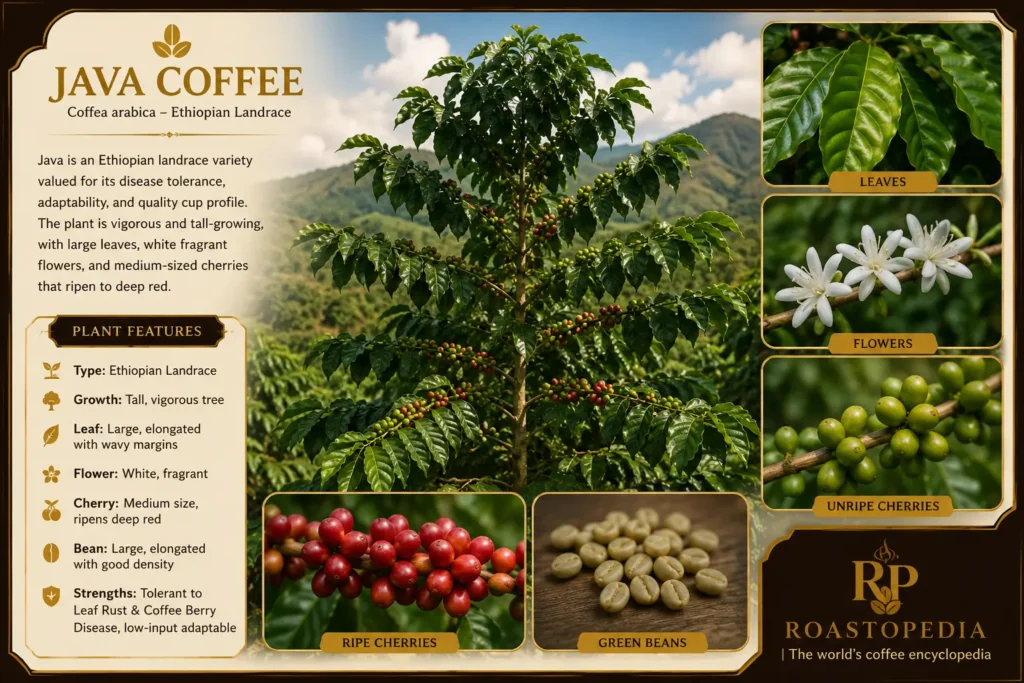
The Java plant is tall-growing, with new leaves emerging bronze that darken as they mature — a trait shared with other Ethiopian landrace-derived types. Its coffee cherries yield beans classified as large, comparable in size to those of SL28, with an average cherry-to-green-bean outturn ratio.
The plant reaches first fruit production around its third year. Its overall vigor and canopy structure resemble those of other tall Ethiopian landraces more than those of the compact Bourbon-Typica derivatives common in Latin America, reflecting its distinct genetic lineage.
Growing Conditions
Java performs best at high altitude, where both its agronomic performance and cup quality potential are maximized; optimal elevation bands shift according to a farm’s latitude relative to the equator, with sites nearer the equator requiring correspondingly higher elevations.
The variety has a low nutrition requirement relative to many commercial cultivars, making it suited to smallholder systems with limited access to fertilizer or compost. Under single-stem pruning, recommended planting density is roughly 3,000 to 4,000 trees per hectare, though multiple-stem pruning systems, more typical in parts of Africa, use lower densities with each tree carrying more than one main stem. Fruit ripening occurs at an average pace relative to other Arabica cultivars, comparable to Caturra.
Diseases
Java’s principal agronomic advantage is its tolerance to coffee berry disease (CBD), the anthracnose caused by Colletotrichum kahawae that damages young cherries and can cause severe yield losses, particularly at high altitude and humidity in parts of Africa.
This tolerance was the original basis for its selection in Cameroon and its later introduction to Central America as a precaution against CBD’s potential spread there.
However, Java shows low resistance to coffee leaf rust, caused by the fungus Hemileia vastatrix, and is classified as susceptible to root-knot and lesion nematodes (Meloidogyne spp. and Pratylenchus spp.), organisms that can weaken or kill the plant through root damage. Because nematode pressure is generally lower in the Central American regions where Java is now grown than in parts of Africa, this susceptibility has been considered a lesser concern for its current cultivation areas.
Java Coffee Global Production
Indonesia remains one of the world’s largest coffee producers by volume, with national output reaching approximately 11 million 60-kilogram bags in 2024, though the great majority of this is Robusta rather than Arabica, following the coffee leaf rust epidemic that devastated Java’s Arabica estates in the late 19th century.
Production of the Java cultivar specifically, as distinct from general “Java coffee,” remains modest and concentrated outside Indonesia. It is grown at limited but increasing scale in Panama, where it is entered as a non-Geisha coffee “varietal” in national quality competitions, as well as in Costa Rica and Colombia’s Huila department. Cameroon retains historical plantings from the cultivar’s mid-20th-century selection period, though commercial volumes there have declined relative to the variety’s peak.
Comparison with Similar Cultivars
Java belongs to the Ethiopian landrace genetic group, distinguishing it from the Bourbon–Typica lineage, which includes cultivars such as Bourbon, Caturra, and Mundo Novo. Although it was once assumed to be a Typica selection because of its association with the Indonesian island of Java, genetic studies have shown that the Java variety is more closely related to Ethiopian landrace material from which it was selected.
Among Ethiopian-derived Arabica varieties, Java is most frequently compared with Geisha, another Ethiopian landrace selection that has gained international recognition, particularly through its cultivation in Panama. While Geisha is renowned for its exceptional cup quality and consistently commands premium prices in the specialty coffee market, Java is valued for its greater agronomic resilience. It generally exhibits better tolerance to coffee leaf rust and coffee berry disease (CBD), while also performing well under lower-input production systems, making it especially suitable for many smallholder farming environments.
Compared with widely cultivated commercial varieties such as Caturra and Catuai, Java typically develops into a taller tree and produces relatively large beans. Although its yield potential is generally considered moderate rather than high, its combination of disease tolerance, adaptability, and desirable cup quality has made it an increasingly important variety in the Coffee Belt, particularly in Central America.
See Also
- Typica
- Bourbon
- Geisha Coffee
- Caturra
- SL28
- Ethiopian Landrace Coffee
- Sumatra Coffee
- Pacamara Coffee
- Mundo Novo Coffee
- Heirloom Coffee
References
- World Coffee Research. “Java.” Varieties Catalog. https://varieties.worldcoffeeresearch.org/varieties/java
- World Coffee Research. “Typica.” Varieties Catalog. https://varieties.worldcoffeeresearch.org/varieties/typica
- Sweet Maria’s Coffee Library. “What is Java Coffee Cultivar?” https://library.sweetmarias.com/what-is-java-coffee-cultivar/
- Sweet Maria’s Coffee Library. “Java Variety.” https://library.sweetmarias.com/glossary/java-cultivar/
- Sweet Maria’s Coffee Library. “Java Coffee Overview.” https://library.sweetmarias.com/coffee-producing-countries/indonesia-se-asia/java-coffee-overview/
- Royal Coffee. “Indonesian Coffee Cultivars and Varieties.” https://royalcoffee.com/indonesian-coffee-cultivars-and-varieties/
- Daily Coffee News. “A Guide to Indonesian Coffee Cultivars and Varieties.” https://dailycoffeenews.com/2026/03/18/a-guide-to-indonesian-coffee-cultivars-and-varieties/
- Online Etymology Dictionary. “Java.” https://www.etymonline.com/word/java
- Driftaway Coffee. “Why is Coffee Called Java?” https://driftaway.coffee/coffee-called-java/
- Discover Life (Springer Nature). “Coffee Berry Disease: A Threat to Arabica Coffee Production in Ethiopia.” https://link.springer.com/article/10.1007/s11084-025-09690-9
- Boquete Coffee Traders. “Best of Panama Coffee: Winners, Records & Where to Buy.” https://boquetecoffeetraders.com/blogs/news/best-of-panama-coffee