
Mundo Novo is a natural hybrid cultivar of the species Coffea arabica, resulting from a natural cross between Red Bourbon and Sumatra coffee, a Typica-derived introduction from Indonesia. Characterized by vigorous vegetative growth, high yield potential, and a tall tree structure, Mundo Novo is considered one of the most commercially significant Arabica cultivars grown in South America, particularly Brazil.
In agronomic literature and commercial trade, the cultivar is designated as Coffea arabica cv. ‘Mundo Novo’. Depending on line selection and local agricultural registries, specific pure-line selections are cataloged under technical codes such as IAC 374-19, IAC 388-17, and IAC 515. The cultivar is occasionally referred to as Novo Mundo in historical records, named after the municipality where its initial propagation and field selection occurred.
Infobox (At a Glance)
| Attribute | Classification / Value |
| Species | Coffea arabica |
| Lineage | Natural hybrid (Bourbon / Sumatra / Typica) |
| Origin | Mineiros do Tietê, São Paulo, Brazil |
| Year of Discovery | 1943 (Commercially released 1952) |
| Plant Height | Tall (3.0 m to 5.0 m / 10 ft to 16 ft) |
| Leaf Tip Color | Bronze or Green |
| Bean Size | Medium to Large |
| Yield Potential | High (25% to 30% higher than Bourbon) |
| Optimum Altitude Range | 800 m to 1,200 m (2,600 ft to 3,900 ft) |
| Coffee Leaf Rust Susceptibility | Highly Susceptible |
| Coffee Berry Disease Susceptibility | Susceptible |
| Root Knot Nematode Susceptibility | Susceptible |
Etymology
The name Mundo Novo translates directly from Portuguese as “New World.” The cultivar received this designation from the municipality of Novo Mundo (renamed Urupês in 1944) in the state of São Paulo, Brazil. Following the initial discovery of spontaneous hybrid trees in Mineiros do Tietê, seeds were distributed to farmers and agricultural stations in Novo Mundo.
When the Agronomic Institute of Campinas (Instituto Agronômico de Campinas, IAC) identified the superior vigor and productivity of these plantings, researchers named the formal selection after the locality where the selections performed best.
History
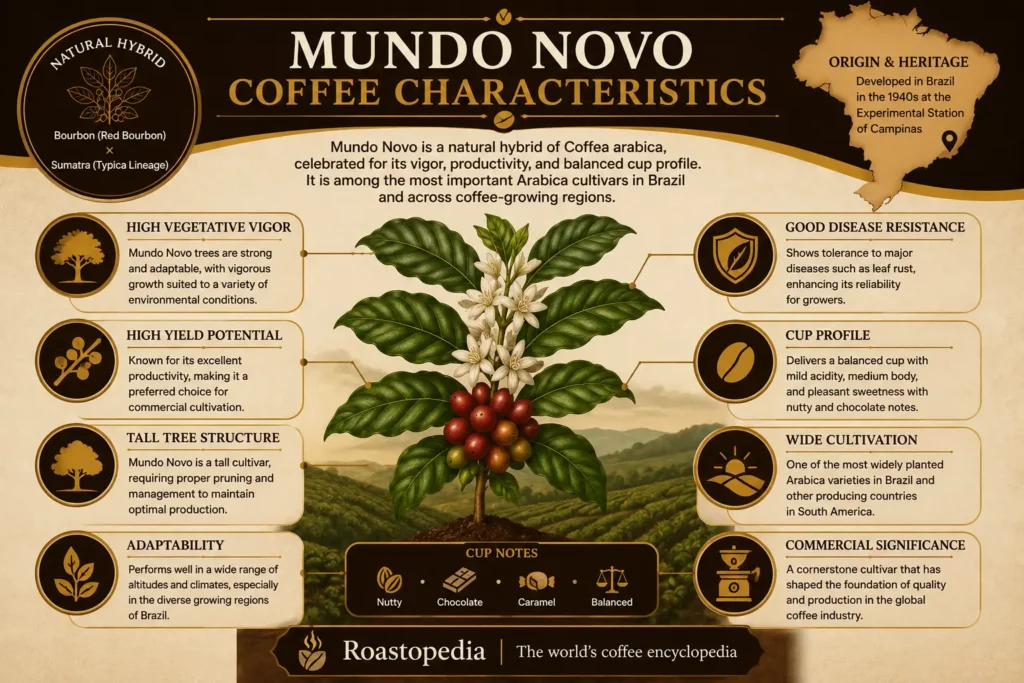
The origin of Mundo Novo dates back to natural cross-pollination events occurring in the state of São Paulo during the early 20th century. Trees of the Sumatra variety, introduced to Brazil from Indonesia via Jaú in 1896, were cultivated in proximity to plantations of Red Bourbon. A spontaneous cross between a Bourbon plant and a Sumatra tree took place on a farm in the municipality of Mineiros do Tietê.
In 1943, agronomists from the Agronomic Institute of Campinas (IAC), led by researcher Alcides Carvalho, were notified of exceptionally productive trees growing in fields near the town of Novo Mundo. These plants originated from seeds harvested from the natural hybrid parent tree in Mineiros do Tietê.
The IAC initiated a systematic plant selection program between 1943 and 1952. Breeders evaluated individual tree selections over multiple generations to isolate lines exhibiting high yields, strong structural branching, and uniform maturation of the coffee cherry. The progeny selections—most notably the line IAC 374-19—showed yield increases of 25% to 30% compared to standard Bourbon lines while displaying improved tolerance to environmental stress and cold winds.
The IAC officially released Mundo Novo to Brazilian producers in 1952. Due to its superior yield and vigor, the variety was rapidly adopted across Brazilian coffee-producing regions, replacing older, lower-yielding Typica and Bourbon plantings. Throughout the mid-20th century, Mundo Novo formed the genetic basis for Brazilian coffee expansion and served as a parent variety in subsequent breeding programs, most notably in the creation of the dwarf hybrid Catuai.
Mundo Novo Coffee Characteristics
Although Mundo Novo is classified botanically as an agronomic selection rather than an Ethiopian wild heirloom, its physical morphology retains several foundational traits inherited from its ancestral Typica and Bourbon lineages.
Tree Architecture and Stature
Mundo Novo trees are physically large, growing to heights between 3.0 and 5.0 meters if left unpruned. The plant features strong main stems and dense, secondary branching that forms a conical canopy. The internodal distances along the primary branches are shorter than those found in pure Typica plants, which contributes to higher cherry density per branch segment.
Foliage Traits
The coffee leaf structure of Mundo Novo is characterized by medium to large, oval-shaped leaves with undulating margins. Young leaves at the growing tip (apical meristems) display either bronze or green coloration, reflecting the genetic segregation of its parent varieties; the Sumatra parent imparts a bronze tip color, whereas certain Bourbon selections carry green tips. Mature leaves are dark green with a glossy upper cuticle.
Root System
A distinct physiological trait of Mundo Novo is its extensive, deep-penetrating taproot and secondary root system. This subterranean architecture provides strong physical anchorage against high winds and allows the plant to extract moisture and mineral nutrients from deeper soil horizons during extended dry spells.
Fruit and Seed Morphology
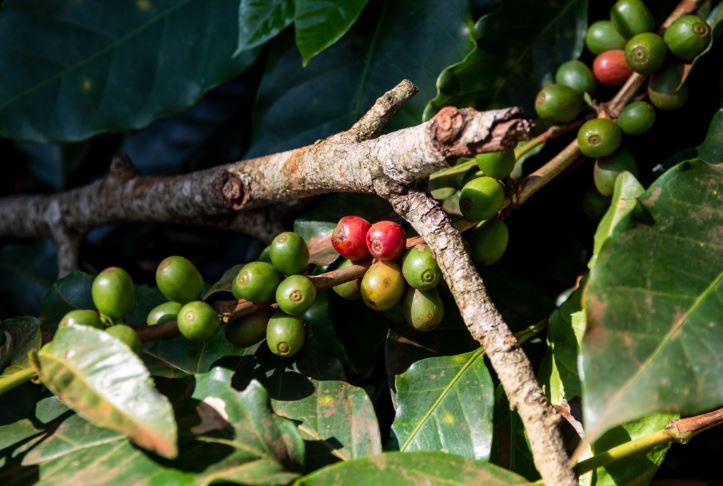
The cherries of Mundo Novo are round to slightly oblong, ripening predominantly to a deep red color, although yellow-fruited variants occur in rare offspring lines. The fruit exhibits a high seed-to-pulp ratio. The green coffee beans (endosperms) inside the fruit are medium to large in size, possessing a rounded shape similar to Bourbon seeds, with an average bean length ranging from 8.0 to 10.0 millimeters.
Growing Conditions
Mundo Novo exhibits wide ecological adaptability, but maximum productivity requires specific environmental parameters:
- Altitude: Optimum performance occurs at elevations between 800 meters and 1,200 meters above sea level. At altitudes below 800 meters, high ambient temperatures accelerate fruit ripening, which can lead to reduced cup quality. At altitudes above 1,200 meters, lower temperatures reduce growth velocity and increase susceptibility to frost damage.
- Climate and Temperature: The cultivar thrives in sub-tropical and tropical highland climates characterized by a dry season during harvest. The optimal mean annual temperature range is 18°C to 23°C. The plant exhibits moderate tolerance to short-term temperature drops and cold wind exposure due to its strong vegetative structure.
- Precipitation: Annual rainfall requirements range between 1,200 mm and 1,800 mm, ideally followed by a defined dry period of 2 to 3 months to trigger uniform flowering upon the return of rains, producing abundant coffee flower blooms.
- Soil Parameters: Deep, well-drained soils such as Latossolos (oxisols) or volcanic soils with high organic matter content are optimal. The ideal soil pH ranges from 5.5 to 6.2. Due to its vigorous root network, Mundo Novo tolerates sandy soil textures better than dwarf varieties, provided adequate macronutrient supplementation is maintained.
Diseases
Mundo Novo lacks genetic resistance factors derived from Coffea canephora (Robusta) or wild Arabica accessions, rendering it susceptible to the primary fungal and biological threats affecting coffee plant development:
- Coffee Leaf Rust (Hemileia vastatrix): Mundo Novo possesses no resistance genes (SH genes) against Hemileia vastatrix. Infection causes premature defoliation, reducing photosynthetic capacity and causing severe dieback in high-yield cropping years. Control requires scheduled applications of copper-based or systemic fungicides.
- Coffee Berry Disease (Colletotrichum kahawae): Highly susceptible. While Colletotrichum kahawae is primarily restricted to African coffee-producing regions, Mundo Novo trees planted at higher altitudes are vulnerable under humid conditions.
- Root-Knot Nematodes (Meloidogyne spp.): Susceptible to root damage caused by Meloidogyne exigua and Meloidogyne incognita, which impair nutrient uptake and reduce drought tolerance. In infested soils, farmers often utilize grafted rootstocks derived from resistant lines such as Coffea canephora.
- Bacterial Blight (Pseudomonas syringae pv. garcae): Moderate susceptibility. In windy, cool regions, physical leaf damage allows bacterial entry, leading to twig dieback and necrosis.
Mundo Novo Coffee Global Production
Mundo Novo remains a vital commercial cultivar within global coffee supply chains, particularly in South and Central America.
Brazil
Brazil is the primary producer of Mundo Novo coffee. The cultivar occupies a significant percentage of the total area planted with Coffea arabica in the states of Minas Gerais (particularly in the Sul de Minas and Cerrado Mineiro regions) and São Paulo (Alta Mogiana). Its high yield capacity matches flat or gently rolling terrain where machine harvesting techniques are utilized to harvest tall canopy architectures alongside traditional selective picking and strip picking.
Central and South America
Outside Brazil, Mundo Novo was introduced to coffee breeding programs across Latin America during the 1960s and 1970s. It is cultivated in countries such as Peru, Guatemala, Honduras, and Costa Rica, although often in smaller quantities compared to dwarf varieties like Caturra or Catuai, which permit higher planting densities per hectare.
Processing and Cup Profile
In commercial production, Mundo Novo is processed using natural (dry), honey, and washed methods. When grown at optimal altitudes and managed properly, its cup profile is characterized by balanced acidity, medium to heavy body, and dominant notes of dark chocolate, caramel, and brown sugar developed during roasting. Because of its structural sweetness and heavy body, it is frequently utilized as a base for espresso extraction.
Comparison with Similar Cultivars
The table below contrasts the botanical, operational, and agronomic attributes of Mundo Novo against four related Arabica cultivars:
| Agronomic Trait | Mundo Novo | Bourbon | Catuai | Caturra |
| Plant Height | Tall (3.0–5.0 m) | Tall (3.0–4.0 m) | Dwarf (1.8–2.2 m) | Dwarf (1.5–2.0 m) |
| Yield Potential | High | Medium | Very High | High |
| Planting Density | Low (2,000–3,000 trees/ha) | Low (2,000–2,500 trees/ha) | High (4,000–6,000 trees/ha) | High (4,000–6,000 trees/ha) |
| Leaf Tip Color | Bronze or Green | Green | Yellow or Green | Green |
| Drought Tolerance | High | Moderate | Moderate | Low |
| Harvest Suitability | Machine Harvesting | Selective Picking | Machine Harvesting | Selective Picking |
| Rust Resistance | Susceptible | Susceptible | Susceptible | Susceptible |
See Also
References
- Carvalho, A. (1952). Melhoramento do Cafeeiro: V – Seleções do Cafeeiro Mundo Novo. Bragantia, 12(4), 215–229. Agronomic Institute of Campinas (IAC). https://www.scielo.br/j/bbag/
- World Coffee Research. (2023). Coffee Varieties Catalog: Mundo Novo. World Coffee Research Organization. https://varieties.worldcoffeeresearch.org/varieties/mundo-novo
- Carvalho, A., & Krug, C. A. (1949). Agrotecnia e Genética no Melhoramento do Cafeeiro. Instituto Agronômico de Campinas. https://www.iac.sp.gov.br
- Fazuoli, L. C., Medina, H. P., & Carvalho, A. (1977). Seleção de Progenies do Cafeeiro Mundo Novo (Coffea arabica L.). Ciênc. Cult., 29(7), 112–118.
- Food and Agriculture Organization (FAO). (2021). Coffee Production Statistics and Cultivar Distribution in South America. FAOSTAT. https://www.fao.org/faostat/
- International Coffee Organization (ICO). (2022). Country Coffee Profile: Brazil. ICO Trade Documents. https://www.ico.org
- Specialty Coffee Association (SCA). (2020). Arabica Cultivars and Genetic Diversity in Commercial Coffee Production. SCA Research Series. https://sca.coffee
- Ukers, W. H. (1935 / Repr. 2012). All About Coffee. New York: Tea and Coffee Trade Journal Company. https://www.gutenberg.org/ebooks/28500
- van der Vossen, H. A. M. (2005). A Critical Review of Coffee Breeding Programs in Selected Arabica Producing Countries. Experimental Agriculture, 41(4), 449–476. Cambridge University Press. https://www.cambridge.org