
Sumatra coffee (also written Sumatran coffee) refers to coffee cultivated and processed on the Indonesian island of Sumatra, the westernmost of the Greater Sunda Islands and one of the world’s most important coffee-producing regions within the Coffee Belt. The term serves as both a geographic designation and a commercial umbrella covering coffees from several renowned producing areas, including Mandheling, Lintong, Gayo, Sidikalang, and Aceh. These names identify specific growing regions rather than distinct botanical varieties.
Although both Coffea arabica and Coffea canephora (Robusta) are cultivated on the island, Sumatra is internationally best known for its Arabica coffees, which are prized for their full body, low acidity, and complex earthy flavor profile. Notes of cedar, dark chocolate, herbs, spices, and tobacco are commonly associated with these coffees.
Much of their distinctive character results from the traditional giling basah (wet-hulling) processing method, together with Sumatra’s volcanic soils, tropical climate, and high-altitude growing conditions, which collectively produce some of the world’s most recognizable and sought-after coffees.
Infobox (At a Glance)
| Category | Details |
| Common names | Sumatra Coffee, Sumatran Coffee, Mandheling, Gayo, Lintong |
| Species | Coffea arabica (majority in specialty trade); Coffea canephora (Robusta, majority by national volume) |
| Common cultivars | Typica, Bergendal, Catimor, S-795, Hibrido de Timor (Tim Tim), Ateng |
| Country of origin (cultivation) | Indonesia |
| Main growing regions | Aceh (Gayo, Takengon), North Sumatra (Lintong, Sidikalang, Lake Toba), South Sumatra, Lampung, Bengkulu |
| Typical altitude | 900–1,700 meters above sea level (Arabica); lower elevations for Robusta |
| Typical processing | Wet-hulled (giling basah) |
| Flavor profile | Full body, low acidity, earthy, herbal, cedar, spice, dark chocolate |
| Harvest season | Arabica: April–May and September–October; Robusta: peaks June–July |
Etymology
The name “Sumatra” refers to the island itself, whose modern spelling was popularized through Malay and later Dutch colonial usage; the island’s coffee inherited the name simply as a place-of-origin designation, in the same way “Java coffee” is named for the neighboring island.
Several regional sub-names carry their own etymologies. “Mandheling” derives from the Mandailing people of the Tapanuli region of North Sumatra and functions as a trade name rather than a botanical or strictly geographic term, since Mandheling-labeled coffee may be grown outside the historical Mandailing homeland.
“Gayo” refers to the Gayo highlands of Central Aceh and the Gayonese ethnic group who cultivate the crop there. The processing term giling basah, from the Indonesian (Bahasa Indonesia) words for “grinding” and “wet,” translates literally as “wet grinding” and is used interchangeably with the English term “wet-hulling.”
History
Coffee cultivation was introduced to the Indonesian archipelago by the Dutch East India Company (VOC), which planted Arabica coffee seedlings, sourced via the Malabar coast of India, near Batavia (present-day Jakarta) on the island of Java beginning around 1696–1699. Cultivation subsequently expanded to other islands in the Dutch East Indies, including Sumatra, Sulawesi, Bali, and Timor, as the VOC and later the Dutch colonial government sought to break the Arab monopoly on the coffee trade.
Within Sumatra itself, coffee was first cultivated commercially near Lake Toba in North Sumatra around 1888, with cultivation extending to the Gayo highlands of Central Aceh in 1924. Coffee production in Java and, to a lesser extent, Sumatra was severely disrupted in the late nineteenth century by an outbreak of coffee leaf rust (Hemileia vastatrix), which devastated the original Typica plantings beginning around 1876–1880.
Colonial authorities responded by introducing Robusta (Coffea canephora) to Java around 1900 as a hardier substitute suited to lower elevations; the species spread through smallholdings around Kerinci from about 1915, expanding across southern Sumatra during the 1920s. Because much of eastern Indonesia was less severely affected by rust than Java, older Typica-derived cultivars such as Bergendal and Sidikalang survived locally at higher altitudes.
Following Indonesian independence, Dutch-owned estates were nationalized, and coffee cultivation shifted increasingly toward smallholder farms, a structure that persists today. The wet-hulling method associated with Sumatran coffee became widespread as a practical response to the island’s high humidity and frequent rainfall, which made conventional sun-drying difficult; the practice is documented as becoming common from the mid-twentieth century onward and remains the dominant processing method among Sumatran smallholders.
Sumatra Coffee Characteristics
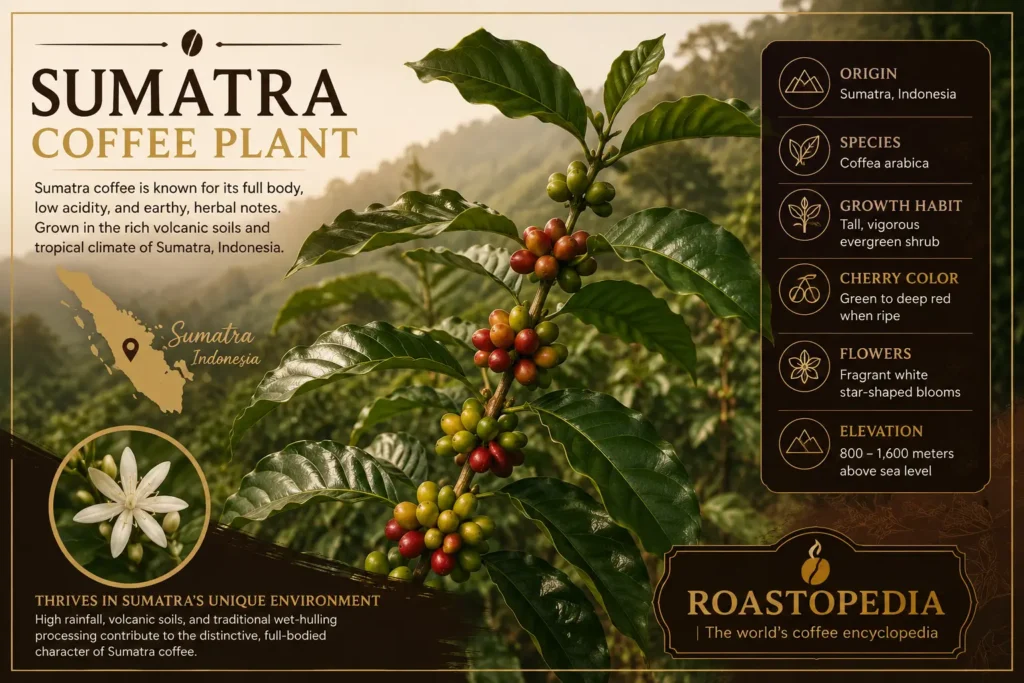
The coffee plant grown in Sumatra is predominantly Coffea arabica at higher elevations and Coffea canephora (Robusta) at lower elevations, alongside historically significant crosses such as the Hibrido de Timor, a natural cross between Arabica and Robusta first identified on the island of Timor.
Sumatran Arabica trees are typically pruned shrubs or small trees reaching 2-4 meters high in cultivation, with glossy, elliptical dark-green leaves arranged in opposite pairs along the branches. The coffee flower is small, white, and star-shaped, forming in dense clusters along the leaf axils and typically remaining open for only 2-4 days before giving way to fruit development.
Following pollination, the coffee cherry develops over roughly seven to nine months, passing through green, yellow, and red or purple ripening stages before harvest. Sumatran cherries most commonly contain two flat-sided seeds, though a smaller proportion develop as single-seeded peaberries.
Because of the region’s wet-hulling method, Sumatran green beans are frequently graded and shipped with a visible bluish-green to grayish-green color and an irregular, sometimes broken or twisted shape compared with fully washed beans from other origins, a trait attributable to hulling the parchment while the bean is still at relatively high moisture content.
Growing Conditions
Sumatran coffee is cultivated primarily in the volcanic highlands of Aceh, North Sumatra, South Sumatra, Lampung, and Bengkulu. Arabica cultivation is concentrated at elevations between roughly 900 and 1,700 meters above sea level, with the Gayo highlands around Takengon situated at approximately 1,200 to 1,500 meters, benefiting from cooler temperatures and consistent cloud cover. Robusta is grown chiefly at lower elevations in southern Sumatra and Lampung, where warmer temperatures and higher humidity are better tolerated by the species.
Soils across the main growing regions are predominantly volcanic and rich in organic matter, offering the fertility and drainage properties generally favorable to coffee cultivation. Rainfall in Sumatra is high and relatively evenly distributed across the year, a factor credited both with supporting continuous flowering and fruiting cycles and with necessitating the region’s distinctive wet-hulling approach to drying, since prolonged, humid conditions make conventional sun-drying to low moisture content difficult to achieve reliably.
Diseases
The most historically significant disease affecting Sumatran and broader Indonesian coffee cultivation is coffee leaf rust (Hemileia vastatrix), a fungal pathogen that devastated Typica plantings across the Dutch East Indies beginning in the 1870s and 1880s and prompted the widespread introduction of Robusta as a more resistant alternative.
Coffee berry disease and various fungal and bacterial leaf pathogens continue to pose periodic risks to smallholder plots, particularly where farm maintenance and access to resistant planting material are limited. Modern Sumatran cultivation also contends with coffee berry borer (Hypothenemus hampei), a pest capable of significantly reducing yield and bean quality.
In response to rust pressure, the region has seen sustained adoption of rust-resistant hybrid cultivars, including Catimor and S-795, alongside older but more rust-tolerant lines such as Bergendal.
Sumatran Coffee Global Production
Indonesia is consistently ranked among the world’s largest coffee producers, and Sumatra accounts for the majority of national output. According to United States Department of Agriculture Foreign Agricultural Service estimates, Indonesian coffee production for the 2025/26 market year was forecast at roughly 11.3 to 12.5 million 60-kilogram bags, with Sumatra contributing an estimated 70 to 75 percent of the national total.
Robusta dominates Indonesia’s overall production, accounting for approximately 85 to 87 percent of national volume, while Arabica — concentrated in Aceh, North Sumatra, and other highland districts — makes up most of the remainder. Indonesian government statistics (Badan Pusat Statistik) identify South Sumatra, Lampung, North Sumatra, Aceh, and Bengkulu as the country’s leading coffee-producing provinces, all located on Sumatra.
Smallholder farmers, typically cultivating plots of one to two hectares, manage an estimated 98 percent of Indonesia’s planted coffee area, making Sumatran coffee overwhelmingly a smallholder-driven crop rather than an estate-based one.
Comparison with Similar Cultivars
Sumatran coffee is frequently compared with other Indonesian origins, particularly Sulawesi (Toraja) and Java coffee, both of which share some cultivars and, in parts of Sulawesi and Flores, the wet-hulled processing method.
Compared with Java coffee, which is more commonly fully washed and exhibits brighter acidity and a cleaner cup, Sumatran coffee generally presents a heavier body, lower acidity, and more pronounced earthy, herbal, and spice notes attributable to wet-hulling. Within Sumatra itself, the three principal regional expressions differ from one another: Gayo coffee, grown at higher elevations in Aceh, tends toward a brighter, more floral, and comparatively cleaner cup; Mandheling, a trade name for Arabica from North Sumatra’s Tapanuli region, is typically associated with deep, chocolate and licorice-toned flavors; and Lintong, grown southwest of Lake Toba, is often described as offering a syrupy body with cedar and dark cocoa characteristics.
Relative to washed Typica or Catuai coffees from Latin America, which tend to emphasize clarity, sweetness, and acidity, Sumatran lots are generally valued for body, low acidity, and savory, earth-forward complexity rather than brightness.
See Also
- Coffee Belt
- Coffee Plant
- Coffee Flower
- Geisha
- SL28
- Typica
- Catuai
- Gayo Coffee
- Java Coffee
- Pacamara Coffee
- Mundo Nono Coffee
- Heirloom Coffee
References
- United States Department of Agriculture, Foreign Agricultural Service. “Indonesia Coffee Semi-annual.” apps.fas.usda.gov.
- Daily Coffee News. “Indonesia Coffee Report: Exports Up Though Tariffs and EUDR Linger.” dailycoffeenews.com.
- Daily Coffee News. “A Guide to Indonesian Coffee Cultivars and Varieties.” dailycoffeenews.com.
- Royal Coffee. “Indonesian Coffee Cultivars and Varieties.” royalcoffee.com.
- Statista. “Indonesia: Production of Coffee 2025/26.” statista.com.
- Indonesia Investments. “Coffee Industry in Indonesia Report – Production & Export.” indonesia-investments.com.
- Asosiasi Eksportir dan Industri Kopi Indonesia (AEKI-AICE). “Indonesian Coffee Production and Its Significant Development.” aeki-aice.org.
- Databoks/Katadata, citing Badan Pusat Statistik (BPS). “Top 10 Coffee Producing Provinces in 2023, Majority from Sumatra.” databoks.katadata.co.id.
- Wikipedia. “Coffee Production in Indonesia.” en.wikipedia.org.
- Sweet Maria’s Coffee Library. “Sumatran Coffee Processing: Why You Should Know Giling Basah.” library.sweetmarias.com.
- Specialty Coffee Association of Indonesia network / specialtycoffee.id. “Get to Know Indonesia’s Wet-Hulled Coffee Process” and “Sumatra Coffee: The Real Guide to Mandheling, Gayo & Lintong.” specialtycoffee.id.