
Sumatra Mandheling Coffee is a regional trade designation for Coffea arabica grown in the Mandailing, Lake Toba, and surrounding highlands of North Sumatra, Indonesia. It is not a single botanical variety or a registered cultivar; rather, the name refers to a category of Sumatran coffee identified primarily by its geographic origin, the traditional wet-hulling (giling basah) processing method commonly used in the region, and the resulting cup profile of low acidity, heavy body, and earthy, spicy character.
Coffee sold under the Mandheling name may be produced from several arabica cultivars, including descendants of Typica, Bourbon, and Timor Hybrid–derived cultivars such as Catimor, Ateng, and Sigarar Utang. Other names and spellings associated with this coffee include “Mandailing,” “Mandeling,” and, historically, simply “Sumatra” in the North American specialty coffee trade.
Sumatra Mandheling Coffee is commercially associated with, but distinguished from, other northern Sumatran coffees marketed as Lintong and Gayo, which differ in geographic origin and, in some cases, growing conditions and cup characteristics.
Infobox (At a Glance)
| Attribute | Detail |
| Common name | Sumatra Mandheling Coffee |
| Other names | Mandailing Coffee, Mandeling |
| Species | Coffea arabica |
| Underlying cultivars | Typica-descended lines, Bourbon, Timor Hybrid derivatives (Catimor, Ateng, Sigarar Utang), S795 |
| Region | North Sumatra (Mandailing, Tapanuli, Lake Toba highlands), Indonesia |
| Primary processing | Wet-hulled (giling basah) |
| Growing altitude | Approx. 750–1,500 m above sea level |
| Harvest | Twice yearly: April–May and September–October |
| Body | Heavy, syrupy |
| Acidity | Low |
| Common flavor notes | Earthy, spicy, herbal, dark chocolate, cedar |
| Global production status (2026) | Component of Indonesia’s arabica output of roughly 1.38–1.5 million 60-kg bags for the 2025/26–2026/27 market years |
Etymology
The name “Mandheling” derives from the Mandailing (also spelled Mandailing or Batak Mandailing), an ethnic group indigenous to the Tapanuli region of North Sumatra, who became closely associated with the coffee produced in that area. The community was historically involved in the cultivation and trade of coffee grown in the surrounding highlands, and the ethnonym was subsequently adopted by exporters as a commercial label for arabica coffee originating from that broader area, regardless of whether individual farms were operated by Mandailing growers.
History
The history of Mandheling coffee dates back to the Dutch colonial period in the 18th century, when the Dutch East India Company introduced Arabica coffee to the region, initially cultivating it on large estates in North Sumatra. Commercial Coffea arabica cultivation on the island expanded significantly during the 19th century under Dutch colonial administration.
According to industry sources, North Sumatran highland coffee cultivation near Lake Toba began around 1888, with cultivation in the Gayo highlands of Aceh, near Lake Laut Tawar, following in 1924 as a related but separate origin.
A major turning point came with the arrival of coffee leaf rust (Hemileia vastatrix) in Indonesia in the 1880s. The disease devastated the original Typica plantings across Java and Sumatra, forcing growers to replace susceptible stock with more resistant material, including Bourbon and, later in the 20th century, Timor Hybrid–derived lines bred for rust tolerance.
Wet-hulling, the processing method most associated with Mandheling coffee today, developed as a regional adaptation to Sumatra’s humid, rainy climate, which made conventional sun-drying of parchment coffee difficult for smallholder farmers.
The Mandheling name gained particular prominence in the international specialty coffee trade during the 1970s, when it was popularized in the American market partly through the efforts of early specialty coffee buyers who sourced high-grade Sumatran lots for U.S. roasters, cementing its identity as one of the classic origins within the broader category of Sumatra coffee.
Sumatra Mandheling Coffee Characteristics
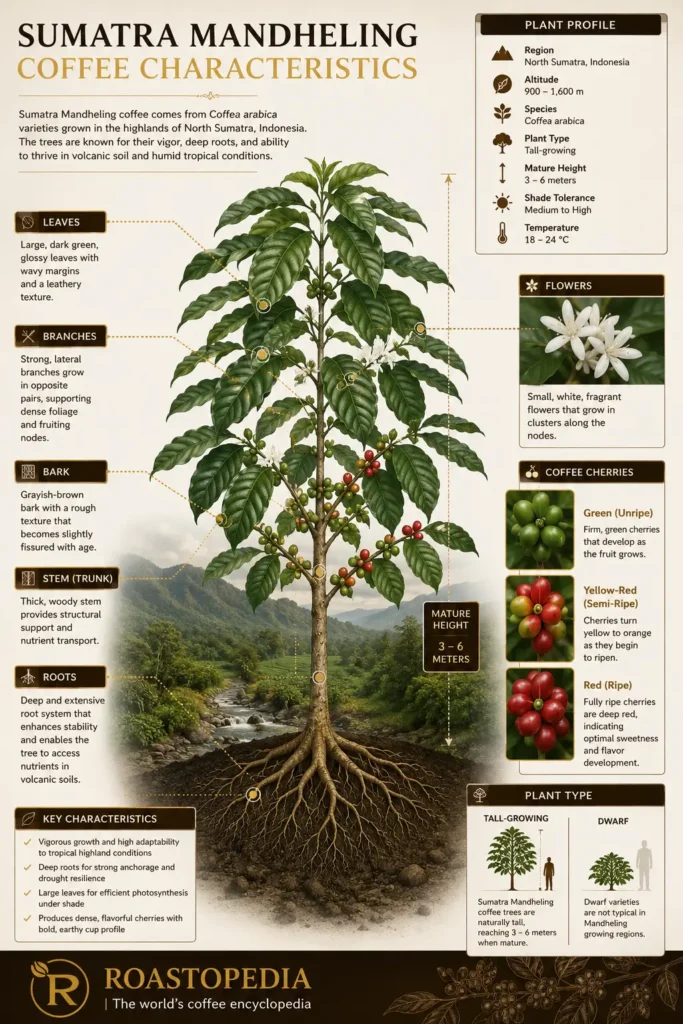
As with all cultivated coffee plants, Mandheling arabica is an evergreen shrub or small tree of the genus Coffea. The specific physical traits vary somewhat according to the underlying cultivar planted (Typica-descended lines tend toward a taller habit, while Timor Hybrid–derived cultivars are typically more compact), but general characteristics common to Mandheling gardens include:
- Stem and habit: A single upright central stem when young, developing lateral branching plagiotropic limbs as the plant matures. Traditionally grown plants may reach 3–5 meters if unpruned, though most smallholder gardens maintain trees at 2–3 meters through periodic pruning to ease hand-harvesting.
- Bark: Smooth and greyish-brown on young wood, becoming rougher and more fissured on older stems and the base of mature trees.
- Roots: A moderately developed taproot accompanied by a dense mat of lateral feeder roots concentrated in the uppermost 20–30 centimeters of soil, which makes the plant sensitive to topsoil erosion and competition from intercropped species.
- Leaves: Opposite, glossy dark green, elliptical leaves with wavy margins and a pointed tip, typically 10–15 centimeters in length.
- Flowers: Small, white, star-shaped, and strongly fragrant, appearing in dense clusters at the leaf axils shortly after the onset of rains, similar to the flowering pattern described for coffee flowers generally.
- Cherries: The Sumatra Mandheling coffee cherries feature oval drupes that ripen from green through yellow to deep red over roughly seven to nine months, each typically containing two flat-sided seeds. After wet-hulling, the parchment-free beans often display an irregular, somewhat compressed or “gnarled” appearance and a distinctive dark bluish-green to brownish coloration, a visual hallmark used to identify Sumatran wet-hulled lots.
In the cup, Mandheling coffee is generally described as full-bodied and syrupy, with muted acidity, low perceptible astringency, and a long, dry aftertaste carrying notes of earth, cedar, dried herbs, and dark chocolate. These characteristics are strongly shaped by both the underlying cultivar and the wet-hulling process, which shortens drying time but exposes parchment to more ambient moisture than fully washed or natural processing.
Growing Conditions
Mandheling coffee is cultivated primarily on the volcanic andosol soils of the Bukit Barisan mountain range and the highlands surrounding Lake Toba, soils that are naturally fertile, well-drained, and moderately acidic (roughly pH 5.5–6.5), conditions generally favorable to arabica within the broader Coffee Belt.
Cultivation occurs at elevations of approximately 750 to 1,500 meters above sea level, with some estate lots grown higher; altitude is widely associated with slower cherry maturation, denser beans, and more concentrated flavor development in arabica generally.
Smallholder plots, which account for the large majority of production, are commonly spaced at roughly 2 x 2 meters to 2.5 x 2.5 meters between trees, though spacing in traditional home gardens is often irregular, with coffee intercropped alongside food crops and shade species such as albizia, erythrina, and various fruit trees.
Fertilization practices vary widely: many smallholders rely on organic inputs such as compost, coffee pulp, and animal manure, while access to synthetic fertilizer depends on proximity to village cooperatives and credit programs. Annual rainfall in the growing region typically falls between 2,000 and 3,000 millimeters, generally well distributed but with a discernible drier period that supports the twice-yearly harvest.
Harvesting is done almost exclusively by hand, most commonly through selective picking of ripe cherries rather than the machine harvesting methods used in some other producing regions, consistent with broader coffee harvesting techniques used on smallholder farms worldwide.
Diseases
Coffee leaf rust (Hemileia vastatrix) remains the most historically significant disease affecting Sumatran arabica, having caused widespread crop failure across Indonesia beginning in the 1880s and permanently altering the varietal composition of the region’s coffee, much as it has affected susceptible cultivars such as Typica and Bourbon in producing regions worldwide. Modern Mandheling gardens rely substantially on rust-tolerant, Timor Hybrid–derived planting material, a strategy comparable to the disease-management approach used for other rust-susceptible cultivars such as Catuai.
Other disease and pest pressures reported in Sumatran coffee-growing areas include coffee berry disease, root-knot and lesion nematodes affecting the root system, and the coffee berry borer (Hypothenemus hampei), which damages developing cherries and can significantly reduce both yield and quality if not managed through integrated pest control and timely harvesting.
Sumatra Mandheling Global Production (as of 2026)
According to the United States Department of Agriculture’s Foreign Agricultural Service (USDA FAS), Indonesia’s total green coffee production for the 2025/26 market year was estimated at roughly 12.37 to 12.5 million 60-kilogram bags, with Coffea arabica accounting for a comparatively small share of that total. USDA forecasts Arabica production to rise slightly to 1.38 million bags in 2026/27, supported by expected recovery and improved yields. Sumatra accounts for 70–75% of national production, with southern provinces leading robusta production, while Sumatran arabica is concentrated in the northern part of the island.
Arabica cultivation in North Sumatra and Aceh faced setbacks heading into the 2025/26 season, as flooding affected key growing areas. USDA revised Arabica production down for 2025/26 due to floods that hit Arabica production regions in Aceh and North Sumatera.
Overall Indonesian coffee exports were projected around 7 to 7.8 million bags for the 2026/27 market year, with the United States, the European Union, and Egypt among the leading destination markets for Indonesian green coffee, and the United States remaining a significant buyer of Sumatran arabica specifically. Nearly all production, arabica included, continues to come from smallholder farms averaging one to two hectares rather than large estates.
Comparison with Similar Cultivars/Varieties
Sumatra Mandheling shares its wet-hulled origin and general flavor family with several other Indonesian and international coffees, while differing significantly from cultivars bred or selected primarily for high acidity and floral character, such as Geisha Coffee, SL28, and coffee grown from Ethiopian landrace populations. It also contrasts with large-fruited cultivars bred for size and yield, such as Pacamara or Mundo Novo, and with other Heirloom or region-specific landrace groups, and with related compact cultivars such as Caturra, which are grown in different agroecological contexts across Latin America and Africa.
| Coffee | Region | Typical Process | Altitude | Acidity | Body | Common Notes |
| Sumatra Mandheling | North Sumatra, Indonesia | Wet-hulled | 750–1,500 m | Low | Heavy | Earthy, spicy, cedar, dark chocolate |
| Sumatra Gayo | Aceh, Indonesia | Wet-hulled | 1,100–1,600 m | Low–medium | Heavy | Herbal, syrupy, mild spice |
| Sumatra Lintong | Lintongnihuta, North Sumatra | Wet-hulled | 1,200–1,500 m | Low | Heavy | Earthy, herbal, less acidity variance |
| Sulawesi Toraja | Sulawesi, Indonesia | Wet-hulled | 1,200–1,800 m | Low–medium | Full | Sweet, nutty, mild earthiness |
| Yemen Mocha | Yemen | Natural (dry) | 1,500–2,400 m | Medium–high | Medium | Wine-like, fruity, spicy |
| Yellow Bourbon/Bourbon-based lots | Latin America | Washed | 1,100–2,000 m | Medium–high | Medium | Sweet, balanced, red fruit |
See Also
- Sumatra Coffee
- Typica
- Bourbon
- SL28
- SL34
- Caturra
- Geisha Coffee
- Pacamara Coffee
- Mundo Novo Coffee
- Ethiopian Landrace Coffee
References
- InterAmerican Coffee Europe, “Indonesia – Sumatra Mandheling.” https://interamericancoffee.de/indonesia-sumatra-mandheling/
- Witham’s Coffee, “Sumatra Mandheling Gr 1 ‘Kuda Mas’.” https://withamscoffee.flywheelsites.com/tasting_notes/sumatra/
- Black Ink Coffee Company, “Best Sumatra Coffee: Our Review of the Best Sumatran Coffee Today.” https://blackinkcoffee.com/pages/sumatra-coffee
- United States Department of Agriculture, Foreign Agricultural Service, “Indonesia: Coffee Annual,” Report ID2026-0021 (May 2026). https://www.fas.usda.gov/data/gain-report/2026/05/Coffee%20Annual_Jakarta_Indonesia_ID2026-0021.pdf
- Daily Coffee News, “Indonesia Coffee Report: Production Predicted to Drop 8% in 2026/27” (May 26, 2026). https://dailycoffeenews.com/2026/05/26/indonesia-coffee-report-production-predicted-to-drop-8-in-2026-27/
- Daily Coffee News, “Indonesia Coffee Report: Exports Up Though Tariffs and EUDR Linger” (June 4, 2025). https://dailycoffeenews.com/2025/06/04/indonesia-coffee-report-exports-up-though-tariffs-and-eudr-linger/
- Statista, “Indonesia: Production of Coffee 2025/26” (citing USDA Foreign Agricultural Service data). https://www.statista.com/statistics/706965/production-of-coffee-in-indonesia/
- Wikipedia, “Giling Basah.” https://en.wikipedia.org/wiki/Giling_Basah
- Wikipedia, “Bourbon coffee.” https://en.wikipedia.org/wiki/Bourbon_coffee
- World Coffee Research, “Typica” variety catalog entry. https://varieties.worldcoffeeresearch.org/varieties/typica
- PHYTON (Techscience), “Coffee Leaf Rust (Hemileia vastatrix) Disease in Coffee Plants and Perspectives by the Disease Control.” https://www.techscience.com/phyton/v93n5/56745/html
- Wikipedia, “List of coffee varieties.” https://en.wikipedia.org/wiki/List_of_coffee_varieties