
Pacamara Coffee, or simply Pacamara, is a large-bean Arabica cultivar bred in El Salvador by intentionally crossing Pacas (a compact Bourbon mutation) with Maragogipe (a giant-bean Typica mutation).
The cross was made at the Salvadoran Institute for Coffee Research (Instituto Salvadoreño de Investigaciones del Café, ISIC) in 1958, but the plant taken to market decades later is not the F1 of that original cross — it’s a later, partially stabilized generation, commercially released in the late 1980s after roughly thirty years of pedigree selection.
The name is a portmanteau of its parents’ names (Pacas + Maragogipe), and the variety is defined agronomically less by a single fixed genotype than by a bundle of traits — dwarf stature, very large flat beans, and a segregating population that still throws a meaningful minority of parent-type offspring generations on.
| Attribute | Pacamara at a Glance |
|---|---|
| Species | Coffea arabica |
| Cultivar Type | Arabica cultivar (hybrid) |
| Developed In | El Salvador |
| Developed By | Salvadoran Institute for Coffee Research (ISIC) |
| Released | 1958 (commercial release) |
| Parent Varieties | Pacas × Maragogipe |
| Bean Size | Very large |
| Plant Size | Tall and vigorous |
| Leaf Characteristics | Large, broad, dark green leaves |
| Cherry Size | Large |
| Growing Altitude | 1,200–2,000 m (3,940–6,560 ft) |
| Climate | Cool tropical highlands |
| Yield | Moderate to high |
| Cup Profile | Sweet, complex, bright acidity, creamy body, floral and tropical fruit notes |
| Common Processing Methods | Washed, Natural, Honey |
| Primary Producing Countries | El Salvador, Honduras, Guatemala, Nicaragua, Costa Rica, Panama, Colombia |
| Disease Resistance | Moderate; susceptible to coffee leaf rust under unfavorable conditions |
| Best Known For | Exceptional cup quality and unusually large beans |
Origin and Breeding History
Pacas, the maternal side of the cross, is a natural, single-gene dwarfing mutation of Bourbon discovered in 1949 on the San Rafael farm on the slopes of the Santa Ana volcano, within a Bourbon block belonging to the Fernando Alberto Pacas Figueroa family — the individual credited with the discovery. ISIC formalized pedigree selection of Pacas starting around 1960, and the variety is among the top five prominent coffees in El Salvador today.
Other Coffea arabica cultivars include Bourbon, which accounts for 60-80% of the country’s coffee production; Pacas, 15%; Caturra and Catuai follow with less than 5% production.
Maragogipe is the large-bean mutation of Typica, first identified in the municipality of Maragogipe in Bahia, Brazil — commonly dated to the 1870s. It’s agronomically a poor performer (tall, low-yielding, disease-susceptible) but produces an unusually large, low-density seed, which is the trait breeders wanted to import.
ISIC’s Genetics Department crossed the two in 1958 with a specific goal: fold Maragogipe’s bean size and cup potential into a plant with Pacas’s compact habit and better field performance. The cross turned out to be genetically messier than planned.
Both parents carry dominant alleles for their defining traits, so a true Pacamara phenotype doesn’t breed true — plantings still segregate, with a commonly cited 10–20% of trees reverting to a Pacas- or Maragogipe-like phenotype in any given generation. That instability is why growers speak of Pacamara less as a fixed line and more as a population requiring ongoing nursery-stage selection.
Botanical and Genetic Profile
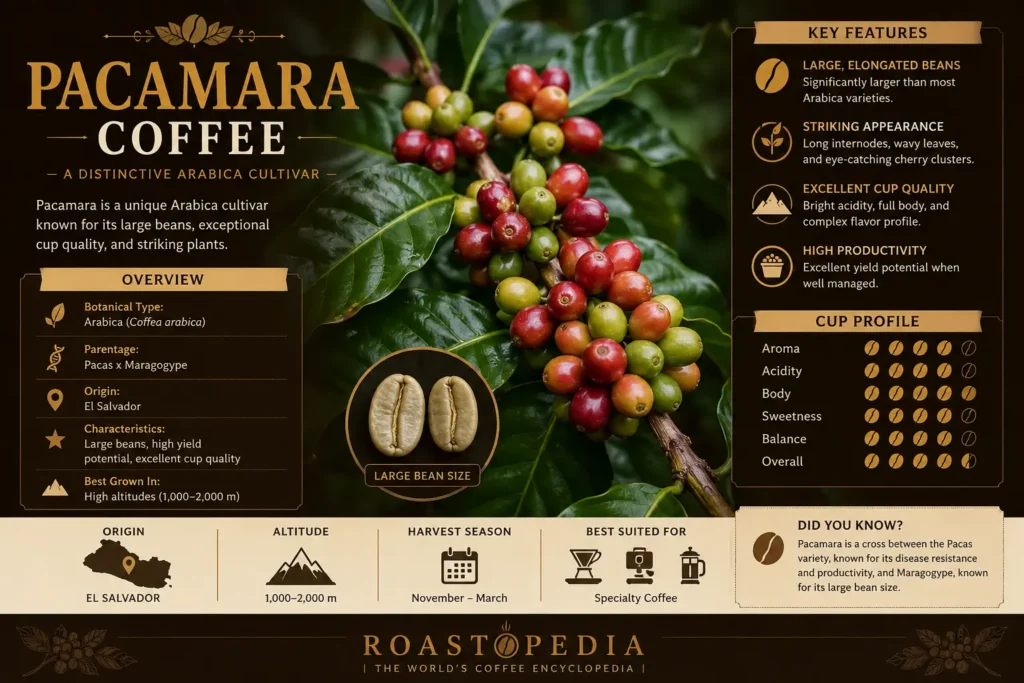
According to World Coffee Research’s variety catalog, Pacamara has a dwarf/compact growth habit inherited from Pacas, green-or-bronze new-leaf tips, very large bean size (on WCR’s relative scale, larger than Maragogipe-adjacent references), low yield potential, and it is not phenotypically uniform from one generation to the next. It is also flagged as highly susceptible to Ojo de Gallo — American leaf spot, caused by the fungus Mycena citricolor — a disease favored by the same high-elevation, high-humidity conditions that tend to produce Pacamara’s best Coffee Acidity and cup clarity.
Bean size is the trait most people notice first — screen sizes commonly run 18–20 or slightly more depending on the farm, altitude, and processing lot rather than being a fixed varietal constant.
Cultivation
Pacamara is grown almost exclusively in Central America, concentrated in El Salvador’s Apaneca-Ilamatepec range and the Alotepec-Metapán highlands, with smaller plantings in Honduras, Guatemala, and Nicaragua. Optimal altitude for quality potential is generally cited around 1,300–1,800 m, consistent with its susceptibility to leaf rust and Ojo de Gallo at lower, warmer elevations.
Because of its low yield and management overhead — not so many nurseries have the seedlings and need to rogue out reverted Pacas/Maragogipe types — it’s planted as a specialty-focused, not a volume, cultivar, usually on smaller estate or cooperative lots rather than commodity blocks.
Cup Profile and Reputation
At altitude, well-processed Pacamara has become one of the more recognizable cups on the competition circuit: pronounced florals, ripe stone- or tropical-fruit notes, herbal high tones (basil, sage — occasionally reads as tobacco in darker roasts), bright acidity, and a chocolate-leaning sweetness in the finish.
The coffee has been repeatedly placed at the top of El Salvador’s Cup of Excellence program — for example, a honey-processed Pacamara from Finca La Bendición in Chalatenango took first place in the 2024 competition at a score of 92.00, and Pacamara or Pacamara-blend lots have placed in the top three in multiple other years. Given how directly the cup depends on ripeness at harvest, most quality-focused Pacamara is produced through selective picking rather than strip harvesting.
See Also
References
- World Coffee Research — Pacamara variety profile, Coffee Varieties Catalog (varieties.worldcoffeeresearch.org/varieties/pacamara)
- World Coffee Research — Pacas variety profile, Coffee Varieties Catalog (varieties.worldcoffeeresearch.org/varieties/pacas)
- Perfect Daily Grind — “Interview: What’s So Special About Pacamara?” (perfectdailygrind.com, 2015, updated 2021)
- Daily Coffee News — “Four 90+ Lots Among Winners of 2022 El Salvador Cup of Excellence” (dailycoffeenews.com, 2022)
- Global Coffee Report — “El Salvador Cup of Excellence 2026 winners revealed” (gcrmag.com, 2026)
- Alliance for Coffee Excellence — El Salvador 2024 Cup of Excellence results (allianceforcoffeeexcellence.org)
- Fresh Cup Magazine — “A Bittersweet Cup of Excellence for El Salvador” (freshcup.com, 2020)
- Ozone Coffee Roasters — “Pacamara Coffee: Origins, Flavour & Why We Love It” (ozonecoffee.co.uk)
- Podium Coffee Club — “Pacamara: El Salvador’s Distinctive Hybrid” (podiumcoffeeclub.com)
- Santiago Coffee Importers — “The Pacamara Bean Story” (santiago.com.au, 2017)
- Inheritance Coffee — Pacas cultivar profile (inheritancecoffee.com)
- INLIGHT Coffee — “PACAMARA: The Art of El Salvador’s Coffee Innovators” (inlightcoffee.com)
- CABI Compendium — Datasheet: Mycena citricolor (American leaf spot of coffee) (cabi.org)
- Agronomía Mesoamericana (Universidad de Costa Rica) — Granados-Montero et al., “Leaf litter and Mycena citricolor inoculum on the American leaf spot epidemic” (revistas.ucr.ac.cr, 2020)