
Ethiopian Landrace Coffee refers to the indigenous, genetically diverse populations of Coffea arabica that occur wild or under traditional cultivation within the forests and highland farming systems of southwestern and southern Ethiopia. Often marketed as Ethiopian Heirloom Coffee, the two terms are frequently used interchangeably in the specialty coffee industry. However, landrace is the more scientifically precise term because it describes locally adapted coffee populations that developed over centuries through natural evolution and traditional farmer selection rather than formal breeding programs.
These landraces are commonly associated with the coffee-growing regions where they have been cultivated for centuries, including Sidama, Yirgacheffe, Harrar, Limu, Jimma, and Kaffa. Others are identified by traditional local names, such as Wolisho. Collectively, Ethiopian landraces represent the world’s largest remaining reservoir of natural Coffea arabica genetic diversity, making them an invaluable resource for coffee breeding, climate adaptation, disease resistance, and the long-term conservation of Arabica coffee.
At a Glance
| Attribute | Detail |
| Common names | Ethiopian Landrace Coffee, Ethiopian Heirloom Coffee |
| Species | Coffea arabica |
| Type | Indigenous landrace population (not a single cultivar) |
| Origin | Southwestern and southeastern highland forests of Ethiopia |
| Notable regions | Sidama, Yirgacheffe, Harrar, Limu, Jimma, Gedeo, Kaffa |
| Estimated genetic pool | 6,000 to over 10,000 distinct genotypes |
| Typical altitude | 1,500–2,200 meters above sea level |
| Cherry maturation | Approximately 7–9 months from flowering |
| Cup character | Floral, fruity, citrus, and tea-like notes with bright aftertaste |
| Related bred selections | JARC varieties (e.g., 74110, 74112, 7440) |
| Global production role | Basis of the majority of Ethiopia’s Arabica exports |
Etymology
The term “landrace” is a general agricultural and botanical term describing a domesticated, locally adapted plant population that has developed largely through natural selection and traditional farmer practices rather than deliberate scientific breeding.
Applied to Ethiopian coffee, the term distinguishes these populations from formally bred cultivars such as Bourbon, Typica, or Caturra, which trace to a single identifiable plant or a narrow set of selections. The alternative term “heirloom” entered common trade usage as a way of signaling that Ethiopian coffee did not fit the standard variety-naming conventions used elsewhere; it borrows from the horticultural sense of “heirloom,” referring to plant material passed down over generations rather than introduced through modern breeding.
Within Ethiopia, farmers and researchers more often refer to individual landraces by their local or regional name, such as Kurume or Dega, names frequently drawn from the indigenous tree species under which the coffee traditionally grows, rather than by the umbrella terms “landrace” or “heirloom” used internationally.
History
Ethiopia is widely regarded as the center of origin of Coffea arabica, with the species believed to have evolved in the undergrowth of the highland forests of the southwestern regions, including present-day Kaffa and Sheka. Wild coffee populations in these forests are considered the closest living relatives of the ancestral arabica gene pool, having developed without the genetic bottlenecking experienced by coffee later introduced to other continents.
According to Ethiopian oral tradition, coffee’s stimulant properties were first noticed by a goatherd named Kaldi, whose goats became energetic after eating the red cherries of a wild shrub; the story places the discovery in the Kaffa region and situates its early preparation with local monks, a tradition also referenced in accounts of the traditional Buna ceremony.
From these highland forests, cultivated coffee is believed to have spread across the Red Sea to Yemen by the fifteenth century, where it was refined into a traded commodity, eventually giving rise to the cultivars that later populated coffee farms across the Americas and Asia.
Within Ethiopia itself, coffee cultivation historically proceeded without centralized variety development. Prior to the 1970s, individual farmers selected and propagated seed locally, generation after generation, resulting in thousands of genetically distinct populations adapted to specific microclimates, soils, and elevations.
A severe outbreak of coffee berry disease in the 1960s prompted the Ethiopian government to establish the Jimma Agricultural Research Center (JARC) to catalog existing coffee populations and begin breeding for disease resistance, yield, and quality; field surveys conducted between 1989 and 1994 documented and named many regional landraces still recognized today.
JARC’s breeding work produced a set of released varieties, identified by numbers such as 74110, 74112, and 7440, grown alongside, though generally on a smaller scale than, the older landrace populations. Because Ethiopian export contracts have traditionally not required detailed varietal disclosure, green coffee from mixed landrace plantings has long been sold under the single umbrella designation “Ethiopian Heirloom,” a labeling practice that persists in the specialty coffee trade today.
Ethiopian Landrace Coffee Characteristics
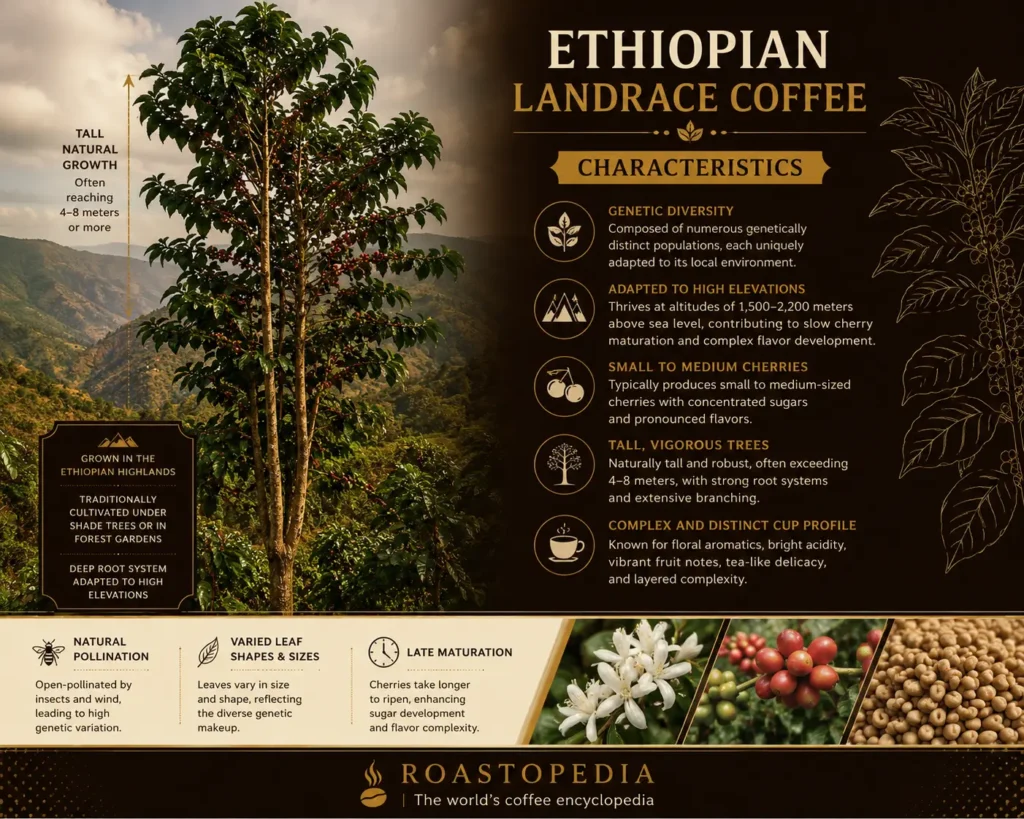
Because Ethiopian landrace coffee comprises thousands of distinct, only partially cataloged genotypes rather than a single defined cultivar, its physical characteristics vary considerably between populations.
In general, landrace coffee plants tend to be taller and less uniform in growth habit than commercially bred dwarf or compact cultivars, reflecting selection for survival within a mixed forest canopy rather than for density planting. Leaf shape, size, and color vary between populations, with some landraces exhibiting narrow, elongated leaves and others broader foliage; certain named landraces, such as Wolisho, are distinguished specifically by leaf length.
The coffee flower follows the typical arabica pattern for the species: small, white, star-shaped blossoms produced in dense clusters at the leaf axils, remaining open for only two to four days and predominantly self-pollinating. Cherry size, shape, and ripening color also differ by landrace, with some populations producing notably large cherries, and bean shape is generally more irregular than that of uniform commercial cultivars, a trait often cited by millers and graders as a practical marker of landrace origin. Cup characteristics associated with Ethiopian landraces frequently include pronounced floral aromatics, citrus and stone-fruit acidity, tea-like body, and a lingering, often winey aftertaste, though flavor profiles differ meaningfully by region, altitude, and processing method.
Growing Conditions
Ethiopian landrace coffee is traditionally grown as an understory crop within or beneath native forest and semi-forest canopy, particularly in the southwestern zones, a cultivation style referred to locally as forest or semi-forest coffee. In more intensively farmed garden systems common in areas such as Sidama and Yirgacheffe, coffee is interplanted with food crops and shade trees on smallholder plots rather than grown in open monoculture.
Soils across the main growing regions are generally deep, well-drained volcanic or loamy soils rich in organic matter, consistent with the broader requirements described for Coffea arabica cultivation. Altitude is a defining factor in quality: the best-regarded landrace lots are typically grown between roughly 1,500 and 2,200 meters above sea level, and higher elevations are generally associated with slower cherry maturation, denser beans, and more pronounced acidity.
Because landrace populations are unevenly distributed and largely unmapped genetically, spacing and fertilization practices vary widely by smallholder tradition rather than standardized commercial protocols, with many farmers relying on organic matter from the surrounding shade-tree ecosystem instead of synthetic fertilizer. Rainfall requirements follow the general arabica pattern of an annual total between approximately 1,500 and 2,500 millimeters, with a distinct drier period that helps trigger flowering.
Diseases
Ethiopian landrace populations as a whole display a wide range of natural resistance and susceptibility, since no single genetic profile applies across thousands of distinct populations; this diversity is considered a valuable resource for breeding disease-resistant coffee worldwide. Coffee berry disease, caused by the fungus Colletotrichum kahawae, has historically been among the most damaging diseases affecting Ethiopian arabica, causing premature fruit drop and, in the 1960s, prompting the establishment of JARC specifically to identify and breed resistant material.
Coffee leaf rust, caused by the fungus Hemileia vastatrix, also affects landrace populations, though documented resistance varies significantly between individual landraces, a trait that has made Ethiopian germplasm of long-standing interest to international breeding programs, including the variety later known as Geisha (Gesha), noted for leaf rust resistance after its introduction to Central America. Pests such as the coffee berry borer additionally affect yields in parts of the growing regions.
Because landrace coffee is frequently grown within a forest or semi-forest ecosystem with high biodiversity, some agronomists associate this cultivation style with a degree of natural pest and disease regulation compared with open monoculture, though outcomes vary by location and management practice.
Ethiopian Landrace Coffee Global Production
Ethiopia is Africa’s largest coffee producer and one of the world’s leading exporters of Arabica coffee, with the overwhelming majority of national output consisting of landrace and heirloom populations rather than internationally recognized bred cultivars. According to United States Department of Agriculture (USDA) estimates, Ethiopian coffee production for the 2025/26 marketing year was projected at approximately 11.6 million 60-kilogram bags, equivalent to roughly 694,000 metric tons, with exports forecast at around 7.8 million bags.
Coffee remains central to the Ethiopian economy, supporting the livelihoods of an estimated 15 to 20 million people and typically accounting for around 30 to 35 percent of total national export earnings. Because Ethiopian export contracts have historically not required disclosure of specific varietal identity for most lots, green coffee derived from mixed landrace plantings is commonly sold internationally under the general designation “Ethiopian Heirloom,” while a smaller share of production, particularly from JARC-released varieties or increasingly from small, traceable estate or single-farm lots, is marketed with more specific varietal or regional identification.
Leading production and export regions include Sidama, Yirgacheffe, Guji, Harrar, Limu, and Jimma, each associated with somewhat distinct flavor tendencies tied to local landrace populations, altitude, and processing traditions such as the washed and natural processing methods common across these areas.
Comparison with Similar Cultivars
Ethiopian landrace coffee differs from most other named coffee cultivars in that it does not represent a single, genetically uniform lineage. Cultivars such as Typica and Bourbon, which spread from early Yemeni and later colonial-era plantings to become the genetic base of much of the coffee grown in Latin America and Asia, both descend from a narrow founder population taken out of Ethiopia and Yemen centuries ago, resulting in comparatively limited genetic diversity relative to Ethiopian landraces.
Cultivars developed for productivity and uniformity, such as Caturra, a natural dwarf mutation of Bourbon, or Mundo Novo, a Brazilian hybrid of Typica and Bourbon, were selected for consistent architecture, yield, and, in some cases, mechanized harvesting, characteristics generally not emphasized in traditional Ethiopian landrace selection.
SL28, developed in Kenya from selections that include Ethiopian-derived genetic material, and Pacamara, a Salvadoran cross of Pacas and Maragogipe, are further examples of deliberately bred cultivars with documented, traceable parentage, in contrast to the largely unmapped ancestry of individual Ethiopian landraces.
The cultivar most directly traceable to Ethiopian landrace material is Geisha (also spelled Gesha), first collected near the town of Gesha in southwestern Ethiopia and later introduced to Central America, where its floral, jasmine-like cup profile made it one of the most commercially valuable coffees in the world; this history is often cited as evidence of the quality potential still present within uncharacterized Ethiopian landrace populations. More broadly, the term “Heirloom Coffee” used across the specialty trade generally refers to this same body of Ethiopian genetic material.
See Also
- Sumatra
- Arabica
- Heirloom Coffee
- Typica
- Bourbon
- Geisha Coffee
- SL28
- Caturra
- Mundo Novo Coffee
- Pacamara Coffee
References
- USDA Foreign Agricultural Service, Ethiopia: Coffee Annual, GAIN Report ET2026-0005 (May 2026), https://www.fas.usda.gov/data/gain-report/2026/05/Coffee%20Annual_Addis%20Ababa_Ethiopia_ET2026-0005.pdf
- USDA Foreign Agricultural Service, Ethiopia: Coffee Annual, GAIN Report ET2025-0014, https://apps.fas.usda.gov/newgainapi/api/Report/DownloadReportByFileName?fileName=Coffee+Annual_Addis+Ababa_Ethiopia_ET2025-0014
- Daily Coffee News, “Ethiopia Coffee Report: Production, Consumption and Exports All Up” (June 2025), https://dailycoffeenews.com/2025/06/09/ethiopia-coffee-report-production-consumption-and-exports-all-up/
- Encyclopædia Britannica, “Coffee,” https://www.britannica.com/topic/coffee
- Centre for Agriculture and Bioscience International (CABI), Invasive Species Compendium, entry on Hemileia vastatrix (coffee leaf rust), https://www.cabi.org/isc
- Ally Coffee, “Ethiopian Coffee Varieties,” Medium (October 2020), https://medium.com/ally-coffee/ethiopian-coffee-varieties-2e3a2703330d
- Sagebrush Coffee, “Heirloom Coffee: Ethiopian Landrace Varieties & Flavors,” https://sagebrushcoffee.com/pages/heirloom-coffee-variety
- 1Zpresso, “Ethiopian Coffee Guide: Flavor Profiles, Varieties, Growing Regions & Grading,” https://1zpresso.coffee/ethiopian-coffee-guide/
- Wikipedia, “Coffee ceremony of Ethiopia and Eritrea,” https://en.wikipedia.org/wiki/Coffee_ceremony_of_Ethiopia_and_Eritrea
- World Coffee Research, Arabica Coffee Varieties Catalog, https://varieties.worldcoffeeresearch.org/
- Further Africa, “Ethiopia Set to Break Coffee Production Record with 694,000 Tonnes Forecast for 2025/26” (June 2025), https://furtherafrica.com/2025/06/09/ethiopia-set-to-break-coffee-production-record-in-2025-26/