
The Washed Process, also known as the Wet Process or Washed Coffee, is a coffee processing method in which the skin, pulp, and mucilage of the coffee cherry are removed before the coffee is dried. It is one of the oldest and most influential post-harvest processing methods in the coffee industry and is widely regarded as the benchmark for producing coffees with exceptional clarity, acidity, and transparency of origin. In the washed process, water serves as the principal medium through which fruit material is separated from the seed, distinguishing the method from the Natural Process, in which the coffee cherry dries intact, and from intermediate methods such as the Honey Process and Pulped Natural Process, which retain varying amounts of mucilage during drying.
The washed process occupies a central position in both commercial and specialty coffee production. For more than a century, it has shaped the reputations of many of the world’s most celebrated coffee-producing regions, including Colombia, Kenya, Guatemala, Costa Rica, Rwanda, and Ethiopia. Although technological developments have introduced numerous variations and innovations, the fundamental objective of the method remains unchanged: to remove the fruit surrounding the coffee seed before drying in order to maximize cup cleanliness and reveal the intrinsic characteristics of the coffee itself.
Terminology
The terms washed process, washed coffee, and wet process are often used interchangeably, though they describe slightly different aspects of the same preparation method. “Wet process” refers broadly to the use of water during post-harvest preparation, while “washed process” specifically describes the removal of mucilage through fermentation and washing. In contemporary specialty coffee discourse, “washed process” has become the preferred term because it more accurately describes the defining stage of the method.
In coffee-producing countries, local terminology may vary. Spanish-speaking regions commonly use terms such as lavado or café lavado, both meaning “washed coffee.” Similar equivalents exist throughout coffee-growing regions in Africa and Asia.
Historical Development
The origins of the washed process can be traced to the nineteenth century, when expanding international demand for coffee encouraged producers to seek more consistent methods of preparing coffee for export. Prior to the widespread adoption of mechanical depulping equipment, coffee was often dried inside the fruit, a method that required minimal infrastructure but frequently produced inconsistent results.
The development of mechanical pulpers transformed coffee processing by enabling producers to remove the skin and pulp shortly after harvest. This innovation was particularly significant in regions characterized by abundant water resources and mountainous terrain. Central American producers were among the earliest adopters, followed by coffee-growing regions throughout South America and East Africa.
The expansion of washed processing coincided with increasing quality standards in international coffee markets. Traders and roasters valued washed coffees for their uniform appearance, reduced incidence of defects, and cleaner flavor profiles. As global coffee commerce matured during the twentieth century, the washed process became the dominant preparation method in many producing countries.
The emergence of the specialty coffee industry further reinforced the importance of washed coffees. As consumers and professionals became increasingly interested in terroir, varietal distinctions, and regional flavor expression, washed processing gained recognition as a method capable of revealing subtle sensory characteristics that might otherwise be obscured by fruit-driven fermentation flavors.
Scientific Principles
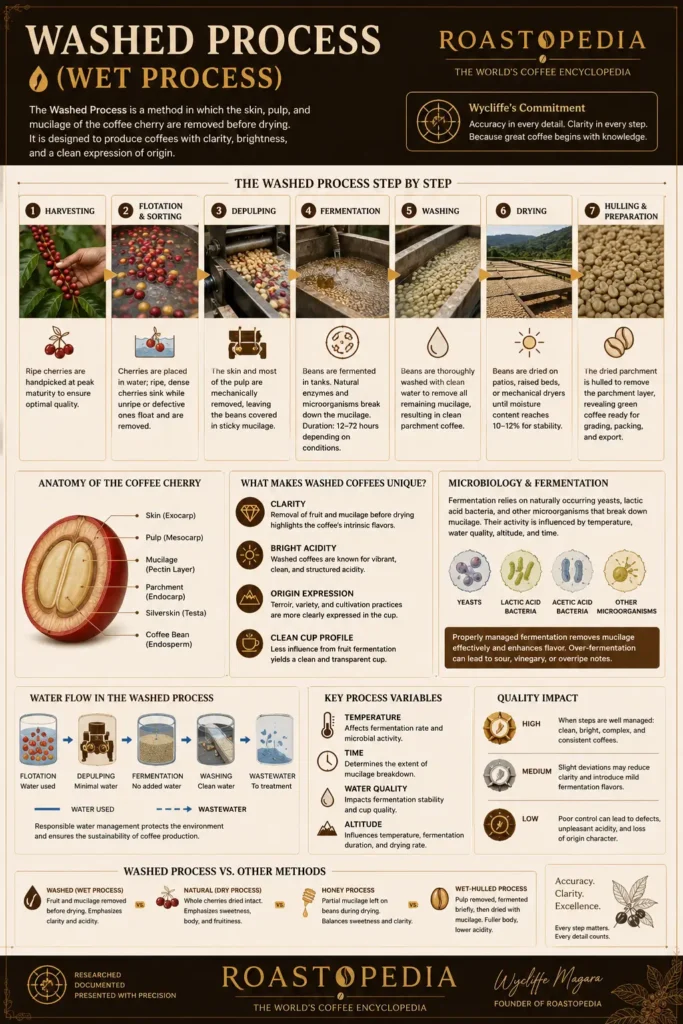
The washed process is fundamentally a method of controlled biological and physical separation. The coffee cherry consists of several layers surrounding the seed, including the outer skin, the fleshy pulp, the mucilage, the parchment layer, and the silverskin. The objective of processing is to remove these outer layers while preserving the integrity of the seed.
The mucilage plays a particularly important role in washed processing. This sticky layer contains complex carbohydrates, sugars, pectins, proteins, minerals, and organic compounds. Its adhesive properties make mechanical removal difficult. Instead, producers rely upon microbial activity and enzymatic degradation to break down the mucilage before washing it away.
The interaction between microorganisms, temperature, moisture, oxygen availability, and processing duration determines the effectiveness of fermentation and influences the resulting coffee quality. Consequently, washed processing is not merely a mechanical operation but a carefully managed biological process.
Harvesting and Cherry Selection
The quality of a washed coffee begins with harvesting. Because the method is designed to reveal the intrinsic characteristics of the coffee, defects introduced during harvest are often highly noticeable in the finished cup.
Selective hand-picking is therefore common in high-quality washed coffee production. Workers harvest cherries at peak ripeness, identified by color, firmness, and sugar content. Overripe cherries may introduce undesirable fermentation characteristics, while underripe cherries can contribute vegetal flavors and astringency.
Following harvest, cherries are typically transported to a wet mill as quickly as possible. Delays between picking and processing can initiate uncontrolled fermentation, increasing the risk of quality deterioration.
Flotation and Sorting
Upon arrival at the processing facility, coffee cherries are frequently subjected to flotation sorting. During this stage, cherries are immersed in water tanks where density differences facilitate separation.
Healthy, mature cherries tend to sink because of their greater density. Defective cherries, insect-damaged fruit, underripe cherries, and foreign matter often float and can be removed. Although flotation is not a substitute for careful harvesting, it serves as an additional quality-control measure that improves uniformity within a processing lot.
Modern processing facilities may incorporate further sorting mechanisms, including mechanical density separators and optical sorting systems, to enhance consistency.
Depulping
Depulping is the process through which the outer skin and much of the fruit pulp are mechanically removed. This operation is performed using machines equipped with rotating drums, discs, or cylinders that separate the seed from the surrounding fruit.
The effectiveness of depulping depends upon proper machine calibration. Excessive pressure may damage the parchment-covered seed, while insufficient pressure can leave excessive fruit material attached. Both outcomes can negatively affect quality.
After depulping, the coffee remains coated in mucilage. At this stage, the coffee is commonly referred to as parchment coffee because the parchment layer remains intact around the seed.
Fermentation
Fermentation is among the most important stages of the washed process. During this phase, naturally occurring microorganisms metabolize sugars and other compounds within the mucilage, facilitating its removal.
Historically, fermentation was viewed primarily as a cleaning mechanism. Contemporary research has demonstrated that fermentation also influences coffee chemistry and sensory quality. The process involves diverse microbial populations, including yeasts, lactic acid bacteria, acetic acid bacteria, and other microorganisms naturally present on coffee cherries and processing equipment.
The duration of fermentation varies considerably. Environmental temperature, altitude, microbial activity, coffee variety, and local tradition all influence the required processing time. In cooler regions, fermentation may extend beyond forty-eight hours, whereas warmer conditions can accelerate the process significantly.
Properly managed fermentation results in efficient mucilage degradation and desirable flavor development. Excessive fermentation, however, may generate undesirable compounds associated with sour, vinegar-like, alcoholic, or overripe flavors.
Washing
Once fermentation is complete, the coffee undergoes washing. Water is used to remove the degraded mucilage from the parchment-covered seed. Traditionally, washing channels allowed workers to agitate the coffee manually while simultaneously removing any remaining defects.
The washing stage is responsible for the characteristic cleanliness associated with washed coffees. By removing residual fruit material before drying, the process minimizes the prolonged interaction between the seed and fruit compounds that characterizes methods such as the Natural Process.
The quality of water used during washing is also important. Contaminated water can introduce undesirable microorganisms and negatively affect coffee quality.
Drying
After washing, the coffee must be dried to a moisture level suitable for storage and transportation. Excess moisture promotes microbial growth, mold development, and physical deterioration.
Drying may occur on patios, raised beds, or mechanical drying systems. Regardless of the method employed, uniform moisture reduction is essential. Uneven drying can create moisture gradients within the coffee, leading to instability during storage.
The drying phase generally continues until moisture content reaches approximately 10–12 percent. At this level, the coffee is sufficiently stable for export preparation while retaining the qualities necessary for long-term preservation.
Microbiology of Washed Processing
Advances in microbiological research have significantly expanded scientific understanding of washed coffee processing. Fermentation is now recognized as a dynamic ecological system involving interactions among numerous microbial species.
Yeasts are typically among the earliest colonizers of the fermentation environment. These organisms metabolize simple sugars and produce metabolites that influence both microbial succession and flavor development. As fermentation progresses, bacterial populations increase, contributing to the degradation of mucilage and the production of organic acids.
The composition of microbial communities varies according to geographic region, environmental conditions, coffee variety, and processing practices. This variability helps explain why washed coffees from different origins often exhibit distinctive sensory characteristics despite sharing a common processing framework.
Recent studies suggest that microbial activity during fermentation may influence the formation of volatile aroma precursors that later contribute to flavor development during roasting.
Influence on Coffee Quality
The washed process is widely associated with sensory clarity. Because fruit material is removed before drying, the resulting coffee tends to exhibit a transparent expression of origin characteristics.
Acidity is often one of the most prominent attributes of washed coffees. Citric, malic, phosphoric, and tartaric acid perceptions are frequently more apparent than in coffees processed through methods that emphasize fruit-driven fermentation.
Flavor separation is another defining characteristic. Individual tasting notes are often easier to identify because fewer fermentation-derived compounds compete for sensory attention. This clarity is particularly valued in specialty coffee evaluation, where judges seek to distinguish subtle origin-specific characteristics.
The body of washed coffees is often perceived as lighter than that of natural-processed coffees. While exceptions exist, the removal of fruit material prior to drying generally produces a cleaner and less syrupy mouthfeel.
Regional Variations
Although the washed process follows common principles worldwide, regional adaptations have produced distinct processing traditions.
In Colombia, washed processing is deeply integrated into smallholder coffee production. Farms frequently depulp coffee shortly after harvest and conduct fermentation in small tanks before washing and drying.
In Kenya, washed processing often incorporates extended soaking stages following fermentation. This practice is believed by some producers and buyers to contribute to the country’s characteristic acidity and intense flavor definition.
Ethiopia produces some of the world’s most celebrated washed coffees, particularly in regions such as Yirgacheffe and Sidama. These coffees are renowned for floral aromatics, citrus-like acidity, and remarkable cup clarity.
In Rwanda and Burundi, centralized washing stations play a major role in coffee production. Smallholder farmers deliver cherries to communal facilities where processing is conducted according to standardized quality protocols.
Central American countries such as Costa Rica and Guatemala have also developed sophisticated washed-processing traditions supported by advanced milling infrastructure and extensive quality-control systems.
Environmental Considerations
The washed process has long been associated with substantial water consumption. Traditional systems may require large volumes of water for flotation, fermentation management, and washing operations.
Improper disposal of processing wastewater can create environmental challenges. Fermentation by-products and dissolved organic matter may reduce oxygen levels in waterways and negatively affect aquatic ecosystems.
In response, many producing regions have adopted water-conservation technologies and wastewater-treatment systems. Eco-pulpers, mechanical mucilage removers, and closed-loop water systems have significantly reduced the environmental footprint of washed processing in many areas.
Sustainability initiatives increasingly emphasize responsible water management as an essential component of modern coffee production.
Contemporary Innovations
Although the washed process is one of coffee’s oldest preparation methods, it continues to evolve. Advances in microbiology, fermentation science, and process engineering have generated new approaches that build upon traditional foundations.
Controlled fermentation techniques allow producers to monitor temperature, oxygen availability, and microbial activity with unprecedented precision. Some producers employ selected microbial cultures to achieve greater consistency and predictability.
Mechanical demucilagers have reduced reliance on lengthy fermentation periods by physically removing mucilage before drying. These systems can substantially decrease water consumption while maintaining many of the sensory characteristics associated with washed coffees.
Research institutions and specialty producers continue to explore how processing variables influence flavor development, demonstrating that washed processing remains an active field of scientific and commercial innovation.
Role in Specialty Coffee
The washed process occupies a foundational role within specialty coffee. Many of the industry’s most celebrated coffees are washed lots whose quality derives from their ability to express varietal, environmental, and agricultural influences with exceptional clarity.
Coffee professionals frequently regard washed coffees as a benchmark for evaluating origin character. Because processing influence is comparatively restrained, sensory attributes can often be traced more directly to genetics, terroir, cultivation practices, and harvest quality.
For this reason, washed coffees remain central to quality competitions, professional cuppings (see Cupping), educational programs, and scientific research.
See Also
- Natural Process (Dry Process)
- Honey Process
- Pulped Natural Process
- Semi-Washed Process (Wet-Hulled Preparation)
- Wet-Hulled Process (Giling Basah)
References
- Illy, Andrea & Viani, Rinantonio. Espresso Coffee: The Science of Quality. Academic Press, 2005.
- International Coffee Organization (ICO). Coffee Processing and Quality Resources. https://www.ico.org
- World Coffee Research. Coffee Processing Fundamentals. https://worldcoffeeresearch.org
- Specialty Coffee Association. Coffee Processing: Methods and Impact on Quality. https://sca.coffee
- Coffee Quality Institute. Post-Harvest Processing and Quality Preservation. https://www.coffeeinstitute.org
- Clarke, R. J., and Macrae, R. Coffee: Technology, Volume 2. Springer Science & Business Media.
- Farah, Adriana. Coffee: Production, Quality and Chemistry. Royal Society of Chemistry.
- De Bruyn, Frederik et al. “Exploring the Impacts of Postharvest Processing on the Microbiota and Metabolite Profiles during Green Coffee Bean Production.” Applied and Environmental Microbiology.
- Evangelista, Sergio R. et al. “Microbiological Diversity Associated with the Coffee Fermentation Process.” Food Microbiology.
- Wintgens, Jean Nicolas. Coffee: Growing, Processing, Sustainable Production. Wiley-VCH.