
Mexican coffee refers either to coffee produced in Mexico or to coffee beverages traditionally associated with Mexican cuisine and culture. As an agricultural product, it denotes coffee cultivated primarily in the southern states of Chiapas, Veracruz, Oaxaca, Puebla, and Guerrero, with Mexico ranking among the world’s leading producers of Arabica coffee.
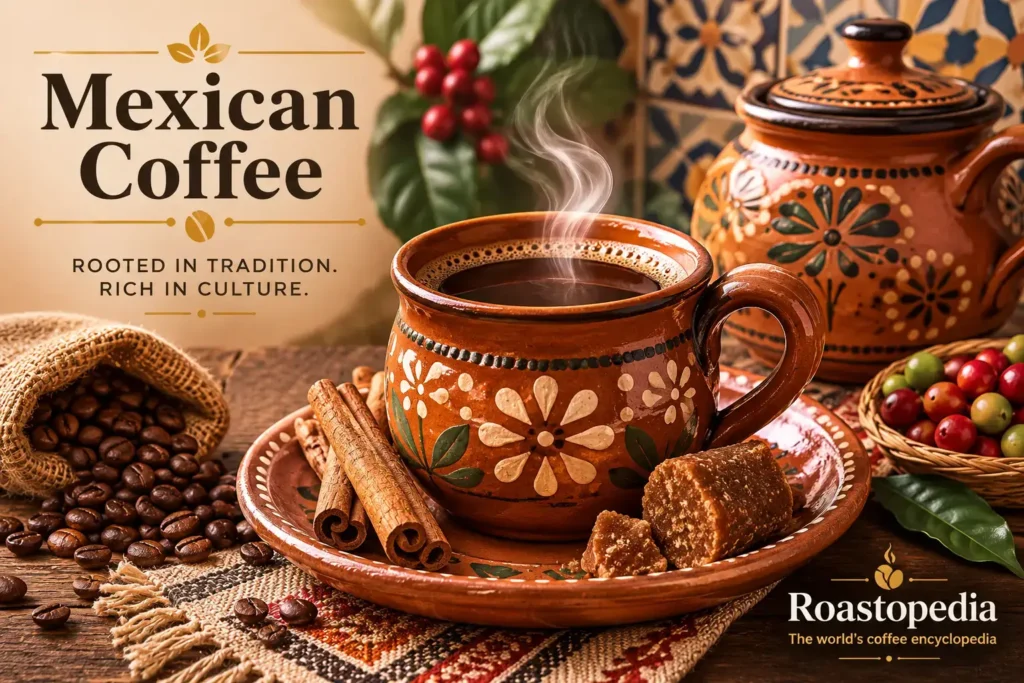
As a beverage, the term most commonly refers to café de olla, a traditional preparation in which coffee is simmered with cinnamon and piloncillo in an earthenware pot. Outside Mexico, particularly in the United States, “Mexican coffee” may also refer to a hot coffee cocktail prepared with brewed coffee, tequila, and coffee liqueur, often Kahlúa, although recipes vary.
Mexican Coffee at a Glance
| Type | National coffee tradition |
| Country | Mexico |
| Primary coffee species | Coffea arabica (predominantly) |
| Main producing regions | Chiapas, Veracruz, Oaxaca, Puebla, Guerrero |
| Traditional preparation | Café de olla |
| Characteristic ingredients | Coffee, cinnamon, piloncillo (traditional) |
| Serving style | Hot; black or with milk, depending on preparation |
| International interpretation | Coffee cocktail made with brewed coffee, tequila, and coffee liqueur (recipe varies) |
| Related beverages | Café de olla, café con leche, café de canela, Mexican coffee cocktail |
| Cultural significance | Integral to Mexican coffee-growing regions and café culture |
Etymology
The word “coffee” entered Spanish as café, derived from the Ottoman Turkish kahve, which in turn traces to the Arabic qahwa. The Arabic term moved through Turkish and Italian (caffè) before entering French as café and then Spanish, the form used throughout Mexico.
The Mexican preparation café de olla combines café with olla, the Spanish word for a clay or earthenware cooking pot, describing the vessel in which the coffee is traditionally simmered. Piloncillo, the unrefined cane sugar used in many Mexican coffee preparations, derives from pilón, referring to the cone-shaped mold in which the sugar is traditionally cast.
History
Before the arrival of coffee, communities in what is now Mexico consumed hot spiced beverages based on cacao. Aztec elites, including Moctezuma, are documented as having consumed infusions of cacao, corn, honey, and spices prepared in clay vessels, a practice that later influenced the preparation style of Mexican coffee.
Coffee itself is not native to Mexico; like all coffee grown in the Americas, it originates from stock introduced from elsewhere within the broader Coffee Belt. Spanish colonists introduced coffee plants to the port of Veracruz in the late 18th century, with most accounts placing the initial plantings in the 1790s using seedstock brought from the Caribbean, including Cuba and the Dominican Republic.
Customs records indicate a few hundred bags of coffee were exported from Veracruz as early as 1802, though exports were interrupted for roughly two decades following the Mexican War of Independence. One of the first notable coffee plantings took place around 1808 at the La Orduña hacienda in Coatepec, Veracruz.
Cultivation subsequently spread beyond Veracruz. In 1828, coffee seeds obtained from Yemen were planted in Uruapan, Michoacán, by Jose Mariano Michelena, and in 1847 coffee trees from Guatemala were introduced into Chiapas, which went on to become Mexico’s second-largest producing state after Veracruz. German immigrants, including botanist Karl Sartorius, established large coffee estates in central Veracruz during the late 1820s, contributing to the growth of a scientifically managed coffee sector in the region.
By 1874, more than three million coffee trees were under cultivation across the country, and Oaxaca began commercial coffee production later in the 19th century after synthetic dyes undercut its traditional cochineal industry. Coffee did not become a significant export commodity until the 1870s, when producers in Veracruz, Oaxaca, and Chiapas began selling beans at volume, and small, often Indigenous-run farms using traditional selective picking methods became central to production in the 20th century.
Café de olla, the beverage most closely identified with Mexican coffee tradition, is generally dated to the Mexican Revolution (1910–1920). Accounts describe soldaderas, also called Adelitas — women who supported revolutionary troops with cooking and camp duties — preparing coffee with cinnamon and piloncillo in large clay pots to sustain soldiers in the field.
The drink was reportedly a favorite of revolutionary leader Emiliano Zapata. Following the revolution, the government later established the Instituto Mexicano del Café (INMECAFE) to provide credit and technical assistance to coffee producers, supporting the expansion of small-scale farming that continues to define Mexican coffee production today.
Mexican Coffee Recipe
The recipe below reflects the traditional preparation of café de olla, the dish most commonly referred to as “Mexican coffee,” and differs from a simple Café Solo in that it is simmered with spices rather than brewed as black coffee alone.
Yield: 4 servings
- 4 cups water
- 1 cinnamon stick (preferably Mexican canela)
- 2–3 whole cloves
- 1 piece piloncillo (approximately 2 oz), or substitute dark brown sugar
- 4 tablespoons coarsely ground coffee
- Optional: orange peel or star anise
Mexican Coffee Ingredients
- Coffee: Coarsely ground, medium-to-dark roast coffee, traditionally sourced from Chiapas, Veracruz, or Oaxaca and drawn from coffee types and varieties & cultivars suited to Mexico’s highland terrain.
- Piloncillo: Unrefined, minimally processed cane sugar that retains molasses content, giving the drink its characteristic caramelized sweetness — the same base sugar featured in Piloncillo Coffee.
- Cinnamon: Typically Ceylon or Mexican canela, added whole rather than ground.
- Cloves: Used in small quantities for aromatic depth.
- Water: The base liquid, simmered rather than passed quickly through a filter or machine.
- Optional additions: Orange peel, star anise, or roasted cacao, depending on regional and family variations.
How to Make Mexican Coffee (Traditional Preparation)
- Combine water, cinnamon stick, cloves, and piloncillo in a clay pot (olla de barro) or a heavy saucepan.
- Bring the mixture to a gentle boil over medium heat, stirring until the piloncillo fully dissolves.
- Reduce the heat and allow the spiced water to simmer for 5–10 minutes so the flavors infuse.
- Add the ground coffee directly to the liquid, a stovetop infusion method distinct from the pressurized or filtered techniques.
- Simmer for an additional 3–5 minutes, without allowing the mixture to boil vigorously.
- Remove the pot from heat and let the coffee grounds settle for a few minutes.
- Strain the coffee through a fine sieve or cloth into cups, traditionally earthenware mugs, and serve hot.
Regional Variations
Mexican coffee culture varies by region, community, and household. Café con leche, prepared by combining brewed coffee with hot milk, is a common everyday beverage throughout much of Mexico and differs from the Italian caffè latte in that it is traditionally made without microfoam or textured milk. Traditional café de olla is prepared with coffee, cinnamon, and piloncillo simmered in an earthenware clay pot, although some regional and family recipes also incorporate ingredients such as roasted cacao, cloves, or orange peel.
In parts of the United States with large Mexican-American populations, “Mexican Coffee” more commonly refers to a cocktail combining hot coffee, tequila, and Kahlúa, garnished with whipped cream and cinnamon. This drink is influenced by the broader Latin American practice of adding spirits to coffee, seen in preparations such as Carajillo Colombiano and Mistela de Café, and shares a serving style with sweetened, chilled preparations such as Coladita.
Elsewhere in Latin America, related sweetened coffee traditions include Café con Panela and Aguapanela con Café in Colombia, along with everyday preparations like Tinto, Perico, Pintado, and Café Campesino, all of which share the region’s preference for simple, sweetened, milk-forward coffee over espresso-based drinks. Chilled versions such as Granizado de Café, Nevado, and Café Helado Colombiano reflect a similar regional approach adapted for warmer climates, as does the sweet, layered Chaqueta.
Coffee-producing parts within Mexico also differ in flavor profile: Oaxaca coffee tends toward a light-to-medium body with bright, citrusy notes; Chiapas coffee is typically medium-bodied with chocolate and nut characteristics; and Veracruz coffee is often medium-to-full-bodied with caramel and malt notes.
Cultural Significance
Café de olla and other traditional coffee preparations occupy a significant place in Mexican domestic life. The drink is closely associated with rural family life, where coffee has historically been grown, roasted, and prepared by family units, often overseen by the matriarch of the household. It is commonly served during festivals, family gatherings, and cold mornings, and is frequently paired with sweet bread (pan dulce) or savory dishes such as tamales.
The drink is also served during observances such as Día de los Muertos and Christmas. Mexico’s coffee sector itself carries broader cultural and economic weight: the country is a leading global producer of certified organic coffee, and small, often Indigenous-run farms of under seven acres account for the large majority of the country’s producers, a scale of operation reflected in artisanal harvesting approaches.
Comparison with Similar Drinks
Mexican coffee preparations share characteristics with, and differ from, spiced and milk-based coffee traditions elsewhere. Compared to Türk Kahvesi (Turkish coffee), which is unfiltered and finely ground, café de olla is coarsely ground and strained before serving, and relies on cane sugar and cinnamon rather than the unsweetened or cardamom-flavored profile common in Turkish preparation.
Compared to Café Cubano, which is sweetened with whipped sugar foam and made from espresso, café de olla is simmered rather than pressure-brewed and uses whole spices rather than a sugar foam. Mexican café con leche resembles the Cuban Colada tradition of shared, sweetened coffee but is typically prepared with drip or stovetop coffee rather than espresso, and is served in larger portions than a Cortadito.
The Mexican-American tequila-based “Mexican Coffee” cocktail parallels Irish Coffee in structure — hot coffee, a spirit, and a cream topping — though it substitutes tequila and coffee liqueur for Irish whiskey. It is also milder and less concentrated than an Americano or a straight Arabic Coffee preparation, both of which are served without added sugar or dairy, and it lacks the milk-foam structure of a Cappuccino or Vienna Coffee.
See Also
- Café Cubano
- Café con Panela
- Piloncillo Coffee
- Mistela de Café
- Coladita
- Colada
- Cortadito
- Carajillo Colombiano
- Irish Coffee
References
- Craft Coffee Guru. “Complete Guide to Café de Olla: Mexico’s Traditional Spiced Coffee.” https://www.craftcoffeeguru.com/cafe-de-olla/
- Volcanica Coffee. “History of Coffee in Mexico.” https://volcanicacoffee.com/blogs/news/history-of-coffee-in-mexico
- The Roasters Pack. “An Origin on the Rise? Coffee Origin Deep Dive: Mexico.” https://theroasterspack.com/blogs/news/origin-deep-dive-mexico
- Covoya Coffee. “History of Mexican Green Coffee.” https://www.covoyacoffee.com/blog/journey-coffee-mexico.html
- Harbinger Coffee. “History of Coffee in Mexico.” https://harbingercoffee.com/blogs/harbinger-coffee-blog/coffee-in-mexico-a-brief-history
- Na’atik Language & Culture Institute. “The History of Coffee in Mexico.” https://naatikmexico.org/blog/the-history-of-coffee-in-mexico
- Perfect Daily Grind. “What Is Café De Olla?” https://perfectdailygrind.com/2021/01/what-is-the-cafe-de-olla/
- Latino USA. “The Revolutionary Origins of Café de Olla and the Mexican Americans Keeping the Tradition Alive.” https://www.latinousa.org/2017/05/30/revolutionary-origins-cafe-de-olla-mexican-americans-keeping-tradition-alive/
- My Slice of Mexico. “Coffee in Mexico and ‘Café con leche’.” https://mysliceofmexico.ca/2021/02/07/coffee-in-mexico-and-cafe-con-leche/
- Wikipedia. “Café con leche.” https://en.wikipedia.org/wiki/Caf%C3%A9_con_leche
- Homemade Food Junkie. “Mexican Coffee Drink Recipe with Kahlua.” https://www.homemadefoodjunkie.com/mexican-coffee-drink-recipe-with-kahlua/
- Colipse. “Mexican Coffee Beans: Regions, Production, Flavors, and Best Brands.” https://colipsecoffee.com/blogs/coffee/mexico
- CASA LEAL. “The History of Café de Olla.” https://casaleal.co/blogs/casa-leal/the-history-of-cafe-de-olla
- Wikipedia. “Coffee production in Mexico.” https://en.wikipedia.org/wiki/Coffee_production_in_Mexico