
Türk Kahvesi (Turkish coffee) is one of the oldest continuously prepared coffee beverages in the world, with roots traceable to 15th– century Yemen before its rapid spread into the Ottoman Empire around 1540 CE.
The Ottoman Grand Vizier Özdemir Pasha is credited with introducing coffee to Sultan Suleiman the Magnificent’s court in Constantinople.
Within decades, coffeehouses called kahvehane proliferated across Istanbul, functioning as centers of political debate, intellectual exchange, and social networking — so much so that Sultan Murad IV briefly banned them in the 17th century under penalty of death.
The drink became foundational to Ottoman diplomacy, daily ritual, and courtship traditions. UNESCO inscribed Turkish coffee culture on its Intangible Cultural Heritage list in 2013.
Etymology
The word kahve entered Ottoman Turkish from the Arabic qahwa (قهوة), itself possibly derived from the verb qahiya, meaning “to have no appetite,” referencing coffee’s appetite-suppressing properties.
An alternative etymology traces qahwa to the historical Kingdom of Kaffa in Ethiopia — believed by some linguists to be the geographic origin of the word “coffee.” The Turkish suffix -si is a possessive marker, making Türk Kahvesi literally “Turkey’s coffee.”
In European languages, the words café, coffee, Kaffee, and kopi all trace back through Turkish or Arabic to this same root.
The Science of the Brew
Türk Kahvesi is brewed in a cezve (also called an ibrik), a small, long-handled copper or brass pot. Finely ground coffee — ground to a powder between 200 and 400 microns, much finer than espresso — is combined with cold water and optionally sugar before heat is applied.
The mixture is heated slowly, never allowed to fully boil, and brought to a gentle foam two or three times. This controlled thermal cycling (between ~85°C and 95°C) extracts a high concentration of oils, acids, and caffeine.
A single 60–90 ml serving contains 40–65 mg of caffeine. The grounds are never filtered; they settle at the bottom of the cup, creating the characteristic dense sediment used in tasseography (cup-reading fortune telling).
| Parameter | Türk Kahvesi | Espresso |
| Grind size | 200–400 microns (powder) | 400–600 microns (fine) |
| Brew temp | ~85–95°C (unfiltered) | 90–96°C (pressurized) |
| Serving size | 60–90 ml | 25–30 ml |
| Caffeine | 40–65 mg | 60–75 mg |
| Filtration | None (sediment remains) | Full (portafilter) |
Taste & Sensory Profile
Türk Kahvesi delivers an intensely concentrated, full-bodied cup with a velvety, almost syrupy mouthfeel due to the unfiltered micro-particles suspended in the brew. Flavors tend toward dark chocolate, earth, and mild bitterness, often undercut by a natural sweetness when sugar is added pre-brew.
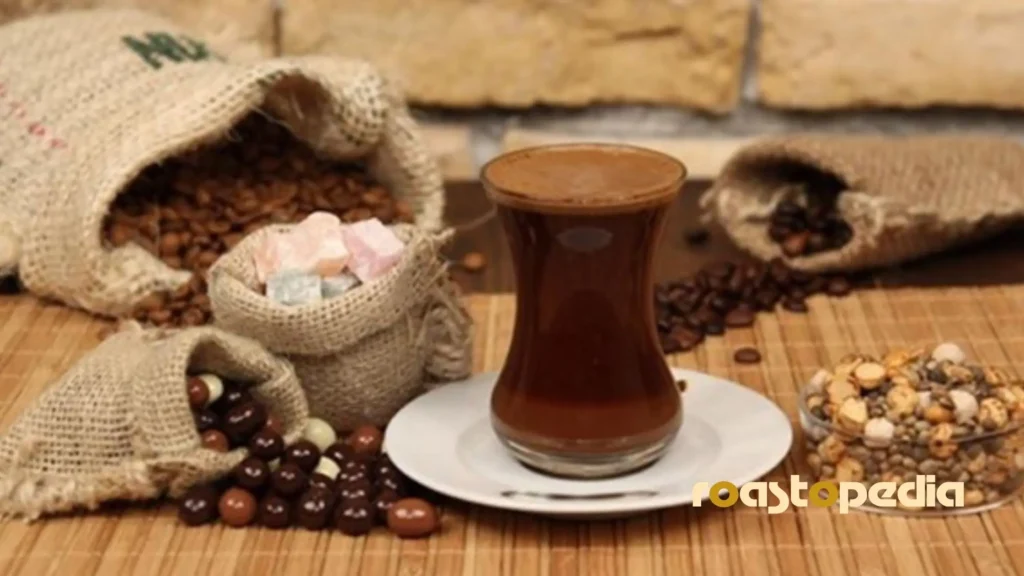
The foam (köpük) is prized as a marker of skill — a thick, uniform layer of reddish-brown foam indicates proper temperature control and grind consistency.
Absence of köpük is considered a flaw. The coffee is sipped slowly to avoid disturbing the sediment, and traditionally served with a glass of water to cleanse the palate.
Variations
Sweetness is the primary variable: sade (plain/unsweetened), az şekerli (little sugar), orta (medium sugar), and çok şekerli (very sweet). Cardamom — especially common in Gulf Arab adaptations — is sometimes added.
Some Balkan versions add a small piece of mastic resin. In Bosnia, the Bosanska kahva variant separates the grounds from the brew before serving.
Dibek and Osmanlı styles (covered separately) represent historical elaborations of the base Türk Kahvesi preparation.
Notable Facts
Ottoman marriage law once permitted a woman to divorce her husband if he failed to keep the household adequately supplied with coffee — a legal provision illustrating how essential the beverage was to domestic life.
The phrase “a cup of coffee has forty years of memory” (Bir fincan kahvenin kırk yıl hatırı vardır) is a Turkish proverb that captures the profound social obligation created by sharing coffee.
The cezve’s design has changed minimally over 500 years; its wide base and narrow neck create optimal surface area for heat transfer while containing the foam.
Turkish coffee spoons are deliberately small — designed to stir before drinking, not to scoop grounds.
Related Drinks
Dibek Kahvesi, Osmanlı Kahvesi, Mirra, Süvari Kahvesi, Menengiç Kahvesi, Bosanska Kahva (Bosnian coffee), Greek Ellinikos Kafes, Arabic Qahwa, Saudi Cardamom Coffee.