
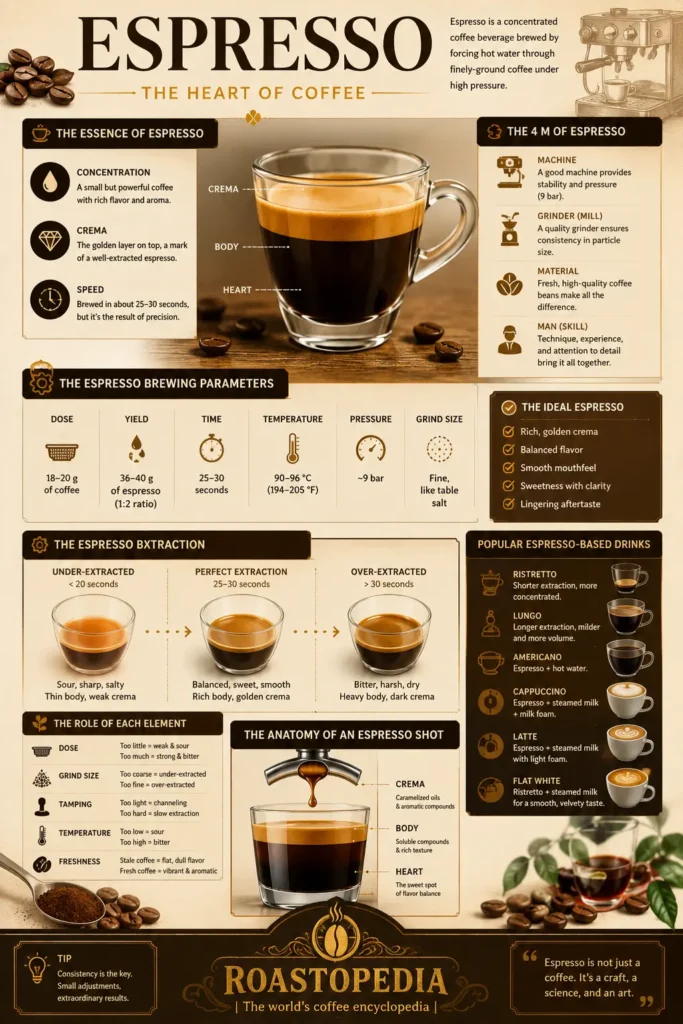
On one hand, espresso is a brewing method — one that forces hot water under high pressure through a compacted puck of finely ground coffee, a process completed in 25 to 35 seconds that no other brewing technique replicates.
On the other, it is the drink that method produces — a small, dense, intensely flavored shot topped with crema, a reddish-brown foam of emulsified coffee oils and CO2.
The two meanings are inseparable: the method defines the drink, and the drink only exists because of the method. A standard shot uses 7–9 grams of coffee and yields roughly 30 milliliters of liquid delivered at nine bars of pressure — a concentrated result that stands as a complete drink in its own right and as the foundation for the majority of milk-based coffee drinks consumed around the world.
Turin, 1884: The First Patent
The story begins with a Turinese businessman named Angelo Moriondo, who on May 16, 1884, received patent number 33/256 from the Italian government for what he called ‘new steam machinery for the economic and instantaneous confection of coffee beverage.’
Moriondo was not a mechanic or an engineer. He was an entrepreneur from a family of manufacturers and confectioners who owned the Grand-Hotel Ligure in Turin’s Piazza Carlo Felice and an American Bar in the Galleria Nazionale di Via Roma.
His problem was practical: he needed to serve coffee to large numbers of guests quickly.
The machine he patented used a large boiler pressurized to approximately 1.5 bars to push hot water through a bed of coffee grounds, with a second boiler producing steam to flash the bed at the end of the extraction.
It was a bulk brewer — designed to serve groups, not individuals. Moriondo demonstrated it at the Turin General Exposition of 1884, where it won a bronze medal, and then did almost nothing with it.
He renewed the patent in 1885 and again in 1890 but never commercialized the invention. No verifiable Moriondo machine survives. No photographs of one are known to exist.
The historical consequence of Moriondo’s failure to commercialize his invention is that espresso’s subsequent development proceeded largely without reference to him. His name disappeared from the record for decades, resurfacing only when coffee historians began tracing the patent lineage more carefully.
He is now recognized as holding the first recorded patent for a pressure-based coffee machine, but the espresso that people actually drink owes its character to the work that came after him.
Bezzera, Pavoni, and the Machine That Reached the Public
Luigi Bezzera was a Milanese mechanic — not an engineer, despite frequent misidentification — who in December 1901 filed a patent for a machine he titled ‘Innovations in the machinery to prepare and immediately serve coffee drinks.’
The patent was granted on June 5, 1902, as Patent No. 153/94, 61707. Bezzera had made several significant improvements on the Moriondo concept: his machine brewed individual servings rather than bulk batches, introduced multiple group heads so several cups could be prepared simultaneously, and incorporated the portafilter — the handled filter basket that a barista fills with ground coffee and locks into the machine’s group head.
The portafilter was a transformation. It created a removable, self-contained brewing chamber that could be filled, locked in, extracted, unlocked, and refilled in sequence. It standardized the serving and made the machine operable at speed. But Bezzera had the engineer’s characteristic blind spot for commercial reality. He had built something remarkable and had no idea what to do with it.
In 1903, a businessman named Desiderio Pavoni purchased Bezzera’s patents. Pavoni founded La Pavoni in Milan and began manufacturing one machine per day in a small workshop on Via Parini.
The first commercial model, the Ideale, was based directly on Bezzera’s Gigante. In 1906, the espresso machine appeared at the Milan Fair under the name Bezzera L — Bezzera’s name still attached to Pavoni’s business acumen behind it. The espresso bar was born.
The machines Pavoni produced still used steam pressure — around 1.5 to 2 bars — which produced coffee faster than any previous method but not at anything close to the pressure that would later define true espresso. The cup was strong and served quickly, which was the innovation.
The crema that now marks an espresso shot did not exist yet. That required a different machine entirely.
Achille Gaggia and the Discovery of Crema
Achille Gaggia was a Milanese bar owner who was dissatisfied with the flavor that steam-pressure machines produced and who began, in the late 1930s, experimenting with a piston mechanism that would drive water through coffee grounds at higher pressure than steam alone could generate.
His first patent application, filed on September 5, 1938, described a spring-powered piston group — a mechanism where pulling a lever compresses a spring, which then drives a piston to force water through the coffee bed when released.
Gaggia’s early prototypes were destroyed in the Allied bombing of Milan during the Second World War. After the war, he returned to the project. His second patent, for the lever-piston mechanism, was registered in 1947.
By 1948, Gaggia’s company — Officine Faema Brevetti Gaggia, founded in partnership with entrepreneur Carlo Ernesto Valente — had produced its first commercial machine, the Tipo Classica.
What the lever-piston machine did that steam pressure could not was reach brewing pressures of eight to ten bars. At these pressures, something unexpected appeared on the surface of the extracted coffee: a thick, persistent, reddish-brown foam.
Gaggia called it ‘crema caffè naturale’ — natural coffee cream — and was reportedly sufficiently uncertain about how the public would receive it that he framed it as a premium feature from the outset.
He placed signs in his bar reading ‘Crema caffè naturale. Funziona senza vapore’ — Natural coffee cream. Works without steam.
The crema was not merely aesthetic. At high pressure, water emulsifies the oils from the coffee in a way that low-pressure extraction does not, producing a physically different liquid.
The crema is a suspension of these oil globules and CO2 bubbles, and its presence indicates both freshness in the coffee and adequacy of pressure in the machine. The term ‘pulling a shot’ — still in common use today — originates here, from the physical act of pulling the long lever on a Gaggia-style machine.
The Faema E61 and the End of the Lever Era
Lever machines required significant physical effort from the barista — a long, forceful pull for every shot — and created safety issues when the spring snapped the lever back unexpectedly. By the late 1950s, the industry was looking for a mechanized solution.
In 1961, Ernesto Valente — who had previously partnered with Gaggia — introduced the Faema E61, a machine that used an electric pump to deliver water at nine bars of pressure continuously and consistently, without any physical effort from the operator.
The E61 also introduced the heat exchanger, a device that allowed the brewing group to be kept at a constant temperature while a separate boiler handled steam for milk texturing. This meant the barista no longer needed to manage temperature by feel or timing — the machine maintained extraction temperature automatically.
The E61 became an immediate commercial success and established the pump-driven, heat-exchanger espresso machine as the industry standard. Most commercial espresso machines made in the subsequent six decades follow the same fundamental architecture.
Nine bars of pressure became the industry standard through Gaggia’s lever mechanism — not through deliberate calculation but through the constraints of what the spring-piston design could deliver.
Later research confirmed that nine bars produced consistent, high-quality espresso extraction, but the number was arrived at mechanically first and validated scientifically later.
The Extraction: What Actually Happens in Thirty Seconds
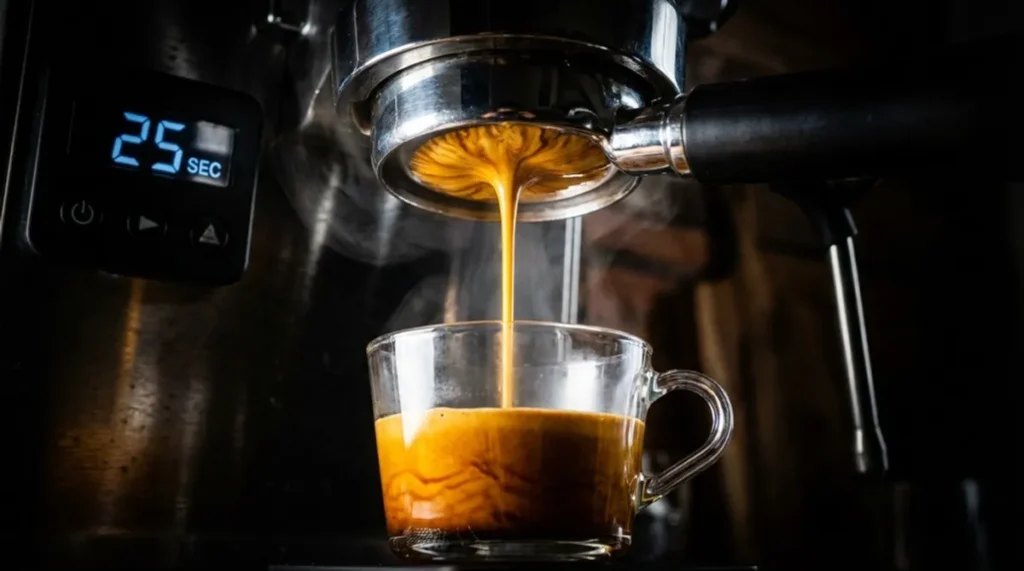
Espresso extraction is a sequence of physical events compressed into less than a minute. Ground coffee — milled to a very fine, sand-like consistency — is dosed into the portafilter basket and compressed with a tamper into a dense, flat puck. The tamped puck has a specific resistance to water flow built into it; getting this resistance right, through the combination of grind size and tamp pressure, is what ‘dialling in’ espresso means.
The portafilter is locked into the group head, and hot water — between 90 and 96 degrees Celsius — is introduced to the top of the puck at nine bars of pressure.
Modern machines often apply a lower pre-infusion pressure first, allowing the puck to saturate evenly before full pressure is applied, reducing channelling — the formation of high-flow pathways through weak points in the puck that cause uneven extraction.
Water moves through the puck from top to bottom, dissolving soluble compounds in sequence as it goes. Acids extract earliest, then sugars, then bitter compounds.
A correctly extracted espresso captures the acids and sugars in balance and stops before the bitterness dominates — this is what the time window of twenty-five to thirty-five seconds represents. Too short, and the shot is sour and underdeveloped; too long, and bitterness takes over.
The ratio of dry coffee in to liquid espresso out — called the brew ratio — is one of the most important variables in contemporary espresso calibration.
Traditionally, a double shot used 14-18 grams of coffee and produced roughly 30-40 milliliters of liquid. Modern specialty espresso practice has pushed toward much higher ratios, producing ‘lungo‘ or ‘allongé’ shots with ratios of 1:3 to 1:5, or toward ‘ristretto’ shots with ratios below 1:2 that concentrate sweetness by cutting the extraction short.
Crema: What it Is and What it Isn’t
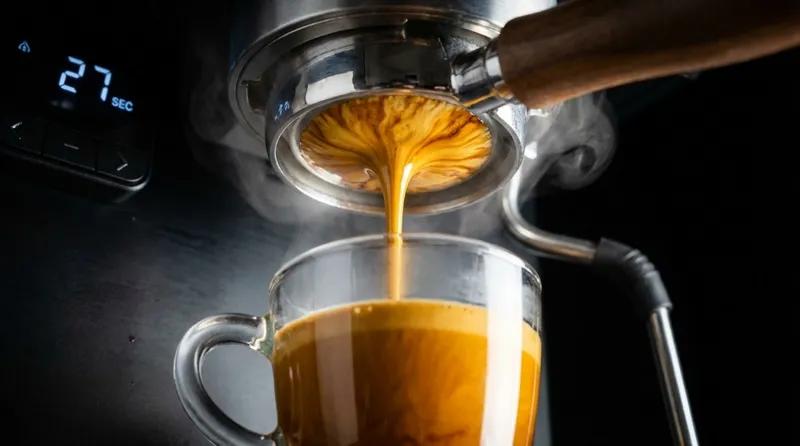
Crema is the most recognized visual feature of espresso, and also the most frequently misunderstood. It is not simply foam. It is an emulsion of CO2 bubbles and oils released from the coffee during high-pressure extraction — a physically stable structure that persists on the surface of the shot for several minutes after pulling.
The presence of crema requires two conditions: sufficient pressure (above four bars) and sufficiently fresh coffee. Coffee that has been roasted recently still contains dissolved CO2 from the roasting process; when extracted under pressure, this gas is released rapidly and forms the crema.
Coffee that has fully degassed — roasted more than three to six weeks ago, depending on the roast level and storage conditions — produces little or no crema regardless of machine pressure.
The color and texture of crema are diagnostic. A hazelnut-brown crema with fine, even bubbling indicates a well-extracted shot from fresh coffee. A pale, thin crema suggests under-extraction or stale coffee.
A very dark, bitter-smelling crema indicates over-extraction. In practice, crema evaluation is one of several real-time indicators the barista reads during and after pulling a shot.
The romantic notion that crema is the ‘best part’ of espresso is not universally shared within specialty coffee. Many experienced tasters find that crema — being a foam — slightly dilutes and mutes the flavour of the liquid beneath it, and deliberately stir shots before drinking to integrate or break the crema. Competition espresso is often evaluated with the crema stirred in.
The Espresso Derivatives: A Drink That Became a Platform
No other brewing method has generated as extensive a family of derived drinks. The espresso shot is the base for the cappuccino — espresso with equal parts steamed milk and milk foam — the latte — espresso with steamed milk at a higher milk-to-coffee ratio — the flat white, the cortado, the macchiato, the Americano, the lungo, the ristretto, and dozens of regional variations.
The Italian bar culture that developed around espresso in the mid-20th century produced a vocabulary of drinks and a set of social rituals — the stand-up espresso at the bar, the mid-morning cappuccino, the after-dinner ristretto — that remain embedded in Italian daily life and have been exported with variable fidelity to coffee cultures worldwide.
The third-wave specialty coffee movement of the 2000s and 2010s brought espresso under closer technical scrutiny than it had experienced since Gaggia’s engineering experiments.
Precise scales, refractometers measuring extraction yield, pressure profiling machines that vary delivery pressure across the extraction curve, temperature-controlled group heads accurate to fractions of a degree — the espresso machine became a precision instrument rather than a commercial appliance.
The same shot of coffee could now be tuned across dozens of variables simultaneously.
Espresso remains the highest-intensity, highest-complexity manual coffee skill in common practice. A well-pulled shot requires the simultaneous calibration of grind size, dose weight, tamp pressure, water temperature, pre-infusion profile, extraction time, and yield — with each variable interacting with the others.
It is the only brew method in which the same coffee, the same machine, and the same water can produce dramatically different results depending on who is operating the equipment.