
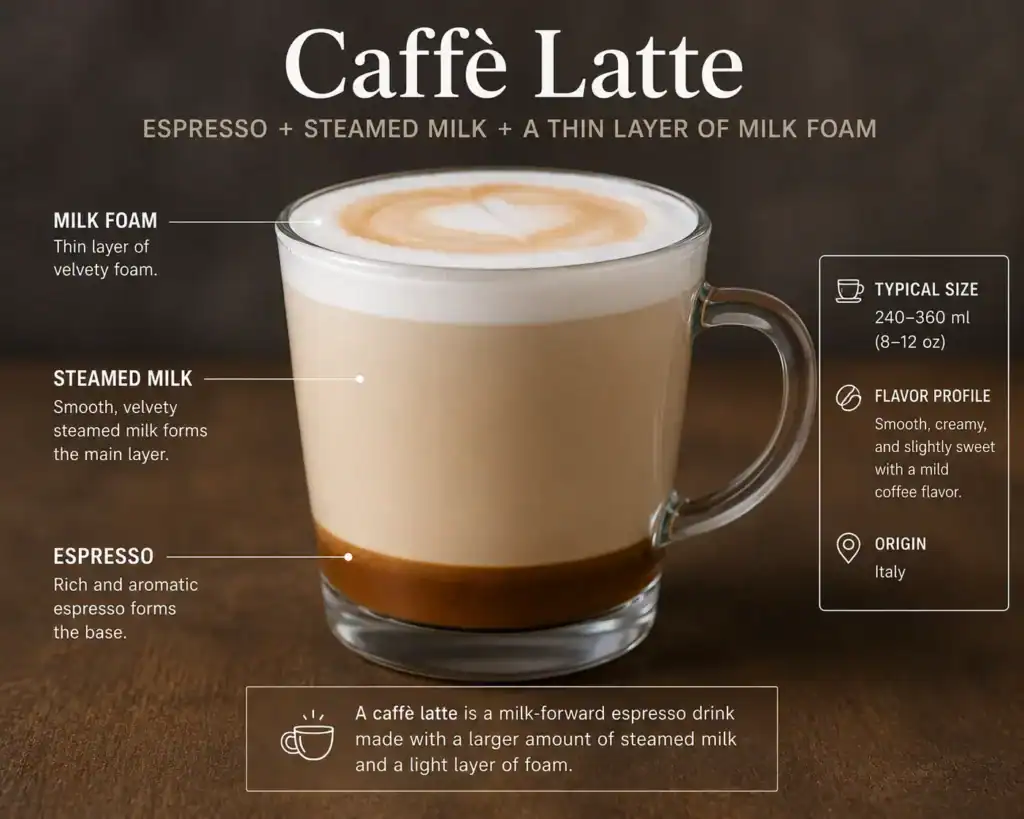
A caffè latte, commonly known simply as a latte, is an espresso-based coffee beverage consisting of espresso and steamed milk, typically topped with a thin layer of milk foam.
It is among the most widely consumed milk-based coffee drinks and is a standard offering in cafés throughout much of the world. The beverage is characterized by a high milk-to-coffee ratio, producing a mild flavor profile in which the sensory attributes of milk are more prominent than in beverages such as cappuccino, macchiato, or cortado.
The term is taken from the Italian expression caffè latte, meaning “coffee and milk.” In Italy, the phrase traditionally refers to coffee mixed with milk and is commonly prepared in domestic settings. Outside Italy, the term has become associated with a specific espresso-based beverage served in cafés.
What is a Latte?
The Italian words caffè and latte translate respectively as “coffee” and “milk.” The expression caffè latte therefore literally means “coffee with milk.” Variants of the term have appeared in European languages for centuries to describe combinations of coffee and milk.
The abbreviated form latte became widespread in English-speaking countries during the late twentieth century. Although common internationally, the use of the word latte alone is largely a non-Italian convention.
History
Coffee mixed with milk predates the invention of espresso by several centuries. Historical records from seventeenth- and eighteenth-century Europe document the widespread consumption of coffee diluted with milk, cream, or both. Such preparations were common in households and coffeehouses throughout the continent.
The modern caffè latte emerged alongside the development of espresso technology in Italy during the twentieth century. As espresso machines became increasingly capable of producing consistent extractions and textured milk, a range of espresso-and-milk beverages evolved, including cappuccino, macchiato, and latte.
Outside Italy, the latte gained prominence during the expansion of espresso culture in North America, Australia, New Zealand, and other regions during the late twentieth century. Specialty coffee shops contributed significantly to the drink’s international popularity, standardizing preparation methods and serving sizes.
By the early twenty-first century, the latte had become one of the most recognized coffee beverages worldwide.
Composition
A caffè latte consists of two principal ingredients: espresso and steamed milk. A small quantity of milk foam is generally added to the surface.
Although ratios vary, a typical latte contains one or two shots of espresso combined with a substantially larger volume of steamed milk. The resulting beverage possesses a creamy texture and comparatively mild coffee intensity.
The high proportion of milk distinguishes the latte from related espresso beverages. Compared with a cappuccino, the latte contains less foam and more liquid milk. Compared with a flat white, it is generally larger in volume and may contain a thinner layer of foam.
Preparation
Preparation begins with the extraction of espresso into a cup or glass. Milk is steamed using a steam wand to produce a smooth, uniform texture. Unlike cappuccino, which requires a thicker foam layer, latte milk is usually textured to create a thin layer of microfoam integrated throughout the liquid milk.
The steamed milk is then poured into the espresso. The interaction between the crema and microfoam frequently produces visible surface patterns. This characteristic has made the latte one of the principal beverages used for latte art.
Serving sizes vary considerably. Traditional preparations are often smaller than those commonly served in commercial cafés outside Italy.
Characteristics
The sensory profile of a caffè latte is determined by the interaction between espresso and milk. The beverage exhibits lower perceived bitterness and acidity than straight espresso due to the moderating effect of milk proteins and fats.
Flavor characteristics vary according to coffee origin, roast level, extraction parameters, and milk composition. Common descriptors include chocolate, caramel, nuts, malt, cereal, and sweet dairy notes.
Coffees with pronounced fruit acidity may retain some of their distinctive characteristics, though these are generally less prominent than in black coffee preparations.
The texture is smooth, creamy, and relatively dense, with the milk contributing body and sweetness.
Table: Comparison of Caffè Latte and Similar Coffee Drinks
| Drink | Espresso | Steamed Milk | Milk Foam | Typical Size | Distinguishing Characteristic |
|---|---|---|---|---|---|
| Caffè Latte | 1–2 shots | High proportion | Thin layer | 240–360 ml | Milk-forward espresso drink with a small amount of foam. |
| Cappuccino | 1–2 shots | Moderate proportion | Thick layer | 150–180 ml | Traditionally equal parts espresso, steamed milk, and foam. |
| Flat White | 1–2 shots | Moderate proportion | Very thin microfoam | 160–180 ml | Stronger coffee flavor and velvety texture with minimal foam. |
| Cortado | 1 shot | Approximately equal to espresso | Little or none | 120–150 ml | Balanced ratio of espresso and milk with pronounced coffee character. |
| Latte Macchiato | Small amount of espresso | Large amount | Thick foam cap | 250–350 ml | Milk is “stained” with espresso rather than espresso being diluted with milk. |
| Caffè Macchiato | 1–2 shots | Very little | Small dollop | 30–60 ml | Espresso marked with a small amount of milk or foam. |
| Mocha (Caffè Mocha) | 1–2 shots | High proportion | Thin layer | 240–360 ml | Latte-like drink containing chocolate. |
| Breve | 1–2 shots | Steamed half-and-half | Thin layer | 180–360 ml | Richer and creamier due to the use of half-and-half instead of milk. |
| Piccolo Latte | Ristretto shot | Small amount | Thin microfoam | 90–120 ml | Smaller and stronger than a standard latte. |
| Café au Lait | None (uses brewed coffee) | Equal or similar amount | Usually none | 200–350 ml | Prepared with brewed coffee rather than espresso. |
Key Distinctions
The drinks most commonly confused with a caffè latte are the cappuccino, flat white, and latte macchiato.
A cappuccino contains substantially more foam, a flat white contains less foam and typically delivers a stronger coffee flavor, while a latte macchiato reverses the preparation order by adding espresso to milk rather than milk to espresso.
The cortado is often mistaken for a small latte, but its much lower milk content results in a more pronounced espresso character.
Serving Vessels
The caffè latte is commonly served in a large ceramic cup, bowl, or glass. Transparent glasses are frequently used to emphasize the visual contrast between espresso and milk.
Serving volumes differ by country, café tradition, and consumer preference. Commercial preparations outside Italy are often considerably larger than traditional espresso-based milk beverages.
Latte Art
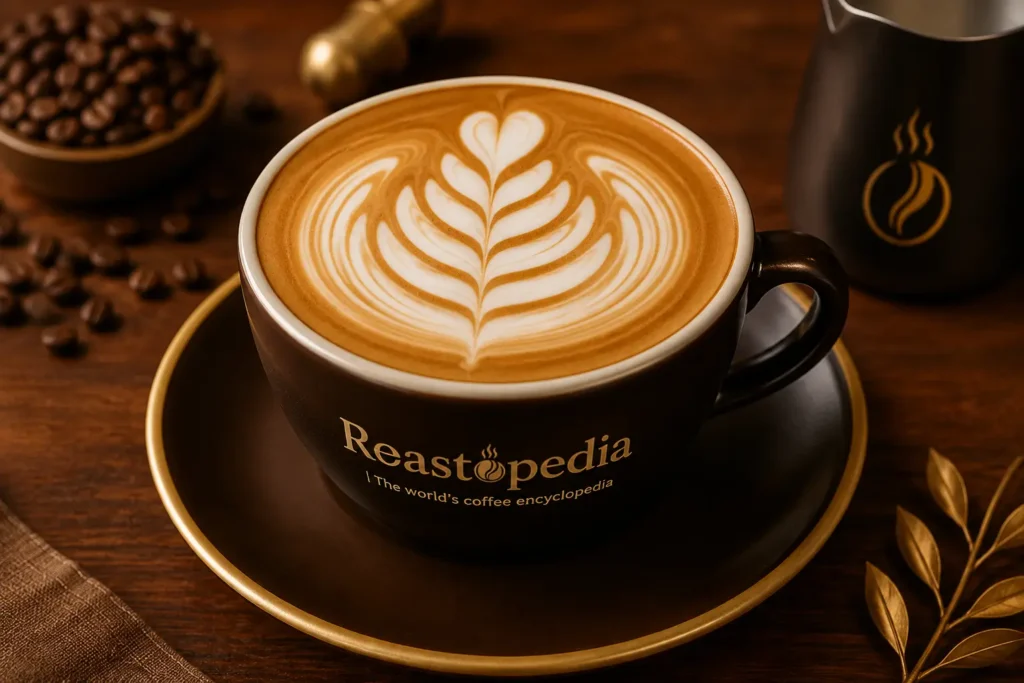
Latte art refers to patterns created by pouring textured milk into espresso. The practice became increasingly prominent with the growth of specialty coffee culture during the late twentieth century.
Common designs include hearts, rosettas, tulips, swans, and other free-pour patterns. The ability to produce latte art depends on espresso quality, milk texture, pouring technique, and cup geometry.
Although primarily decorative, latte art is often regarded as an indicator of proper milk texturing and beverage preparation.
Regional Variations
Numerous regional variations of the latte exist.
In North America, flavored lattes frequently incorporate syrups such as vanilla, caramel, hazelnut, or chocolate. Seasonal variants have become a notable feature of commercial coffee chains.
Iced latte preparations substitute chilled milk and ice for steamed milk. These beverages are particularly common in warmer climates.
Alternative-milk lattes prepared with oat, soy, almond, coconut, pea, or other plant-based beverages have become increasingly widespread due to dietary preferences and environmental considerations.
Some regions incorporate spices, sweeteners, or local ingredients into latte preparations, creating distinct national and regional interpretations.
Cultural Significance
The caffè latte occupies a prominent position in contemporary coffee culture. It is among the most frequently ordered espresso beverages and serves as an entry point for many consumers into espresso-based coffee.
The beverage is closely associated with the expansion of specialty coffee, the globalization of café culture, and the development of modern coffeehouse chains. Its popularity has contributed to widespread familiarity with espresso terminology and preparation methods.
In many countries, the latte has become a cultural symbol of urban café life and contemporary coffee consumption.
Relationship to Other Coffee Drinks
The caffè latte belongs to a family of espresso-and-milk beverages that differ primarily in milk volume, foam content, and serving size.
The cappuccino traditionally contains a greater proportion of foam and a smaller overall volume. The flat white generally contains less foam and a stronger coffee-to-milk ratio. The cortado uses approximately equal proportions of espresso and milk. The macchiato contains only a small quantity of milk, while the café au lait is traditionally prepared using brewed coffee rather than espresso.
These distinctions form part of the standardized terminology employed throughout the coffee industry.
Contemporary Role
Caffè latte remains one of the most commercially significant coffee beverages worldwide. It is a staple offering in traditional cafés, specialty coffee shops, restaurants, hotels, and international coffee chains.
The beverage has adapted readily to changing consumer preferences through the incorporation of alternative milks, flavored syrups, cold preparations, and specialty coffee origins.
Its continued popularity reflects the broad appeal of combining espresso with milk in a balanced, accessible form.
See Also
- Cappuccino
- Flat White
- Cortado
- Caffè Macchiato
- Latte Macchiato
- Café au Lait
- Mocha
- Breve
- Gibraltar
- Piccolo Latte
- Espresso
- Americano
- Long Black
- Vienna Coffee
- Freddo Cappuccino
- Espresso con Panna
- Ristretto
- Lungo
- Café Cubano
- Red Eye Coffee
References
- Ukers, William H. All About Coffee. Tea and Coffee Trade Journal Company, 1922.
- Morris, Jonathan. Coffee: A Global History. Reaktion Books, 2018.
- Pendergrast, Mark. Uncommon Grounds: The History of Coffee and How It Transformed Our World. Basic Books, 2019.
- Illy, Andrea and Riccardo Illy. Espresso Coffee: The Science of Quality. Academic Press, 2015.
- Hoffmann, James. The World Atlas of Coffee. Mitchell Beazley, 2023.
- Davids, Kenneth. Espresso: Ultimate Coffee. St. Martin’s Press, 2012.
- Schomer, David. Espresso Coffee: Professional Techniques. Espresso Vivace Publications, 2014.
- Wild, Antony. Coffee: A Dark History. W. W. Norton & Company, 2005.
- Standage, Tom. A History of the World in Six Glasses. Walker Publishing, 2005.
- Thurston, Robert W. Coffee: From Bean to Barista. Rowman & Littlefield, 2013.
- Tucker, Catherine. Coffee Culture: Local Experiences, Global Connections. Routledge, 2017.
- Ellis, Aytoun. The Penny Universities: A History of the Coffee-Houses. Secker & Warburg, 1956.
- Smith, Andrew F. The Oxford Encyclopedia of Food and Drink in America. Oxford University Press, 2013.
- Specialty Coffee Association. Coffee Standards and Protocols. Various editions.
- International Coffee Organization. Coffee Development Reports. Various editions.
- Han, Byung-Duk. The Economics of Coffee. Routledge, 2020.
- Topik, Steven, and Allen Wells. The Global Coffee Economy. Cambridge University Press, 2010.
- Hatos, Alexandra. Coffee and Café Culture. Bloomsbury Academic, 2022.